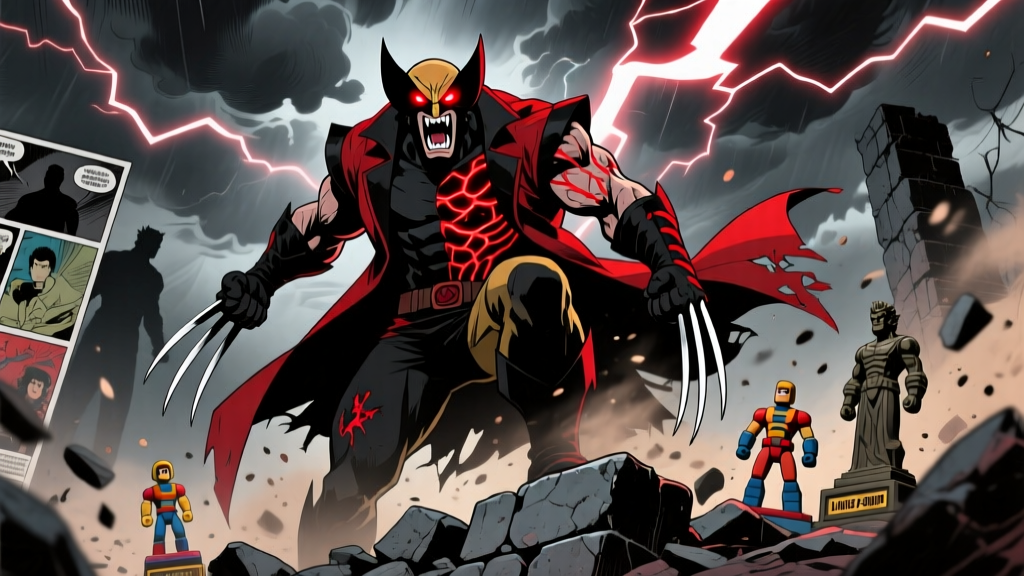
The panel shows nothing but claw marks and blood spatter. Three slashes across a Sentinel's chest cavity. No speech balloon. No thought caption. Just a low crouch, yellow eyes burning through ink and page, and the unmistakable silhouette of a man who stopped being James Howlett somewhere around the third time they pumped adamantium into his skeleton. That image — feral, wordless, pure violence rendered in four colors — is primal Wolverine. And it has haunted comic book readers since 1979.
The berserker rage is not a superpower in the conventional sense. It does not level up. It does not grant new abilities. What it does is strip away everything that makes Logan human — restraint, tactical thinking, mercy — and leave behind something that frightens even other X-Men. Writers have spent four decades trying to pin this beast to the page. Artists have built entire careers on depicting it. And the collectibles market has turned that rage into serious money.
Where the Rage First Showed Up
Chris Claremont and John Byrne planted the seed in Uncanny X-Men #139 (November 1980), but the berserker state did not fully manifest on the page until Uncanny X-Men #141 (January 1981) — the opening chapter of the legendary "Days of Future Past" arc. In that issue, Byrne drew Logan mid-slash with something new in his expression: a complete absence of recognition. The eyes were blank. The jaw locked. The body moved on instinct alone. Readers at the time had no name for it yet. Claremont would not use the phrase "berserker rage" explicitly until later issues, but the visual vocabulary was already there.
Byrne's approach was restrained compared to what came later. He showed the rage through restraint rather than excess — a single panel of Wolverine standing over a downed opponent, chest heaving, fists still clenched. The restraint made it more frightening. You were seeing something the character himself could not control, drawn by an artist who understood that the scariest thing about losing control is the quiet afterward.
Weapon X: Barry Windsor-Smith Unleashes the Animal
If Byrne hinted at the beast, Barry Windsor-Smith ripped the cage open. In Marvel Comics Presents #72–84 (1991), the "Weapon X" storyline showed Logan's transformation in full, grotesque detail. Windsor-Smith's art was baroque and obsessive — he spent panels on the surgical horror of the adamantium bonding process, then let loose with splash pages where Logan broke free from the facility in a state that could only be described as subhuman. Naked except for surgical wrappings, eyes wild, slashing through armed guards with zero hesitation.
Windsor-Smith's contribution was psychological. The berserker state in "Weapon X" was not heroic. It was a trauma response. The man was being tortured, and his mind retreated to something primal as a survival mechanism. That framing stuck. Every writer who tackled Wolverine's rage afterward had to reckon with the idea that this was not just anger — it was a wound that would never close.
"He's not angry. He's not thinking at all. That's what makes him dangerous. The animal doesn't negotiate. It doesn't hesitate. It just moves." — Larry Hama, Wolverine (Vol. 2) #50, 1991
The Storylines That Defined the Savage State
Across fifty years of publication, a handful of arcs stand out for how they used the berserker concept. These are not just fight scenes — they are character studies of what happens when a century-old man with unbreakable bones stops pretending to be civilized.
Enemy of the State (2004–2005)
Mark Millar and John Romita Jr. took a different approach. In Wolverine (Vol. 3) #20–31, HYDRA captures Logan, brainwashes him, and turns him into an assassin. The berserker rage here is not uncontrolled — it is weaponized. JRJR drew Logan as a cold, efficient killing machine, and the result was somehow more disturbing than any foam-at-the-mouth frenzy. The scene where Logan slaughters an entire S.H.I.E.L.D. helicarrier crew in under three pages remains one of the most brutal sequences Marvel has ever published. Romita Jr.'s linework was clean, almost surgical, which made the violence feel deliberate rather than chaotic.
The arc grossed over $12 million in collected editions by 2010, according to Diamond Comic Distributors data, and it cemented the idea that Wolverine's primal side could be directed — which in some ways made it worse.
Savage Wolverine (2013)
Zeb Wells wrote it. Jock drew it. And the result was a five-issue limited series (Savage Wolverine #1–5, Marvel NOW!) that put Logan on a mysterious island with Shanna the She-Devil and let the art do the screaming. Jock's style — angular, scratchy, heavy on shadow — was built for this material. His Wolverine was all sinew and scar tissue, moving through jungle terrain like a predator that had forgotten it was ever anything else.
Jock spoke about the project in a 2013 ComicsAlliance interview, saying he wanted every panel to feel like Logan was "one bad day away from going completely feral." The book used the berserker state not as a climax device but as a baseline. Logan was operating at a heightened state of aggression from page one, and the tension came from watching him try to hold it together while everything around him pushed him closer to the edge.
Old Man Logan (2008–2009)
Mark Millar and Steve McNiven's Wolverine (Vol. 3) #66–72 presented a future where Logan had sworn off violence after a trauma so severe it broke something fundamental inside him. When the rage finally returns — in issue #71, against a gang of Hulk's grandchildren — McNiven drew it as something ancient and terrible waking up. The double-page spread of Logan emerging from the farmhouse, claws out, eyes glowing, surrounded by corpses, is one of the most reprinted images in Wolverine's publication history. McNiven used a desaturated palette throughout the arc, which made the red of Logan's rage-state eyes hit like a freight train.
Schism (2011) and the Feral Turn
Jason Aaron's Wolverine & the X-Men run and the X-Men: Schism event showed a different dimension of the berserker rage. Logan's break with Cyclops was not physical — it was philosophical. But in Schism #4, when Logan slashes through a squad of Kid Omega's followers to protect a group of young mutants, the rage reads differently. It is protective. Directional. Almost paternal. Artist Carlos Crain put a trembling quality in Logan's hands even mid-slash, suggesting the effort it took to channel the fury rather than let it consume everything.
How Artists Have Drawn the Unhinged
The visual language of Wolverine's berserker state has evolved dramatically since Byrne's subtle hints in 1981. Each generation of artists brought something new to how rage translates on a static page.
Marc Silvestri, who drew Wolverine throughout the late 1980s and early 1990s, established the "classic feral" look. He exaggerated Logan's musculature during rage sequences, added visible veins along the forearms and neck, and narrowed the eyes into slits. Silvestri's berserker Wolverine looked less like a man and more like a compact, snarling animal — a wolverine in the literal sense. His covers for Wolverine (Vol. 2) in this period remain some of the most widely reproduced images of the character.
Leinil Francis Yu took over in the late 1990s and brought a photorealistic intensity. His Logan in Wolverine (Vol. 2) #133–146 was bulkier, rougher, with a jaw that looked perpetually clenched. Yu's berserker panels were defined by motion blur and environmental destruction — panels where Logan moved through a scene like a natural disaster, leaving debris and shattered architecture in his wake.
Simone Bianchi brought something unexpected in the mid-2000s: elegance. His cover paintings for Astonishing X-Men and various Wolverine one-shots rendered the berserker state with painterly brushstrokes that emphasized beauty alongside brutality. The contrast was unsettling — gorgeous compositions depicting horrific violence.
Jock, in his 2013 Savage Wolverine run, stripped everything back to ink blots and angular silhouettes. His berserker Logan was almost abstract — you read the rage in the body language, in the jagged edges of the panel borders, in the negative space where details should have been. It was the most experimental visual take on the character's primal state, and it worked because it trusted the reader to fill in the violence with their own imagination.
| Artist | Period | Berserker Style | Signature Issue |
|---|---|---|---|
| John Byrne | 1979–1981 | Subtle restraint; blank eyes, clenched fists | Uncanny X-Men #141 |
| Barry Windsor-Smith | 1991 | Baroque horror; naked, feral, trauma-driven | Marvel Comics Presents #79 |
| Marc Silvestri | 1988–1993 | Exaggerated musculature; snarling, animalistic | Wolverine (Vol. 2) #50 |
| John Romita Jr. | 2004–2005 | Cold efficiency; surgical violence, clean lines | Wolverine (Vol. 3) #25 |
| Leinil Francis Yu | 1998–2000 | Photorealistic motion blur; environmental destruction | Wolverine (Vol. 2) #140 |
| Simone Bianchi | 2006–2009 | Painterly elegance; beauty-meets-brutality | Astonishing X-Men #25 (variant) |
| Jock | 2013 | Angular abstraction; ink blots, negative space | Savage Wolverine #1 |
What the Berserker State Actually Does (In-Universe Mechanics)
Marvel has never pinned down the berserker rage with a single canonical explanation, which is probably the right creative call. But scattered references across decades of publication paint a rough picture of what is happening inside Logan's head when the red takes over.
The healing factor plays a role. In Wolverine (Vol. 2) #60 (1992), Larry Hama wrote a sequence where Logan's healing factor was temporarily suppressed, and the berserker rage did not trigger — suggesting the two systems are neurologically linked. The adrenal surge that kicks off the rage state appears to be an extension of the same mutant biology that keeps him alive through injuries that would kill a normal human twelve times over.
What happens during the state: heightened pain tolerance (already extreme, pushed further), suppression of higher cognitive function, acceleration of combat reflexes, and — crucially — a narrowing of threat assessment. In the berserker state, Logan does not distinguish between enemy and bystander. He has hurt allies in this state. In Wolverine (Vol. 2) #90 (1995), he slashed Nightcrawler during a rage episode and did not recognize what he had done until the fury passed. That incident haunted the character for years and became a recurring reference point for writers exploring the cost of the berserker.
The duration varies wildly depending on the writer. Hama depicted episodes lasting seconds — quick, explosive bursts followed by disorientation. Millar's Enemy of the State showed a sustained rage state lasting days. Jason Aaron, in his Wolverine (Vol. 3) run (2010–2014), introduced the concept of Logan learning to "ride" the rage — dipping into it deliberately for combat advantage while trying to maintain enough awareness to avoid collateral damage. That tension between control and chaos became a defining theme of Aaron's entire run.
Primal Wolverine in Collectibles: Where the Money Goes
The berserker Wolverine is a collectible category unto itself. While standard Wolverine figures — yellow suit, standing pose, claws out — dominate the market, the feral/savage variants command premium prices and dedicated collector attention. Here is what the landscape looks like as of mid-2026.
Sideshow Collectibles — Wolverine: Berserker Rage Statue
The flagship piece. Sideshow's 1/3 scale polystone statue, product number 300847, stands 19 inches tall with a base footprint of roughly 17 by 20 inches. The sculpt captures Logan mid-rampage — torn costume, exposed musculature along the left arm, claws fully extended, mouth open in a snarl. The base incorporates shattered Sentinel parts and cracked concrete. Retail price was set at $595 for the regular edition, with a limited "EX" variant (additional blood-splatter paint application and interchangeable head sculpt) at $635. Both editions sold out within pre-order windows, and secondary market prices on eBay tracked between $800 and $1,200 by early 2026 depending on condition and box state.
Iron Studios — Wolverine Legacy Replica (1/4 Scale)
Brazil-based Iron Studios released their quarter-scale Wolverine as part of the Legacy Replica line. Standing approximately 15 inches tall, this piece leans into the classic Jim Lee design but with the feral edge — torn glove, bloodied knuckles, a facial expression that sits somewhere between determination and fury. The mixed-media build (polystone body, fabric costume elements) gives it a tactile quality that pure resin pieces lack. Originally priced around $449, aftermarket values have climbed to the $550–$700 range for mint-in-box specimens.
Hot Toys — Weapon X Sixth Scale Figure
Hot Toys approached the primal Wolverine from the Weapon X angle — the surgical horror version. Their 1/6 scale figure (approximately 12 inches) features Logan in torn surgical wrappings with visible adamantium injection scarring, interchangeable rage-expression head sculpts, and a display base styled after the Weapon X facility floor. The figure includes 23 points of articulation and multiple claw-hand configurations. The deluxe edition added a damaged facility backdrop and additional blood-splatter effects. Retail pricing started at $265 for the standard version, with the deluxe at $295. Hot Toys' distribution through Sideshow Collectibles gave the piece wider reach than typical sixth-scale releases.
Marvel Legends and the Mass-Market Feral
Hasbro's Marvel Legends line has produced at least four berserker-adjacent Wolverine figures since 2019, including a 2022 "Savage Wolverine" build-a-figure wave that featured Logan in a torn brown costume with a snarling head sculpt. At the $25–$30 price point, these are the most accessible entry into primal Wolverine collecting. The 2024 "Berserker Barrage" two-pack (Wolverine vs. Sabretooth, both in rage-state sculpts) became one of the fastest-selling Marvel Legends waves in the line's history, with initial retail allocation clearing within 72 hours at major chains according to Hasbro's Q3 2024 earnings call references.
| Product | Scale | Original Retail | Secondary Market (2026) |
|---|---|---|---|
| Sideshow Berserker Rage Statue | 1/3 (19") | $595 / $635 (EX) | $800–$1,200 |
| Iron Studios Legacy Replica | 1/4 (15") | $449 | $550–$700 |
| Hot Toys Weapon X | 1/6 (12") | $265 / $295 (DLX) | $300–$420 |
| Marvel Legends Berserker Barrage | 1/12 (6") | $49.99 (2-pack) | $65–$95 |
| Marvel Legends Savage Wolverine | 1/12 (6") | $24.99 | $35–$55 |
The Psychology Underneath the Claws
Strip away the adamantium, the healing factor, the century-plus lifespan, and the berserker rage maps onto something recognizable. Logan is a man who has experienced more trauma than any human nervous system was built to process. The rage is not a superpower. It is a coping mechanism that outgrew its container.
Writer Daniel Way explored this most explicitly in his Wolverine: Origins run (2006–2010). Across 45 issues, Way positioned the berserker state as a dissociative episode — Logan's mind essentially handing the wheel to a more primitive version of itself when the emotional load became too heavy. Way's Logan would sometimes "wake up" from a rage episode to find himself miles from where the episode started, surrounded by wreckage he had no memory of creating. It was horror writing dressed in superhero clothing.
Paul Jenkins, in his brief but impactful Wolverine: Origin miniseries (2001–2002), showed the roots of this pattern in Logan's childhood. The scene where young James Howlett's mutation first triggers — claws erupting from his hands in response to witnessing his father's murder — is not a triumphant origin moment. It is a child's psyche fracturing under unbearable stress. The berserker was born in that panel, long before the adamantium, long before the codename, long before the X-Men.
"Every time I go to that place, it takes a little longer to come back. One of these days, I'm going to go there and the door's going to close behind me." — Wolverine, Wolverine (Vol. 3) #62, Jason Aaron, 2008
On Screen: Berserker Rage Beyond the Page
Hugh Jackman's portrayal in the Fox X-Men films introduced the berserker concept to a mainstream audience that had never opened a comic book. The hallway fight in X2: X-Men United (2003) — Logan versus a squad of William Stryker's soldiers in a confined space — remains the single best live-action depiction of the berserker state. Director Bryan Singer shot the sequence in tight close-ups with rapid cuts, keeping the camera on Jackman's face and the soldiers' reactions rather than wide establishing shots. The result felt claustrophobic and overwhelming, which is exactly what the berserker rage reads like on the page.
Logan (2017), directed by James Mangold, took the concept to its logical endpoint. An aging, deteriorating Wolverine whose healing factor is failing experiences rage episodes that leave him physically worse afterward. The berserker state in Logan is not cool or empowering — it is desperate and ugly and sad. The film's climax, where a drugged Logan tears through the Reavers in a final berserker burst, plays less like a superhero action sequence and more like a man burning the last of his fuel. Jackman's physical transformation for that film — leaner, more weathered, moving with visible effort — sold the idea that the rage was consuming him from the inside.
The MCU has not yet tackled berserker Wolverine as of mid-2026, but with the character's introduction via Deadpool & Wolverine (2024), the foundation is laid. Kevin Feige confirmed in a March 2025 Variety interview that future X-Men integration would explore Logan's "darker psychological elements," which reads like a direct reference to the rage cycle.
Why the Savage Version Endures
There are hundreds of Wolverine variants in the Marvel multiverse. Samurai Wolverine. Zombie Wolverine. Phoenix-host Wolverine. A version where he is literally a horse (do not ask). But the primal, berserker, feral Logan is the one that sticks. It is the version that appears on t-shirts, tattoo designs, and the covers of trade paperbacks stacked in the front displays of comic shops. It endures because it is the most honest version of the character.
Logan has spent over a century pretending to be something he is not — soldier, spy, teacher, mentor, lover, team player. The berserker state is the moment the mask falls off. What is left is not pretty, but it is true. And in a medium built on fantasy, there is something oddly grounding about a character whose most powerful moment is the one where he stops pretending.
That truth is what artists keep returning to. It is what collectors pay hundreds of dollars to freeze in polystone. It is what writers spend entire runs trying to articulate. The primal Wolverine is not a variant or an alternate costume. It is the character at his most exposed — claws out, eyes blank, nothing left to lose.
Frequently Asked Questions
Is the berserker rage a separate personality or just extreme anger?
Marvel has portrayed it both ways, depending on the writer. Larry Hama and Daniel Way wrote it as a dissociative state — almost a separate consciousness taking over. Chris Claremont and Jason Aaron depicted it more as an extreme amplification of Logan's existing personality, where his restraint and moral code get overridden by raw survival instinct. Neither interpretation has been declared definitively canonical, which gives future writers flexibility.
Which comic issue first used the term "berserker rage" for Wolverine?
The phrase appeared in dialogue as early as Uncanny X-Men #167 (March 1983), written by Chris Claremont, where another character describes Logan's combat behavior. However, it was not used as a defined, named ability until Larry Hama's run on Wolverine (Vol. 2) in the early 1990s, where it became a recurring plot element with specific mechanical effects.
Can Wolverine be killed while in the berserker state?
Theoretically, yes, though it has not happened in main continuity. The berserker state enhances his combat effectiveness but does not make him invulnerable. His healing factor is what keeps him alive, and the rage state actually accelerates healing factor output in some depictions (Hama, Aaron) while suppressing it in others (Way, Millar). A sufficiently powerful attack — think a nuclear detonation or complete molecular disintegration — would work regardless of his mental state.
What is the most expensive primal Wolverine collectible ever sold?
Original Barry Windsor-Smith pages from the "Weapon X" storyline hold the top values. Page 8 from Marvel Comics Presents #79 — depicting Logan's berserker breakout from the Weapon X facility — sold at Heritage Auctions for $168,000 in November 2022, setting a record for Wolverine interior art. Among mass-produced collectibles, artist-proof editions of the Sideshow Berserker Rage statue (limited to 25 units) have traded above $2,000 on the secondary market.
Will the MCU version of Wolverine have a berserker rage?
Nothing has been confirmed in specific terms as of mid-2026. However, Kevin Feige's public comments about exploring Wolverine's "darker psychological elements" in future MCU X-Men projects strongly suggest the berserker state will be adapted. The PG-13/TV-14 rating constraints of the MCU may require a toned-down depiction compared to the R-rated Logan, though the success of that film demonstrated audience appetite for the concept.