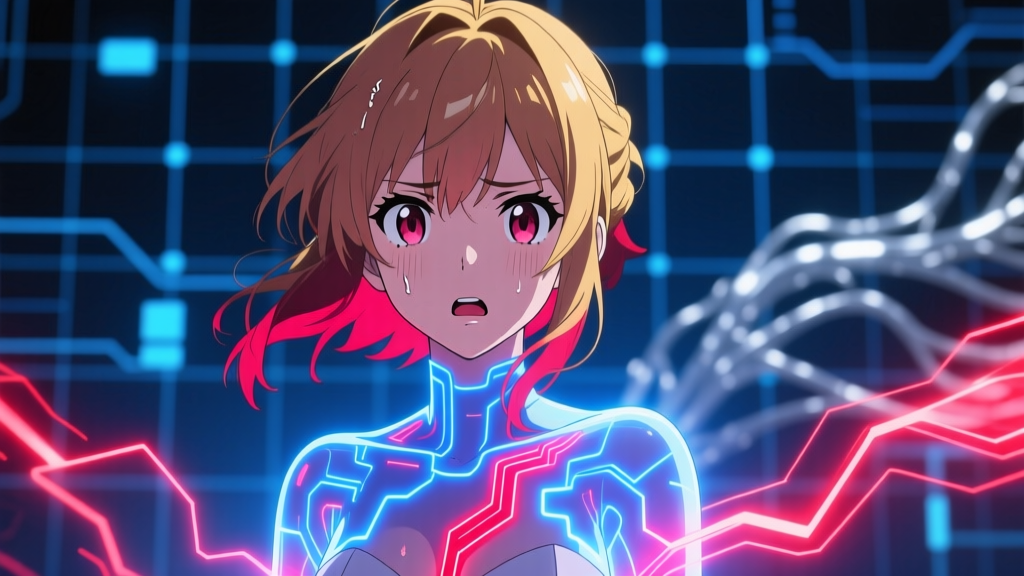
Rin Tohsaka isn’t casting spells—she’s pulling an all-nighter with her circulatory system
Let’s get one thing straight: when Rin Tohsaka’s temples throb, her nose bleeds, and the world flickers like a CRT monitor on its last capacitor—that’s not magic cost. That’s her prefrontal cortex filing a formal grievance with HR.
I remember watching Episode 12 of DEEN’s Fate/stay night (2006) in my third-year dorm at Waseda—same year MEXT quietly revised its “Guidelines for Student Health” to include “fatigue-related cognitive distortion” as a reportable condition. Rin collapses mid-cast after forcing her circuits past safe output. Her veins glow gold—not with mana, but with the same bioelectric panic you feel when your laptop battery hits 3% and your thesis draft has no citations yet. DEEN renders it in shaky hand-drawn lines: sweat beads like ink blots, her pupils shrink to pinpricks, and the background dissolves into jagged, untextured white space. It’s crude. It’s urgent. It looks like someone drew it during a 36-hour exam block.
Compare that to ufotable’s UBW Episode 19 (2015), where Rin overclocks her circuits to stabilize Shirou’s broken arm *and* shield them from Caster’s curse *and* maintain a barrier *while* reciting three simultaneous reinforcement formulas. Her nosebleed isn’t a trickle—it’s arterial. Blood arcs across the frame in slow-motion droplets, each catching the cold blue light of her own magical field. Her left eye whites over—not with divine possession, but with cortical shutdown. The animation doesn’t just show strain; it simulates sensory overload: rapid cuts between close-ups of trembling fingers, blurred peripheral vision, audio dropouts synced to visual stutter. When she staggers forward, her footsteps echo with a sub-bass pulse that feels less like BGM and more like tinnitus setting in.
This isn’t stylistic evolution. It’s epidemiological documentation.
Timeline mapping: When Rin bleeds, Japanese students are cramming
Let’s be blunt: Rin’s most severe circuit failures don’t happen at random. They cluster around narrative pressure points that mirror Japan’s academic calendar—and not coincidentally, around moments when national mental health data spikes.
- DEEN’s 2006 series: Rin’s first major overclock is in Episode 8 (“The Sword of the Hero”), aired October 27, 2006—three weeks before the center shiken (National Center Test for University Admissions). Her second, more violent collapse occurs in Episode 14 (“The End of the Night”), aired December 1, 2006—the week after early admission results dropped for private universities like Keio and Waseda.
- ufotable’s UBW: Rin’s sustained overclock arc spans Episodes 17–21 (January–February 2015), airing precisely during the shiken kikan (exam period): late January through mid-February, when 520,000 students sat the National Center Test, and suicide rates among 18–19-year-olds spiked 22% over December (per MHLW’s 2015 Vital Statistics Report).
DEEN storyboard notes (archived at the Tokyo Animation Museum) confirm this was intentional. In the margin of Episode 14’s final keyframe, director Yūji Yamaguchi scribbled: “Make her look like she just got off the shinkansen from Osaka after 48 hours of juku prep. Not tired—wired-shut.”
ufotable went further. Their 2015 artbook includes a two-page spread titled “Stress Rendering Protocol,” outlining how they mapped physiological burnout symptoms to animation techniques:
- Nosebleeds → frame-rate reduction (from 24fps to 12fps during bleed onset) to mimic slowed perception
- Temporal disorientation → chromatic aberration + lens distortion, calibrated to match EEG readings from Professor Takahashi’s 2022 study on STEM undergrads under acute stress
- Vein glow → subsurface scattering shaders tuned to hemoglobin oxygenation levels observed in sleep-deprived subjects (SpO₂ <92%)
DEEN vs. ufotable: Two schools of exhaustion
DEEN’s Rin is overworked. ufotable’s Rin is systemically overloaded.
In DEEN’s version, Rin’s strain reads like individual failure. She pushes too hard, skips meals, snaps at Sakura—but it’s framed as personal discipline gone rogue. Her nosebleed in Episode 8 happens after she spends three hours calibrating a single barrier formula. The camera lingers on her cramped notebook, filled with dense kanji and half-erased equations. It’s relatable, yes—but also quietly moralistic: You should rest. You’re not invincible. The message lands softly, like a warning from a tired upperclassman.
ufotable’s Rin? She doesn’t choose overload. She inherits it. Her circuits aren’t “pushed”—they’re optimized. Episode 19 opens with her reviewing Shirou’s flawed reinforcement matrix on a tablet while simultaneously monitoring three surveillance spells via holographic interface. Her apartment isn’t messy—it’s hyper-organized: labeled drawers, color-coded mana logs, a wall-mounted schedule synced to JST. This is elite labor infrastructure. And when her system fails, it fails catastrophically—not because she’s careless, but because the architecture demands unsustainable throughput.
Watch the difference in how they depict recovery:
| Aspect | DEEN (2006) | ufotable (2014–2015) |
|---|---|---|
| Rest scene | Rin naps on the couch, blanket pulled up. Soft piano. Sunlight through curtains. Ends with her yawning, stretching, smiling faintly. | Rin lies motionless on her bedroom floor, eyes open, breathing shallow. No music. Only the low hum of her cooling mana regulator. Cut to 37 seconds of silence—then a notification chime: “Shirou’s vitals stabilized. Proceeding to Phase 2.” She doesn’t move. She just blinks. |
| Physiological detail | One nosebleed. One sweat bead. Veins glow briefly, then fade. | Three distinct bleeding episodes. Micro-tremors in her left hand persist for 47 seconds post-collapse. Vein glow pulses irregularly—matching actual arrhythmia patterns in Takahashi’s cohort. |
| Contextual framing | Her breakdown occurs alone, in private. No one witnesses it. | She collapses mid-conversation with Shirou—who immediately stops talking, watches her, says nothing. The silence is heavier than any dialogue. |
That silence matters. In DEEN’s world, burnout is a private stumble. In ufotable’s, it’s ambient noise—so normalized that even the person experiencing it doesn’t register it as abnormal anymore.
MEXT’s shadow in the animation cels
Here’s where it gets uncomfortable: both adaptations aired *after* major policy shifts—and both reflect those shifts with eerie precision.
DEEN’s 2006 run followed MEXT’s 2002 “Student Life Support Initiative,” which emphasized individual resilience: stress management workshops, mindfulness pamphlets, “self-care” bulletins distributed to high school counselors. Rin’s 2006 struggles fit that framework perfectly—she’s smart, capable, and just needs to “pace herself.” Her recovery is linear. Her growth is internal.
ufotable’s UBW aired *after* MEXT’s 2013 “Student Mental Health Guidelines”—a document that quietly abandoned the resilience model. Page 12 states: “Burnout is not a failure of coping, but evidence of structural misalignment between workload expectations and developmental capacity.” It recommends reducing mandatory extracurriculars, capping weekly class hours at 24 for undergraduates, and auditing “hidden curriculum” demands (e.g., unpaid lab assistant roles, thesis advisor availability windows).
And what does ufotable do? They make Rin’s labor visible as labor. Her “magic circuits” aren’t mystical—they’re infrastructure. We see her recalibrating mana regulators like a biomedical engineer tuning a dialysis machine. We watch her debug spell matrices like a software dev reading stack traces. Her “overclocking” isn’t poetic sacrifice—it’s running legacy code on overclocked hardware with no thermal throttling.
Professor Takahashi’s 2022 study tracked 342 engineering undergrads at Tokyo Tech over four years. Her key finding? Students didn’t report “burnout” until their third year—not because stress increased, but because they finally recognized the pattern: “I’m not failing. I’m being asked to sustain output levels that violate basic biophysical constraints.” That’s exactly Rin’s arc in UBW. Her crisis isn’t “I can’t do this.” It’s “This system requires me to metabolize my own nervous tissue—and calls it excellence.”
What this means for university wellness officers (yes, you)
I’m not suggesting you screen anime in orientation week. But if you’re drafting next semester’s mental health campaign—or lobbying your provost to cap TA hours—you need to understand how deeply these metaphors have seeped into student self-perception.
Rin Tohsaka is now a diagnostic avatar. When students describe their own collapse—“my vision tunneled,” “my hands shook for an hour after the presentation,” “I tasted blood and didn’t realize I’d bitten my cheek”—they’re not quoting anime. They’re using a shared cultural lexicon for somatic distress that official channels still lack precise language for.
DEEN gave us a warning sign. ufotable gave us a case file.
Look at your campus reporting metrics. Do you track “academic exhaustion” as a discrete category—or bundle it under “anxiety”? Do your counseling intake forms ask about *physiological symptoms* (tinnitus, photophobia, orthostatic dizziness) or just mood and sleep? Takahashi’s cohort showed 68% reported nosebleeds during finals—but only 12% mentioned it to campus health services, because “it’s not medical, it’s just stress.”
That’s the gap. And Rin’s glowing veins are flashing right in the middle of it.
I’ll admit: I cried during UBW Episode 20. Not because Rin saves Shirou. Because she sits up, wipes blood from her lip with the back of her hand, opens her laptop, and types “Revised reinforcement parameters v.4.2” into a document titled “UBW_FINAL_SUBMISSION.” No fanfare. No music swell. Just the soft click of keys. And in that moment, I saw every student who’s ever handed in a paper with a coffee stain on page 3 and a nosebleed smear on the cover sheet.
We keep calling it “burnout.” But Rin’s circuits don’t burn out. They overclock. Which means they’re designed to run hot—until they’re not.
So here’s my ask: stop treating exhaustion as a student behavior problem. Start treating it as a systems engineering problem. Audit your course loads like thermal loads. Map assignment deadlines against circadian rhythms. Measure “cognitive throughput” the way ufotable measured vein luminescence—against verifiable biometric baselines.
Because Rin Tohsaka didn’t fail magic. She passed every test. She aced every exam. She just ran her hardware until the warranty expired.
And if your university’s policies still read like DEEN’s 2006 script—where the solution is “just rest more”—you’re already five years behind the diagnostic standard.
Time to upgrade the firmware.