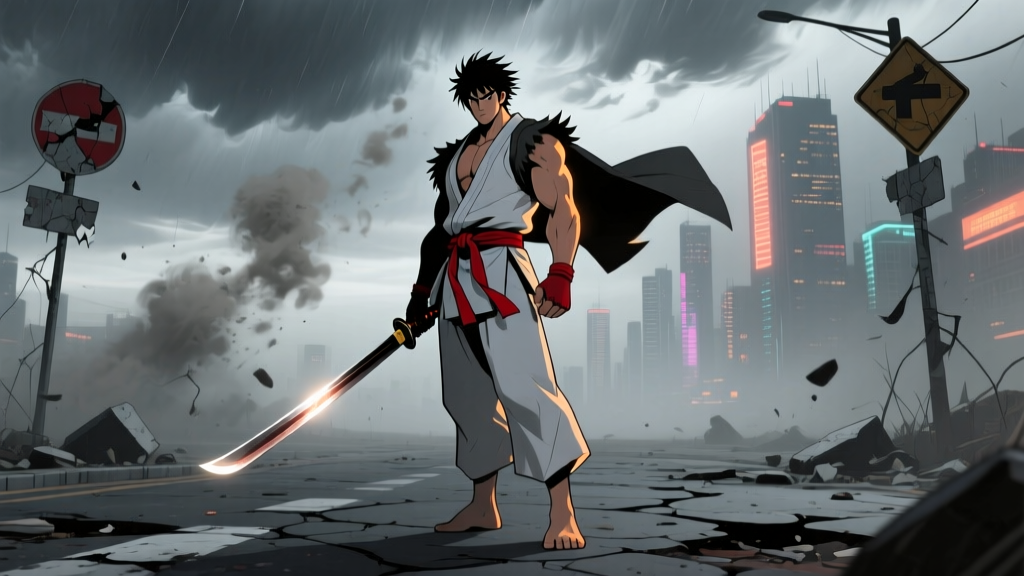
Close your eyes and picture Ryu's face. You're probably seeing the scowl — heavy brows drawn together, mouth set in a flat line of pure concentration, maybe the flash of blue light reflecting off his cheekbones as he cups his hands at his hip. That face has been a constant in arcades, living rooms, and now online lobbies since 1987. But if you actually go back and look at the original Street Fighter sprite from that year, you'll barely recognize him. The ryu face we know today — stoic, battle-worn, quietly intense — took shape over six mainline games, dozens of revisions, and more than three decades of art direction shifts at Capcom.
The Pixel That Started the Scowl: Street Fighter (1987)
The first Street Fighter hit Japanese arcades in August 1987, running on Capcom's CP System hardware. Ryu appeared as a small, chunky sprite barely 64 pixels tall. His face? A smattering of tan-colored blocks with two dark dots for eyes and a vague line for a mouth. There was no headband — or at least, nothing you could clearly make out at that resolution. His gi was white, sure, but the "white" bled into the skin tones, and under the CRT glow of a dimly lit arcade, Ryu looked more like a thumb with legs than the wandering martial artist Capcom intended.
What's interesting about SF1 Ryu is what he lacked in facial identity. There was no win pose close-up, no super move that zoomed in on his expression. When you threw a Hadouken — which, in this game, was nearly impossible to execute consistently on those brutal pressure-sensitive buttons — Ryu's face didn't change at all. The same blank stare accompanied every attack. Yet even in those crude pixels, the design DNA was present: brown hair, white gi, the suggestion of a martial arts headband. The face was a sketch, but the silhouette was already iconic.
"The original Street Fighter was never about character expression. The hardware simply couldn't render a face with any subtlety. We were focused on making the punches feel heavy." — Noritaka Funamizu, Capcom planner (interview, Gamest magazine, 1992)
Akiman's Blueprint: The SF2 Face That Defined a Generation (1991)
Everything changed with Street Fighter II: The World Warrior in February 1991. Character designer Akira "Akiman" Yasuda took the rough concepts from SF1 and rebuilt the cast with a level of detail that had never been seen in a fighting game. Ryu's face in SF2 is the one most people still carry in their heads: thick, dark eyebrows casting shadow over narrowed eyes; a strong jaw covered by the faintest suggestion of stubble; a mouth that, in his idle stance, sits in a tight, determined line.
The SF2 sprite was roughly 96 pixels tall — a 50% increase over the original — and Capcom's artists used every one of those pixels. For the first time, Ryu had distinct facial expressions tied to his moveset. When he threw a Hadouken, his brow furrowed deeper and his mouth opened in a shout — the famous "Tatsumaki!" yell that arcade players would mimic between rounds. When he landed a Shoryuken, his face twisted with effort, teeth clenched, eyes wide with the explosive upward surge. Getting hit produced a pained grimace, cheeks pulled back, eyes squeezed shut.
The Idle Stance That Said Everything
Akiman's masterstroke was Ryu's idle animation. Standing in his fighting stance, Ryu's face cycled through a subtle loop: eyes narrowing slightly, then relaxing, then narrowing again. It was maybe three frames of animation, but it communicated everything about the character — the perpetual readiness, the coiled intensity, the warrior who never truly rests. Those three frames did more character work than most fighting game bios do today.
The Super Street Fighter II and Super Street Fighter II Turbo revisions (1993–1994) refined the palette and added shading, but Ryu's face stayed fundamentally the same. Akiman's design was so strong that Capcom had no reason to deviate. The SF2 ryu face had become shorthand for "fighting game character" in the broader culture — appearing on lunchboxes, cartoon adaptations, and the Street Fighter movie poster in 1994, where the late Raul Julia's Bison got top billing but Ryu's scowl was front and center in every promotional still.
Softer Lines, Deeper Eyes: The Alpha Era (1995–1998)
The Street Fighter Alpha trilogy (known as Street Fighter Zero in Japan) served as a prequel, showing a younger, less hardened Ryu. Artist Akira "Akiman" Yasuda returned for Alpha 1 and 2, but the sprite work shifted toward a more anime-influenced aesthetic. Ryu's face here is noticeably smoother: the stubble is gone, his features are rounder, and his expression carries more curiosity than grit. He's a student of the Ansatsuken, still searching, still uncertain about the Satsui no Hado stirring inside him.
Alpha 3 (1998) pushed the CPS-2 hardware to its limits, and Ryu's sprite work was the most detailed the series had seen. His Hadouken face was now a full-on grimace — teeth bared, veins suggested on his temples, headband fluttering in the energy surge. The introduction of the Shinku Hadouken (Super Hadouken) gave Capcom's animators a chance to show Ryu's face in a new context: extreme concentration, eyes glowing white-blue, the entire face washed in azure light. It was the first time the "ryu face" had become a lighting challenge, not just a pixel challenge.
The Satsui no Hado Split
Alpha 2 introduced Evil Ryu (Kage no Ryu / Satsui Ryu), a version of the character consumed by the dark energy of the Ansatsuken. Evil Ryu's face is one of the most striking design departures in the franchise: same features, but the eyes burn red, the expression twists into a sadistic grin, and the skin takes on a sickly, greyish pallor. For a character defined by his calm composure, seeing that face contorted with malice was genuinely unsettling. Capcom understood that Ryu's face was so recognizable that even a small corruption — red eyes instead of brown, a smirk instead of a scowl — would hit players viscerally.
The Grizzled Veteran: Street Fighter III and the Age Lines (1997–1999)
Street Fighter III: New Generation (1997) made a controversial choice — Ryu was no longer the default protagonist. Alex, a brash American wrestler, took center stage. But Ryu was still in the game, and his face told a story that no other character's did: he was aging. The SF3 Ryu has visible crow's feet around his eyes, deeper nasolabial folds, and a more weathered complexion overall. He looks like a man in his early thirties who has spent too many years getting punched in the face for a living. Which, canonically, he had.
The CPS-3 hardware allowed for an enormous leap in sprite detail. Ryu's Third Strike (1999) sprite is arguably the most beautiful pixel art ever created for a fighting game — and his face is a big part of that. When he performs a Denjin Hadouken (the electric-charged variant), his face contorts with an intensity that borders on desperation. The lightning-blue glow catches every crease and shadow, making his expression look almost sculpted. The parry system in SF3 also added a unique facial moment: when Ryu successfully parries an attack, his expression barely shifts — a micro-smirk, a slight narrowing of the eyes. It's the most restrained, confident ryu face in the entire series, and it fits the game's philosophy of calm precision perfectly.
3D Polygons Meet 2D Soul: Street Fighter IV (2008)
After a long drought — nearly nine years between Third Strike and Street Fighter IV — Ryu returned in full 3D, rendered in a cel-shaded style that Capcom called "sumi-e ink painting brought to life." The ryu face in SF4 occupies a fascinating middle ground: the proportions are more realistic than any sprite, but the shading is deliberately stylized, with bold ink-outline effects on the eyebrows and jaw. His stubble is back — more pronounced than ever, rendered as a dark shadow across his chin and upper lip.
The Focus Attack system gave Ryu a new expression: the charged focus stance, where he draws back and his face goes completely blank — eyes half-lidded, mouth neutral, almost meditative. It's a callback to the idle composure of SF2 but filtered through a 3D pipeline that could actually render the subtle tension in his cheek muscles. When the Focus Attack releases, his face explodes into a shout, and the ink-splash effects across the screen make the whole thing feel like a woodblock print coming alive.
Ultra Combos in SF4 delivered the most cinematic Ryu face moments to date. The Metsu Hadouken shows Ryu's face in extreme close-up, sweat visible on his brow, eyes blazing, as he charges a massive energy sphere. The Metsu Shoryuken goes the other direction — pure, unbridled aggression, teeth fully bared, face twisted in a war cry. For the first time, players could see the pores on Ryu's nose during these cinematics. The face that had once been three pixels was now rendered in thousands.
The Clean-Shaven Controversy: Street Fighter V (2016)
Street Fighter V launched on Unreal Engine 4, and Capcom made a decision that split the fanbase: Ryu was clean-shaven. The stubble that had been part of his identity since SF2 was gone, replaced by a smooth, almost youthful face. His features were softer, his expression less weathered. He looked ten years younger than his SF4 counterpart. The official explanation was that Ryu had "found inner peace" after overcoming the Satsui no Hado, and his face reflected that calm.
The community was... not convinced. Forum threads on Reddit and EventHubs filled with side-by-side comparisons, fans arguing that Ryu's stubble was as essential to his identity as the headband. Capcom eventually responded — not by bringing back the stubble in the base design, but by introducing alternate costumes and the Kage character (the physical manifestation of Evil Ryu), whose face was a nightmarish inversion: glowing red eyes, ashen skin, mouth frozen in a rictus grin. Kage's face was the anti-Ryu, and it proved once again how much emotional weight the original design carried. Any deviation from the stoic scowl registered as wrong on a gut level.
The V-Trigger system in SF5 did add something new to the ryu face toolkit: when activating V-Trigger I (Denjin Renki), Ryu's eyes glow electric blue and small arcs of lightning dance across his face. It was a callback to the Denjin Hadouken from SF3, and the lighting effects in the Unreal Engine made it genuinely striking — blue light reflecting off his smooth skin, headband whipping in the electrical wind.
Every Wrinkle Tells a Story: Street Fighter 6 (2023)
Street Fighter 6 runs on Capcom's RE Engine — the same tech behind the Resident Evil remakes — and it delivers the most detailed, most realistic, and arguably most emotionally expressive Ryu face in the franchise's history. This Ryu is old. Canonically in his late thirties, he has deep laugh lines, prominent crow's feet, visible pores, sun-damaged skin on his forehead, and — yes — the stubble is back, thicker and more textured than ever. He looks like a man who has been hit by a Shoryuken or two and lived to tell about it.
The RE Engine's facial animation system captures micro-expressions that no previous game could attempt. When Ryu charges a Hadouken in SF6, you can see the muscles in his jaw tighten, his nostrils flare, and his brow furrow in distinct stages. The blue energy pooling between his palms casts real-time light across his face, illuminating individual strands of stubble and the faint sheen of sweat on his upper lip. It's not just a face anymore — it's a face performing.
The Bearded Sage and the Classic Scowl
SF6 also introduced a radical alternate: Classic Ryu, based on his SF2 appearance, available as a bonus costume. And then there's the World Tour mode, where Ryu appears as a mentor figure — older, wiser, with a full beard and a grey-streaked headband. The bearded Ryu face was a revelation for fans: same strong features, same piercing eyes, but framed by silver facial hair that communicated years of wandering and training. For a character who had been "ageless" for three decades, seeing him actually age — gracefully, with dignity — was a quietly powerful moment.
Every Game, Every Scowl: A Visual Comparison
| Game (Year) | Art Style | Facial Detail Level | Key Feature |
|---|---|---|---|
| Street Fighter (1987) | Pixel art, ~64px | Minimal | Two-dot eyes, no visible headband detail |
| SF II (1991) | Pixel art, ~96px | Defined | Iconic scowl, stubble, expression-linked move faces |
| Alpha/Zero (1995) | Anime-styled pixel art | Smooth | Younger face, no stubble, curious expression |
| SF III: Third Strike (1999) | High-res pixel art | Detailed | Aging lines, weathered look, parry micro-smirk |
| SF IV (2008) | 3D cel-shaded (ink style) | High | Bold outlines, heavy stubble, ink-splash shout |
| SF V (2016) | 3D stylized (UE4) | Polished | Clean-shaven (controversial), V-Trigger glow eyes |
| SF 6 (2023) | 3D realistic (RE Engine) | Photorealistic | Pores, stubble texture, dynamic Hadouken lighting, bearded variant |
| Sprite heights are approximate. Art style descriptions reflect primary rendering approach per title. | |||
The Hadouken Face: Anatomy of a Gaming Icon
If there's one expression that defines the "ryu face" more than any other, it's the Hadouken. The pose is universal — hands cupped at the hip, energy sphere forming between the palms — but the face is what sells it. Across every iteration, from the blank stare of SF1 to the pore-level rendering of SF6, Ryu's Hadouken face follows the same emotional arc: focus, build, release.
In SF2, the face tightens during the charge (brows draw together, mouth opens) and peaks at the moment of release (full shout, eyes wide). In SF3's Third Strike, the Denjin Hadouken adds an electric charge — Ryu's face practically vibrates with energy, eyes narrowed to slits, teeth gritted so hard you can see the molars. SF4's cinematic Ultra shows him from a low angle, face half in shadow, half in blue light, and the expression is one of absolute determination — not anger, not rage, just pure, undiluted will.
The Shoryuken face is different. Where the Hadouken face is about control, the Shoryuken face is about explosion. Ryu's face twists upward as he launches, mouth agape, brows raised — a warrior caught mid-battle-cry. In SF6, the Shoryuken face is the most detailed expression in his moveset: you can see the tendons in his neck strain, his jaw jut forward, and a flash of reflected light hit the sweat on his temple. Capcom's animation team has openly discussed in GDC talks (2024) that Ryu's Shoryuken face alone required 47 blend shape targets in the RE Engine — more than some entire characters in other games.
Fan Art, Memes, and the Face That Launched a Thousand Drawings
Ryu's face occupies a unique space in fan art culture. He's one of the most drawn characters in gaming history — a search on Pixiv returns over 85,000 results for "リュウ (ストリートファイター)" as of mid-2026 — yet he's also one of the most parodied. The "serious face with a headband" formula is so recognizable that it's become visual shorthand far beyond the Street Fighter community.
The most common fan art tropes around the ryu face include:
- The Chibi Hadouken: Ryu drawn with an oversized head, tiny body, and a massive blue Hadouken — his face scrunched in maximum effort. This style exploded on Tumblr and Twitter around 2014 and remains a staple.
- Ryu Doing Mundane Things: The stoic Hadouken face photoshopped onto a barista making coffee, a salaryman on a train, a dad at a PTA meeting. The humor comes from the contrast — the most intense face in gaming applied to the most boring situations.
- The Aging Ryu Timeline: Fan artists love drawing Ryu at different ages side by side — young Alpha Ryu, prime SF2 Ryu, grizzled SF3 Ryu, bearded SF6 Ryu. These "life of Ryu" pieces have become their own genre, with some artists adding imagined future versions: elderly Ryu, still wearing the headband, still scowling, but now at a garden or fishing pond.
- Crossover Face Swaps: Ryu's face on other characters' bodies (and vice versa) has been a meme since the early 2000s. Ryu with Cloud's hair, Ryu with Mario's mustache — the headband and scowl are so iconic that they survive any transplant.
On the competitive scene, the ryu face has its own mythology. Daigo Umehara — perhaps the most famous fighting game player alive — has been associated with Ryu for his entire career, and his real-life "Daigo face" (a calm, almost blank expression during high-pressure matches) is frequently compared to Ryu's idle scowl. The parallel isn't accidental: Daigo's composure mirrors the character he's played for 25+ years, and fan art frequently merges the two, drawing Daigo with Ryu's headband or Ryu with Daigo's signature sunglasses.
The Red Headband: Ryu's Face, Framed
You can't talk about Ryu's face without talking about what sits above it. The red headband (hachimaki) has been part of his design since SF1, and it serves a crucial visual function: it frames his face. In pixel art, the headband provides a color break between his brown hair and his skin-toned forehead — without it, Ryu's face would blur into his hair at low resolutions. In 3D, it casts a shadow across his brow, deepening the scowl and giving his eyes a darker, more hooded look.
The headband also carries narrative weight. In SF lore, it originally belonged to Ken Masters, who gave it to Ryu as a gift (or, depending on the continuity, Ryu received it from his master Gouken). The headband is, in effect, a symbol of Ryu's connections to other people — his friendship with Ken, his training under Gouken, his rivalry with Sagat (who scarred Ryu's chest, adding another "mark" to his visual identity). When Ryu loses the headband in certain storylines — or when Evil Ryu appears without it — his face looks naked, exposed, wrong. The headband isn't just an accessory; it's the frame that makes the picture complete.
What the Ryu Face Says About Fighting Game Design
The evolution of Ryu's face tracks the evolution of fighting game technology more cleanly than any other character. He's the constant — the control group in Capcom's ongoing experiment. When the hardware could only render a few colored blocks, Ryu's face was a suggestion. When sprites gained detail, his face gained personality. When 3D polygons arrived, his face gained dimension. And when photorealistic engines became viable, his face gained humanity.
There's a design lesson here that Capcom's team has articulated in interviews: a fighting game character's face needs to be readable at every scale. In an arcade cabinet, you're seeing Ryu from three feet away on a 25-inch screen. In a tournament setting, you're watching on a projector from the back of a ballroom. On a Steam Deck, he's six inches from your nose. The ryu face has to work in all of these contexts — and the reason it does is that the core design is simple enough to survive any resolution. Heavy brows. Narrowed eyes. Tight mouth. Red band. White gi. Five elements, consistently applied, across thirty-six years and six revolutions in rendering technology.
That simplicity is also why the ryu face works as a meme, as a tattoo, as a sticker on a laptop, as a Halloween mask. It's a face reduced to its emotional essence — determination, focus, quiet power — and that essence survives every art style change, every engine swap, every generational leap. Capcom didn't just design a character. They designed a glyph.
Frequently Asked Questions
Why does Ryu look so different in Street Fighter 1 compared to SF2?
Hardware limitations. SF1 ran on early CPS hardware with limited sprite memory, restricting Ryu to roughly 64 pixels in height with a 16-color palette per sprite. SF2, released four years later, benefited from improved CPS-1 hardware that allowed larger sprites, more colors, and distinct animation frames tied to specific moves. Akira Yasuda (Akiman) also took over character design for SF2 and deliberately sharpened Ryu's features — adding the stubble, the prominent brow ridge, and the expression-linked move animations that defined the character going forward.
Why was Ryu clean-shaven in Street Fighter V?
Capcom's stated rationale was narrative-driven: Ryu had overcome the Satsui no Hado (the dark killing intent that plagued him through SF3 and SF4), and his smoother face reflected a calmer inner state. The design choice was controversial among fans, many of whom felt the stubble was integral to Ryu's rugged, wandering-warrior identity. Capcom partially walked it back by introducing Kage (the physical form of the Satsui no Hado) as a separate character, and by SF6, the stubble had returned in force.
What makes the Hadouken face different from the Shoryuken face?
Emotional intent. The Hadouken face communicates focused control — narrowed eyes, clenched jaw, a shout of exertion channeled into a precise energy projection. The Shoryuken face communicates explosive release — wider eyes, more open mouth, an upward surge of full-body effort. Capcom's animation teams have treated these as two poles of Ryu's emotional range: the calm warrior and the erupting fighter. In SF6's RE Engine, the Shoryuken face uses nearly three times as many blend shapes as the Hadouken face because of the complexity of the upward motion and the open-mouth expression.
How old is Ryu in Street Fighter 6?
Canonically, Ryu is approximately 38–40 years old in SF6, based on the series timeline established by Capcom. The SF6 World Tour mode presents him as a seasoned mentor — older than most of the new cast (like Luke and Kimberly) and visibly aged, with grey streaks in his hair and deeper facial lines. This is the first mainline game where Ryu's age is a deliberate part of his visual design rather than something players have to infer from sprite quality.
Who is the main artist responsible for Ryu's iconic look?
Akira "Akiman" Yasuda is the character designer most associated with Ryu's definitive appearance. He designed the cast for SF2 (1991) and continued through the Alpha series, establishing the white gi / red headband / brown hair / stubble formula that every subsequent artist has used as a foundation. Other notable contributors include Daigo Ikeno (SF4 character models), Bengus (SF5 promotional art), and the SF6 design team led by Kaname Fujioka and art director Kazuki Takahashi, who pushed Ryu's face into photorealistic territory using the RE Engine.
Why does Evil Ryu's face look so different from regular Ryu?
Evil Ryu (or Satsui Ryu / Kage) represents the version of Ryu consumed by the Satsui no Hado — the dark energy of the Ansatsuken fighting style. His face retains Ryu's basic bone structure but swaps the color palette: brown eyes become glowing red, healthy skin becomes ashen grey, and the stoic expression becomes a sadistic grin or an anguished snarl. The design is intentionally uncanny — close enough to Ryu that you recognize him, wrong enough that it disturbs you. Capcom has used this "corrupted Ryu face" concept since Alpha 2 (1996), and it remains one of the most effective examples of using a familiar face to generate unease.
Tags: Ryu, Street Fighter, Capcom, ryu face, Hadouken, Shoryuken, character design, fighting games, Akiman, Akira Yasuda, Street Fighter 6, RE Engine, pixel art, otaku culture, gaming history