“He’s just bored”—No, He’s Weaponizing Boredom
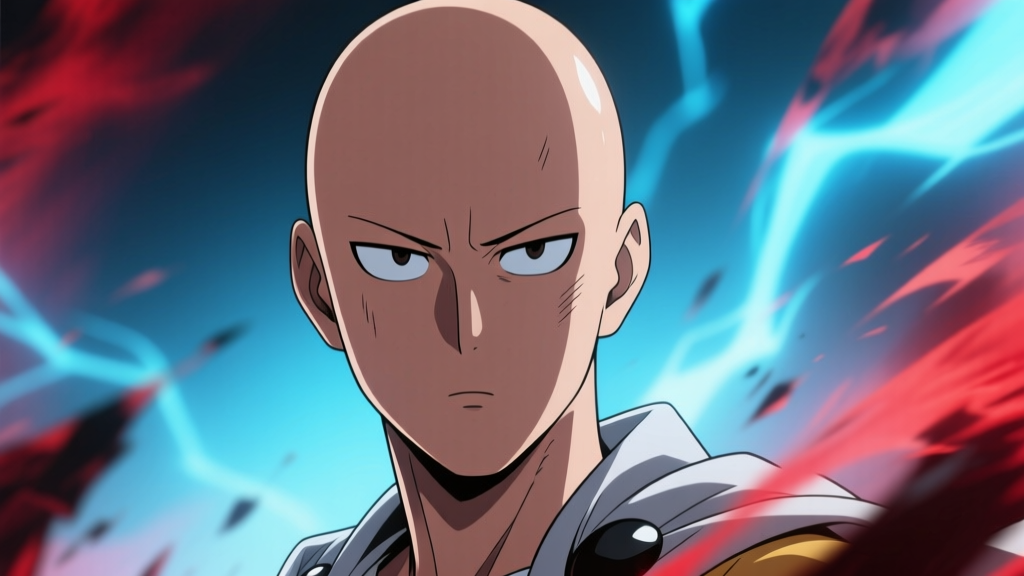
That’s the most common misread of Saitama’s face: a shrug in ink and cel. Critics, fans, even some academics have filed his blank stare under “comic relief” or “lazy characterization.” I remember watching Season 1’s Genos origin flashback—Madhouse cranking up the sweat, the trembling lips, the tear-streaked close-ups—and then cutting back to Saitama, dead-eyed, scratching his head like he’d just misplaced his keys. *Of course* he’s bored, we tell ourselves. He’s overpowered. The fight’s already over. But that’s not how ONE built him. And it’s definitely not how Murata drew him—or how MAPPA animated him in Season 2. Saitama’s neutrality isn’t the *result* of power saturation. It’s the *premise*. His face is the thesis statement.Not Absence—Aesthetic Refusal
Let’s start with Murata’s 2018 interview in Weekly Shonen Jump, where he said outright: *“Saitama’s expression isn’t neutral because he has nothing to feel—it’s neutral because he refuses to perform feeling for the audience’s sake.”* That line hit me like a curb stomp. Because think about it: every major shonen protagonist before him *performs* triumph. Naruto’s grin after the Pain fight (S4E316) isn’t just joy—it’s narrative punctuation. Luffy’s wide-eyed, toothy roar when he first uses Gear 2 (S3E152) is emotional escalation as plot engine. Even Tanjiro’s quiet tears after defeating Rui (S1E26) are carefully calibrated catharsis. These aren’t spontaneous reactions—they’re choreographed releases, timed to the beat of the genre’s emotional metronome. Saitama breaks the metronome. Not by being loud, but by going silent. Compare two panels from Murata’s manga: - Page 127, Chapter 42: Saitama defeats Vaccine Man with a single punch. The panel is tight—his face fills 70% of the frame. Eyes half-lidded, mouth slack, eyebrows unraised. Behind him, Vaccine Man’s body is mid-explosion, limbs splayed, mouth agape in silent scream. The contrast isn’t comedic—it’s structural. One figure is *designed* to register impact; the other is designed *not to*. - Now flip to Chapter 15, the Boros fight climax: Saitama lands the Serious Punch. Murata doesn’t zoom in on his face. He pulls *out*—a full-body shot, arms lowered, wind blowing his cape, hair flat. No sweat, no gritted teeth, no afterimage glow. Just posture. Just weight. This isn’t omission. It’s composition as critique.Madhouse vs. MAPPA: Two Studios, One Strategy
Madhouse’s Season 1 leaned into contrast—not Saitama’s stillness, but everyone else’s hysteria. When Saitama defeats Speed-o’-Sound Sonic (S1E6), the camera lingers on Genos’s jaw-dropped disbelief, on King’s trembling knees, on the crowd’s synchronized gasp. Saitama? A medium shot, eyes downcast, one hand in pocket. His silence *works* because it’s surrounded by noise. MAPPA didn’t replicate that. They doubled down on vacuum. Take Season 2, Episode 12—the Garou fight climax. Madhouse would’ve cut between rapid-fire reaction shots: Genos’s cracked visor, Tatsumaki’s flared hair, Bang’s clenched fist. MAPPA does none of that. Instead: a 3.2-second static close-up on Saitama’s face as he catches Garou’s kick. No blink. No micro-twitch. Just pupils catching light, faint shadow under his lower lid. Then—a cut to black. No music swell. No slow-motion debris. Just silence and title card. That choice wasn’t budget-driven. It was ideological. Hiroshi Ishii notes in his 2021 paper on “affective flattening” that post-2010 shonen increasingly treats emotion as *scalable resource*: bigger threat → bigger scream → bigger aura → bigger transformation. MAPPA’s Saitama rejects scalability entirely. His face is anti-escalation hardware. And it lands harder *because* we’re exhausted. Think about the industry context: by 2022, we’d sat through six seasons of My Hero Academia’s Quirk awakenings, three arcs of Jujutsu Kaisen’s cursed energy surges, and the entire Black Clover finale—all building toward emotional peaks so tall they required CGI scaffolding. MAPPA didn’t give us another peak. They gave us a flatline—and called it victory.The Stare as Narrative Counterpoint
Here’s what gets missed: Saitama’s blankness isn’t isolated to fights. It’s consistent across *all* registers of experience. - He doesn’t flinch when learning he’s been erased from Hero Association records (S2E5). - He doesn’t smile when offered unlimited ramen (S1E10). - He doesn’t frown when Genos confesses he wants to surpass him (S2E9). His affective baseline stays level—not because he lacks interiority, but because his interiority operates outside the genre’s reward circuit. Traditional shonen protagonists are *rewarded* for emotional labor: crying proves empathy, roaring proves willpower, trembling proves stakes. Saitama’s lack of those signals isn’t apathy—it’s immunity to the system’s incentives. Murata confirmed this in a 2020 livestream Q&A: *“If Saitama reacted like other heroes, he’d be playing the same game. His refusal to react is how he wins without competing.”* That reframes every “boring” moment. When he stares blankly at the moon after beating Boros—not in awe, not in sorrow, just *looking*—it’s not anticlimax. It’s the visual equivalent of stepping off the treadmill.Why This Matters Beyond Comedy
Some critics dismiss One Punch Man as parody, not deconstruction. But parody imitates to mock; deconstruction dismantles to reveal. Saitama’s face reveals something uncomfortable: the shonen power fantasy isn’t just about strength—it’s about *performance*. About proving you *earn* your power through visible struggle, audible anguish, escalating stakes. Saitama earns nothing. He *has*. And his face says: *What if the cost of winning isn’t sacrifice—but silence? What if the ultimate victory isn’t transformation, but stillness?* That’s why the final panel of Murata’s manga (Chapter 172) hits so hard: Saitama sitting on a rooftop, eating donuts, watching the sunset. No narration. No inner monologue. Just the curve of his cheek, the soft shadow under his eye, the faintest suggestion of a sigh—not relief, not sadness, just breath. It’s not empty. It’s full of everything the genre refuses to name: exhaustion, clarity, indifference to legacy, freedom from spectacle. And it works *because* it falls flat—deliberately, precisely, devastatingly. We spent decades training our eyes to read shonen climaxes as crescendos: widening eyes, flared nostrils, trembling hands. Saitama taught us how to read silence as resolution. Not every hero needs a roar. Some need only a blink—and the courage not to make it.TL;DR: Saitama’s blank stare isn’t a joke about overpowered heroes. It’s a meticulously engineered rejection of shonen’s emotional economy—drawn by Murata with forensic calm, animated by MAPPA with surgical stillness, and rooted in a simple, radical idea: victory doesn’t require performance.