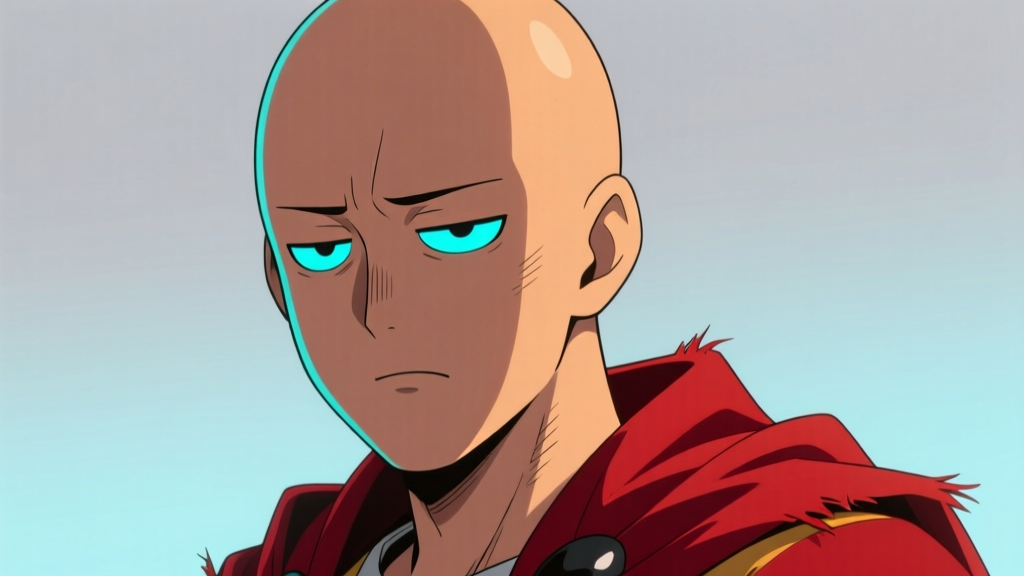
How Saitama’s Boredom in One Punch Man Subverts Shonen Protagonist Archetypes (2012–2023)
Saitama is like a microwave that’s been set to “reheat existence” and forgotten about—he’s still humming, still functional, but nothing inside is getting warmer, and no one’s checking the display.
I remember watching Episode 1 of the 2015 anime—Murata’s manga adaptation just starting its run—and feeling like I’d walked into a dojo expecting kata demonstrations and found the sensei napping on a tatami mat while casually catching falling ceiling tiles with his pinky. That’s not laziness. That’s a structural intervention.
Let’s walk through it—not as theory, but as tour guide holding a slightly bent laminated map:
The Webcomic’s First Punch Wasn’t Against Monsters—It Was Against the Training Montage
ONE’s original 2012 webcomic opens with Saitama already done. No origin flashback. No “I will become strong!” speech. Just a man who did 100 push-ups, 100 sit-ups, 100 squats, and a 10km run—every. single. day. For three years. Then he got bald and bored. That’s it. No inner turmoil. No rival whispering doubts. No mentor saying, “You’re not ready.” He *is* ready—and that readiness has zero narrative velocity.
This works because shonen doesn’t know what to do with completion. Naruto trained for years to master Rasengan—but the *struggle* was the story. Saitama’s training arc ends before the story begins. The webcomic treats his power-up like an expired coupon: technically valid, utterly useless at the register.
Murata Didn’t “Fix” Saitama—He Amplified the Flatness
When Yusuke Murata took over the manga in 2012 (officially serialized from 2015), he didn’t soften Saitama’s affect. He deepened the contrast: hyper-detailed monster designs, cinematic panel layouts, sweat-slicked muscles on Genos—then cut to Saitama’s face, drawn with four lines and a single eyebrow twitch. In Chapter 47 (“The Strongest Hero”), when Boros’ planet-destroying attack hits, Murata renders the explosion across *seven panels*, each more catastrophic than the last—then cuts to Saitama blinking. One blink. No motion lines. No sound effect. Just white space around his head like negative pressure.
This isn’t bad art direction. It’s anti-climax as aesthetic principle.
MAPPA’s Season 2 (2019) Didn’t Raise the Stakes—It Lowered the Camera Angle
Compare Naruto’s Valley of the End fight: dynamic angles, rapid cuts, chakra flares pulsing like heartbeats. Now watch Saitama vs. Deep Sea King (Episode 11, 2019). MAPPA animates the King’s rampage with operatic grandeur—tentacles whipping, civilians screaming, buildings collapsing in slow-motion debris. Then Saitama walks in. The camera drops low—not to emphasize his power, but to show his sneakers scuffing asphalt. His punch lands off-screen. We hear a dull thunk, then cut to the King mid-air, already disintegrating, his scream cut off like a tape rewound too fast.
No follow-through. No recoil. No dramatic pause. Just… resolution. MAPPA didn’t animate a hero—they animated the sound of a light switch flipping off.
And Then Came the OVA: ‘A Hero Nobody Knows’ (2023)
This 22-minute OVA isn’t filler. It’s the thesis statement delivered in grocery-store lighting.
Saitama spends the entire runtime doing mundane things: returning a lost wallet, helping an old woman carry bags, waiting in line at a convenience store. No villains. No cameos. Just him, his bland jacket, and the quiet hum of fluorescent lights. At one point, he stares at a vending machine for 17 seconds—not because he’s calculating attack vectors, but because he’s wondering if the strawberry milk is actually strawberry-flavored or just “strawberry-adjacent.”
That’s when it clicks: his boredom isn’t emotional emptiness. It’s ontological whiplash. He solved the central problem of shonen—the quest for strength—so thoroughly that the genre’s scaffolding collapses under its own weight. There’s no “next level.” No “hidden boss.” Just the persistent, low-grade ache of being unchallenged in a world that keeps insisting on drama.
Naruto had Pain. Goku had Beerus. Saitama has a coupon for 10% off ramen—and he forgets to use it.
So Why Does This Resonate?
Because we’ve all stared at our own vending machines.
We’ve all trained—through school, jobs, relationships—for some undefined “arrival,” only to get there and realize the manual ended three pages ago. Saitama isn’t broken. He’s the first shonen protagonist to reach the finish line and find it’s just a bench. And he sits. And waits. Not for the next fight—but for someone to admit the race was rigged, the trophy hollow, and the real villain wasn’t Deep Sea King or Boros.
It was the premise itself.