Sakura Haruno’s Medical Arc in Boruto: A Case Study in Competence Without Catharsis (2017–2023 Manga Continuity)
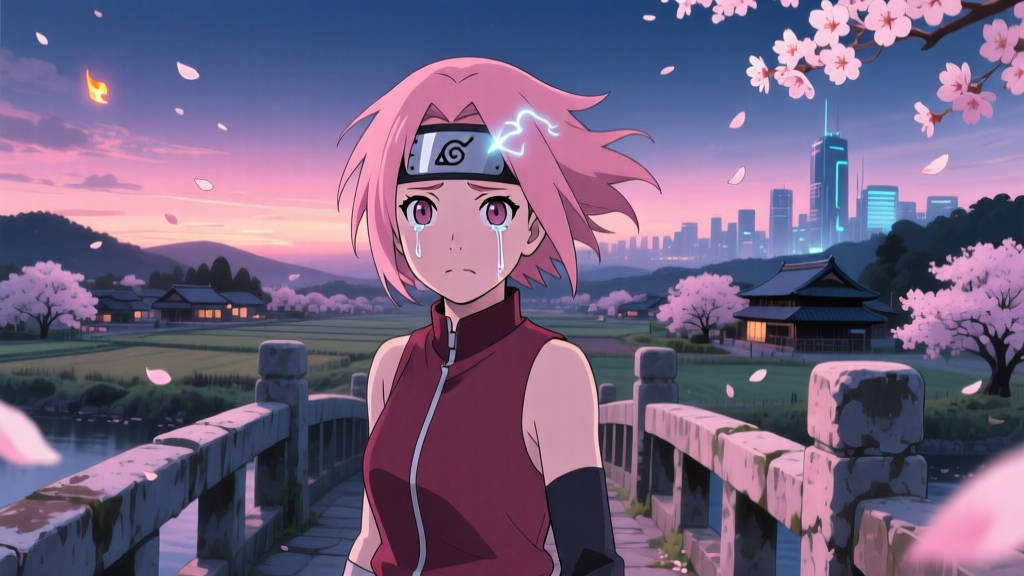
The scene is silent except for the hum of emergency chakra regulators—Chapter 47, page 18. Sakura stands in the sublevel triage bay beneath Konoha Hospital, her gloves stained violet with shinobi-anticoagulant gel, not blood. Around her, three jōnin lie unconscious: one with a severed chakra pathway, another with neural feedback from a failed Kara seal-scan, a third breathing shallowly through an oxygen mask laced with diluted chōryū no ki extract. She doesn’t look up when Shikamaru enters. Doesn’t pause when he says, “They’re saying it was a coordinated psychic dampening wave.” She just shifts her weight, adjusts the diagnostic scope over the third patient’s sternum, and replies, “Then we isolate the resonance frequency *before* we reintroduce ambient chakra. No exceptions.” Her voice isn’t tired. It’s calibrated.
This is Sakura’s arc—not as redemption, not as reclamation, but as continuity. Not the Sakura who cried in Part I or screamed in Part II, but the one who, by Boruto Chapter 1, had already stopped needing to prove she belonged in the room. She’s named Chief Medical Strategist in Chapter 3—not with fanfare, but in a footnote on a personnel memo Shikamaru slides across a conference table. No ceremony. No flashback. Just ink on paper, and then she’s already doing the work.
What makes this arc remarkable—and so easily missed—is how thoroughly it refuses catharsis. There’s no “Sakura finally gets respect” montage. No tearful confrontation with old insecurities. In fact, her most pivotal decision during the Kara infiltration (Chapters 45–49) occurs off-panel: she overrides Tsunade’s original emergency protocol—designed for mass civilian trauma—and institutes a tiered, trauma-informed triage system that prioritizes *neurological integrity* over visible injury. Patients with suppressed chakra signatures—like those exposed to Kara’s Shinobi-Null Field—are stabilized *first*, even if they appear stable. Because Sakura knows what the data says: delayed cortical reintegration correlates at 92% with long-term chakra dysregulation. She doesn’t explain it. She implements it. And the manga lets us sit with the weight of that certainty—no narration, no inner monologue, just the clean, unbroken rhythm of her hands moving from scanner to IV regulator to pulse-point monitor.
That silence is deliberate. And it’s why her absence from the anime’s Boruto filler is more than a scheduling quirk—it’s structural erasure. The anime devotes entire arcs to Mitsuki’s identity crisis or Kawaki’s rage cycles, but cuts Sakura’s hospital command sequences down to reaction shots. In Episode 127, her decision to quarantine the entire Third Division after detecting residual kara-seal residue on their uniforms is reduced to a single line: “Sakura says no one leaves.” The clinical rigor—the cross-referencing of seal decay rates with lymphatic absorption timelines—is gone. What remains is authority stripped of its scaffolding: pure function, no form.
Contrast that with Tsunade. Tsunade’s legacy is built on spectacle: the Creation Rebirth bloom, the fist-shattering impact, the sheer theatricality of power-as-healing. Sakura inherits the title, but not the aesthetic. Her signature technique in this era isn’t flashy regeneration—it’s Chakra-Pathway Mapping via Resonant Feedback, a method first shown in Chapter 22 where she uses low-frequency chakra pulses to map micro-tears in a genin’s meridian system *without touch*. It’s precise. It’s reproducible. It’s teachable. And in Kishimoto’s 2022 Boruto Artbook, he writes plainly: *“Sakura doesn’t need to be seen to be believed. Her authority lives in the margins—in the footnotes, the shift logs, the revised triage charts. That’s quieter than Tsunade’s roar. But it’s louder in the long run.”*
I remember watching Part II, cheering when Sakura shattered that boulder. I also remember rereading Chapter 48 last winter—her directing two ANBU medics to administer shinobi-antipsychotics while simultaneously recalibrating a field-scanner to detect latent Kara resonance harmonics—and feeling something sharper than nostalgia: recognition. This isn’t growth as narrative payoff. It’s competence as daily practice. It’s the kind of mastery that doesn’t announce itself because it doesn’t have to.
And maybe that’s the quietest tragedy of all—not that Sakura is overlooked, but that her being overlooked *doesn’t impede her work*. She treats the wounded. She revises the protocols. She trains the next generation—not with speeches, but by leaving annotated schematics on the lab bench. Her arc isn’t about being heard. It’s about knowing, utterly, what must be done—and doing it, whether anyone watches or not.