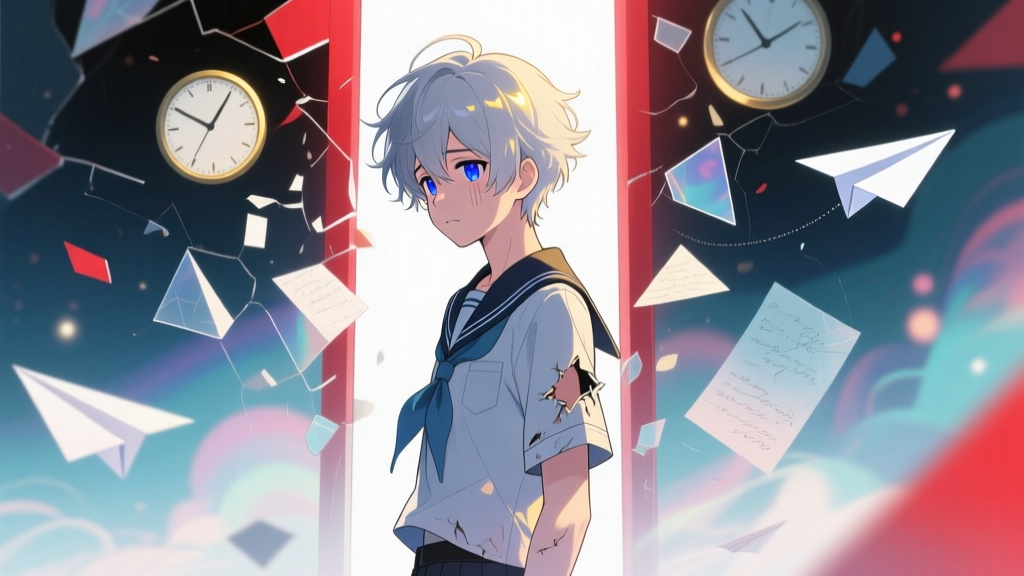
Sakuta stands on the Shin-Yokohama Station platform at 7:43 p.m., backpack slung over one shoulder, hands in his pockets—not waiting for a train, but for the platform to stop feeling like a threshold.
He’s seventeen. Legally an adult in Japan. Practically, he’s just passed his college entrance exams and been accepted into a decent university. Yet in Rascal Does Not Dream, he insists—repeatedly, almost reflexively—that he’s “still a middle schooler.” Not as a joke. Not as irony. As declaration.
Most analyses treat this as trauma regression: a psychological retreat after the Incident with Shoko, a way to shield himself from emotional vulnerability by shrinking back into a safer, pre-adolescent self. That reading isn’t wrong—but it’s incomplete. It mistakes symptom for strategy.
I remember watching S1E9, “The Girl in the Photo,” where Sakuta stares at the distorted reflection of himself in the glass door of a convenience store—his face blurred, doubled, slightly out of sync—and says, quietly: “I don’t want to grow up yet. Not like this.” Not *can’t*. Don’t want. That distinction matters. This isn’t passive collapse. It’s active refusal.
The calendar is rigged
In Japan’s post–Lost Decade labor landscape, “adulthood” isn’t marked by maturity—it’s marked by entry into a system that demands immediate, irreversible commitments: full-time employment (often without negotiation), rent in Tokyo or Osaka (where average monthly rent for a 20m² apartment exceeds ¥85,000), student loan repayment beginning the moment graduation clears, and social expectation to marry by thirty. The 2010s saw a surge in freeters—young people cycling between part-time gigs, not out of laziness, but because stable employment was structurally scarce, and the cost of opting in was prohibitive.
Mai’s arc crystallizes the pressure Sakuta resists. In S2E4, “The Girl Who Can’t Be Saved,” she’s already enrolled at Keio—her acceptance letter framed like a diploma, her dorm room booked, her future path mapped in bullet points by her parents’ expectations and her own quiet terror of falling behind. Her panic attacks aren’t just about anxiety—they’re somatic protests against a timeline she didn’t choose but can’t opt out of without social penalty.
Sakuta watches her rehearse her “adult voice” before a job interview simulation. He doesn’t mock her. He watches, silent, then says: “You sound like you’re reciting someone else’s script.” He knows the script. He’s just declined the audition.
Liminality as infrastructure
David Production doesn’t just set scenes at Shin-Yokohama Station—they build atmosphere with it. Look closely at the background art: the station signage is deliberately faded Heisei-era typography—rounded sans-serifs, soft blue gradients, kanji rendered in the kind of gentle, bureaucratic optimism that peaked around 2005. The ticket gates blink with analog LEDs. The departure boards flicker, never quite updating. Even the light has a slight haze—like film left too long in a drawer.
This isn’t nostalgia. It’s temporal anchoring. Every frame reinforces a world suspended mid-transition—not stuck, but *holding position*. Sakuta doesn’t live *in* middle school. He lives in the *aftermath of its ending*, refusing the next act until he can define its terms.
His “middle schooler” identity isn’t denial of time. It’s insistence on duration—the right to stretch out the space between childhood and the debt-laden, precarity-soaked adulthood offered to him. He wears his school uniform long after enrollment ends. He keeps his old desk lamp. He re-reads manga he liked at twelve. These aren’t regressions. They’re boundary markers.
What grows in the pause?
Here’s what the trauma-regression model misses: Sakuta *does* mature—but laterally, not vertically. He learns to hold space for others’ pain without fixing it (Shoko), to name coercion without flinching (Mai’s family), to sit with uncertainty without collapsing (Rio’s silence in the hospital corridor). His growth isn’t linear ascent—it’s deepening roots in the soil he’s chosen to occupy.
When he finally walks through the station gates—not toward a train, but toward the exit, toward Mai, toward something unnamed—he doesn’t say, “I’m grown up now.” He says: “I think I’m ready to decide what ‘ready’ means.”
That’s not resolution. It’s sovereignty.
And maybe that’s the point of adolescent limbo—not to avoid adulthood, but to delay its definition until you’ve had time to write your own contract with it.