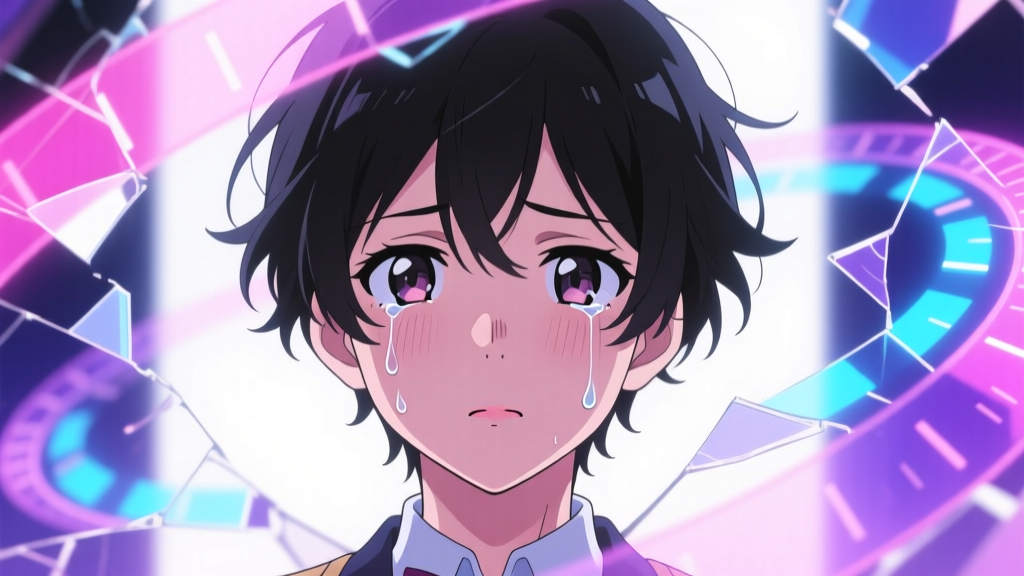
Sakuta doesn’t *enter* time loops—he collapses into them.
That’s not metaphor. Watch Season 1, Episode 5—“The Girl in the Library”—again. Not for Mai’s cliffhanger fall, but for the three seconds *before* Sakuta runs toward her: his breath hitches, his left hand jerks inward like he’s trying to grip his own ribs, and the camera tilts 12 degrees left—not a dramatic Dutch angle, but a subtle, nauseating lean, as if the floor has softened under him. That tilt isn’t stylistic flourish. It’s somatic translation. His body has already registered threat before his conscious mind catches up. And only then does the loop begin.
I remember watching that episode in 2019 and pausing it—not because of the mystery, but because I recognized that tilt. I’d felt that exact vertigo before job interviews, before walking into crowded lecture halls, before calling my therapist back after skipping two sessions. Not fear *of* something, but fear *that the world might destabilize* if he stays still too long in the wrong light, with the wrong people, in the wrong silence. Sakuta’s time loops aren’t magical accidents. They’re autonomic failsafes—narrative expressions of what happens when avoidant attachment meets chronic anticipatory anxiety so severe it fractures causality itself.
Let’s ground this clinically first—not to pathologize Sakuta, but to see how precisely the text maps onto real diagnostic architecture. The DSM-5-TR defines Generalized Anxiety Disorder (GAD) by excessive, uncontrollable worry occurring more days than not for at least six months—but Sakuta’s anxiety is neither generalized nor merely excessive. It’s *context-bound*, *somatic-dominant*, and *relationally triggered*. His panic attacks before school assemblies (Chapter 12 of the light novel; Season 1, Episode 3) feature classic autonomic symptoms: tachycardia, diaphoresis, derealization (“the ceiling tiles blurred like wet ink”), and motor inhibition (“I couldn’t lift my legs past the third stair”). These meet Criterion B of Panic Disorder: “recurrent unexpected panic attacks,” yes—but crucially, they’re *not* unexpected to Sakuta. He *anticipates* them. He tracks their likelihood like weather patterns.
That’s anticipatory anxiety—and it’s where Rascal Does Not Dream diverges from most anime psychological narratives. Most shows treat anxiety as internal noise: shaky hands, inner monologue spirals, flashbacks. Here, it’s structural scaffolding. Every major loop begins not with a wish or a curse, but with Sakuta’s nervous system hitting its threshold and *shutting down linear time as a coping mechanism*. In Chapter 39 (“The Girl Who Couldn’t Be Saved”), he experiences a full panic attack moments before Mai’s accident—chest tightness, tunnel vision, auditory muffledness—then blinks into the loop’s “reset point”: the same hallway, same fluorescent hum, same knot in his stomach, but now *with memory*. The loop doesn’t grant him power. It grants him *repetition as relief*: he knows exactly where the dread will land this time. He can brace.
Hajime Kamoshida confirmed this intentionality during his Aniplex+ panel in March 2023. When asked why Sakuta never seeks therapy in-universe, Kamoshida didn’t deflect with “it’s not that kind of story.” He said, bluntly: “Because Sakuta doesn’t experience his anxiety as a problem to be solved—he experiences it as the atmosphere he breathes. Therapy would require him to name it. And naming it means admitting it lives inside him, not just outside, in the crowd, in the assembly hall, in the silence after someone says his name.” That distinction is critical. Sakuta’s avoidant attachment isn’t just “he keeps people at arm’s length.” It’s a neurobiological strategy: proximity = dysregulation = threat to coherence. So when Shoko appears in Season 2 with her adolescence syndrome, it’s not coincidence she manifests as *physical erasure*—a literal vanishing act. His deepest fear made flesh: that closeness will dissolve him.
MAPPA’s direction crystallizes this. Compare Season 1, Episode 5’s library sequence with Season 2, Episode 10’s hospital corridor scene—the moment Sakuta realizes he’s trapped in the final loop with Rio. In both, the camera doesn’t just follow Sakuta; it *mimics his proprioceptive collapse*. In Ep. 5, the lens distorts peripherally, stretching doorframes horizontally while keeping Sakuta’s face sharp—a visual representation of tunnel vision meeting hyperfocus. In Ep. 10, the hallway floor seems to rise and fall beneath him in slow undulation, synced to his breathing rate (which the sound design amplifies: inhale—low cello drone; exhale—a faint, decaying synth tone). This isn’t surrealism for effect. It mirrors clinical descriptions of depersonalization/derealization disorder (DPDR), listed in the DSM-5-TR as a dissociative condition often comorbid with severe anxiety. Patients report “feeling like a robot” or “watching themselves from outside their body”—exactly how Sakuta describes looping: “It wasn’t me making the choice. It was my body remembering the shape of the escape.”
What makes Rascal Does Not Dream structurally audacious is how little agency Sakuta has *within* the loops. He doesn’t strategize. He doesn’t optimize. He *stumbles through repetition until his nervous system recalibrates enough to tolerate the original trauma without fracturing time*. In the first arc, he doesn’t “solve” Mai’s fall by finding a clever intervention. He solves it by enduring the assembly *twice*—first paralyzed, second time gripping the railing so hard his knuckles whiten, breathing through the tremor in his forearms. The loop ends not when he “fixes” anything, but when his amygdala stops screaming *danger* at the sight of a crowded stage. That’s exposure therapy rendered in narrative syntax.
This is why the series’ emotional climax isn’t Sakuta shouting a declaration of love—it’s him sitting silently beside Mai in the infirmary (Season 1, Ep. 13), not speaking, not touching, just *staying present while his pulse steadies*. No music swells. The shot holds for 17 seconds on his hands resting flat on his knees—palms down, fingers relaxed, no white-knuckling, no clenching. It’s the first time we see his body unguarded *without* dissociation. That’s the victory. Not saving anyone. Not being chosen. Just *not leaving himself*.
And yet—the show refuses easy resolution. Season 2’s core tension isn’t whether Sakuta will “get over” his anxiety, but whether he’ll replicate his avoidance pattern with Rio. Her syndrome erases her from others’ memories, but Sakuta remembers. And in remembering, he risks becoming her sole anchor—which terrifies him, because anchoring requires presence, and presence requires tolerating the vulnerability of being seen *while* feeling unstable. His panic attack before confronting Rio’s father (Ch. 62) isn’t about the man’s anger. It’s about the sheer *weight* of being the only person who sees her—and thus, the only person responsible for holding space for her terror *while* his own threatens to capsize him. The loop here isn’t temporal; it’s relational. He reenacts the same withdrawal he used with his sister—silence, distance, the illusion of control—until Mai calls him out: “You’re not protecting her. You’re protecting yourself from how much it hurts to care.”
That line lands because the series has spent two seasons proving it’s true. Sakuta’s loops don’t originate in magic. They originate in the precise, measurable physiology of threat response: elevated cortisol, vagal withdrawal, hippocampal suppression of contextual memory. When he loops, it’s not because the universe bends for him—it’s because his nervous system *stops encoding continuity*, defaulting to a previously “safe” neural pathway (the reset point) like a corrupted file reverting to last save. MAPPA visualizes this with uncanny fidelity: the slight motion blur on Sakuta’s peripheral vision in Ep. 7 (“The Girl Who Forgot the Date”) matches documented saccadic disruption during panic; the way background characters freeze mid-gesture in Ep. 12’s classroom scene replicates the perceptual fragmentation reported in acute stress reactions.
This isn’t “anxiety as metaphor.” It’s anxiety as operating system. The plot doesn’t accommodate Sakuta’s psychology—the plot *is* his psychology, externalized. Which is why the ending feels earned, not saccharine. When Sakuta finally walks into the school festival crowd without looping, it’s not because he’s “cured.” It’s because he’s learned to carry the tremor *with* him—to let his hands shake while handing Mai cotton candy, to feel his throat tighten while laughing at Kaede’s joke, to breathe *into* the discomfort instead of fleeing *from* it. The final shot of the series isn’t him embracing anyone. It’s him standing alone in sunlight, eyes open, shoulders loose, watching the crowd move *around* him—not as a threat, but as weather he’s learned to stand inside.
That’s the quiet revolution of Rascal Does Not Dream: it treats mental illness not as a character flaw to be overcome, nor as a tragic quirk to be aestheticized, but as a coherent, rule-bound reality with its own physics—and then builds an entire narrative cosmology around those rules. Sakuta’s social anxiety isn’t the obstacle. It’s the gravity well that bends every story orbit around it. And in doing so, the series achieves something rare: it makes the invisible labor of nervous system regulation visible, tangible, and profoundly dignified.
We don’t watch Sakuta to see him win. We watch him to recognize the shape of our own breath catching—and to remember that sometimes, the bravest thing isn’t moving forward. It’s staying right where you are, trembling, and choosing not to blink.