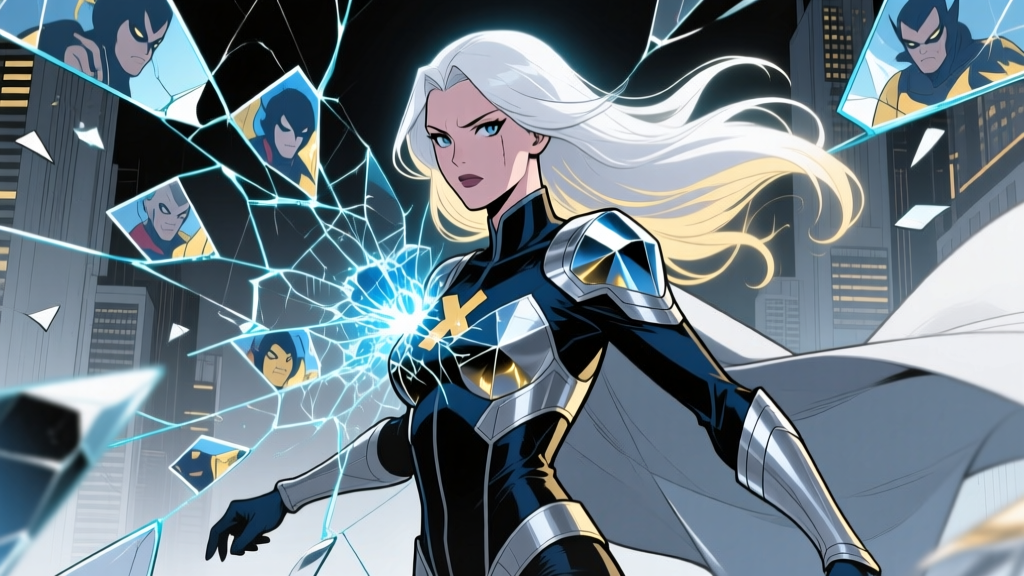
She opens Uncanny X-Men #1 not with a telepathic blast or a diamond-fisted uppercut, but with something far more dangerous: a conversation. Brian Michael Bendis and artist Chris Bachalo relaunched Uncanny X-Men in February 2013 as part of Marvel NOW!, and from the first page it was clear this book would live or die on the strength of its character work. At the center of that gamble stood Emma Frost — former villain, former Phoenix host, former headmistress, and now, according to most of the planet, a terrorist.
The 2013 Uncanny X-Men run spans 35 issues (plus an Annual and the oversized Uncanny X-Men #600), collected across six trade paperbacks: Revolution, Magik, The Good, The Bad, The Inhuman, Vs. SHIELD, The Omega Mutant, and Storyville. Across all of them, Emma Frost is the emotional fulcrum. Not the leader — that role belongs to Cyclops, and the book never lets you forget it — but the person whose interior life Bendis returns to again and again when he wants to examine what this revolution is actually costing the people fighting it.
The Phoenix Hangover: Where Emma Begins
To understand Emma Frost's position in this series, you have to understand what happened to her roughly six months before issue #1 hit shelves. In Avengers vs. X-Men (2012), written by Bendis alongside Jason Aaron, Ed Brubaker, Jonathan Hickman, and Matt Fraction, five mutants — Cyclops, Emma Frost, Colossus, Magik, and Namor — became hosts for the Phoenix Force. The event ended with Scott Summers killing Professor Xavier while possessed, the Phoenix Five scattered, and the entire mutant community branded as dangerous radicals by the world at large.
Emma Frost ended AvX in bad shape. The Phoenix Force had burned through her, leaving her telepathy erratic and unreliable. Her diamond form — the secondary mutation Grant Morrison introduced in New X-Men #116 (2001) — still functioned, but switching between flesh and crystal became less seamless than before. More importantly, her relationship with Scott Summers was effectively over. The Phoenix had forced them to witness each other at their worst, and whatever romantic bond they'd shared couldn't survive that kind of exposure.
“Emma Frost and Magik are broken. They didn’t lose their powers, but they lost something. And they’re trying to figure out what that something is.” — Brian Michael Bendis, pre-release interview for Uncanny X-Men (2013)
That quote became the thesis statement for Emma’s entire arc. Bendis positioned her as someone who had spent twenty years of publication climbing from villain to anti-hero to full-fledged X-Man, only to have the ground ripped out from under her in a single crossover event. The 2013 series asks: what does a woman like Emma Frost do when the world has decided she’s a monster, her lover has become a fugitive revolutionary, and her own mind — the one weapon she always trusted — won’t fire straight?
The Brotherhood of Uncanny Mutants
The team Bendis assembled was deliberately small, deliberately ugly, and deliberately compelling. Cyclops led. Emma Frost served as his second-in-command and the team’s primary telepathic asset, compromised as she was. Magneto, his powers diminished to the point where he could barely manipulate small metal objects, joined out of a combination of guilt and genuine belief that Scott’s cause was just. Magik — Illyana Rasputin — rounded out the core four, carrying her own post-AvX trauma and a sorcerous skillset that made her unpredictable in ways the rest of the team couldn’t fully control.
Their mission, at least initially, was recruitment. With new mutants continuing to manifest and no Xavier School to shepherd them, Cyclops’s team traveled the country finding these kids before the government or hostile anti-mutant groups could. Emma’s role in these recruitment arcs was specific and psychologically rich: she was the one who could read the frightened new mutant’s mind, assess their threat level, and determine whether they were in danger from their own powers. Except her telepathy kept glitching. She’d reach into someone’s thoughts and get static, or worse, get everything — an uncontrolled flood of surface thoughts she couldn’t filter.
Benjamin Deeds and the Mentorship Question
One of the more interesting recruitments during this era was Benjamin Deeds, a young mutant whose power allowed him to physically transform into whoever was near him — essentially a chameleon ability tied to proximity. Benjamin’s storyline intersected with Emma’s in a meaningful way. Here was a kid whose power was fundamentally about becoming someone else, and here was Emma Frost, a woman who had spent decades constructing and reconstructing her public persona, from Hellfire Club White Queen to X-Man to Phoenix host and back again. Bendis didn’t belabor the parallel. He let it sit there, visible to anyone paying attention, while Emma quietly guided Benjamin through the same choices she’d been making since Chris Claremont first introduced her in Uncanny X-Men #129 (1980).
Other new recruits included Christopher Muse (Triage), a healer whose powers placed him in the rarest category of mutant ability; Goldballs (Fabio Medina), whose gold-ball-generation power was more useful than it sounded; and the time-displaced original X-Men from Bendis’s companion series All-New X-Men, who occasionally crossed over into Uncanny storylines.
Six Volumes, One Slow Unraveling
Tracking Emma’s trajectory across the six collected volumes reveals a character who isn’t so much developing as she is reassessing — constantly, sometimes painfully, and always with the sharp-tongued self-aware that makes her one of Marvel’s most distinctive voices.
| Volume | Issues | Emma’s Role | Key Moments |
|---|---|---|---|
| Revolution (Vol. 1) | #1–5 | Reluctant lieutenant; broken telepath | Powers glitching during recruitment missions; tense dynamic with Cyclops; chooses to stay with the team despite her family’s pressure to leave |
| Magik (Vol. 2) | #6–11 | Supporting player in Illyana’s crisis | Attempts to telepathically stabilize Magik; confronts her own Phoenix-induced damage while trying to heal someone else |
| The Good, The Bad, The Inhuman (Vol. 3) | #14–18 | Strategist during the Inhuman conflict | Terrigen Mist crisis; Emma’s tactical mind deployed against the Inhuman royal family; moral questions about mutant supremacy |
| Vs. SHIELD (Vol. 4) | #19–22 | Field operative under siege | Maria Hill’s manhunt forces Emma into defensive combat; diamond form used extensively as telepathy remains unreliable |
| The Omega Mutant (Vol. 5) | #23–27 | Increasingly isolated team member | The team’s internal fractures widen; Emma questions whether Cyclops’s revolution is saving mutants or just creating more targets |
| Storyville (Vol. 6) | #28–35 | Survivor; redefined identity | Final confrontations; Emma’s relationship with Scott fully resolved (ended); sets stage for her post-Bendis trajectory |
The Revolution Arc: Choosing to Stay
In Revolution, Emma’s most significant act isn’t combat or telepathy — it’s the decision to remain with Cyclops’s team at all. Her family, the Frost clan, pressures her to walk away. The Frost fortune is still substantial; she could disappear into a life of luxury and let Scott play revolutionary without her. Bendis writes this as a quiet, almost private moment. There’s no big speech, no dramatic declaration. Emma simply refuses to leave. Part of it is loyalty to the cause, even if she disagrees with Scott’s methods. Part of it is the stubborn Frost pride — she will not be seen as someone who runs. And part of it, the part Bendis lets you infer rather than stating outright, is that she doesn’t know who she is without this fight.
Chris Bachalo’s art in these early issues deserves specific attention. His Emma Frost is angular and severe — sharp cheekbones, narrow eyes, a mouth that looks like it’s permanently holding back a cutting remark. When she shifts into diamond form, Bachalo renders her as a faceted, light-refracting sculpture, beautiful and cold in equal measure. The visual language is clear: this woman is hard to reach, hard to hurt, and harder to love.
The Magik Arc: Healing What Can’t Be Healed
Volume 2 turns the spotlight on Illyana Rasputin, whose own Phoenix corruption manifests differently than Emma’s — less as broken powers and more as a fractured personality. Magik’s demonic Limbo dimension bleeds into her waking life, and Emma, as the team’s telepath, is the logical person to intervene.
The irony is thick and intentional. Emma can barely read a surface thought without her powers misfiring, yet she’s tasked with navigating the labyrinth of another Phoenix survivor’s damaged psyche. The scenes where Emma enters Magik’s mind are among the strongest in the run, because Bendis uses them to mirror Emma’s own interior chaos. Every time she confronts one of Illyana’s demons, she’s also confronting the parts of herself she hasn’t dealt with — the Phoenix’s echo, the memory of what she did while possessed, the gnawing suspicion that her worst impulses didn’t come from the Phoenix at all but were always there, waiting.
“The Phoenix didn’t create new darkness in Emma Frost. It gave the existing darkness permission to speak louder.”The End of Scott and Emma
Any discussion of Emma Frost in the 2013 Uncanny X-Men has to contend with the breakup. Scott Summers and Emma Frost had been one of Marvel’s most compelling power couples since Grant Morrison paired them during New X-Men in 2001, a relationship that survived Jean Grey’s return, Scott’s death and resurrection, and the constant weight of leading a species on the brink of extinction. The Phoenix Force, it turned out, was the thing that finally broke them.
Bendis handles the dissolution with a kind of brutal economy. There isn’t a single dramatic breakup scene. Instead, the distance between Scott and Emma accumulates across issues in small, almost incidental moments — a conversation that ends a beat too early, a tactical disagreement that carries personal weight, a look that says what neither character will articulate. By the time the relationship is formally acknowledged as over, it feels like something that happened weeks ago in-story and the characters have simply been too busy surviving to mention it.
This approach frustrated some readers who wanted a definitive emotional confrontation. But it’s arguably the most honest portrayal of how relationships actually end under extreme circumstances — not with a cinematic argument but with a slow, exhausted drift. Emma’s response to the breakup, as Bendis writes it, is characteristically Frost: she buries it under competence. She works harder, plans more meticulously, and allows herself precisely zero moments of visible grief. The reader has to do the work of noticing what she’s suppressing.
Powers, Design, and the Diamond Problem
Emma Frost’s power set has always been a balancing act between her Omega-level telepathy and her secondary mutation — the ability to transform her body into organic diamond. The trade-off, established by Morrison and maintained (mostly) by every writer since, is that she cannot use telepathy while in diamond form. The diamond body is physically resilient and immune to telepathic intrusion, but it shuts down her psychic abilities entirely.
In the 2013 Uncanny X-Men, this dynamic becomes a recurring tactical problem. Emma’s telepathy is damaged, so she defaults to diamond form in combat situations where she can’t afford to be unreliable. But diamond form leaves the team without its primary telepath at precisely the moments when they need telepathic support most. Bendis turns this into a storytelling engine: every fight scene involving Emma carries an implicit decision point. Does she go diamond and become a physical weapon, or does she risk her glitching telepathy and hope it doesn’t backfire?
Visual Design Under Bachalo
Chris Bachalo drew the majority of the run’s early issues, and his interpretation of Emma Frost became the definitive look for this era. His Emma favors a white-and-black color scheme with occasional silver accents — a more militarized version of her classic White Queen aesthetic. The diamond form, in Bachalo’s rendering, isn’t the smooth, gem-like body introduced by Frank Quitely in Morrison’s run. It’s rougher, more geometric, with visible facet lines that make her look less like a polished jewel and more like something still being formed under pressure.
When other artists filled in — Kris Anka, Frazer Irving, and others contributed across the 35-issue run — Emma’s design shifted subtly, but the core elements remained consistent: white hair (sometimes platinum blonde), pale skin, athletic build, and a wardrobe that balanced practicality with Emma’s characteristic refusal to look anything less than immaculate.
Comparing Eras: How Bendis’s Emma Stacks Up
Emma Frost had been a major X-Men character for over thirty years before Bendis wrote her in 2013. Each creative era left a distinct mark on her characterization:
- Chris Claremont (1980–1991): Created her as the White Queen of the Hellfire Club — a villain and rival to Charles Xavier. Claremont’s Emma was cruel, calculating, and genuinely dangerous. Her telepathy was formidable enough to challenge Xavier himself. She was defined by her rivalry with the X-Men and her devotion to the Hellions, the student team she mentored with a ruthlessness that bordered on abuse.
- Generation X (1994–2001): Scott Lobdell and Larry Hama repositioned Emma as a mentor figure, co-running the Massachusetts Academy with Banshee. This era softened her considerably, introducing genuine care for her students (Jubilee, M, Skin, Husk) while maintaining her cutting wit. It also introduced the emotional complexity that would define her going forward — the sense that her cruelty was armor, not nature.
- Grant Morrison / New X-Men (2001–2004): The most transformative era for the character. Morrison gave Emma her diamond form secondary mutation, paired her romantically with Scott Summers, and made her co-headmistress of the Xavier Institute. This Emma was at her most layered — genuinely heroic but still capable of staggering moral failures, like the psychic affair with Scott that she conducted while he was married to Jean Grey.
- Joss Whedon / Astonishing X-Men (2004–2008): Whedon inherited Morrison’s version and pushed her further into heroism, most notably in the “Dangerous” and “Torn” arcs. His Emma was still acerbic and self-serving, but her commitment to the X-Men was no longer in question. She fought alongside the team against existential threats and proved herself as a combat telepath.
- Bendis / Uncanny X-Men (2013–2015): The first era to depict Emma as genuinely damaged. Previous writers had put her through trauma — the death of the Hellions, her battle with cancer, the Phoenix corruption — but she always recovered quickly, returning to her default state of composed superiority. Bendis doesn’t let her recover. His Emma is still sharp-tongued and still brilliant, but there’s a crack running through her that she can’t paper over. This makes her more vulnerable than she’s ever been, and paradoxically, more interesting.
What This Era Got Right (and Where It Stumbled)
Bendis’s portrayal of Emma Frost has its defenders and its critics, and both sides have legitimate arguments. What the run gets right is her interiority. For a character whose primary power is literally getting inside people’s heads, Emma had often been written as opaque — all surface wit and tactical calculation, with her emotional life hidden behind walls of snark. Bendis inverts this. His Emma is constantly, sometimes agonizingly, self-aware. She knows exactly what’s wrong with her, she knows she can’t fix it quickly, and she’s angry about it in a way that feels specific to her character rather than generic superhero angst.
The run also handles her relationship with Cyclops in a way that respects both characters. It would have been easy to make the breakup melodramatic — a screaming match, a betrayal, a love triangle. Instead, Bendis treats it as what it is: two people who went through something unimaginable together and came out the other side as different people. The love didn’t disappear. The compatibility did.
Where the run stumbles, at least regarding Emma specifically, is in her agency. She spends much of the series reacting to Scott’s decisions rather than driving the plot herself. For a character whose Claremont-era incarnation was a master manipulator who played entire teams of heroes like instruments, seeing her reduced to a supporting role in someone else’s revolution felt like a step backward to some longtime readers. Her powers being diminished was a smart narrative choice, but it also conveniently removed her ability to act independently at a telepathic level — the level where she’s always been most dangerous and most interesting.
The Inhuman Intersection
Volume 3, The Good, The Bad, The Inhuman, crosses over with the broader Marvel Universe’s Inhuman push, tying into the Inhumanity event. For Emma, this arc is primarily tactical — she’s deployed as the team’s strategist when dealing with the Inhuman royal family and the emergence of the Terrigen Mist as a threat to mutant biology. The Terrigen connection would become enormously important to Emma’s character years later, in the Inhumans vs. X-Men (2016) event, where she took a far more aggressive role. The seeds of that future confrontation are visible here, in small moments where Emma’s assessment of the Inhumans is colder and more pragmatic than anyone else on the team.
The Legacy of Bendis’s White Queen
When the 2013 Uncanny X-Men series concluded with issue #35, leading into the Battle of the Atom crossover and eventually the Secret Wars event that would reboot large portions of the Marvel Universe, Emma Frost emerged as a character in transition. She was no longer the Phoenix-corrupted revolutionary’s companion. She was no longer Cyclops’s partner. Her powers were slowly stabilizing but not fully restored. She was, in effect, a blank page — which for Emma Frost is either the most terrifying or the most exciting possible state.
The Bendis era didn’t redefine Emma Frost the way Morrison did or the way Claremont’s original Hellfire Club stories did. What it did was something subtler and, in its way, more honest: it showed what happens to a character like Emma when the narrative stops protecting her. Previous writers had always let her land on her feet. Bendis let her fall, and then asked the reader to watch her figure out how to stand back up without any of the usual shortcuts — no quick power restoration, no new love interest, no convenient retcon. Just a woman with a diamond exterior and a very human interior, trying to decide what kind of mutant she wanted to be next.
That version of Emma — the one who’s been broken and is slowly, grudgingly, putting herself back together — became the foundation for everything that followed. Gerry Duggan’s later Marauders and Hellions runs, the Inhumans vs. X-Men event, and her eventual role in the Krakoa era all carry traces of the Bendis interpretation: an Emma Frost who knows what it feels like to lose everything and has decided, with characteristic defiance, that she’s not going to let it happen again.
Frequently Asked Questions
Which issues of the 2013 Uncanny X-Men series does Emma Frost appear in?
Emma Frost is a core team member throughout the entire run, appearing in issues #1–35 as well as the Annual and the oversized Uncanny X-Men #600. She is present in all six collected volumes: Revolution, Magik, The Good, The Bad, The Inhuman, Vs. SHIELD, The Omega Mutant, and Storyville.
Why are Emma Frost’s powers diminished in this series?
Her telepathic abilities are damaged as a consequence of her time as a Phoenix Five host during the Avengers vs. X-Men (2012) event. The Phoenix Force burned through her psychic architecture, leaving her telepathy erratic and unreliable. Her diamond form still functions, but switching between forms becomes less fluid. This power degradation is a central element of her character arc throughout Bendis’s run.
Does Emma Frost get back together with Cyclops in this run?
No. The end of their romantic relationship is one of the defining emotional threads of the series. Bendis portrays the breakup as a slow drift rather than a single dramatic event — the accumulated damage of the Phoenix experience makes sustaining their partnership impossible. Brian Michael Bendis confirmed in interviews that “the romance is done” following this era.
Who else is on the Uncanny X-Men team in the 2013 series?
The core team consists of Cyclops (Scott Summers), Emma Frost, Magneto, and Magik (Illyana Rasputin). Over the course of the run, new recruits join, including Benjamin Deeds, Christopher Muse (Triage), Fabio Medina (Goldballs), and temporarily the time-displaced original X-Men from the companion series All-New X-Men.
How does Bendis’s Emma Frost compare to Morrison’s version?
Morrison’s Emma (New X-Men, 2001–2004) was at her most powerful and most morally complex — she gained her diamond form, began her relationship with Scott, and committed the psychic infidelity that became one of the defining scandals of X-Men continuity. Bendis’s Emma is a direct continuation, but stripped of her usual composure. Where Morrison wrote her as someone always three moves ahead, Bendis writes her as someone struggling to stay even one move ahead of her own unraveling.
What role does Emma Frost play in the Inhuman crossover?
In Volume 3 (The Good, The Bad, The Inhuman), Emma serves as the team’s primary strategist when dealing with the Terrigen Mist crisis and the Inhuman royal family. Her approach is notably colder and more pragmatic than her teammates’, foreshadowing her far more aggressive role in the later Inhumans vs. X-Men (2016) event written by Charles Soule and Jeff Lemire.