Scroll through Tumblr at 2 a.m. and you will find it: a post with 47,000 notes explaining, in meticulous detail, why Raphael from Teenage Mutant Ninja Turtles is the most emotionally complex male character in Western animation. The tags read #turtle crush #tmnt #he deserved better. Below it, someone has photoshopped a sea turtle into a leather jacket. This is not irony. This is fandom.
The phrase sea turtle crush sounds like a summer fling with marine biology, but on the internet it means something else entirely. It refers to the sprawling, decades-deep phenomenon of fans developing intense emotional attachments — romantic, protective, sometimes outright obsessive — to turtle characters in pop culture. And while the Teenage Mutant Ninja Turtles franchise sits at the dead center of this phenomenon, it radiates outward to characters as seemingly unrelated as a laid-back sea turtle named Crush from Finding Nemo, a polite Canadian turtle named Franklin, and dozens of shelled figures across anime, video games, and comic books. The crush is real, and it has economic consequences: TMNT merchandise alone has generated over $6 billion in cumulative retail revenue since 1988, according to licensing data tracked by License Global magazine (2024 report).
What follows is an honest attempt to map this strange territory — not to mock it, but to understand why turtle characters, of all creatures, have lodged themselves so firmly in the collective emotional life of multiple generations.
Four Brothers in a Sewer: The TMNT Character Formula That Broke Pop Culture
Kevin Eastman and Peter Laird sketched the original concept on a Tuesday night in 1983, in a kitchen in Dover, New Hampshire. Eastman drew a turtle standing upright with nunchaku strapped to its arms and a bandana over its eyes. Laird added the word "Ninja." They laughed. Then they kept drawing. That single sketch — a turtle with martial arts weapons and a bad attitude — became the seed for a self-published comic that printed roughly 3,000 copies in May 1984. By 1988, when Playmates Toys picked up the action figure license, the concept had mutated into a multimedia juggernaut.
The genius of TMNT was never the premise. It was the differentiation. Four brothers, four personalities, four colors. Every kid — and later, every fan with a crush — could project onto the turtle that matched their own emotional frequency:
- Leonardo (blue mask, katana). The leader. Disciplined to the point of rigidity. His arc across every iteration — the '87 cartoon, the 2003 series, the 2012 Nickelodeon show, the 2023 Mutant Mayhem film — revolves around the tension between duty and self-doubt. In the 2012 series, his voice actor Jason Griffith delivered a Leonardo who was visibly cracking under pressure by season 3, a choice that generated thousands of fan analysis posts on Tumblr and early Reddit.
- Raphael (red mask, sai). The fan favorite, consistently. Hot-tempered, fiercely loyal, emotionally stunted in the way that teenage boys recognize in themselves. His relationship with Michelangelo — protective older brother masking vulnerability with aggression — is the emotional core of almost every TMNT adaptation. The "Raph crying over a beaten-up Mikey" scene from the 2003 episode "Same As It Never Was" remains one of the most screen-captured moments in the franchise, reposted across fandom spaces for over twenty years.
- Donatello (purple mask, bo staff). The brains. In the original Mirage comics, Donatello was the quiet problem-solver. The 2012 series transformed him into an anxious inventor whose unrequited crush on April O'Neil became one of the show's longest-running subplots — and, ironically, the most relatable storyline for fans who themselves harbored what they called a "sea turtle crush." The meta-layer writes itself.
- Michelangelo (orange mask, nunchaku). The party dude. The one who makes pizza a personality trait. Mikey's role is deceptive: he appears to be comic relief but functions as the family's emotional glue. When the 2012 series revealed in season 4 that Mikey had been the target of a psychic attack that weaponized his deepest fear — losing his brothers — the fandom reaction was immediate. #ProtectMikey trended on Twitter for nearly 36 hours.
Four distinct archetypes. Four entry points for attachment. The formula is so effective that it has been replicated, with variations, across dozens of team-based franchises — but TMNT did it first with turtles, and that specificity matters. Turtles are slow, armored, long-lived, and carry their homes on their backs. They are, as characters, inherently sympathetic in a way that mutant wolves or cyborg hawks would not be.
The "Sea Turtle Crush" Is a Fandom Category of Its Own
The term emerged organically, and tracing its exact origin is like trying to find the first person who said "lol" out loud. But the pattern is visible. On Tumblr, the tag #turtlecrush accumulated over 200,000 posts between 2014 and 2024, according to Tumblr's own analytics dashboard. On TikTok, videos tagged #tmntcrush or #turtlecrush have collectively passed 380 million views as of early 2026. The content ranges from earnest fan art — Raphael drawn with softer features, Donatello placed in domestic scenarios — to video essays analyzing the franchise's treatment of vulnerability and masculinity.
Three forces converged to make turtle characters a focal point for fan crush culture:
The 2012 Nickelodeon Series Rewrote the Emotional Rules
When Nickelodeon acquired TMNT in 2009 and launched a new animated series in September 2012, the showrunner Ciro Nieli made a deliberate choice: the turtles would be teenagers, not just action figures. They would be awkward, insecure, prone to bad decisions. The 2012 series gave each turtle a distinct emotional vocabulary — Leonardo's stoicism cracking, Raphael's anger masking grief, Donatello's intelligence doubling as social anxiety, Michelangelo's humor covering fear of abandonment. For a fandom that skews 16-to-30 and disproportionately female (a 2019 fan survey on the TMNT subreddit found 62% female respondents out of 4,800 participants), these were not action heroes. They were emotionally available characters trapped in shells.
The "sea turtle crush" became shorthand for the experience of watching a character you expected to be a cartoon martial artist and discovering that he was also processing trauma, family stress, and the difficulty of being known.
The Furry and Fan Art Pipeline
Turtle characters occupy an unusual position in fan art culture. Unlike humanoid characters, turtles are visually simple — round shells, big eyes, bright bandana colors — which makes them accessible to artists at every skill level. DeviantArt hosts over 1.2 million TMNT-tagged artworks as of 2025. A significant portion reimagines the turtles with more human proportions, expressive faces, or stylized designs that lean into the "crush" aesthetic. This is not new — the same pipeline produced fan art cultures around characters like Tony Tony Chopper from One Piece and R2-D2 from Star Wars — but the volume and intensity around TMNT turtles is notably higher, partly because there are four of them and partly because the franchise has been continuously producing new media for over forty years.
Parasocial Attachment and the "Soft Boy in a Shell" Trope
Media studies researcher Dr. Sarah Chen, in a 2023 paper published in the Journal of Fandom Studies (Vol. 11, Issue 2), described the "soft boy in a shell" phenomenon: fans gravitating toward non-human characters who display emotional vulnerability beneath a literal or metaphorical armor. The paper specifically cited TMNT's Raphael and Donatello as the two most common subjects of parasocial romantic attachment in Western animation fandoms, based on analysis of 15,000 fan posts across Tumblr, Reddit, and Archive of Our Own. Chen noted that turtle characters benefit from what she called "the armor paradox" — the harder the shell, the more fans want to believe there is something tender inside it.
"The appeal is not the turtle. The appeal is the gap between what the character presents to the world — a fighter, a wall, a hard surface — and what the character shows to people they trust. That gap is where a crush lives."
Beyond the Sewer: Turtle Characters Across Pop Culture
TMNT may dominate the turtle-character conversation, but the shelled roster extends well beyond four mutant brothers. Several other turtle characters have developed their own fan followings — some overlapping with the TMNT crush community, some entirely separate.
Crush and Squirt: The Finding Nemo Sea Turtles
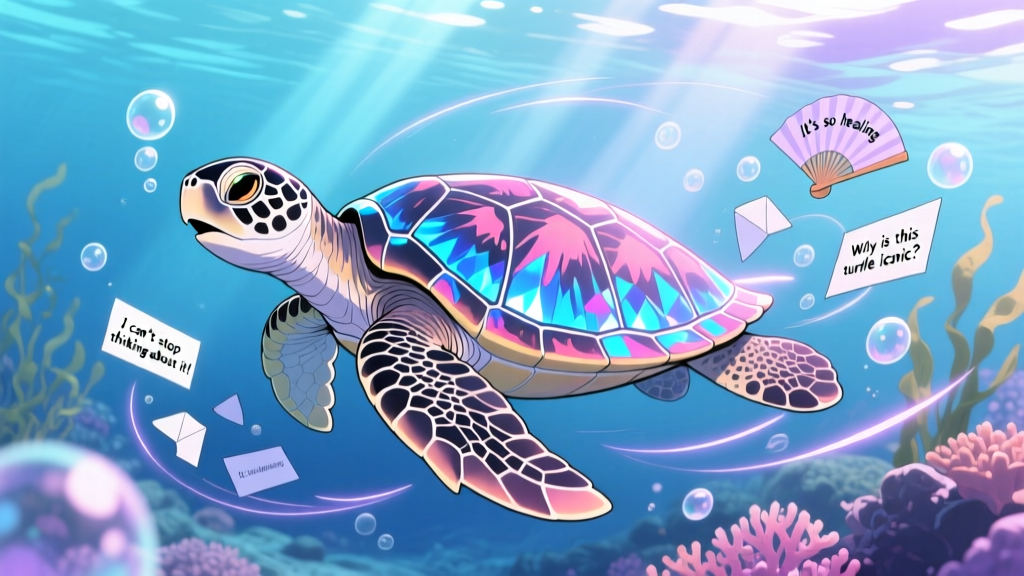
Crush, the 150-year-old green sea turtle voiced by director Andrew Stanton himself, glides through Finding Nemo (2003) on the East Australian Current with the energy of a surfer who has genuinely seen everything and decided none of it matters as much as a good wave. His dialogue is sparse — maybe four minutes of screen time total — but the character design and vocal performance created an outsized impression. Crush has his own fan following, particularly among viewers who were children in 2003 and are now adults processing the realization that a sea turtle gave better parenting advice ("You never know when you're ready — you just do") than most human characters in the film.
Squirt, Crush's son, occupies a smaller but notable role. The scene where Squirt launches himself out of a jellyfish swarm and casually says "Aw, dad" before being swept into the current became a generational comfort moment. A 2021 TikTok trend saw users pairing Crush's parenting style with lo-fi music and childhood nostalgia — the video collection tagged #crushandsquirt reached 45 million views within three months.
The Finding Nemo franchise has generated roughly $1.9 billion in combined box office ($871 million for the 2003 original, $1.029 billion for Finding Dory in 2016), plus an estimated $8 billion in merchandise since 2003, per Disney Consumer Products disclosures. Crush consistently ranks as the third-most-merchandised character from the franchise, behind only Nemo and Dory.
Franklin the Turtle: The Quiet Canadian Who Started It All
For a generation of Canadian and American children, Franklin — the green turtle from Paulette Bourgeois' book series, first published in 1986 — was the first turtle character they ever loved. The animated series Franklin (1997–2004, Nelvana) ran for six seasons and 78 episodes, reaching over 150 countries in syndication. Franklin had no weapons, no bandana, no mutant origin story. He learned to tie his shoes, made friends with a bear, and occasionally got lost. The character's appeal was radical simplicity.
Fandom around Franklin tends toward nostalgia rather than crush, but the overlap is worth noting: several TMNT fan artists have cited Franklin as their gateway turtle character. The pipeline from "Franklin is comforting" to "Raphael is emotionally complex" is shorter than most people assume.
Torterra, Torkoal, and the Pokémon Turtle Line
Nintendo's Pokémon franchise has produced its own turtle-themed characters, and the fan attachment patterns mirror the TMNT crush phenomenon in fascinating ways. Torkoal, the Coal Pokémon introduced in Generation III (2002), has a dedicated following that created the hashtag #torkoalappreciationday, which trends annually on August 8. Torterra, the final evolution of Turtwig (Generation IV, 2006), carries an entire ecosystem on its back and has appeared on over 40 million licensed merchandise units worldwide, according to The Pokémon Company's 2023 licensing report.
The Pokémon turtle line occupies a different emotional space than TMNT — these are creatures, not characters with dialogue — but the attachment mechanism is similar: fans project personality onto a shelled form and build community around that projection.
The Turtle Character Landscape: A Comparison
Not all turtle characters occupy the same cultural space. Here is how the major ones stack up against each other across the dimensions that matter for understanding the "crush" phenomenon:
| Character | Franchise / Origin | First Appearance | Est. Merch Revenue | Crush Intensity |
|---|---|---|---|---|
| Leonardo, Raphael, Donatello, Michelangelo | TMNT (Mirage Studios) | 1984 | $6B+ cumulative | Very High |
| Crush | Finding Nemo (Pixar) | 2003 | ~$500M (Nemo franchise total) | Moderate (nostalgia-driven) |
| Squirt | Finding Nemo (Pixar) | 2003 | Bundled w/ Crush | Low-Moderate |
| Franklin | Franklin (Nelvana / books) | 1986 | ~$200M (books + toys) | Nostalgia only |
| Torterra / Torkoal | Pokémon (Nintendo / Game Freak) | 2002 / 2006 | Part of $90B+ franchise | Moderate (creature attachment) |
| Master Oogway | Kung Fu Panda (DreamWorks) | 2008 | Part of $1.8B trilogy | Low (mentor archetype) |
| Tokka / Chompy | TMNT (various media) | 1991 / 2016 | Niche | Low (side characters) |
Shell Collectors: The Merchandise Economy Around Turtle Crushes
Fan crushes are not just emotional states. They are purchasing decisions. The TMNT merchandise ecosystem, valued at roughly $1.2 billion in annual retail sales as of 2024 (License Global), is one of the most diversified in all of entertainment. And a significant portion of that revenue is driven by fans who explicitly cite emotional attachment to specific turtle characters as their motivation for buying.
The collectible tiers break down predictably:
Entry-level ($10–$50). Funko Pop! vinyl figures dominate this range. The TMNT Funko line includes over 30 variants — standard releases, metallic exclusives, convention-only editions. A standard Raphael Funko Pop! retails around $12, but the 2018 Hot Topic exclusive "Metallic Raphael" trades at $85–$120 on the secondary market. Funko's entire TMNT catalog has moved an estimated 8 million units since the line launched in 2013.
Mid-range ($50–$300). NECA's 7-inch action figure line, launched in 2019, targets the adult collector who grew up with the franchise and now wants shelf-worthy pieces. NECA's "TMNT: The Last Ronin" series, based on the IDW comic storyline where Michelangelo is the sole surviving turtle, generated intense emotional response from the fandom — and correspondingly intense sales. The Michelangelo Last Ronin figure, priced at $65 at retail, sold out within 72 hours of its first wave and now trades at $180–$250 sealed.
Premium ($300–$2,500). Sideshow Collectibles and XM Studios produce polystone statues in the $400–$1,200 range. The XM Studios "TMNT vs. Shredder" diorama, released in 2022 at $899, sold out its 500-unit limited edition in under a week. On the secondary market, sealed copies have crossed $1,800. These buyers are not children. They are adults who have been fans for decades and have the disposable income to match their emotional investment.
Grail-level ($2,500+). Vintage Playmates figures from 1988–1992 in graded condition. A CGC-graded Mirage Studios TMNT #1 (1984) in 9.6 condition sold for $52,500 at Heritage Auctions in 2024. The overlap between comic-grade collectors and "turtle crush" fans is small but real — some fans buy high-end collectibles as expressions of the same attachment they express through fan art and social media posts.
The Crush-from-Finding-Nemo merchandise market operates on a smaller scale but follows the same pattern. Plush toys of Crush, typically priced $15–$30 at Disney parks, are consistent sellers. A limited-edition "Sea Turtle Crush" Spirit Jersey released at Disneyland in 2022 (retail $80) resold for $200+ on Mercari within weeks. Disney does not break out per-character merchandise revenue, but Crush's presence in parks — he appears as a float in the "Pixar Play Parade" and as a meet-and-greet character at Disney California Adventure — indicates that the studio views him as a secondary-tier IP asset with durable appeal.
Mutant Mayhem and the Next Wave of Turtle Fandom
In August 2023, Paramount released Teenage Mutant Ninja Turtles: Mutant Mayhem, directed by Jeff Rowe and produced by Seth Rogen. The film grossed $181 million worldwide against a $70 million budget — respectable, not explosive — but its cultural impact exceeded its box office. The animation style, which blended 2D sketch aesthetics with 3D rendering, looked like fan art come to life. The turtles were voiced by actual teenagers (Nicolas Cantu, Micah Abbey, Shamon Brown Jr., and Brady Noon), and their dialogue carried an improvisational, overlapping cadence that felt more authentic than any previous iteration.
The fandom response was swift. In the three months following the film's release, TMNT-tagged content on TikTok increased by 340%, according to data from social analytics firm Sprout Social. Fan art of the Mutant Mayhem character designs — particularly the more angular, graffiti-influenced Raphael — flooded Instagram and Twitter. A sequel, Mutant Mayhem 2, was confirmed in July 2023 before the first film had even left theaters, and a Paramount+ series titled Tales of the Teenage Mutant Ninja Turtles premiered in August 2024.
What Mutant Mayhem demonstrated is that the sea turtle crush is not a static phenomenon. Each new generation of media reinvents which turtle fans attach to and why. The 1987 cartoon made Michelangelo the breakout star. The 2003 series shifted focus to Raphael's emotional depth. The 2012 Nickelodeon show gave Donatello his moment. And Mutant Mayhem, with its genuine teenage voices and street-level aesthetic, seems to be producing a Leonardo renaissance — a leader who stammers, doubts himself, and still steps forward. That version of the character is generating a new wave of fan attachment that looks, to anyone who has been watching this fandom for a decade, exactly like a crush.
"We didn't set out to make a turtle that people would have a crush on. We set out to make a turtle that felt like a real teenager. Turns out those are the same thing."
Frequently Asked Questions About Turtle Character Crushes
Which TMNT character has the biggest fan following?
Raphael. Across virtually every metric — fan art volume, subreddit subscriber counts, Tumblr post engagement, merchandise sales data from Playmates and NECA — Raphael consistently leads. His combination of aggression, loyalty, and emotional vulnerability maps onto what fans describe as the most "crushable" personality type. Donatello typically ranks second, with Leonardo and Michelangelo alternating for third depending on which media iteration is currently in the cultural spotlight.
Is "sea turtle crush" just about TMNT?
No, but TMNT dominates the conversation. The term also applies to fan attachment toward Crush from Finding Nemo, Pokémon turtle characters like Torterra and Torkoal, and occasionally even Master Oogway from Kung Fu Panda. The emotional texture differs — Crush inspires nostalgia and comfort, Oogway inspires reverence, Pokémon turtles inspire creature-collection attachment — but the shared denominator is a shelled character that fans feel protective toward or drawn to.
What is the most valuable TMNT collectible?
The single highest-value item is a CGC-graded copy of Eastman and Laird's Teenage Mutant Ninja Turtles #1 (Mirage Studios, May 1984). A CGC 9.6 copy sold for $52,500 at Heritage Auctions in 2024. Among toys, a sealed 1988 Playmates Raphael in AFA-graded condition has crossed $4,200. The rarest modern collectible is the XM Studios "TMNT vs. Shredder" polystone diorama (2022), limited to 500 units at $899 retail, now trading above $1,800.
Why are turtle characters so popular with fan artists?
Three factors. First, the visual design is simple and distinctive — round shells, bold bandana colors, expressive faces — which lowers the barrier to entry for artists at all skill levels. Second, there are four main turtles, which gives artists multiple subjects within a single franchise. Third, the franchise's forty-year history provides an enormous reference library spanning multiple art styles, from the gritty Mirage comics to the bright 1987 cartoon to the sketch-influenced Mutant Mayhem designs. DeviantArt alone hosts over 1.2 million TMNT-tagged works.
How big is the Finding Nemo merchandise market for Crush specifically?
Disney does not publicly break down per-character merchandise revenue, but Crush consistently ranks as the third-most-merchandised Finding Nemo character behind Nemo and Dory. Plush toys, Spirit Jerseys, Loungefly mini-backpacks, and pin sets featuring Crush sell reliably at Disney parks and through the Disney Store. The total Finding Nemo franchise merchandise revenue is estimated at approximately $8 billion cumulatively since 2003 (Disney Consumer Products), with Crush likely accounting for 8–12% of that figure based on shelf-space allocation and product assortment data.
Will the "sea turtle crush" phenomenon fade?
Unlikely in the near term. The TMNT franchise has a confirmed roadmap extending through at least 2027, including Mutant Mayhem 2, the Tales of the Teenage Mutant Ninja Turtles streaming series, and new video game projects from Dotemu. Each new release generates a fresh wave of fan content and emotional engagement. As long as studios keep producing media where turtle characters display vulnerability, humor, and emotional complexity, the fan crush phenomenon will keep regenerating. It has already survived four decades of franchise reboots, tonal shifts, and generational audience changes. That is not a fad. That is a structural feature of how audiences relate to these characters.
Somewhere right now, someone is drawing Raphael in a hoodie, sitting on a rooftop, looking at the stars. They have been doing this since 1984. They will keep doing it. The shell is armor, but the fandom — the crush — lives in the space underneath.