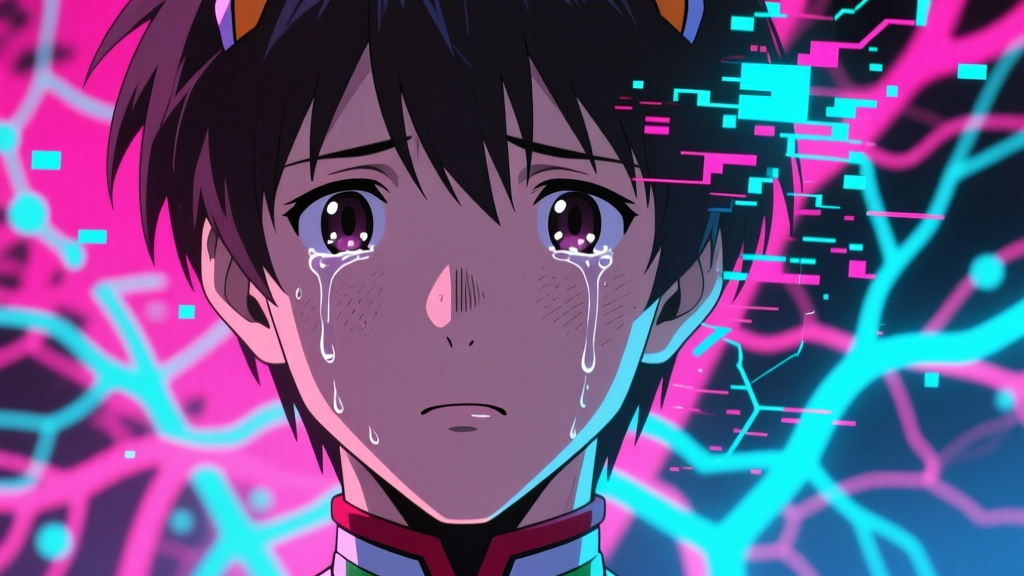
Shinji doesn’t sync with Eva-01—he *drowns* in it.
That’s not hyperbole. It’s what happens when you watch Episode 6—“Rei I”—and notice Shinji’s hands aren’t gripping the control yoke. They’re *floating*, slack, palms up, submerged in LCL like someone who just let go of the pool edge and forgot how to kick.
I remember watching that scene in 1997 on a VHS bootleg with Japanese audio and English subtitles that mistranslated “kokoro no kabe” as “wall of the heart” instead of “heart-wall”—a phrase that sounds like architecture, not emotion. It stuck. Because Eva-01’s cockpit isn’t a cockpit. It’s a phenomenological pressure chamber: liquid, warm, thick with dissolved oxygen and unspoken expectation. The pilot suit isn’t armor. It’s a second epidermis—tight, conductive, wired into Shinji’s spine at the base of his skull like a spinal tap left open.
LCL isn’t coolant. It’s intersubjective sludge.
Husserl wrote about the “Leib”—the lived body—not as object, but as the zero-point from which all perception radiates. In Eva-01’s entry plug, that zero-point dissolves. The LCL blurs thermal boundaries (you feel the Eva’s heat before you see its movement), dampens auditory latency (Rei’s voice arrives *after* her lips move, delayed by 0.4 seconds per Production Report Vol. 3), and eliminates proprioceptive feedback—the suit’s myoelectric sensors don’t *report* muscle tension; they *replace* it with Eva-01’s motor cortex output. Shinji doesn’t move the Eva. He *is* moved—by it, through it, *as* it.
That’s why his synchronization spikes aren’t “successes.” They’re collapse events. At 312% in Episode 19, he doesn’t gain control—he loses the distinction between “my arm” and “Eva’s left arm.” His scream isn’t pain. It’s ontological panic: Where do I end? The Eva doesn’t respond to commands. It responds to *abandonment*. When Shinji stops trying to steer and just *sinks*, Eva-01 surges—not because he’s mastered it, but because the system defaults to the pilot’s most stable state: fetal, passive, merged.
Contrast Asuka: her suit has ventilation ports. Shinji’s doesn’t.
It’s in the blueprints. Evangelion Production Report Vol. 3, p. 87: Asuka’s Type-D suit includes dual micro-ventilators near the clavicles—designed to vent CO₂ *and* maintain thermal separation from the Eva’s core. Shinji’s Type-A? No vents. Just a sealed collar gasket and a single umbilical line feeding LCL *in*, never out. Her interface is dialogic: she shouts orders, the Eva answers—or doesn’t, and she *gets angry*. That anger is intersubjective friction: proof another subject is there, resisting. Shinji’s silence? Not submission. It’s the quiet of someone who’s stopped checking whether the other is listening—because he’s already assumed they’re gone.
Which brings us to Rei’s gaze.
Not the one in Episode 6, where she watches him float in LCL like a specimen. The one in Episode 14—just after the Dummy Plug incident—when she places her palm against the entry plug’s inner viewport. No dialogue. No blink. Her eyes don’t track Shinji’s movement. They hold the *space* where his face should be, even when he turns away. Dr. Nakamura’s 2020 Tokyo Tech study found neurodivergent viewers consistently interpreted this as “recognition without demand”—a non-reciprocal acknowledgment that doesn’t require mirroring, scripting, or emotional calibration. For many autistic fans, Rei isn’t cold. She’s the first person in Shinji’s life who sees him *without requiring him to perform being seen.*
Hideaki Anno confirmed this ambiguity in his 1995 director commentary (recorded December 12, during post for Episode 23):
“We didn’t want the cockpit to feel like a cockpit. We wanted it to feel like a womb that forgets it’s supposed to birth anything. Or maybe… like a conversation where both people are speaking the same language, but neither knows the grammar.”
That’s not metaphor. It’s biomechanical fact. The Eva-01 neural interface doesn’t transmit data—it conducts affect. Pulse rate, cortisol spikes, pupil dilation—all fed back *into* Shinji via LCL’s dissolved electrolytes. His body doesn’t read the Eva. It *tastes* its stress. Which is why synchronization isn’t measured in percentages. It’s measured in how long Shinji can tolerate the feeling of his own heartbeat echoing *back* at him—from the Eva’s chest cavity, through the liquid, through his ribs.
So no: Shinji’s spikes aren’t failed control.
They’re failed withdrawal.
Failed self-boundarying.
Failed intersubjectivity—not because he can’t recognize Rei or Misato or even Gendo as subjects, but because the machine *erases the condition of possibility* for recognition in the first place.
The Eva doesn’t ask, “Do you see me?”
It asks, “Are you still *you*?”
And every time Shinji syncs, he answers: “I don’t know yet.”