What does it mean to say “I am me” when the world has already erased your name?
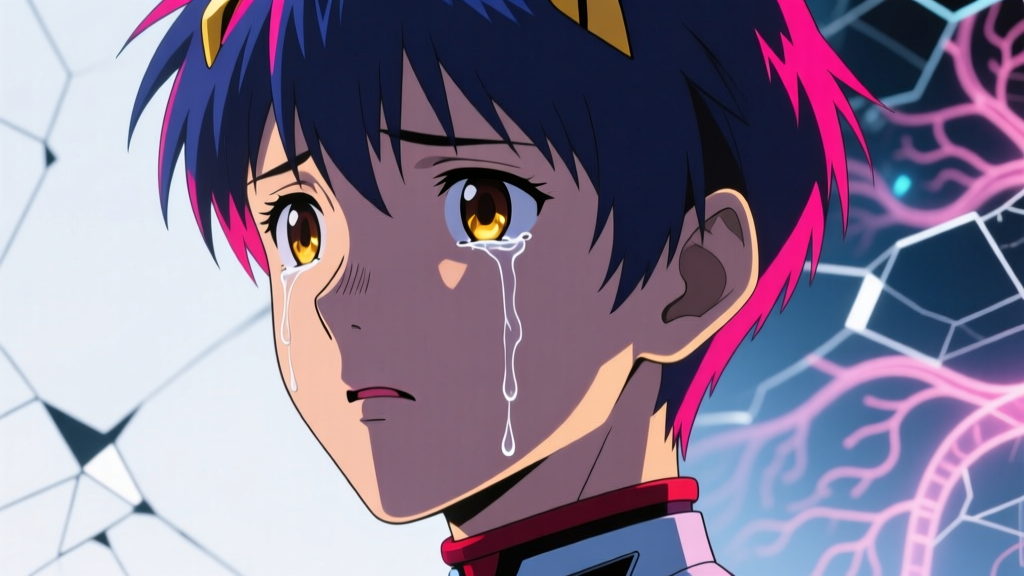
In The End of Evangelion (1995), Shinji Ikari screams those words—not as a declaration, but as a raw, guttural rupture. His voice cracks. His face is slick with tears and snot. He’s kneeling in the LCL sea, surrounded by floating faces—Rei, Asuka, Misato, his mother—each one a mirror, each one a demand. “I am me.” It’s not triumphant. It’s desperate. It’s the first time he’s ever spoken his own existence *into* reality, rather than waiting for someone else to confirm it.
Twenty-six years later, in Evangelion: 3.0+1.0 Thrice Upon a Time (2021), Shinji says nothing at all. He sits on a quiet hillside outside the rebuilt village of Katsuragi. Mari offers him tea. Asuka sits beside him—not touching, but present. He looks down at his hands. A tear falls. Then another. He nods—just once—and that’s it. No monologue. No metaphysical sea. No choir of ghosts. Just silence, sunlight, and the faint sound of wind through barley stalks.
Fans call it healing. Critics call it closure. Khara Studio calls it “a gentle ending.” But what if it’s neither? What if that nod isn’t resolution—it’s exhaustion so deep it’s indistinguishable from peace?
The LCL Sea Was Never a Metaphor. It Was a Diagnosis.
In 1995, Instrumentality wasn’t abstract theology. It was clinical collapse made visible. The LCL sea—a viscous, warm, breathing ocean of collective unconsciousness—was Hideaki Anno’s direct translation of what happens when trauma exceeds containment: the self dissolves not into transcendence, but into undifferentiated psychic sludge. You don’t become godlike; you become *unmoored*. You lose the boundary between “I” and “you,” between memory and hallucination, between grief and hunger. That’s why Shinji’s refusal matters: it’s not philosophical dissent. It’s a neurological act of reclamation—the moment his prefrontal cortex wrestles back control from the amygdala.
Watch episode 26 again—not the TV version, but EoE. When Shinji rejects Instrumentality, he doesn’t just reject merging. He rejects the fantasy that erasing difference will erase pain. He chooses *fracture*, because fracture means he can still *feel* Asuka’s hand, even if she won’t hold it. He chooses imperfection, because imperfection means he might still be worthy of love—not as an idealized son or pilot, but as a trembling, selfish, contradictory boy who once ran away and once came back.
I remember watching that scene in 1996, age 14, rewinding VHS tapes until the tape stretched thin. I didn’t understand Freud or Lacan, but I understood Shinji’s scream. It sounded like mine.
Khara’s Austerity Isn’t Minimalism. It’s Amputation.
By 2021, the LCL sea is gone. Not transformed. Not reimagined. Erased. In 3.0+1.0, Instrumentality is replaced by a quiet, pastoral dissolution—Shinji and Asuka walking hand-in-hand across a field of wheat, their Eva units gently disintegrating into light. There’s no sea. No voices. No confrontation with the dead. Even Kaworu appears only as a flicker—not as a challenge to Shinji’s autonomy, but as a soft, forgiving echo. The metaphysical stakes are evacuated. The visual language is stripped bare: no grotesque body horror, no surreal distortions, no layered superimpositions. Just clean lines, muted palettes, and long, unbroken takes.
This isn’t artistic evolution. It’s symptom management.
In a 2020 interview with Real Sound, Anno described himself as suffering from “kanjō teishi”—emotional bankruptcy. Not depression. Not burnout. Bankruptcy: a depletion so absolute there’s nothing left to spend—not energy, not metaphor, not even the will to dramatize pain. He said, “I no longer have the strength to show suffering. So I show its absence.” That line haunts 3.0+1.0. Every frame feels like a concession—not to hope, but to survival.
Which makes Shinji’s nod less a choice and more a cessation. He doesn’t choose humanity. He stops resisting its weight.
Resignation Is Not Remission. And That Matters.
Clinically, this distinction is precise—and devastating. According to the DSM-5-TR (p. 312), complex PTSD remission involves observable functional improvement: sustained regulation of affect, capacity for reciprocal relationships, reduced hypervigilance, and *volitional engagement* with life—even amid residual symptoms. Remission includes agency. It includes risk. It includes saying “I want” instead of “I’ll try.”
Resignation looks different. It’s flat affect masking emotional exhaustion. It’s compliance without investment. It’s the relief of surrender dressed up as serenity. Resignation doesn’t require integration of trauma; it requires only that the trauma stop *demanding*. And in 3.0+1.0, Shinji is no longer being demanded of—at least not visibly. The Angels are gone. NERV is dismantled. Gendo is dead—not as a villain, but as a spent man who apologizes, then vanishes. Even Asuka’s anger is softened, folded into weary patience. The world has stopped shouting. So Shinji stops fighting—not because he’s healed, but because he’s finally, utterly, out of breath.
Consider the final sequence: Shinji helps rebuild the village school. He carries lumber. He sands wood. He smiles—small, infrequent, never reaching his eyes. There’s no scene where he initiates contact with Asuka. No confession. No reckoning with what he did to her in Terminal Dogma. No acknowledgment that he abandoned her *twice*: once in the void of Instrumentality, once in the real-world neglect of the 14-year gap. Their reunion isn’t earned; it’s permitted. She meets him halfway—not because he’s changed, but because *she* has decided, alone, to extend grace.
This isn’t reciprocity. It’s asymmetry disguised as balance.
Why the Silence Feels Like a Betrayal to Some Fans
For viewers who grew up with EoE, Shinji’s silence in 3.0+1.0 doesn’t read as mature restraint. It reads as erasure—of his voice, his rage, his unfinished grief. In EoE, Shinji’s climax is preceded by *Asuka’s* breakdown: her violent, animalistic rejection of Instrumentality (“I don’t want to disappear!”), her fight to preserve her singularity even as her body unravels. That scene gives Shinji’s “I am me” its gravity—it’s not solitary. It’s part of a duet of resistance. Without it, his statement floats, untethered.
In 3.0+1.0, Asuka’s agency is muted. Her final line—“Idiot… you’re still here”—is tender, yes, but also profoundly passive. She doesn’t say, “I chose you.” She says, “You’re still here.” Which implies contingency, not commitment. And Shinji doesn’t respond. He nods. That nod becomes the entire emotional payload of the film—yet it carries no linguistic weight, no syntactic complexity, no contradiction. It’s the ultimate reduction: a single neural impulse masquerading as resolution.
This is why fans argue over whether 3.0+1.0 is hopeful or hollow. It depends on whether you believe peace requires presence—or merely the absence of crisis.
Anno Didn’t Give Us Growth. He Gave Us Witness.
There’s power in that. Not every story must conclude with triumph. Not every survivor must narrate their recovery. Sometimes, the most honest thing art can do is show what comes after the last scream fades: the dull thud of daily life resuming, the way light falls differently on a quiet morning, the unbearable lightness of not having to decide, for once, whether to stay or go.
But we must name it correctly. This isn’t the Shinji who *chose* humanity in 1995. That Shinji fought for the right to be flawed, to be seen, to be *interrupted*. The Shinji of 2021 doesn’t fight. He waits. He receives. He accepts.
And perhaps that’s okay—not as an endpoint, but as a document. Anno didn’t write a sequel. He wrote an epilogue to his own exhaustion. And in doing so, he gave us something rarer than catharsis: permission to rest without calling it healing.
That matters. Especially now.
Because if Shinji’s nod teaches us anything, it’s this: sometimes, the bravest thing a traumatized person can do isn’t speak—but simply let the silence hold them, without apology, without explanation, without the burden of meaning.
That silence isn’t empty.
It’s full of everything he couldn’t say.