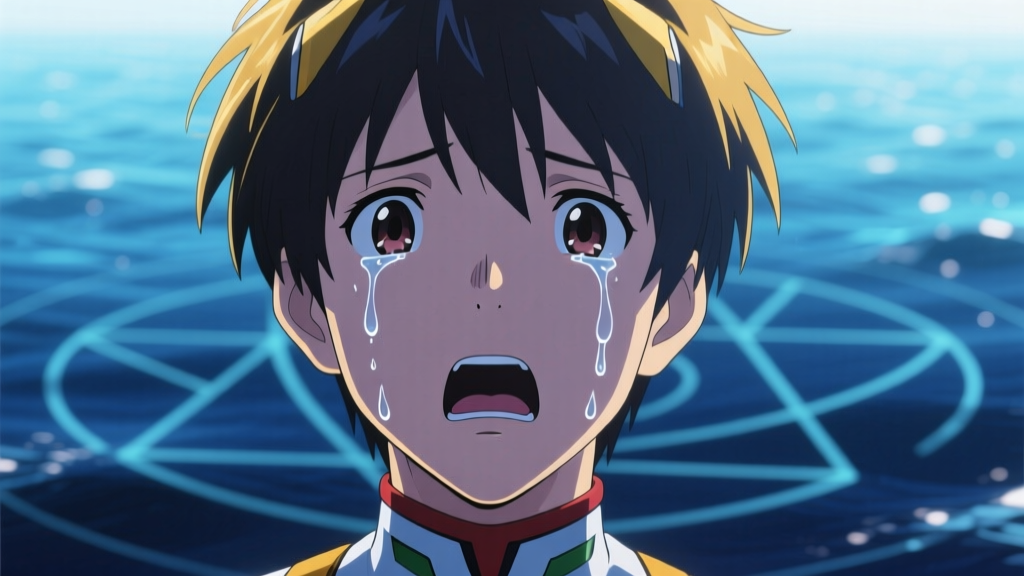
“I don’t want to be whole.”
Shinji Ikari says it plainly in Evangelion: 3.0+1.0 Thrice Upon a Time—not as a cry, not as a stutter, but as a quiet, grounded statement, delivered while kneeling barefoot on sun-warmed grass, hands resting loosely on his thighs. He’s just stepped out of Instrumentality—not as a triumphant return, but as an exit. This line isn’t the culmination of a Jungian hero’s journey toward “individuation.” It’s its demolition.
I remember watching the 1995 TV ending—the claustrophobic close-ups, the pulsing red void, Shinji’s voice dissolving into overlapping whispers (“I am me… I am Shinji…”), the mandala-like symmetry of the final frames. At the time, it felt like revelation: ego surrendering to collective unconscious, shadow integrated, self made whole. But rewatching it now—especially after Hideaki Anno’s 2021 NHK documentary The End of the World is Inside You—that resolution feels less like healing and more like sedation. Anno tells the camera, straight-faced: “The original ending was about escaping pain by dissolving the self. In 2021, I wanted to ask: what if escape isn’t the answer? What if staying broken—and choosing to stay—is the bravest thing?”
That shift is anatomized in Shinji’s body. In Episode 26 of the TV series, his posture collapses inward—knees drawn up, arms wrapped tight, face buried. His vocal timbre flattens, losing pitch variation; he speaks in near-monotone, as if the self has already begun liquefying into the group psyche. Contrast that with the final scene of Thrice Upon a Time (Chapter 84, “The World That Is”). Shinji sits upright—not rigid, not performative, but *present*. His shoulders are relaxed but open; his breath is audible, uneven at times, but never suppressed. When he says “I don’t want to be whole,” his voice dips slightly on “whole”—a micro-pause, almost a flinch—not because he’s rejecting integration, but because he’s rejecting the *demand* to integrate. The word carries weight, not shame.
This is where Jung stumbles—and where Freud, surprisingly, gets closer to the truth. Scholar Yoko Nishimura, in her 2018 essay “Neon Genesis Evangelion and the Unfinished Self,” argues that the TV ending misreads Freud’s concept of the ego as something to be *transcended*, rather than *fortified*. She points to Freud’s late work in The Ego and the Id: “The ego is first and foremost a bodily ego… it is not merely a surface entity, but is itself the projection of a surface.” Shinji’s 1995 dissolution violates that principle—it evacuates the bodily ego entirely. His “wholeness” is disembodied, abstract, mandalic—a perfect circle of unity that erases friction, contradiction, and skin.
And that’s why the absence of mandala imagery in Thrice Upon a Time matters so much. No symmetrical compositions. No recursive geometry. No golden ratios framing Shinji’s face. Instead: asymmetrical shots—off-center framing in the Wunder’s cockpit; shallow focus on Rei’s hand brushing dirt off Shinji’s shoulder; a wide, uncomposed shot of the new world’s coastline, where the horizon tilts slightly, deliberately imperfect. Khara’s art direction doesn’t avoid symbolism—it refuses *Jungian* symbolism. The mandala promised wholeness through containment. Here, meaning leaks out at the edges.
Consider the sequence where Shinji walks away from the Instrumentality sphere—not toward anyone, not toward a goal, but *alongside* Asuka, who walks silently beside him, not holding his hand, not looking at him, just sharing the same pace and direction. There’s no dialogue for 47 seconds. Their footsteps sync, then drift apart, then sync again. This isn’t individuation—the Jungian process that culminates in the “Self” as a transcendent, archetypal center. This is *relational endurance*: two incomplete people moving in proximity without fusion, without merger, without the pressure to become one symbolic unit. It’s Freud’s “reality principle” reasserted—not as repression, but as commitment.
Even Shinji’s final act—planting the small potted tree—is anti-mandala. A mandala is closed, cyclical, self-referential. A sapling is open-ended, vulnerable, contingent. It may die. It may grow crooked. It requires repeated, unglamorous tending—not a single moment of enlightenment. When Shinji presses soil around its base with his thumbs, his knuckles are scuffed, his nails cracked. His hands are not vessels of cosmic harmony. They’re just hands.
Some fans read this as regression: Shinji “giving up” on growth. But growth isn’t always vertical. Sometimes it’s lateral—choosing a different axis altogether. The TV ending asked, “What if we stopped hurting by becoming everyone?” Thrice Upon a Time asks, “What if we stop hurting by refusing to make our pain someone else’s problem—and by accepting that healing doesn’t mean becoming seamless?”
Anno confirms this in the NHK documentary, describing the 2021 ending not as closure, but as “a door left ajar—not for Instrumentality to return, but for Shinji to walk through it *as himself*, not as a symbol.” That “himself” is deliberately unpolished: uncertain in tone, inconsistent in resolve, physically tired. His refusal isn’t ideological—it’s somatic. It lives in the slump of his lower back when he sits, the way his eyes linger on Asuka’s wristwatch before looking away, the slight rasp in his voice when he says, “I’ll try.” Not “I will.” Not “I understand.” Just: “I’ll try.”
Jung saw individuation as the soul’s telos—the inevitable, sacred drive toward totality. Evangelion’s final evolution says no. Not in anger. Not in despair. But in quiet, stubborn fidelity to the irreducible mess of being alive in a body that aches, hesitates, and chooses—not because it has arrived, but because it’s still here.
That’s not the end of the world.
It’s the beginning of living inside it.