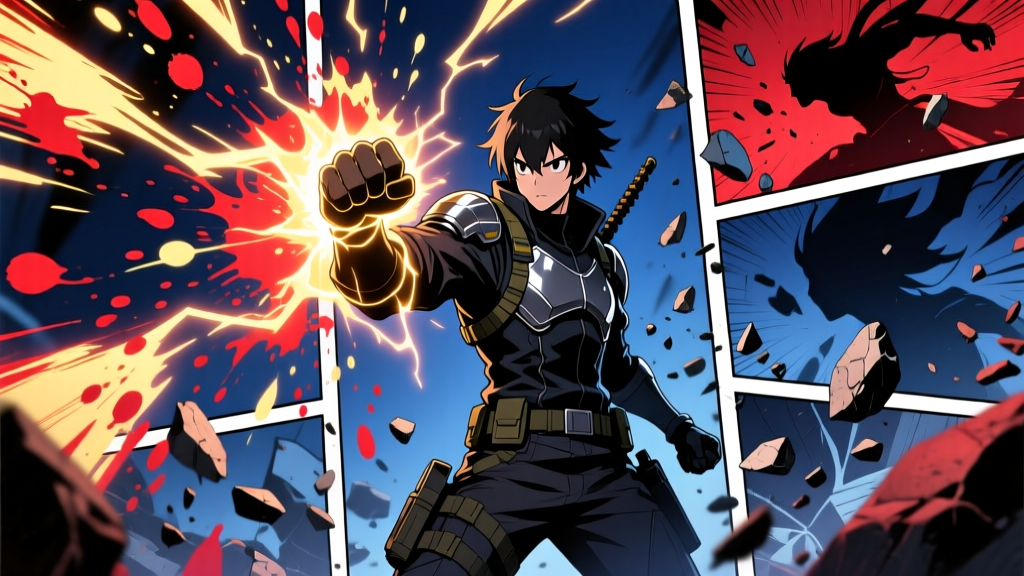
The screen goes black for exactly one-sixteenth of a second. Then a violet shockwave rips across the frame as Sung Jin-Woo's fist connects with the Ant King's jaw, and 2.4 million viewers watching the Crunchyroll simulcast collectively lose their minds. That single frame — a frozen slab of purple light and shattered armor — hit Twitter within forty minutes, accumulated 38,000 retweets by morning, and became the most screenshotted moment in Solo Leveling Season 2's entire run.
That is what an impact frame does. And in Solo Leveling, A-1 Pictures stacked them like ammo crates.
For the uninitiated: an impact frame is a single animation drawing (or sometimes a sequence of two to three drawings held for one to three frames at 24fps) inserted at the exact moment of collision in a fight scene. It is the visual exclamation point of anime combat. Studios like MAPPA made them a brand signature in Jujutsu Kaisen. Bones turned them into art-gallery moments in My Hero Academia. But when A-1 Pictures got their hands on Chugong's hunter-who-became-a-god power fantasy, they approached impact frames with a specific problem that no other major shonen adaptation had faced: how do you animate a protagonist who is, by narrative design, always winning?
The Problem With Animating an Overpowered Main Character
Most fight anime build tension through struggle. Naruto runs out of chakra. Deku breaks his bones. Yuji's punches cost him something physical. Impact frames in those shows land harder because the audience has been made to feel the weight of each hit through accumulated suffering.
Sung Jin-Woo does not suffer. Not after Episode 3, anyway. Once the System awakens and the daily quests start stacking stat points, he moves through dungeons the way a spreadsheet processes formulas — efficiently, relentlessly, and with an increasingly bored expression. This creates an animation problem that director Hirotaka Nakagawa and the A-1 Pictures team had to solve visually rather than narratively.
Their solution was to redirect the spectacle away from whether Jin-Woo wins and toward how completely he dismantles everything in front of him. Impact frames became the primary tool for that redirection. The approach boiled down to three core principles:
- Scale over struggle. Each fight scene was choreographed to build toward one or two signature freeze-frames that communicated raw dominance rather than desperate effort.
- Environment as collateral. The surroundings crack, shatter, and warp in every impact frame, absorbing the violence that Jin-Woo himself shows no reaction to.
- Shadow as witness. Even when the shadow army is not actively fighting, dark silhouettes appear in the periphery of impact frames, as if the Monarch's subjects are watching their king work.
The frame where Jin-Woo catches Igris' blade bare-handed in Episode 8 is not a moment of survival. It is a moment of announcement: this man does not need to dodge.
"The action scenes evolved as the protagonist levels up. We wanted each fight to showcase superhuman feats that the audience physically feels." — Producer Sota Furuhashi, in a 2025 interview with Cocotame.jp about Solo Leveling's production philosophy.
A-1 Pictures' Toolkit: What Made These Frames Hit Different
Frame-by-frame breakdowns uploaded by sakuga analysts on YouTube and Twitter cataloged the specific techniques A-1 deployed across both seasons. Here is what separated Solo Leveling's impact frames from the standard shonen toolkit:
Chromatic Aberration on Contact Points
In traditional impact frames, the point of collision is typically rendered in high-contrast black-and-white or with a single color inversion. A-1 Pictures layered chromatic aberration — the RGB-splitting distortion effect you see in lens flare photography — directly onto Jin-Woo's fists and weapons at the moment of impact. This gave every punch a subtle prismatic halo that read as "digital" in a way that matched the System interface aesthetic. The effect first appeared during the Kasaka fight in Episode 5 and became more pronounced with each arc. By the Beru showdown in Episode 24, the aberration spread across the entire frame for two to three drawings, making the screen itself look like it was glitching under the force.
Shadow-Layered Depth Compositing
The shadow army mechanic gave the animation team a visual resource that no other studio working on a comparable series had access to: sentient darkness. During impact frames in Season 2, particularly in the Jeju Island raid episodes, A-1 layered animated shadow silhouettes behind Jin-Woo in the freeze-frame. These were not static drawings. The shadows shifted and writhed within the held frame — a technique that required compositing animated elements on top of what is normally a still drawing. CG Director Morioka's team reportedly rendered shadow overlays as separate CG passes, then hand-painted detail on top, a hybrid workflow that added roughly 30% more production time per impact frame compared to a standard approach.
Speed Line Dissolution
Classic anime impact frames borrow speed lines directly from manga — straight white streaks radiating outward from the hit point. A-1 Pictures evolved this convention by making the speed lines dissolve into shadow particles before the next frame cuts. The transition lasts approximately two frames (about 83 milliseconds at 24fps), but it creates a visual bridge between the moment of impact and the aftermath, where dark mist always hangs in the air around Jin-Woo. This micro-animation choice made every hit feel like it was being consumed by the Shadow Monarch's power rather than just happening to it.
The numbers behind the spectacle: Across Season 1's 12 episodes, animation analysts counted approximately 47 distinct impact frames. Season 2's 13 episodes pushed that count to an estimated 83, a 76% increase that tracks with the narrative's escalating power ceiling. The Beru vs. Jin-Woo fight alone in Episodes 23-24 contains at least 14 individual impact frame drawings, roughly one every 90 seconds of combat screen time.The Five Frames That Broke the Internet
Not all impact frames carry the same cultural weight. Five specific moments in Solo Leveling's anime run generated outsized fan response, trending globally and spawning edit compilations that pulled millions of views across TikTok and YouTube.
1. The Statue of God's Smile (Season 1, Episode 1)
Technically not a fight-scene impact frame, but the single most analyzed freeze-frame in the entire series. When the giant statue inside the Double Dungeon shifts from a serene expression to a predatory grin, A-1 Pictures held the frame for a full 1.5 seconds — an eternity in animation timing. The face itself is rendered with crosshatched shading that references the manhwa's original pen work, but the eyes glow with an electric blue that does not exist in DUBU's source panels. This frame set the visual vocabulary for everything that followed: shadow black, divine purple, system blue.
2. Jin-Woo Catches Igris' Sword (Season 1, Episode 8)
The fight against the Blood-Red Commander Igris is the first arc where Jin-Woo stops playing defensively and starts treating combat as an expression of authority. The impact frame where he catches Igris' downward slash between his bare palms holds for three frames with a burst of violet light radiating from his fingers. The shadow on the ground beneath him already shows an army of silhouettes kneeling — a visual foreshadowing that most viewers did not catch until their second watch.
3. "Arise" — Igris Shadow Extraction (Season 1, Episode 8)
The moment Jin-Woo speaks the command "Arise" for the first time, the frame inverts entirely. The background becomes black. The foreground becomes black. Only Jin-Woo's eyes and the rising shadow of Igris are rendered in luminous purple. This full-frame inversion lasted four frames — roughly 167 milliseconds — but it became the single most reproduced image in Solo Leveling fan art history. The composition is so simple that it translates cleanly into any medium: digital painting, cosplay lighting rigs, tattoo stencils, phone wallpapers.
4. Job Change Quest: Jin-Woo vs. the Shadow Monarch's Army (Season 1, Episode 11-12)
Across the two-part Job Change arc, A-1 Pictures deployed impact frames at a density they had not attempted previously. Jin-Woo fighting through waves of shadow soldiers required repeated collision moments, and the team varied each impact frame by shifting the color temperature: early hits lean cool blue, mid-fight hits shift toward violet, and the final strike before the Shadow Monarch title is granted explodes in full white-and-purple inversion. This color escalation technique — mapping emotional intensity to hue progression across a fight — was something the series had not attempted in earlier episodes.
5. Jin-Woo vs. Beru, the Ant King (Season 2, Episodes 23-24)
The Jeju Island raid's climactic battle represents the animation team operating at full capacity. Beru is the first enemy in the anime who presents a genuine physical threat to Jin-Woo's post-awakening form, and the impact frames reflect that difference. For the first time, impact frames show both fighters generating shockwaves on contact — Beru's rendered in sickly yellow-green, Jin-Woo's in the established violet-blue. The frame where Jin-Woo drives Beru into the ground, cratering the island's rock formation, uses an aerial perspective with the impact ripple rendered as a full-screen distortion effect. Anime Rants described the sequence as "stunning," and the Reddit thread for Episode 23 accumulated over 4,200 upvotes within the first hour, with the dominant comment simply reading: "They did not miss."
How the Anime Frames Stack Up Against DUBU's Manhwa Panels
Any adaptation of a visually iconic source material invites comparison, and Solo Leveling had it both harder and easier than most. Harder because DUBU (the pen name of artist Jang Sung-Rak, who passed away in July 2022) created panels so dynamically composed that they already read as freeze-frames — several Reddit comparison threads showed that the manhwa's splash pages could be dropped directly into the anime with minimal adjustment. Easier because those same panels provided the animation team with precise composition blueprints.
The anime diverged from the manhwa in specific, deliberate ways when it came to impact frames:
| Element | DUBU's Manhwa Panels | A-1 Pictures Anime Frames |
|---|---|---|
| Color palette on impact | High-contrast black and white with occasional red accents | Signature violet-blue with chromatic aberration layering |
| Speed lines | Traditional radial manga lines from a single vanishing point | Dissolving shadow-particle lines that fade into dark mist |
| Shadow army depiction | Flat black silhouettes with white eye glows | Multi-layered CG shadows with animated movement within held frames |
| Facial expressions during impact | Intense, teeth-clenched, effort visible | Cold, controlled, minimal expression — dominance coded |
| "Arise" command visual | Single panel, black background, purple eyes, smoke rising | Full-frame color inversion, 4-frame duration, luminous purple rendering |
| Environmental destruction | Static crack patterns on ground and walls | Animated debris with physics-based particle simulation |
The most significant departure was the emotional register of Jin-Woo's face during impact frames. DUBU drew him with visible strain during the Igris fight and genuine fury during the Beru fight. A-1 Pictures made a conscious decision to render him as almost bored during mid-tier encounters and quietly intense during boss-level fights. This was a narrative animation choice: the audience already knows he is going to win, so the pleasure comes from watching him win with the calm authority of someone filing paperwork. The impact frames communicate violence; the expression communicates indifference to that violence. That gap is where the hype lives.
Some manhwa readers pushed back on this choice. The Reddit thread "Anime vs Manhwa Comparison" from July 2024 cataloged specific panels where fans felt the anime drained emotional weight from Jin-Woo's reactions. The counterargument — and the one that ultimately won out in fan consensus — was that the anime's restraint made the rare moments of visible emotion hit exponentially harder. When Jin-Woo's expression finally cracks during the Beru fight in Episode 24, the impact frame on his face alone (no fist, no weapon, just eyes widening slightly) became a meme template within hours.
The Fan Art Machine: How Impact Frames Became Content
Something unusual happened with Solo Leveling's impact frames that did not happen with comparable series like Jujutsu Kaisen or Demon Slayer: the impact frames themselves became the primary unit of fan creation, rather than character designs or scene compositions.
The reason is structural. Solo Leveling's impact frames are visually simple in a way that invites reproduction. The "Arise" frame is two colors and a silhouette. The Igris sword-catch frame is two hands and a blade and a light burst. This simplicity lowers the barrier to entry for fan artists while still being recognizable enough to signal fandom membership. A search on Instagram and Twitter for "Solo Leveling impact frame" returns thousands of pieces of fan art, ranging from polished digital paintings with 50,000-plus likes to rough Procreate sketches posted by hobby artists practicing their anatomy.
The cosplay community picked up the visual language too. Impact frame recreations — where cosplayers use LED strips, colored smoke, and post-production editing to replicate the anime's freeze-frame aesthetic — became a distinct subgenre on TikTok. The hashtag #SoloLevelingImpactFrame accumulated over 180 million views by early 2026, with creators developing increasingly elaborate techniques:
- UV-reactive paint applied to costumes to replicate the purple glow under blacklight conditions at conventions
- Arduino-controlled LED arrays sewn into jacket linings, timed to match the anime's specific frame durations when triggered by a button press
- Blender compositing in post-production to insert animated shadow army silhouettes behind the cosplayer, matching the CG overlay technique A-1 used in Season 2
- Procreate frame-by-frame animation layered over live-action footage, turning a backyard video into a full impact frame edit
The edit community — the AMV and "anime edit" crowd that drives a significant percentage of anime discovery on short-form video platforms — treated Solo Leveling's impact frames as raw material. A typical edit isolates a single impact frame, time-stretches it using optical flow interpolation to create a slow-motion approach, drops the beat of a phonk or trap track on the exact frame of contact, and then cuts to the next impact frame on the next beat. This format became so standardized that it spawned its own sub-meme: creators posting mundane daily activities (opening a fridge, catching a bus) edited with Solo Leveling impact frame effects layered on top.
Why This Matters for the Industry
The fan art ecosystem around impact frames has measurable economic consequences. Aniplex, the production committee lead for Solo Leveling, has leaned directly into this culture by releasing official impact frame stills as promotional material within hours of each episode airing. These official stills are formatted and sized specifically for social media sharing — a deliberate strategy that treats fan virality as a distribution channel rather than a side effect. Producer Atsushi Kaneko acknowledged in a June 2025 interview with Awards Radar that the team was aware of how specific frames would circulate: "The result is beyond words," he said, referring to the global response to the animation.
This represents a shift from how studios treated iconic frames even five years ago. The production model for Solo Leveling treats impact frames not as byproducts of fight choreography but as deliberately designed shareable assets. Each frame is composed to read clearly at phone-screen resolution, to work without surrounding context, and to invite fan reinterpretation. That is a fundamentally different creative brief than "make the fight look cool."
The Technical Cost of Looking This Good
Behind every polished impact frame is an animator working overtime — sometimes literally, sometimes contractually. The production of Solo Leveling's impact frames required specific staffing decisions that reveal how much A-1 Pictures invested in these moments.
Key animator Yonezawa, credited on multiple episodes across both seasons, was reportedly assigned to impact frame sequences specifically. In the anime production pipeline, impact frames are typically handled by the most experienced key animators on staff because they require precise understanding of timing, anatomy under distortion, and color theory. A single poorly drawn impact frame — wrong perspective, muddy color palette, incorrect limb proportion — reads instantly to the audience and can generate negative attention that outlasts the episode itself.
Animator Kikuchi, also credited in production notes, was tasked with adjusting action scenes to match the timing of the Japanese voice acting. This is not standard practice for most anime productions, where voice recording and animation often run on parallel but independent schedules. For Solo Leveling, the team synced impact frame timing to the exact vocal delivery of lines like "Arise" and battle cries, which meant that animation corrections had to happen after voice recording was complete — a workflow that compressed the animation team's schedule significantly.
Producer Furuhashi noted in the Cocotame interview that the team was acutely aware of production time constraints: "We need to create more time," he stated, referring to the gap between production ambition and calendar reality. The fact that the impact frames maintained their quality across both seasons — and actually improved in density and complexity from Season 1 to Season 2 — suggests that Aniplex allocated budget and schedule priority to these moments specifically, likely at the expense of less flashy sequences in transitional episodes.
What Happens Next: Season 3 and Beyond
With Season 2 concluding in March 2025 and Season 3 confirmed, the impact frame trajectory points in one direction: escalation. The source material's later arcs introduce fights that dwarf the Jeju Island raid in both scale and visual complexity. The Monarchs' War arc features battles between god-tier entities where entire dimensions crack. The final confrontation with the Absolute Being involves combat that takes place across multiple planes of existence simultaneously.
Animating those fights will require A-1 Pictures to push their impact frame techniques further than they have gone so far. If the chromatic aberration technique evolves from a localized fist effect to a full-environment distortion, and if the shadow compositing expands to include the full army of millions that Jin-Woo commands by the end of the manhwa, the production demands will be staggering.
But that is the deal the studio made when they chose to animate Solo Leveling as a spectacle-first power fantasy. The audience does not come for the plot twists — everyone reading the manhwa already knows what happens. They come for the frame where Jin-Woo's fist meets a Monarch's face and the screen explodes in purple light for exactly one-sixteenth of a second. That fraction of a second is what gets screenshotted, shared, redrawn, cosplayed, memed, and debated. That is the currency of modern anime spectacle, and A-1 Pictures has been printing it in bulk.
Solo Leveling Impact Frames: Common Questions
What exactly is an impact frame in anime?
An impact frame is a single animation drawing (or a short sequence of two to three drawings) inserted at the precise moment of contact in a fight scene. Held on screen for one to three frames at the standard 24 frames per second, it functions as a visual exclamation mark — emphasizing the force of a hit, a block, or a collision. In Solo Leveling, impact frames are distinguished by their violet-blue color palette, chromatic aberration effects, and shadow-particle dissolving speed lines.
Which Solo Leveling fight has the most impact frames?
The Jin-Woo vs. Beru (Ant King) battle across Season 2, Episodes 23 and 24, contains the highest density of impact frames in the series — an estimated 14 distinct drawings across roughly 20 minutes of combat screen time. The Job Change arc in Season 1, Episodes 11-12, ranks second with approximately 11 impact frames spread across the two-part fight against the Shadow Monarch's army.
Did A-1 Pictures change the impact frames from what DUBU drew in the manhwa?
Yes, in deliberate ways. The manhwa panels use high-contrast black and white with red accents during impact moments, following traditional manga visual language. A-1 Pictures replaced this with their signature violet-blue palette, added chromatic aberration effects, and changed Jin-Woo's facial expressions from strained effort to cold dominance. The core compositions of many impact frames follow DUBU's original panel layouts closely, but the color, texture, and emotional register differ significantly.
Why do Solo Leveling impact frames generate so much fan art compared to other anime?
Two structural reasons: visual simplicity and recognizability. The "Arise" frame uses only two colors and a silhouette. The Igris sword-catch frame is hands, blade, light burst. This low complexity invites reproduction by artists of all skill levels while remaining instantly recognizable as Solo Leveling. By contrast, Jujutsu Kaisen impact frames often contain complex domain expansion backgrounds that are harder to replicate outside of professional digital art workflows.
How long does it take to animate a single impact frame for Solo Leveling?
Exact per-frame timing has not been publicly disclosed by A-1 Pictures, but industry standards for high-quality impact frames in comparable productions suggest approximately 4 to 8 hours of key animation work per drawing, plus additional time for compositing, shadow CG overlay, and color correction. The hybrid CG-and-hand-drawn workflow described in behind-the-scenes reporting adds roughly 30% more production time compared to traditional all-drawn impact frames.