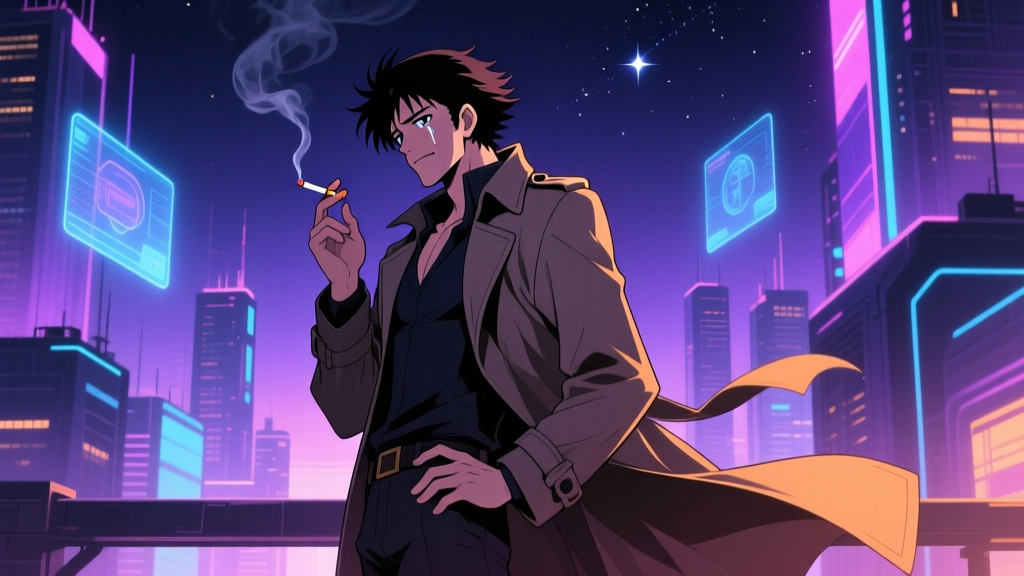
Spike Spiegel and the Art of Running From Your Past
There’s a moment in Cowboy Bebop—Episode 5, “Ballad of Fallen Angels”—where Spike stands alone on a rain-slicked rooftop, cigarette glowing, watching a church steeple burn behind him. He doesn’t move. Doesn’t flinch. Just exhales smoke like it’s the last thing he owns. That stillness isn’t calm. It’s resignation wearing the mask of cool.
I remember watching that scene for the first time and feeling something crack open—not in Spike, but in me. Here was a man who’d spent five seasons dodging bullets, debts, and memories, only to arrive at this: a quiet, unblinking confrontation with the very thing he’d spent his life outrunning. Not death. Not the Syndicate. Hisself.
Freedom as Flight
Existentialism doesn’t begin with meaning—it begins with freedom. Radical, terrifying, inescapable freedom. Jean-Paul Sartre wrote that we are “condemned to be free.” Spike lives that condemnation like scripture. Every bounty he takes, every bar he walks into, every offhand quip he delivers (“I’m not looking for anything—I’m just killing time”) is an act of willful deflection. He chooses the Bebop not because it offers purpose, but because it offers motion. And motion—especially sideways, backward, or reckless—feels like agency.
Consider how often Spike refuses to explain himself. When Faye asks why he won’t go after Vicious in Episode 22, “Pierrot le Fou,” he says only, “It’s not my style.” That’s not evasion. It’s assertion. He’s declaring his right to withhold meaning—even from himself. His silence isn’t emptiness; it’s sovereignty over narrative. The past (Julia, the Red Dragon, the betrayal) isn’t gone. It’s cordoned off. Labeled *Do Not Enter*. Not because he can’t face it—but because he insists on choosing when, if ever, the door opens.
The Jazz Aesthetic as Existential Grammar
Cowboy Bebop’s jazz score isn’t decoration. It’s philosophy made audible. Think of how Yoko Kanno’s compositions lean into improvisation—melodies that wander, hesitate, double back, then resolve in ways that feel earned, not inevitable. That’s Spike’s inner life rendered in brass and brushed snare.
Take the opening theme, “Tank!” Its urgent bassline propels forward while the trumpet spirals in unpredictable intervals. There’s no fixed key center for long—just tension held, released, reconfigured. That’s Spike’s moral architecture: no dogma, no doctrine, no inherited code. Just instinct, reflex, and the occasional, gut-deep choice that surprises even him. When he disarms a gunman mid-conversation in Episode 17 (“Mushroom Samba”), it’s not choreography—it’s jazz: responsive, economical, alive in the moment.
Even the show’s visual rhythm echoes this. Scenes cut on breaths, not beats. Camera lingers on empty doorways (Episode 10, “Jupiter Jazz Part I”), steam rising from a mug (Episode 13, “Waltz for Venus”), the slow blink of a neon sign (Episode 24, “Hard Luck Woman”). These aren’t pauses—they’re existential rests. Spaces where meaning could gather… but doesn’t have to.
Fatalism Without Faith
Here’s what makes Spike uniquely tragic: he believes in fate—but rejects its authority. “Whatever happens, happens,” he tells Jet in Episode 26, “The Real Folk Blues.” Yet he spends the entire series fighting it. He doesn’t pray. He doesn’t bargain. He just… shows up. Even when he knows it’s pointless.
That’s the existentialist pivot: fatalism without surrender. Sartre argued that recognizing our situation—the absurdity, the lack of cosmic guarantee—doesn’t paralyze us. It liberates us to act *despite* it. Spike’s final walk toward the red door in the Syndicate tower isn’t suicide. It’s the ultimate exercise of freedom: choosing an end he knows is coming, not because he wants it, but because it’s the only way left to say *this is mine*.
Compare that to Vicious. Vicious clings to order, hierarchy, legacy—the very structures existentialism dismantles. He quotes Nietzsche (“God is dead”) but mistakes nihilism for control. Spike quotes no one. He moves through the world like a man who’s read all the books and decided the only honest answer is a shrug and another cigarette.
The Weight That Isn’t Carried
We talk about Spike “carrying” his past—but he doesn’t carry it. He drags it. Like an anchor tied to his ankle, half-submerged, slowing him down but never sinking him. Watch how he handles memory: Julia’s voice triggers no monologue, no flashback montage. Just a micro-expression—a tightening around the eyes, a pause in his step—then he lights a new cigarette. The past isn’t integrated. It’s managed. Contained. Kept at arm’s length, like a loaded gun he never quite holsters.
That’s why his relationship with Faye is so quietly devastating. She’s trying to reconstruct her identity from fragmented data. He’s trying to deconstruct his before it reconstructs *him*. When she says, “You don’t trust anyone, do you?” in Episode 20 (“Polaris”), he answers, “I don’t trust myself.” That line lands like a hammer. Self-distrust isn’t weakness—it’s the clearest sign he’s still free. To distrust yourself is to refuse to become a fixed thing. To remain, perpetually, in process.
No Epilogue, Only Echo
The series ends not with resolution, but resonance. Spike vanishes into the red light. No body. No grave. No eulogy. Just the Bebop drifting, the crew silent, the saxophone holding one long, unresolved note.
That’s the existentialist victory: refusing closure. Refusing to let the story end with a moral, a lesson, or even a name. Spike doesn’t “overcome” his past. He doesn’t “heal.” He doesn’t “find peace.” He simply stops running long enough to meet it—and in that meeting, asserts, one last time, that the choice was always, irrevocably, his.
And maybe that’s the most human thing of all: not winning the war against memory, but learning to dance with it. Off-beat. Improvised. Leaving space—for breath, for smoke, for the next note that may never come.
“You’re gonna carry that weight.”
—Jet Black, Episode 25, “The Doors”
But Spike? He never lets it settle on his shoulders. He holds it out, at arm’s length, like a glass he’s about to set down—knowing full well he might drop it. And knowing, too, that the shattering would be entirely his own.