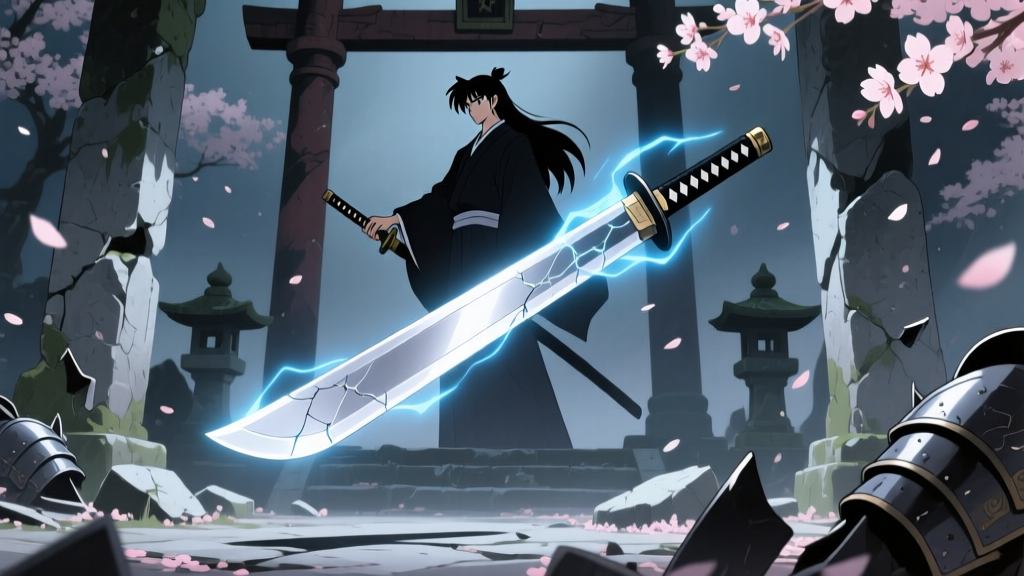
A demon lord carries a sword that cannot cut the living, cannot kill, and exists to undo death itself. Rumiko Takahashi buried her sharpest thematic work inside a weapon most fans dismissed as “the boring one.”
Sword Analysis Character Growth Inuyasha LorePicture the scene: Sesshōmaru, the most feared demon in feudal Japan, draws his blade on the battlefield. Soldiers brace for carnage. The steel sings as it leaves the scabbard—and then nothing happens. No shockwave. No demonic energy blast. The blade passes clean through a fallen body, and for one bewildering moment, everyone thinks the sword failed. Then the dead man’s chest rises. A gasp. A heartbeat. Life floods back into a corpse that had been cooling for minutes. That is what the Tenseiga does. It does not kill. It has never killed. And in a franchise built around sword fights between demons, that single fact makes it the most radical weapon Rumiko Takahashi ever conceived.
Most Inuyasha fans fixate on the Tetsusaiga—the fang-sword that shatters a hundred demons with one swing, the one Inuyasha wields with all the subtlety of a freight train. And look, the Tetsusaiga is a great sword. The Wind Scar alone is one of shonen anime’s most iconic attacks. But if you want to understand what Takahashi was actually doing with Inuyasha’s mythological framework, you need to look at the other sword. The quiet one. The one that heals instead of harms, carried by a character who spent the first half of the series convinced that compassion was a weakness.
This is the full story of the Tenseiga: where it came from, what it does, how it mirrors its wielder’s transformation, and why it remains one of the most thematically sophisticated weapons in all of anime.
Forged from the Fang of a Dead King
The Tenseiga’s origin story is inseparable from Inuyasha’s central family drama. The Great Dog Demon, known in supplementary materials and the third film (Inuyasha the Movie: Swords of an Honorable Ruler, 2003) as T&omacrga, died protecting his human lover Izayoi and their newborn half-demon son Inuyasha from a rival demon. His left fang was extracted after death and used to forge the Tetsusaiga, a weapon of destruction intended for Inuyasha. His right fang became the Tenseiga, a weapon of restoration, which he left to his full-demon heir Sessh&omacromarumaru. The old swordsmith T&omacrotsai shaped both blades, and My&omacrga was tasked with guarding the Tenseiga until Sessh&omacromarumaru was ready to claim it.
The symbolism here is not subtle, and Takahashi does not want it to be. Two swords from two fangs of the same dead father. One given to the son he loved openly—the half-blood, the vulnerable one, the boy who would need to fight just to survive in a world that despised his existence. The other given to the son who already had everything: pure demon blood, a castle, an army, and a contempt for anything weaker than himself. The Tenseiga was not a gift so much as a challenge. T&omacrga was telling Sessh&omacromarumaru something he could not say aloud: you have power enough to destroy, but you do not yet understand what power is actually for.
The word tenseiga itself breaks down to roughly “heavenly life fang” in the original Japanese—ten (heaven), sei (life), ga (fang). The Tetsusaiga, by contrast, translates to something like “iron-breaking fang.” One sword breaks. The other mends. The naming convention alone tells you everything about Takahashi’s intentions with these two blades and the brothers who carry them.
The Sword That Cannot Cut the Living
Here is the thing about the Tenseiga that frustrates people who approach it like a conventional weapon: it physically cannot harm a living being. The blade passes through flesh and bone as if they were not there. Sessh&omacromarumaru’s first encounter with this limitation comes early in the manga, and his reaction is the exact reaction you would expect from a warlord who has spent centuries solving every problem through violence. He is disgusted. He nearly discards the sword. The idea that his father—the most powerful demon to ever walk feudal Japan—left him a blade that cannot kill feels like an insult, and Sessh&omacromarumaru takes it personally.
But the Tenseiga’s inability to harm the living is not a weakness. It is a constraint that defines its entire purpose, and once you accept that constraint, its actual power is staggering. The blade can sever the connection between a deceased soul and the underworld messengers (the shinigami-like spirits that appear as small, pale figures collecting the dead). When those messengers are cut away, the soul is returned to the body, and the dead are revived. Sessh&omacromarumaru can perform this act once per person—the Tenseiga will not resurrect the same individual a second time, a rule that introduces genuine stakes into a power that might otherwise feel overpowered.
The most iconic demonstration of this ability occurs when Sessh&omacromarumaru uses the Tenseiga to revive Rin, the human girl who followed him through the series. Rin dies during the Narakumi arc, and Sessh&omacromarumaru—a demon who has spent the entire narrative insisting he feels nothing for humans—draws the Tenseiga and brings her back. The scene works because the sword’s power only matters if its wielder cares enough to use it. A sword that heals the dead is meaningless in the hands of someone indifferent to death. Tenseiga demands that Sessh&omacromarumaru acknowledge he values a life, and that acknowledgment is the real power at work.
Here is a complete breakdown of every confirmed ability the Tenseiga demonstrates across the manga, anime, and third film:
- Resurrection — severs underworld messengers from a deceased soul, restoring life (one-time use per individual)
- Protective Barrier — generates an automatic shield around Sessh&omacromarumaru when activated, deflecting incoming attacks
- Underworld Perception — allows the wielder to see the spirits of the dead and the messengers collecting souls, invisible to ordinary eyes
- Meidō Zangetsuha — tears open a rift to the underworld, banishing anything in its path to the realm of the dead
- Immunity to Miasma — the blade’s purifying nature shields Sessh&omacromarumaru from Naraku’s corrosive miasma in the final arc
Five abilities total, and only one of them (Meidō Zangetsuha) deals damage. That ratio alone sets the Tenseiga apart from virtually every other named sword in shonen anime, where the ability count usually skews the opposite direction—three or four attack techniques and maybe one defensive move. Takahashi inverted the formula entirely.
Meidō Zangetsuha: When the Healer Learns to Open Graves
If the Tenseiga’s resurrection ability represents Sessh&omacromarumaru’s capacity for compassion, then Meidō Zangetsuha—literally “dark path to the underworld, slashing moon”—represents the moment he reconciles that compassion with his nature as a warrior. The technique tears open a rift between the mortal world and the underworld, sending anything caught in its path into the realm of the dead. It is devastating, it is visually spectacular, and its origin is tangled up in the most complicated sibling rivalry in the entire Inuyasha canon.
Meidō Zangetsuha was originally the Tetsusaiga’s ultimate technique. T&omacrga developed it but deemed it too dangerous for Inuyasha to inherit in its raw form—it required a mastery over demonic energy and a psychological detachment from killing that Inuyasha, still young and emotionally volatile, did not possess. So the old dog demon split the technique between the two swords. The destructive capability went to the Tetsusaiga, but the key to activating it—the path to the underworld itself—was encoded in the Tenseiga. Sessh&omacromarumaru had to master the technique on his own, using a sword that could not kill, before the true nature of the power could be revealed.
The final arc of the manga forces a confrontation between the brothers that functions as a sword duel, a family reckoning, and a philosophical argument all at once. Sessh&omacromarumaru perfects his version of Meidō Zangetsuha using the Tenseiga, creating a path to the underworld that is complete and self-contained. Inuyasha’s Tetsusaiga version is incomplete without it. The narrative implication is unmistakable: the brother who carries the sword of death needs the brother who carries the sword of life to reach his full potential. Neither blade is complete on its own. Takahashi is making a point about duality, interdependence, and the fallacy of separating destruction from restoration as if they were unrelated forces.
In practical combat terms, Sessh&omacromarumaru’s Meidō Zangetsuha with the Tenseiga creates a crescent-shaped void that expands outward, pulling everything in its trajectory into the underworld. The visual is striking—a black-and-blue rift splitting the sky like a wound in reality. Against Naraku, this technique becomes one of the few attacks capable of threatening the villain’s seemingly endless regeneration, because you cannot regenerate a body that has been banished to the realm of the dead.
Two Fangs, Two Philosophies: Tenseiga vs. Tetsusaiga
Comparing these swords side by side is the fastest way to see what Takahashi was building. They are not just different weapons—they are different arguments about what strength means, forged from the same dead father’s mouth and placed in the hands of sons who represent opposite extremes of the demon-world hierarchy.
| Attribute | Tenseiga (Heavenly Life Fang) | Tetsusaiga (Iron-Breaking Fang) |
|---|---|---|
| Wielder | Sessh&omacromarumaru (full-blood demon) | Inuyasha (half-demon) |
| Origin | T&omacrga’s right fang; forged by T&omacrotsai | T&omacrga’s left fang; forged by T&omacrotsai |
| Core Purpose | Restoration; undoing death | Destruction; slaying demons |
| Can Harm the Living? | No — passes through living bodies harmlessly | Yes — primary function is lethal force |
| Signature Ability | Resurrection (cuts underworld messengers to restore souls); Meidō Zangetsuha | Kaze no Kizu (Wind Scar); Bakury&umacruha (Dragon Scale enhancement); Kongōsōha |
| Barrier / Shield | Projects a protective barrier around the wielder | Barrier activates when wielder protects others (requires compassion) |
| Transformation | No physical transformation (remains a plain blade) | Transforms from rusted fang to massive sword when demonic energy flows |
| Thematic Role | Forces the wielder to develop compassion; growth through restraint | Requires compassion to unlock full power; growth through connection |
| Kill Count (Manga) | Zero (by design) | Thousands (the Wind Scar alone clears entire battlefields) |
The table makes the contrast explicit, but the deeper parallel is harder to see at a glance. Both swords require their wielders to develop compassion—but they do so from opposite directions. The Tetsusaiga demands that Inuyasha, a half-demon raised among humans, learn to protect others to unlock his full strength. The Tenseiga demands that Sessh&omacromarumaru, a full-blood demon who views humans as insects, learn to value a life enough to save it. Both swords are, in effect, moral training devices disguised as weapons. T&omacrga was not just arming his sons. He was raising them from beyond the grave.
The Blade as Mirror: Sessh&omacromarumaru’s Arc Through the Tenseiga
You can track Sessh&omacromarumaru’s entire character development by looking at how he treats the Tenseiga at different points in the story. The sword is not just a tool in his inventory—it is the narrative’s measuring stick for his humanity, and Takahashi uses it with surgical precision across 558 manga chapters and 193 anime episodes (plus four films and the 2020 sequel series Yashahime).
Act One: Contempt
When Sessh&omacromarumaru first learns what the Tenseiga does, he wants nothing to do with it. He has spent the opening arc of the series trying to steal the Tetsusaiga from Inuyasha, convinced that his father’s real inheritance was the destructive blade and that he was cheated. Learning that the Tenseiga cannot harm the living confirms his worst suspicion: the old man left him a useless sword. He carries the Tenseiga at his hip more out of obligation than respect, and he makes no attempt to explore its powers. At this stage, Sessh&omacromarumaru measures worth exclusively in terms of killing capacity. A sword that cannot kill is, by his logic, not a sword at all.
Act Two: Reluctant Attachment
Rin changes everything, and she does it without trying. A human child, orphaned by war, who follows a demon lord through feudal Japan with the stubbornness of a lost puppy—Rin is the catalyst for every meaningful shift in Sessh&omacromarumaru’s behavior. When she is killed, the Tenseiga becomes the only thing standing between Sessh&omacromarumaru and a loss he cannot rationalize away. He uses the sword to revive her, and the act itself is a confession. He will not admit it aloud for a long time, but the Tenseiga has already told the audience what Sessh&omacromarumaru thinks of the sword now: it is the thing that kept Rin breathing. That makes it valuable. That makes it his.
Jaken, Sessh&omacromarumaru’s long-suffering retainer, notices the shift before anyone else. In the manga (Volume 21, Chapter 8), he observes that his master has begun carrying the Tenseiga differently—no longer as an afterthought at his hip, but drawn and ready, as if the sword finally means something to him. It is a small detail, but it captures exactly how Takahashi handles character growth: through physical behavior rather than internal monologue.
Act Three: Mastery and Surrender
The final transformation happens when Sessh&omacromarumaru unlocks Meid&omacron Zangetsuha. The technique requires him to confront his own demonic nature—the part of him that wants to dominate and destroy—and channel it through a sword whose purpose is restoration. The cognitive dissonance is the point. To master the technique, Sessh&omacromarumaru has to hold two opposing truths in his mind simultaneously: he is a demon who kills, and he is a being who has learned to value life. The Tenseiga does not ask him to stop being a warrior. It asks him to understand that warriors fight for something, not just against something.
In the manga’s climax, Sessh&omacromarumaru gives up the Tenseiga’s Meidō Zangetsuha to Inuyasha’s Tetsusaiga, completing the technique his father could not finish. This is not a surrender. It is the act of someone who has outgrown the need to prove himself through possession of a weapon. The Tenseiga has done its work. The demon lord who once dismissed it as useless has become someone who no longer needs it to define his power.
Why the Tenseiga Stands Alone Among Anime Weapons
Anime is crowded with iconic swords. Ichigo’s Zangetsu. Ichigo Kurosaki’s blade that grows stronger as his resolve hardens. Erza Scarlet’s arsenal of requipped weapons in Fairy Tail. Guts’ Dragon Slayer in Berserk—a slab of iron so large it qualifies as blunt force trauma. Every shonen protagonist seems contractually obligated to carry a sword that gets bigger, sharper, and more destructive as the series progresses. The escalation is built into the genre: bigger threats demand bigger weapons, and bigger weapons sell more merchandise.
The Tenseiga runs in the opposite direction. It is a sword that deliberately refuses to participate in the power-escalation arms race. Its primary function—bringing the dead back to life—is something no other major anime weapon does as a core mechanic, and the restrictions Takahashi places on it (one resurrection per person, no harm to the living) prevent it from becoming a narrative cheat code. The limitation is what gives the power weight.
“A sword that cannot kill is not weaker than a sword that can. It simply asks a harder question of the one who carries it.”
— Thematic paraphrase of T&omacrga’s intent, as interpreted across Inuyasha fan analysis communities and the Inuyasha Official Guide (Shogakukan, 2004)
There is also the matter of how the Tenseiga handles the “chosen weapon” trope. In most anime, the hero is chosen by the sword—it responds to their bloodline, their spirit energy, their destiny. The Tenseiga does not choose Sessh&omacromarumaru because he is worthy. It was left to him because he needed the lesson it teaches, not because he had earned the right to carry it. The sword is a corrective instrument, not a reward. That distinction changes how you read every scene in which Sessh&omacromarumaru draws the blade. He is not wielding a symbol of his status. He is working through the most difficult assignment his father ever gave him.
Compare the Tenseiga to the Sword of Omens from ThunderCats, which grants its bearer sight beyond sight and the power to summon allies across vast distances. Or Excalibur in Fate/stay night, which translates the wielder’s heroic ideal into a beam of light. Those weapons are amplifiers—they take what the wielder already is and make it louder. The Tenseiga is a corrector. It takes what the wielder lacks and forces him to develop it. No other anime weapon I can name operates on that principle as its primary narrative function.
Legacy: The Tenseiga in Yashahime and Beyond
The 2020 sequel series Hanyō no Yashahime picks up a generation later, with Sessh&omacromarumaru’s twin daughters Towa and Setsuna navigating a world their parents helped shape. The Tenseiga appears again, but its role has shifted. By this point, Sessh&omacromarumaru has completed his arc—he is no longer the cold-blooded warlord who viewed humans as vermin—and the sword functions more as a narrative bridge between the original series and its successor than as an active plot device. Its presence in Yashahime serves as a reminder of where Sessh&omacromarumaru started and how far he traveled.
The Tenseiga also persists in Inuyasha’s broader merchandise and pop-culture footprint. Replica Tenseiga swords are produced by several licensed manufacturers (most notably the Japanese company Bever, whose 1:1 scale replicas have been collector staples since the early 2000s). The blade appears in crossover video games like Jump Force and various mobile titles, where its resurrection ability is typically translated into healing mechanics rather than offensive attacks—a rare case of a game adaptation respecting the source material’s thematic intent.
For fans revisiting the series or newcomers picking up the manga for the first time, here are the moments where the Tenseiga plays its most pivotal role—the scenes that define what the sword means to the story:
- Resurrection of Rin — Sessh&omacromarumaru’s first deliberate use of the Tenseiga to save a human life; the moment the sword stops being an insult and starts being a responsibility
- Underworld Arc (manga Vol. 41–43) — Sessh&omacromarumaru descends into the underworld itself, where the Tenseiga’s connection to death becomes a navigation tool through a realm no living being should enter
- Meidō Zangetsuha Unlocked — the technique reveals that the Tenseiga was always capable of destruction; Sessh&omacromarumaru simply needed the psychological maturity to access it
- Transfer to Tetsusaiga — in the final arc, Sessh&omacromarumaru yields the Meidō Zangetsuha to Inuyasha’s blade, completing T&omacrga’s unfinished technique and symbolizing the brothers’ reconciliation
In fan communities, the Tenseiga remains a subject of debate. Some fans argue that its limitations make it underwhelming compared to the Tetsusaiga’s explosive power. Others contend that the one-resurrection-per-person rule is the single most elegant restriction Takahashi ever placed on a supernatural ability, because it forces the wielder to make choices with permanent consequences. Both readings are valid, and the fact that the sword generates this kind of discussion more than two decades after the manga began serialization speaks to the depth of Takahashi’s design.
Questions Fans Keep Asking About the Tenseiga
Can the Tenseiga kill demons from the underworld?
Yes, with a caveat. The Tenseiga can harm beings that originate from or are connected to the underworld—this is how it severs the underworld messengers from the souls of the deceased. However, against standard demons native to the mortal plane, the blade remains non-lethal. The distinction is not about the target’s species but about their metaphysical connection to death and the afterlife. If a being exists in the liminal space between life and death, the Tenseiga can interact with it. Otherwise, the blade passes through harmlessly.
Why didn’t Sessh&omacromarumaru use the Tenseiga to resurrect more people?
The one-resurrection limit is the practical answer, but the character-driven answer is more interesting. Early-series Sessh&omacromarumaru had no desire to save anyone. He used the Tenseiga for Rin because she was the one person whose death he could not dismiss. As his character develops, he uses the blade’s power sparingly and deliberately, which is consistent with a warrior who has learned that life’s value is tied to its fragility. Indiscriminate resurrection would undermine the very lesson the Tenseiga was designed to teach.
Is the Tenseiga stronger than the Tetsusaiga?
They are not designed to be compared on a linear power scale, and Takahashi deliberately avoids giving a definitive answer. In terms of raw destructive output, the Tetsusaiga is overwhelmingly superior—the Wind Scar and Bakury&umacruha can level entire forests. But the Tenseiga’s ability to reverse death and open paths to the underworld operates on a conceptual level that brute force cannot counter. During the final confrontation with Naraku, the Tenseiga’s Meidō Zangetsuha is one of the few techniques that poses a genuine existential threat. The swords are complementary, not competitive. That is the entire point of T&omacrga’s design.
What happened to the Tenseiga at the end of the manga?
In the final arc, Sessh&omacromarumaru perfects Meidō Zangetsuha and then transfers the technique to the Tetsusaiga, completing what T&omacrga could not finish alone. The Tenseiga itself remains in Sessh&omacromarumaru’s possession, but its most devastating offensive capability now resides in Inuyasha’s blade. This transfer symbolizes the brothers’ reconciliation and Sessh&omacromarumaru’s acceptance that his role was never to be the most powerful fighter in the room—it was to become something the demon world had not seen before: a warrior who chose mercy.
Does the Tenseiga have a spirit or consciousness?
Not in the way the Tetsusaiga does. The Tetsusaiga has a demonstrable will of its own—it transforms based on Inuyasha’s emotional state and can reject wielders it deems unworthy (as seen when Sessh&omacromarumaru attempted to claim it in the early chapters). The Tenseiga is quieter, more enigmatic. It does not resist or transform, but it does seem to “decide” when its power can be activated, suggesting a form of sentience that expresses itself through restraint rather than action. Whether this is a deliberate personality or simply a more passive enchantment is never fully clarified in the manga, and that ambiguity is probably intentional.
Rumiko Takahashi spent twelve years writing a manga about a half-demon with a big sword and a full-demon with a bigger attitude. On the surface, it is a series about fighting Naraku, collecting jewel shards, and navigating feudal Japan’s monster-of-the-week structure. But buried inside that framework is a quiet, persistent argument about what power actually means, and the Tenseiga is the sharpest expression of that argument. A sword that heals. A weapon that refuses to be a weapon. A gift from a dead father that says: the strongest thing you can do is choose not to destroy.
Sessh&omacromarumaru took the long way around to understanding that message. He spent hundreds of chapters, several near-death experiences, and one very persistent human child to get there. But when he finally stopped seeing the Tenseiga as an insult and started seeing it as an invitation, the entire series shifted. The demon lord who could not be moved was moved. The sword that could not cut had cut through the one thing that mattered: the wall between what Sessh&omacromarumaru was and what he could become.
References: Inuyasha manga, Rumiko Takahashi (Shogakukan, Weekly Sh&omacronnen Sunday, 1996–2008); Inuyasha anime adaptation (Sunrise, 2000–2004) and Inuyasha: The Final Act (2009–2010); Inuyasha the Movie: Swords of an Honorable Ruler (Sunrise, 2003); Inuyasha Official Character Guide (Shogakukan, 2004); Hanyō no Yashahime (Sunrise, 2020–2022).