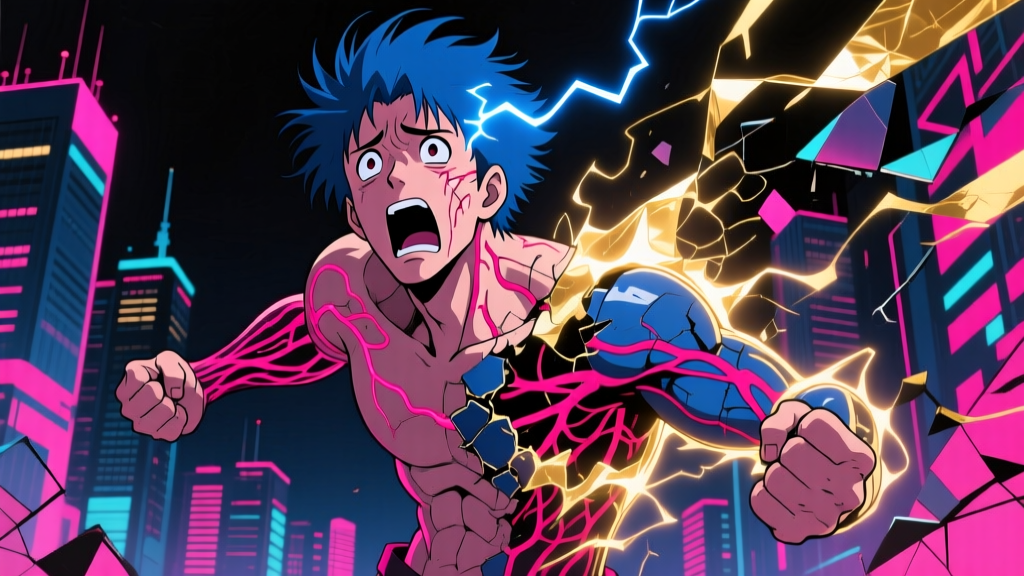
Let’s get this out of the way first: no, Tetsuo doesn’t become a god in the manga. And yes—*yes*—that’s the whole point.
I remember watching the film for the third time in college, jaw slack as Tokyo dissolved into light, convinced I’d just witnessed the ultimate transhumanist fantasy: a broken kid, discarded by state and science alike, *overcoming* biology, physics, even narrative coherence to ascend beyond human limits. It felt like prophecy. Like warning. Like awe.
Then I read the manga.
And everything cracked open—not with a bang, but with a slow, nauseating *unspooling*. Chapter 120 doesn’t climax. It *fibrillates*.
Not explosion—entropy
The film’s finale is cathartic violence: Tetsuo’s scream becomes a singularity, the city vaporizes, and Kaneda stands in stunned silence amid ash and silence. It’s mythic. It’s clean. It’s *cinematic*.
The manga? Chapter 120 opens with Tetsuo suspended inside a pulsing, non-Euclidean cavity—no sky, no ground, no horizon—his body dissolving *and reforming* simultaneously across overlapping panels. Otomo uses *fourteen* panels on a single page—not to accelerate pace, but to *fracture perception*. Some panels show Tetsuo’s face melting into circuitry; others zoom into his eye, where a miniature, screaming version of himself floats in vitreous fluid. One panel is just a black square with a single trembling line—like a seismograph recording its own failure.
This isn’t ascension. It’s *recursive collapse*: a system eating its own feedback loops until there’s nothing left to interpret, not even itself.
I flipped back to Chapter 119, where Kei pleads with Tetsuo not to “become something else”—not “don’t destroy us,” but “don’t *lose the ‘you’ that can still be spoken to.” That line hit me like cold water. In the manga, Tetsuo never stops *being* Tetsuo—even at his most monstrous. He whimpers. He begs for his mother. He mispronounces “Akira” like a child who’s forgotten how to speak. His final form isn’t divine—it’s *developmentally arrested*, trapped in the exact same psychic wound that birthed his powers: helplessness mistaken for omnipotence.
Otomo’s 1988 interview: “Evolution is not progress”
In that now-famous 1988 interview with Manga Eiga, Otomo was blunt:
“People say Tetsuo ‘evolves.’ But evolution has no direction. No goal. What happens to him isn’t growth—it’s runaway feedback. Like a microphone too close to a speaker. You don’t get music. You get noise that destroys the system.”
He wasn’t talking about biology. He was referencing the cybernetic debates simmering in Kyoto and Tokyo universities in the mid-80s—especially Kitaro Nishida’s concept of basho (場), or “place-logic”: reality as a dynamic, relational field where subject and object co-arise, neither prior nor superior to the other. To “transcend” that field isn’t enlightenment—it’s ontological suicide. There’s no “outside” to stand on. No stable self to upgrade.
Tetsuo’s final sequence mirrors this precisely. He doesn’t escape the system—he becomes its overloaded buffer. His body doesn’t transform *into* data; it *stutters between states*, unable to resolve syntax. Panels bleed into gutters. Speech bubbles dissolve into static glyphs. On page 217 of Volume 6, Tetsuo’s mouth opens—but instead of words, the bubble contains a tiny, inverted image of the entire preceding double-page spread. It’s not self-reference. It’s *self-cancellation*.
This works because Otomo treats the page as a cognitive interface—not a window, but a *circuit*. When Tetsuo breaks, the layout breaks *with him*. You don’t watch his collapse. You *experience its structural logic*.
The Kodansha remaster: restoring the rot
Here’s something most fans miss: the original 1984–1990 Kodansha tankōbon censored key sequences—not for gore, but for *conceptual discomfort*. In Chapter 117, Tetsuo’s arm sprouts a cluster of embryonic faces, each whispering fragments of childhood memories. The original print blurred their mouths. The 2022 remastered edition restores them, sharp and wet, eyes blinking in unison.
Same with Chapter 118’s “skin-melt” sequence: Tetsuo’s epidermis peels back not to reveal muscle or chrome, but *more skin*—layer after layer, each thinner, paler, more translucent, until the final fold shows nothing but a faint watermark of his own fingerprint. It’s not body horror as shock. It’s body horror as *infinite regress*: identity stripped down to an echo of its own trace.
That censorship mattered. It softened the manga’s central thesis—that transhumanist fantasies aren’t just naive; they’re *dangerously incoherent*. You can’t “upload consciousness” if consciousness isn’t a thing *in* you, but a pattern *between* you, your body, your language, your trauma. Tetsuo’s tragedy isn’t that he fails to become godlike. It’s that he *succeeds* at becoming pure, ungrounded signal—and signal without a receiver is just noise.
Kaneda’s silence isn’t hope—it’s exhaustion
Film Kaneda shouts, “Tetsuo!”—a lifeline, a name thrown into the void.
Manga Kaneda says nothing.
He stands at the edge of the crater—not looking *at* the light, but *through* it, eyes unfocused, shoulders slumped. His final panel is three-quarters empty. The background isn’t rubble or sky. It’s blank white space—the kind that follows a system crash.
That silence isn’t stoicism. It’s semantic fatigue. After witnessing Tetsuo’s dissolution—not as spectacle, but as *process*—Kaneda has no framework left to name what happened. Not “death.” Not “transcendence.” Not even “failure.” Just… cessation. A period where a sentence should continue.
And crucially: no rebirth. No new world. No Akira rebooting society. The last page of Volume 6 is a two-panel spread. Left: Kaneda walking away from the crater, small, centered, dwarfed by negative space. Right: a single, unmarked streetlamp flickering—not brightly, not steadily, but *intermittently*, like a failing synapse. Its light doesn’t illuminate anything. It just *pulses*, waiting for a rhythm that never returns.
That lamp appears in exactly three other places in the manga:
- Chapter 5, when Kei first sees the Olympic Stadium ruins (pre-Akira, pre-Tetsuo)
- Chapter 42, right after the Colonel orders the bombing of the Esper facility (the moment the state chooses control over understanding)
- Chapter 98, when Tetsuo first loses his grip on linear time and screams, “I’m not *here* anymore!”
It’s not a symbol of hope. It’s a metronome counting down the intervals between systemic failures.
Why this matters now
We live in the era of AI “breakthroughs” sold as evolutionary leaps, of neural lace startups promising “consciousness upgrades,” of billionaires funding cryonics like it’s a software patch. We’ve rebranded Tetsuo’s scream as a feature, not a bug.
But Otomo knew better. In 1988, he saw the trap: that “progress” narratives flatten history, erase contingency, and mistake *complexity* for *maturity*. Tetsuo isn’t defeated by Kaneda or the military. He’s undone by the sheer *impossibility* of sustaining a self that refuses all relational grounding—no language, no body, no memory that isn’t immediately overwritten by the next impulse.
The manga’s ending isn’t ambiguous because Otomo couldn’t decide. It’s ambiguous because *ambiguity is the only honest response* to a system that has consumed its own conditions of meaning.
So no—Tetsuo doesn’t become a god.
He becomes the question no theology, no algorithm, no manifesto can answer:
What do you *do* with infinite power… when you’ve forgotten how to want anything at all?
And the manga’s final, flickering lamp? It’s still on.
Waiting.
Not for a savior.
But for someone willing to look at the static—and call it what it is.
Emma Rodriguez
Contributing writer at SenpaiSite — Your Ultimate Anime & Manga Guide.