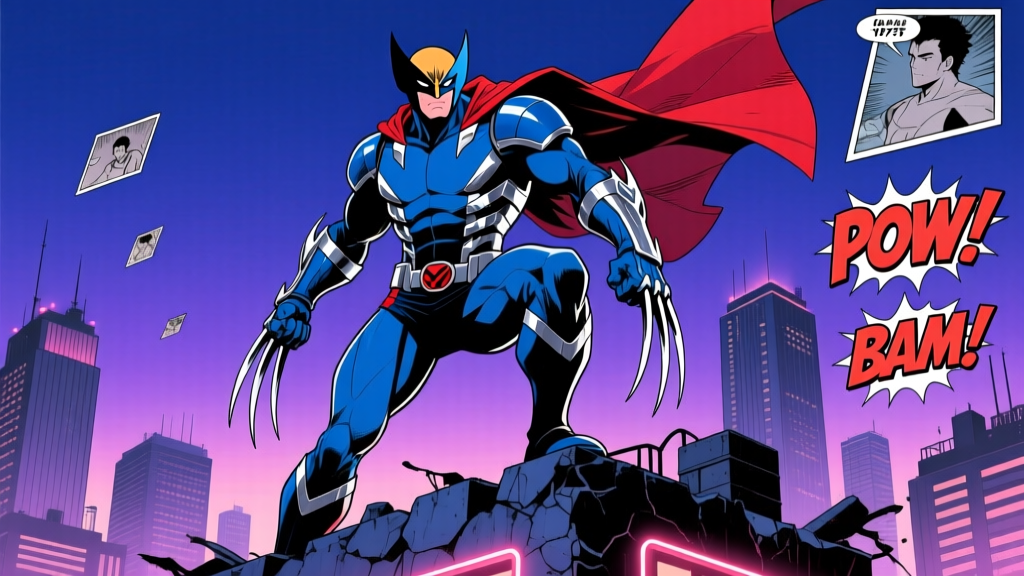
From Dave Cockrum's pencil to Ryan Reynolds' blockbuster, the blue-and-yellow tights that defined Marvel's most ferocious mutant.
⚔Wolverine — Blue & Yellow Costume
1. Origin: Giant-Size X-Men #1 (1975)
In May 1975, Marvel Comics published Giant-Size X-Men #1, a one-shot intended to revive a flagging title that had been reprinting old issues for half a decade. Writer Len Wein and artist Dave Cockrum assembled a brand-new, international roster of mutants to rescue the original team from the living island Krakoa. Among the recruits: a short, snarling Canadian government agent codenamed Wolverine, who had already appeared briefly in The Incredible Hulk #180–181 (1974).
Cockrum's costume design for Wolverine in that issue was striking and deliberately unconventional. Rather than the earth-toned military garb the character wore during his Hulk cameo, Cockrum dressed him in a skin-tight blue-and-yellow bodysuit with a dramatic pointed mask featuring two long, wing-like fins protruding from the temples. The mask's angular silhouette evoked both a samurai kabuto and a bat's cowl—an unusual hybrid that immediately set Wolverine apart from the rest of the X-Men lineup.
The color choice was deliberate. In a team where Cyclops wore blue-and-yellow and Storm sported black leather, Wolverine's palette placed him squarely in the "heroic" color quadrant of the comic book spectrum. Blue read as noble and reliable; the yellow accents signaled energy and danger. Together, the combination told readers that this character was fierce but fundamentally on the side of good—a crucial piece of visual storytelling for a figure whose personality leaned heavily toward antisocial rage.
Wein and Cockrum did not initially plan for Wolverine to become the breakout star of the book. He was one of seven new characters introduced simultaneously. But something about the visual package—the mask, the claws, the compact blue-and-gold frame tearing through panels—stuck with readers. Sales for Giant-Size X-Men #1 were strong enough that Marvel relaunched the series as Uncanny X-Men with issue #94, and Wolverine came along for the ride.
2. John Byrne Refines the Look
If Dave Cockrum gave Wolverine his costume, John Byrne gave him his soul. Byrne joined Uncanny X-Men as penciller with issue #108 (December 1977) and eventually co-plotted the series with writer Chris Claremont. Over the next several years, Byrne systematically sharpened every aspect of Wolverine's character, and the blue suit evolved right alongside the writing.
Byrne's most significant contribution was streamlining Cockrum's design. The original mask fins were even longer and more elaborate in Giant-Size X-Men #1, almost resembling a Valkyrie helmet. Byrne shortened and stiffened them, giving the mask a more aggressive, aerodynamic profile. He also tightened the suit's musculature rendering, emphasizing Wolverine's compact, barrel-chested build rather than the leaner physique Cockrum had drawn. Under Byrne's pen, Wolverine looked like a fireplug stuffed into spandex—short, thick, and ready to explode.
Byrne was also the artist who established the definitive blue-and-yellow color blocking that would define the suit for decades. He pushed for the yellow to dominate the torso and upper arms while the blue covered the legs, gloves, and mask. This split made Wolverine instantly recognizable even in silhouette and ensured he would stand out in crowded group shots—a practical concern in a book featuring up to ten costumed characters per page.
The famous Uncanny X-Men #139 (November 1980) cover, drawn by Byrne, shows Wolverine crouched in a three-point landing pose, claws extended, the blue suit gleaming under moonlight. It is widely considered one of the most iconic single images in X-Men history and cemented the blue suit as Wolverine's definitive look in the minds of an entire generation of readers.
3. Anatomy of the Blue Suit
Stripping away nearly fifty years of reinterpretation, the classic Wolverine costume breaks down into a handful of unmistakable components:
The Mask Full-face cowl with pointed, wing-shaped fins extending from each temple. Eye holes are narrow and angular, giving Wolverine a perpetually furious expression. The fins originally served no stated in-universe function, though later writers occasionally suggested they housed sensors or were purely psychological warfare—making a short man look wider and more intimidating. Torso & Arms Bright yellow bodysuit covering the chest, shoulders, and upper arms. The yellow panel typically forms a V-shape tapering toward the waist, creating a visual arrow that draws the eye to Wolverine's center of mass and emphasizes his stocky power build. Legs & Gloves Deep royal blue covers from mid-thigh to boot and from wrist to elbow. The blue gloves often feature reinforced knuckle plating in later artistic interpretations, acknowledging that Wolverine punches things harder than most people swing hammers. Boots Typically rendered in blue or black, Wolverine's boots are flat-soled and nondescript—a deliberate contrast to the flamboyant footwear of characters like Doctor Strange or Thor. He is a brawler, not a runway model. The Claws Not technically part of the suit, but inseparable from the visual identity. Three retractable adamantium claws per hand, usually depicted gleaming silver against the blue gloves. No other accessory in comic book history is so immediately associated with a single character.One element worth noting: the suit has no visible utility belt, holster, or equipment pouch. Wolverine carries nothing. He has no gadgets, no communicator, no Batarang. This was a conscious design choice that reinforced his characterization as a lone wolf who relies on nothing but his own body and instincts.
4. Why Fans Refuse to Let It Die
Wolverine has worn dozens of costumes over the decades—brown-and-tan (a fan favorite in its own right), the black-and-silver X-Force stealth suit, the red-and-black Astonishing X-Men look by John Cassaday, the white suit from his time as a Horseman of Apocalypse, and countless one-off variants. Yet the blue-and-yellow remains the version that triggers the deepest emotional response from the fanbase.
Part of this is pure generational imprinting. The X-Men: The Animated Series (1992–1997) used the blue suit as Wolverine's primary costume, and that show reached millions of children who never picked up a comic book. For an entire cohort of fans born in the 1980s and early 1990s, the blue suit is Wolverine the same way the red-and-blue tights are Spider-Man. It does not matter that the brown costume appeared in more comic book issues during the 1990s; the blue suit owned the cultural airwaves.
There is also a symbolic dimension. The blue suit represents Wolverine at his most heroic—the version of the character who fights alongside a team, protects younger mutants, and channels his berserker rage toward a cause bigger than himself. When comic storylines return Wolverine to the blue suit after an extended absence, it signals to readers that the character is recommitting to the X-Men's ideals. The costume is shorthand for moral clarity in a character defined by moral ambiguity.
Fandom attachment has real-world consequences. When Marvel announced the "Return of Wolverine" storyline in 2018, artist Declan Shalvey initially depicted the character in a redesigned outfit that departed significantly from the classic look. Fan backlash on social media was swift and vocal. Marvel course-corrected: by the time the series launched, Wolverine was back in a blue-and-yellow suit, albeit with modernized armor plating. The message was clear—the blue suit is not optional; it is essential.
5. Across Comics, Cartoons & Games
Comics
The blue suit appeared continuously in Uncanny X-Men from 1975 through 1991, when Jim Lee redesigned Wolverine in the brown-and-tan outfit for X-Men #1 (the relaunch issue that still holds the record for highest-selling American comic book of all time, at over 8 million copies). The blue suit returned periodically throughout the 1990s and 2000s in flashback stories and alternate-timeline arcs. In 2010's Wolverine #900, Marvel brought the blue suit back as Wolverine's primary costume, where it remained through various reinterpretations up to the present day.
Animation
The blue suit's most influential non-comic appearance remains X-Men: The Animated Series, which aired on Fox Kids from 1992 to 1997. Voice actor Cal Dodd delivered Wolverine's growl while animators rendered the character in a slightly desaturated blue that worked well against the show's colorful backgrounds. The suit also appeared in Wolverine and the X-Men (2009), the X-Men: Evolution series (where it appeared as a future/alternate costume), and the anime-influenced X-Men: The Anime shorts.
In 2024, Disney+ released X-Men '97, a direct continuation of the original animated series. The blue suit returned in its full glory, updated with modern animation techniques that gave the fabric texture and weight while preserving the nostalgic color palette. Promotional art for the show leaned heavily on the blue suit, and merchandise sales tied to X-Men '97 reportedly exceeded Disney's expectations by a significant margin.
Video Games
The blue suit has been Wolverine's default or unlockable costume in nearly every game appearance:
- X-Men: Children of the Atom (1994) — blue suit as primary costume, arcade fighter that established the character's gaming identity.
- Marvel vs. Capcom 2 (2000) — the blue suit appears in sprite form, with the yellow rendered as a bright amber due to hardware color limitations.
- X-Men Legends (2004) and X-Men Legends II (2005) — blue suit available as default or alternate skin.
- Marvel: Ultimate Alliance (2006) — classic blue suit as one of four unlockable costumes per character.
- Marvel vs. Capcom 3 (2011) — high-fidelity 3D model of the blue suit with dynamic fabric physics.
- Marvel Snap (2022) — the blue suit card art by various artists has become one of the most collected variants in the game.
- Marvel's Wolverine (upcoming, Insomniac Games) — trailer footage shows a modernized take on the blue suit with tactical armor elements, generating enormous fan speculation.
6. Deadpool & Wolverine (2024): The Suit Hits Live Action
For twenty-four years, Hugh Jackman played Wolverine on screen without ever wearing the blue suit. The X-Men film franchise, beginning with Bryan Singer's 2000 debut, dressed the character in black leather—a choice rooted in the post-Matrix aesthetic that dominated early-2000s action cinema. Jackman's Wolverine wore variations of dark tactical gear across nine films. Fans accepted the choice but never stopped asking for the blue.
The payoff arrived on July 26, 2024, with the release of Deadpool & Wolverine, directed by Shawn Levy and produced under the Marvel Studios banner following Disney's acquisition of Fox. In the film, Jackman plays a variant of Wolverine pulled from an alternate timeline—and that variant wears a faithful live-action adaptation of the blue-and-yellow costume, mask fins and all.
The suit's design for the film balanced comic accuracy with practical filmmaking concerns. Costume designer Mayes C. Rubeo (known for her work on Thor: Ragnarok and WandaVision) created a version that used textured, layered materials rather than flat spandex. The yellow was toned down to a deep gold rather than the bright primary yellow of the comics, preventing the costume from reading as garish under cinematic lighting. The mask fins were slightly shortened compared to their most exaggerated comic iterations, but remained unmistakable.
The reveal of the blue suit in the film's trailers generated one of the most intense social media reactions of 2024. The trailer amassed over 365 million views in its first 24 hours, and a significant portion of online commentary focused specifically on seeing Jackman finally in blue and gold. When the film opened to $211 million domestically and $444 million worldwide in its opening weekend, the blue suit was cited in exit polling as a primary reason audiences chose to see it in theaters rather than wait for streaming.
The moment carried weight beyond box office numbers. Jackman had publicly stated that Logan (2017) was his final appearance as Wolverine, and the blue suit in Deadpool & Wolverine served as both a farewell gift to fans and a bridge to Marvel Studios' long-term plans for the character. The suit's live-action debut was not just a costume choice—it was a decades-old promise finally kept.
7. Collectibles & Merchandise
The blue Wolverine suit is one of the most merchandised character designs in comic book history. A partial inventory of notable collectibles:
Action Figures & Statues
- Toy Biz X-Men Classics (1993) — the 5-inch blue-suit Wolverine figure, with "slashin' action" claw arms, remains one of the best-selling action figures of the 1990s. Mint-on-card examples trade for $80–$150.
- Hasbro Marvel Legends (2007–present) — multiple blue-suit releases across different waves, including the 2019 Retro Collection that replicated the original Toy Biz cardback art. Retail price typically $25–$30; secondary market varies.
- Sideshow Collectibles Premium Format (2018) — a 19-inch polystone statue depicting Wolverine in the blue suit, claws out, standing on a Sentinel head. Original retail $560; secondary market $700–$1,200.
- Hot Toys Movie Masterpiece (2024) — the Deadpool & Wolverine blue suit figure, featuring a newly sculpted Hugh Jackman head beneath the mask. Retail $285; pre-orders sold out within minutes.
Apparel & Lifestyle
The blue suit has appeared on officially licensed t-shirts, hoodies, compression athletic wear, sneakers (Adidas and Vans collaborations), and even high-end fashion pieces. Marvel's licensing division has reported that Wolverine-related merchandise consistently ranks among the top five Marvel characters in annual revenue, often surpassing characters with more recent film exposure.
Trading Cards & Comics
Key comic issues featuring the blue suit command significant prices on the collector market:
| Issue | Date | Significance | CGC 9.8 Value (approx.) |
|---|---|---|---|
| Giant-Size X-Men #1 | May 1975 | First blue suit appearance; first new X-Men team | $15,000–$30,000 |
| Uncanny X-Men #94 | Aug 1975 | First regular-series appearance of the new team | $5,000–$12,000 |
| Uncanny X-Men #139 | Nov 1980 | Iconic Byrne cover; definitive blue suit pose | $800–$2,000 |
| Wolverine #900 | Dec 2010 | Blue suit returns as primary costume | $40–$80 |
| Return of Wolverine #1 | Nov 2018 | Modernized blue suit with armor elements | $15–$40 |
8. Timeline at a Glance
1974
Wolverine debuts in The Incredible Hulk #180–181 wearing a brown-and-yellow military uniform—not the blue suit.
1975
Giant-Size X-Men #1 introduces the blue-and-yellow suit designed by Dave Cockrum.
1977–1981
John Byrne refines the suit's proportions, mask fins, and color blocking during his Uncanny X-Men run.
1991
Jim Lee's brown-and-tan redesign in X-Men #1 temporarily replaces the blue suit in the main comics continuity.
1992
X-Men: The Animated Series uses the blue suit, embedding it in global pop culture.
2000
The first X-Men film dresses Hugh Jackman in black leather. The blue suit stays on the page.
2010
Wolverine #900 restores the blue suit as the character's primary comic book costume.
2024
Deadpool & Wolverine delivers the blue suit to live-action cinema for the first time. X-Men '97 revives the animated version on Disney+.
9. Frequently Asked Questions
Who designed Wolverine's blue-and-yellow costume?
Artist Dave Cockrum designed the original blue-and-yellow suit for Giant-Size X-Men #1 (1975), working with writer Len Wein. John Byrne later refined the design during his Uncanny X-Men run beginning in 1977, tightening the mask fins, adjusting the color blocking, and establishing the version most fans recognize today.
Why did Wolverine stop wearing the blue suit in the comics?
Wolverine switched to a brown-and-tan costume in X-Men #1 (1991), redesigned by Jim Lee. The change was part of a broader 1990s trend toward grittier, more militaristic costume designs. The blue suit returned periodically in flashback issues and alternate timelines before being permanently restored in Wolverine #900 (2010).
Does Hugh Jackman wear the blue suit in Deadpool & Wolverine?
Yes. In Deadpool & Wolverine (2024), Hugh Jackman plays a variant of Wolverine from an alternate timeline who wears a faithful live-action adaptation of the classic blue-and-yellow costume, complete with the pointed mask fins. It marks the first time the blue suit appears in a live-action theatrical film.
What is the most valuable comic featuring the blue Wolverine suit?
Giant-Size X-Men #1 (May 1975) is the key issue. A CGC-graded 9.8 copy can sell for $15,000 to $30,000 or more at auction. Lower-grade copies (CGC 7.0–8.0) typically trade in the $1,500–$4,000 range.
Is the blue suit Wolverine's most popular costume?
By most measures, yes. The blue-and-yellow suit consistently ranks as Wolverine's top costume in fan polls, merchandise sales, and pop culture recognition. The brown-and-tan 1990s outfit has a passionate minority following among longtime comic readers, and the Astonishing X-Men red-and-black suit by John Cassaday is popular with younger fans, but the blue suit remains the consensus pick for Wolverine's definitive look.
Will the blue suit appear in future MCU projects?
Marvel Studios has not officially confirmed future appearances, but the overwhelmingly positive reception to the suit in Deadpool & Wolverine strongly suggests it will return. Industry analysts expect Wolverine to play a role in upcoming ensemble projects such as Avengers: Secret Wars, and the blue suit would be the natural choice for any team-oriented appearance.
The Suit That Outlasted Everything
Costume trends in superhero comics are notoriously fickle. Characters change outfits every few years, driven by new artists, marketing campaigns, or editorial mandates to keep things "fresh." Most of these redesigns are forgotten within a decade. Wolverine's blue-and-yellow suit has survived nearly half a century of reinvention, outlasting creative teams, film reboots, corporate acquisitions, and the death and resurrection of the character himself.
The reason is straightforward: the design works. It is bold enough to command attention on a crowded newsstand, distinctive enough to be recognized at a glance from any angle, and balanced enough to carry the tension that makes Wolverine compelling—the coexistence of controlled heroism and barely contained fury. Blue for the discipline. Yellow for the wildfire. Claws for everything in between.
Fifty years from now, when someone draws three slash marks across a blue background, everyone in the room will know exactly who they mean.