Sometime in the spring of 1962, Jack Kirby sat at his drawing board in his Long Island home and sketched a figure that didn't yet have a name the public would recognize. It wasn't Superman. It wasn't Captain Marvel. It was a muscular, bearded figure holding a short-handled hammer, wrapped in what looked like a cross between Norse armor and Kirby's own boundless imagination. Within weeks, that sketch would become the centerpiece of a thirteen-page story stuffed inside a comic book that, up until that moment, had spent a decade printing monster tales and science fiction potboilers.
Journey Into Mystery #83 hit newsstands with a cover date of August 1962. It cost twelve cents. Most kids who picked it up had no idea they were holding the birth certificate of one of the most financially successful fictional characters in entertainment history. The Thor franchise — comics, films, merchandise, licensing — has generated well over $6 billion at the global box office alone, not counting the MCU ensemble films where Thor played a central role. All of it traces back to this single, unassuming comic book with a green-skinned alien on the cover and a thirteen-page story that Stan Lee and Larry Lieber banged out in a matter of days.
• • •A Horror Book Gets a New Tenant
To understand why Journey Into Mystery #83 matters, you have to understand what the book had been for the previous ten years. Atlas Comics (the direct predecessor to Marvel) launched Journey Into Mystery in June 1952 as a horror and suspense anthology. For roughly a hundred issues, it delivered exactly what its title promised: creepy stories about monsters, mad scientists, and things that lurked in the dark. It was the comic-book equivalent of a late-night campfire story — disposable, entertaining, and utterly forgettable.
By 1961, the comic book landscape had shifted. The Comics Code Authority had gutted the horror genre, and Atlas — now rebranding as Marvel — was experimenting with superheroes again after the surprise success of Fantastic Four #1 in November 1961. As documented in Gerard Jones's Men of Tomorrow (2004), Stan Lee needed places to put new characters, and the existing anthology titles were convenient real estate. Journey Into Mystery was one of several titles that got repurposed. The horror stories didn't vanish overnight; they simply got pushed to the back of the book.
Issue #83 contains three stories. The lead feature, "The Stone Men from Saturn!", runs thirteen pages and introduces Thor. The two backup stories — shorter pieces in the old anthology style — fill out the remaining pages. Nobody reading it in 1962 would have guessed that the lead story was fundamentally different from the backups. But it was. The lead had a character who wanted to come back.
The Origin Kirby and Lee Built in Thirteen Pages
The plot of "The Stone Men from Saturn!" is deceptively simple, and that simplicity is a large part of why it worked.
Dr. Donald Blake is an American physician with a pronounced limp, vacationing in Norway. He's described as lame — not merely injured or temporarily disabled, but permanently impaired. This detail matters because the entire emotional architecture of the Thor concept rests on the contrast between Blake's physical limitation and the godlike power he's about to receive.
While hiking in the Norwegian countryside, Blake witnesses something terrifying: a squad of massive, rocky-skinned aliens — the Stone Men from Saturn — landing on Earth and beginning their invasion. He runs. With his bad leg, he can't run fast, which makes the chase genuinely tense in Kirby's rendering. Blake ducks into a cave, and the Stone Men seal him inside.
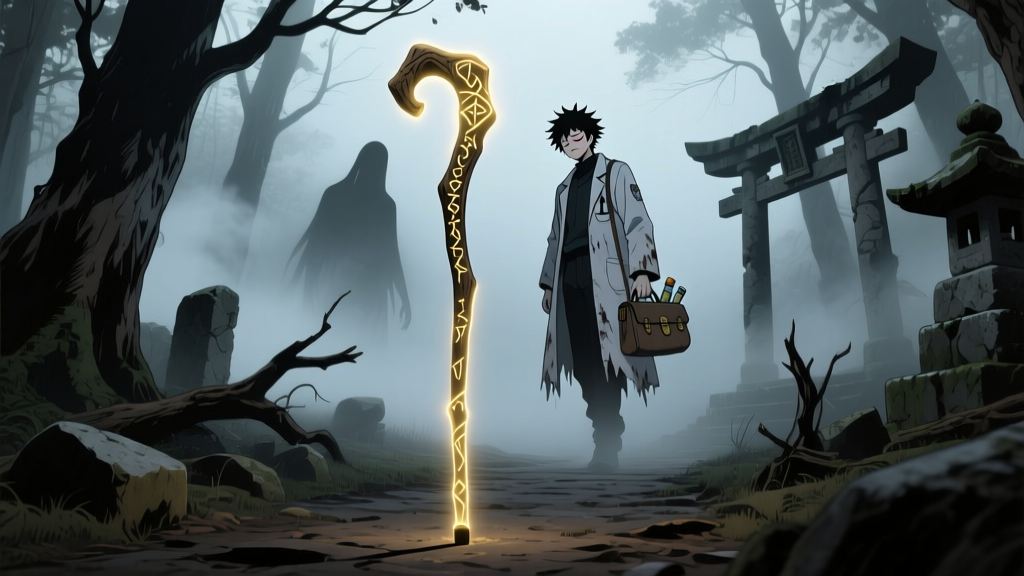
Deep within the cave, Blake finds a wooden staff — a gnarled, unremarkable walking stick. Frustrated, he strikes the cave wall with it. The stick transforms into Mjolnir, Thor's enchanted hammer, and Blake himself transforms into the Thunder God: towering, muscular, crackling with power. The limp is gone. The weakness is gone. In its place stands something that makes the Stone Men look like pebbles.
"When Donald Blake struck his cane upon the ground, he was no longer a lame doctor. He was Thor — and the very earth trembled at his coming." — Narration, Journey Into Mystery #83 (August 1962)
Thor bursts out of the cave, hurls Mjolnir at the Stone Men's invasion equipment, generates a tornado by spinning the hammer, and single-handedly drives the alien force off Earth. The whole thing takes about eight pages. Then he strikes the hammer on the ground, transforms back into the frail Dr. Blake, and walks away. Nobody around him knows what happened.
The Secret Identity Gambit
The Don Blake / Thor dual identity was a calculated creative decision. Lee and Kirby were operating in the post-Superman tradition where secret identities weren't just a convention — they were the engine of drama. Blake's disability gave the concept a specific emotional texture that other superhero alter egos lacked. Clark Kent wasn't suffering. Bruce Wayne had trauma but not physical limitation. Donald Blake was a man who lived every day with a body that failed him, and then discovered he had access to a body that could not fail at all. That tension — between weakness and omnipotence, between human frailty and divine power — became the spine of the character for decades.
It's worth noting that Larry Lieber, Stan Lee's younger brother, scripted the story from Lee's plot outline. Lieber was a reliable workhorse at Marvel during the early 1960s, scripting many of the anthology stories and early superhero features. His contribution to Thor's debut is frequently overshadowed by Lee's showmanship and Kirby's art, but Lieber's clean, direct prose gave the story its readability. The dialogue is spare — Thor barely speaks in this first appearance — but the narration carries the weight, establishing the mythic register that would become the character's trademark.
Thirteen pages. One disabled doctor. One magic cane. And the entire Marvel mythological pantheon begins here.Kirby at Full Voltage
If Stan Lee provided the concept, Jack Kirby provided the thunder. By 1962, Kirby was already one of the most prolific and technically accomplished artists in the comic book industry. He'd drawn hundreds of stories across every genre — romance, westerns, war, science fiction, horror — and he was just beginning the creative explosion that would produce the core Marvel Universe.
The art in Journey Into Mystery #83 shows Kirby working at the intersection of two styles. The Stone Men are pure 1950s Kirby monster work: hulking, craggy, vaguely ridiculous aliens with the kind of physical mass that Kirby conveyed better than anyone who ever held a pencil. When they march through the Norwegian landscape, you can feel the ground shake. Kirby understood weight. His characters didn't float on the page — they occupied space, displaced air, left footprints.
But Thor himself required something different. Here was a character who needed to look simultaneously mythological and modern, ancient and immediate. Kirby's solution was characteristically bold: he designed Thor not as a historically accurate Viking but as a comic book god. The helmet with its small winged projections, the short tunic, the massive arms bare to the shoulder, the circular medallion on the chest — none of this has any basis in actual Norse iconography. It's pure Kirby invention, and it works because it reads instantly. You see that silhouette and you know exactly what you're looking at: power.
The Inking Question
Joe Sinnott is credited as the cover inker for Journey Into Mystery #83, and his contribution to the book's visual impact should not be understated. Sinnott's inks over Kirby's pencils became one of the defining visual partnerships in comic book history. Sinnott had a way of finishing Kirby's figures that preserved the explosive energy of the pencils while adding a polished depth — rich blacks, controlled spot shadows, clean line weights — that gave the art a professional sheen. On the interior pages, the inking on this early Thor story is rougher than what would come later, but the cover art benefits enormously from the Kirby-Sinnott combination.
The page layouts follow Kirby's standard grid of the period: mostly six-panel pages with occasional splash moments. But even within this conventional structure, Kirby found ways to make Thor's first appearance feel visually distinct. The transformation sequence — Blake striking the cane, the flash of light, the emergence of Thor — is rendered with a sense of kinetic release that the surrounding panels of Blake limping through Norway deliberately suppress. The contrast is the point. Kirby made you feel the liberation in your hands as you turned the page.
The Cover That Sold the Book
The cover of Journey Into Mystery #83 is one of the more debated images in Silver Age comics, primarily because of a peculiar production inconsistency. The Stone Men appear green on the cover but orange in the interior story. This discrepancy has fueled decades of fan discussion about whether the cover was painted before or after the interior art was finalized, and whether anyone at Marvel noticed or cared.
What's not debatable is the cover's visual power. Thor dominates the composition, hammer raised overhead, his body twisted in the dynamic mid-action pose that Kirby used to convey explosive force. The Stone Men surround him, craggy and menacing, but they're visibly outmatched. The cover tells the entire story in a single image: one god against an army, and the army is losing.
From a commercial standpoint, the cover did exactly what it needed to do in 1962: it made a twelve-year-old kid standing at a newsstand want to spend twelve cents. The bright colors, the action, the sheer scale of the conflict — it's a masterclass in impulse-purchase design. Kirby understood that a comic book cover wasn't art for art's sake. It was a sales tool, and its job was to get picked up off the rack.
Issue Credits at a Glance
| Role | Credit | Notes |
|---|---|---|
| Plot | Stan Lee | Story concept and outline |
| Script | Larry Lieber | Full dialogue and narration from Lee's plot |
| Pencils | Jack Kirby | Interior art and cover pencils |
| Cover Inks | Joe Sinnott | One of the earliest Kirby-Sinnott collaborations |
| Lead Story | "The Stone Men from Saturn!" | 13 pages, first appearance of Thor |
| Cover Date | August 1962 | On sale approximately May–June 1962 |
| Cover Price | 12 cents | Standard Silver Age pricing |
| Publisher | Marvel Comics | Transitioning from Atlas Comics branding |
What $432,000 Buys You: The Collector Market
If you had bought Journey Into Mystery #83 off a newsstand in 1962 for twelve cents and somehow kept it in near-mint condition — no creases, no spine stress, no sun fading, pages still white — you would now own one of the most valuable comic books in existence.
The collector market for this issue has escalated dramatically over the past two decades, driven by Thor's growing cultural profile and the general appreciation of Silver Age Marvel keys. According to the CGC Census (Certified Guaranty Company, ongoing population report), approximately 1,738 copies of Journey Into Mystery #83 have been professionally graded. That number sounds large until you consider how many copies were originally printed and how few survived in high grade. The Overstreet Comic Book Price Guide (2023 edition) lists this issue among the top 100 most valuable Silver Age comics, with values climbing steadily at each annual revision.
The highest-graded copies sit at CGC 9.4 (Near Mint), and these are extraordinarily rare. In 2024, a CGC 9.4 copy sold at Heritage Auctions for $432,000, setting a new record for the issue. Prior to that, a 9.4 copy from the Twin Cities pedigree had sold for $222,200 through ComicLink/Pedigree Comics, which was itself considered a landmark price at the time. The trajectory is unmistakable: each new high-grade sale resets expectations.
| CGC Grade | Condition | Notable Sale / Est. Value | Market Notes |
|---|---|---|---|
| 9.4 (NM) | Near Mint | $432,000 (Heritage, 2024 record) | Highest grade known; fewer than 5 copies at this tier |
| 9.2 (NM-) | Near Mint minus | $275,000 – $325,000 est. | Extremely scarce; appears at auction every few years |
| 9.0 (VF/NM) | Very Fine / Near Mint | $105,000+ | Sweet spot for serious collectors |
| 8.5 (VF+) | Very Fine Plus | $75,000+ | Strong demand; reliable auction performer |
| 8.0 (VF) | Very Fine | $40,000 – $55,000 est. | Overstreet 2014 listed VF 8.0 at $13,000; has tripled since |
| 5.0 (VG/FN) | Very Good / Fine | $8,000 – $12,000 est. | Accessible entry for mid-range collectors |
| 1.8 (GD-) | Good minus | $2,000 – $3,500 est. | Reading-copy grade; value still significant |
Even a beat-up, low-grade copy with a torn cover and brittle pages will run you several thousand dollars. The twelve-cent cover price has appreciated by a factor of roughly 25,000x in the lowest collectible grades. That kind of return would make any venture capitalist weep.
Why This Issue Specifically?
First-appearance issues always carry a premium in the collector market, but Journey Into Mystery #83 benefits from several compounding factors that most Silver Age keys can't match:
- Continuous character relevance. Thor appeared in The Avengers #1 (1963) as a founding member of Marvel's premier superhero team and has been a continuous presence in Marvel publishing for over sixty years. Unlike characters who faded and were revived, Thor never left.
- MCU transformation. Chris Hemsworth's portrayal across four solo Thor films and multiple Avengers movies grossed billions at the global box office. Every new Thor film or Disney+ appearance drives renewed interest in the character's origin, funneling collector attention directly back to this comic.
- Accidental scarcity. Newsstand comics in 1962 were treated as disposable entertainment. Kids read them, traded them, left them on buses, spilled soda on them. The copies that survived in high grade did so largely by accident — stored in a closet, forgotten in a box, saved by a parent who didn't throw things away.
- First-appearance premium. In the grading-and-slabbing economy, a character's debut issue always commands the highest multiplier. Journey Into Mystery #83 is to Thor what Action Comics #1 is to Superman: the single most important artifact in the character's history.
From Thirteen Pages to a Sixty-Year Empire
What happened after Journey Into Mystery #83 is the real story. The Thor feature didn't just appear once and vanish. It took over the book. By Journey Into Mystery #84, Thor was the lead feature every month, and the anthology backup stories were shrinking. By issue #126 (April 1966), the title was renamed outright to The Mighty Thor, and the pretense of it being anything other than a Thor comic was permanently abandoned.
Over the decades, Thor has been reimagined by dozens of writers and artists. A few milestones stand out:
- Walt Simonson's run (1983–1987). Widely considered one of the greatest creative achievements in mainstream comics. Simonson introduced Beta Ray Bill, reimagined Asgardian politics, and delivered storytelling that elevated Thor from B-list Avenger to genuine epic literature.
- Jason Aaron's tenure (2012–2019). Introduced the War of the Realms and made Jane Foster the new Thor when Odinson became unworthy. Both storylines became major crossover events and were adapted into MCU plotlines.
- The Unworthy Thor arc (2014–2015). Thor loses the ability to wield Mjolnir after the Original Sin event, forcing a complete rethinking of the character's identity beyond the hammer. The storytelling risk paid off commercially and critically.
- MCU solo films (2011, 2013, 2017, 2022). Kenneth Branagh's 2011 debut earned $449 million. Ragnarok (2017) reached $854 million. Love and Thunder (2022) crossed $760 million. Cumulative Thor franchise revenue exceeds $6 billion across all film appearances.
The character has died, been replaced, wielded different hammers, lost an eye, and been reborn — but the core concept introduced in those thirteen pages in 1962 has never been abandoned.
Stan Lee reportedly chose a Norse thunder god because he wanted a character who was already, in some sense, larger than any human hero. "How do you make someone stronger than the strongest human?" Lee asked in various interviews over the years, including his autobiography Excelsior! The Amazing Life of Stan Lee (2002). "You make him a god." It was a simple answer to a simple creative problem, but the execution — the disabled doctor, the magic cane, the hidden cave in Norway — gave the concept a human anchor that pure mythology alone could never provide.
• • •Collector and Reader Questions
What is the most valuable copy of Journey Into Mystery #83 ever sold?
A CGC 9.4 (Near Mint) copy sold at Heritage Auctions in 2024 for $432,000, setting the all-time record for the issue. A prior CGC 9.4 from the Twin Cities pedigree sold for $222,200 through ComicLink. These are the only confirmed sales above $200,000 for this issue, and both involved copies graded at the highest known tier.
Who actually wrote the story in Journey Into Mystery #83?
Stan Lee plotted the story (created the concept and outline), and his brother Larry Lieber wrote the full script, including dialogue and narration. This was a common arrangement at early-1960s Marvel: Lee would dictate a plot, and Lieber or another writer would flesh it out. Jack Kirby then drew the story from the script, with additional input from Lee during the art stage.
Why do the Stone Men look green on the cover but orange inside the comic?
This is a well-known production discrepancy. The cover and interior art were likely colored at different stages, possibly by different colorists working from different guides. In the 1960s, comic book coloring was a fast, low-precision process using a limited palette of four-color process inks. Consistency between cover and interior was not a priority, and discrepancies like this were common across the industry.
Is Journey Into Mystery #83 the same as the Golden Record Reprint?
No. The Golden Record Reprint (GRR) of Journey Into Mystery #83 was published in 1966 as a promotional item tied to a record album offer. The GRR is a separate collectible with its own market — a GRR copy in top condition typically sells for under $3,000, far less than the original 1962 printing. Collectors should verify which version they're looking at before making purchasing decisions.
How many copies of Journey Into Mystery #83 have been graded by CGC?
Approximately 1,738 copies have been submitted for CGC grading as of recent census data. However, the vast majority of these fall in the mid-grade range (4.0–7.0). Copies graded 9.0 or above are exceptionally rare, with fewer than a dozen confirmed at 9.0 or higher across all known sales.
What other stories are in the issue besides the Thor feature?
Journey Into Mystery #83 contains two shorter backup stories in the anthology tradition, filling out the rest of the issue's page count. These are standalone tales in the science fiction/mystery genre that the title had been publishing for years. They are not connected to Thor and are rarely discussed — the lead feature's significance has entirely eclipsed them in collector and fan memory.
• • •Sixty-odd years after a kid spent twelve cents on a comic with a green alien on the cover, Thor is still here. He's been in more than six hundred comic issues, headlined four solo films, fought alongside the Avengers in four more, appeared in animated series, video games, and more merchandise than anyone could count. And it all started because Stan Lee needed a feature to fill thirteen pages in a horror anthology that was running out of monsters.
The next time you see a hammer-shaped pendant on someone's neck or hear the thunder-roll sound effect in a Marvel trailer, remember where it came from: a cave in Norway, a walking stick, and a doctor who couldn't walk right. That's the whole origin. Thirteen pages. Twelve cents. And the rest, as they say in Asgard, is saga.