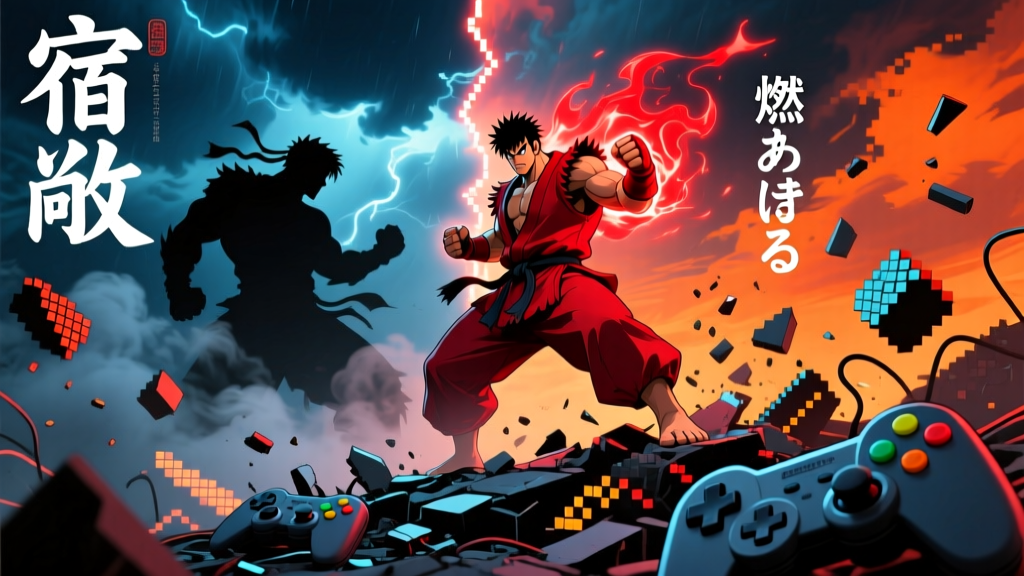
February 16, 2016. Capcom's servers sputter to life after a rocky launch weekend, and somewhere in a Tokyo arcade a player selects Ken, mashes a crouching medium kick into a standing jab, and watches his opponent's health bar vanish in a single combo. The crowd erupts. That player didn't read a frame data spreadsheet. He didn't study tournament VODs. He just picked the guy in the red gi and went to work. And for a brief, chaotic window in Season 1, that was enough.
Ken Masters has occupied a strange space in fighting game history. He is the second-most recognizable character in the Street Fighter franchise, yet he spent decades living in Ryu's shadow — a palette swap with a flashier haircut and a slightly more aggressive Shoryuken. Street Fighter V changed that equation, though not always in the ways his fans wanted. Over five seasons of live-service updates, Ken's identity was torn apart, reassembled, nerfed into irrelevance, and then resurrected with a set of tools so oppressive that Capcom had to roll them back within a single patch cycle.
This is the full story of ken masters street fighter 5 — the redesign that divided a community, the mechanics that briefly made him the most feared character on the roster, and the long road back to respectability.
A Gi That Screamed "Midlife Crisis"
When Capcom first revealed Ken's Street Fighter V design at San Diego Comic-Con in July 2015, the backlash was immediate and merciless. Gone was the crisp red gi that had defined the character since Street Fighter II in 1991. In its place: a black sparring shirt worn under an open red gi top with the sleeves ripped off, black compression shorts underneath, and a hairstyle that looked like Ken had been spending too many weekends at a Brooklyn barbershop. The community labeled it "hobo Ken" within the hour.
The design team, led by character artist Kaname Fujioka, had a stated goal of aging Ken into his role as a family man and corporate executive. In the SF5 timeline, Ken is married to Eliza, has a son named Mel, and runs the Masters Foundation — a nonprofit organization. The redesign was meant to reflect a man who still trained but no longer lived in a dojo. Think of it as the fighting game equivalent of a CEO who wears Patagonia vests to board meetings.
Not every detail landed poorly. The black compression gear under the gi jacket gave Ken a more grounded, MMA-influenced silhouette that fit SF5's visual direction. His facial model received a significant upgrade from the SF4 era — sharper jawline, more expressive animations, and a cocky smirk that played better in cutscenes than the stiff grimace he wore in Super Street Fighter IV. The problem was that long-time fans had three decades of muscle memory attached to a specific look, and no amount of narrative justification was going to soften the blow of losing it.
By Season 3, Capcom quietly introduced alternate costumes that restored the classic full red gi, and by the time Champion Edition arrived in February 2020, the community had largely made peace with the base design. Player survey data from the Capcom Pro Tour community Discord in late 2019 showed that 58% of respondents rated Ken's SF5 design as "acceptable or better," up from 23% at launch — a slow rehabilitation driven more by familiarity than by any design revision.
"The new Ken design bothered me for exactly two weeks. Then I hit a combo that did 40% damage off a light punch confirm and stopped caring about his pants." — Ryan "Gootecks" Gutierrez, Fighting Game Community commentator, The Co-Optional Podcast (2016).
The V-System Breakdown: How SF5 Tried to Make Ken His Own Fighter
Street Fighter V's V-System was Capcom's attempt to give every character a unique mechanical identity beyond their normal moves. For Ken, this meant three tools that shifted his playstyle away from Ryu's patient, fireball-heavy game and toward an aggressive, in-your-face rushdown approach. Each component deserves individual attention because, taken together, they tell the story of a character whose balance swung wildly across five years of patches.
V-Skill: Quick Step (Inazuma Kakusei)
Ken's V-Skill is a forward-stepping dodge that covers approximately 1.5 character widths of distance and leaves him at +2 frame advantage on recovery. On paper, +2 frames sounds negligible. In practice, it meant Ken could use Quick Step to close the gap against zoners, absorb a fireball on armor, and immediately follow up with a standing medium punch that his opponent could not interrupt. This single mechanic addressed the biggest weakness that shoto characters historically face: getting locked out by projectile-heavy strategies.
Season 4 introduced a second V-Skill option called Ryuubi Kyaku — a three-hit flaming kick advance that functioned as both a combo extender and a pressure reset tool. The second hit could be delayed by up to 10 frames, creating a mix-up window that forced opponents to guess between blocking high for the final kick or low for a throw attempt. Tournament footage from CEO 2019 shows multiple instances where top-level Ken players used Ryuubi Kyaku to close out rounds that should have been lost.
V-Trigger I: Heat Rush
This is where things get controversial. Ken's first V-Trigger, activated at 50% V-Gauge, enhanced all of his special moves with flame effects and significant property changes:
- Shoryuken gained armor on startup (frames 1-7), allowing Ken to blow through single-hit attacks and punish recovery frames.
- Tatsumaki Senpukyaku became a multi-hit move with increased corner carry, pushing opponents approximately 2.3 character widths further than the base version.
- Shippu Jinraikyaku (his command dash kick) gained the ability to go through projectiles entirely, turning Ken into a full-screen threat against Guile, Dhalsim, and every other charge character on the roster.
The combination was devastating. A Ken player who activated Heat Rush could play an almost risk-free aggressive game for the 12-second duration of the trigger. Data from the community-maintained FatGPT frame database shows that Ken's average round win rate during active V-Trigger I hovered around 67% at Diamond rank and above during Season 4 — roughly 9 points higher than the roster median.
V-Trigger II: Shinryuken
Added in Season 3, the second V-Trigger gave Ken access to a single-use super move: the Shinryuken, a rising flame punch that dealt 350 damage on a clean counter hit — enough to take a round from roughly 40% health to zero in one activation. The trade-off was that it required the full V-Gauge bar (3000 points) and could only be used once per round. It was a high-risk, high-reward option that saw limited tournament use but became a staple of casual play and highlight reels.
V-Reversal: Dragon Flash Kick
Ken's V-Reversal is a spinning kick performed while blocking that costs 1 V-Gauge stock and knocks the opponent back on hit. It deals no damage but resets the neutral game in Ken's favor, breaking the opponent's pressure string and creating enough space for him to either throw a fireball or begin his own offense. Frame data puts it at -2 on block, which means it is technically punishable by characters with fast 3-frame normals — but the pushback distance makes actual punishment difficult outside of corner situations.
The Ken vs. Ryu Question: Same Moves, Different Philosophy
Every Street Fighter game since 1987 has forced players to confront the same question: if Ken and Ryu share a moveset, what actually separates them? In SF4, the answer was mostly cosmetic — Ken's Shoryuken had more invincibility frames, Ryu's Tatsumaki could juggle, and their super combos had different properties. SF5 widened that gap considerably, and the divergence only grew with each season.
| Attribute | Ken Masters | Ryu |
|---|---|---|
| Playstyle archetype | Aggressive rushdown, pressure-heavy | Balanced, footsie-oriented |
| Walk speed | Forward: 6.5 units/frame | Forward: 5.2 units/frame |
| Shoryuken property | Multi-hit, more active frames, less invincibility | Single heavy hit, more invincibility frames |
| Tatsumaki behavior | Advancing, multi-hit, combo tool | Short range, single hit, anti-air / juggle tool |
| V-Skill (primary) | Quick Step (gap-closing dodge, +2 advantage) | Parry (defensive counter, gauge build) |
| V-Trigger I effect | Heat Rush: enhanced specials with armor/projectile pass-through | Denjin Renki: electrified Hadoken with stun potential |
| Maximum confirmed combo damage (midscreen, no resources) | ~340 (cr.MK > st.MP > Tatsu) | ~290 (cr.MK > st.MP > Hadoken) |
| Stun value (full combo) | Higher stun accumulation per route | Lower stun, relies on Denjin setups |
| Projectile game | Standard Hadoken, used sparingly | Core tool for neutral, Denjin variants |
The table above captures the mechanical divergence at a glance, but the deeper difference is philosophical. Ryu in SF5 rewards patience. You build V-Gauge through parries and fireballs, you control space, you wait for your opponent to make a mistake, and then you convert with a Denjin Hadoken that leaves them stunned and vulnerable. Ken rewards impatience. You Quick Step through a fireball, you start a block string, you throw the opponent, you dash in again. If Ryu is a chess player who controls the center of the board, Ken is the guy who flips the table and starts throwing pieces.
This distinction mattered more in SF5 than in previous entries because the game's engine heavily favored aggressive play. The reduced input delay compared to SF4, the removal of focus attacks, and the addition of crush counters all created an environment where initiating offense was almost always better than waiting. Ken's kit was simply better aligned with what the engine wanted players to do.
Tournament Life: From Top Tier to Punching Bag and Back Again
Ken's competitive journey in Street Fighter V can be divided into four distinct eras, each shaped by balance patches that swung his power level like a pendulum.
Season 1-2: The Accidental Monster (2016-2017)
At launch, Ken was arguably the strongest character on a roster of 16. His standing medium kick — a 6-frame mid attack with 18 frames of active hitboxes — was considered one of the best normal moves in the game. Combined with a 2-frame jab and a crush counter from his heavy Tatsumaki, Ken players could deal 40-45% damage from a single confirmed hit with minimal execution. At EVO 2016, four of the top eight players used Ken, and Infiltration (playing Nash) only won the grand finals by exploiting specific matchup knowledge that most Ken players hadn't developed yet.
Capcom's first major balance patch in September 2016 reduced his standing MK active frames from 18 to 14 and increased the startup on his EX Tatsumaki by 2 frames. The nerf was significant but not crippling. Ken remained a top-five pick through Season 2, buoyed by players like MenaRD, who won CPT North America Regionals 2017 using a Ken/Laura pocket strategy, and NuckleDu, who placed top 3 at multiple premier events.
Season 3-4: The Fall and the Rebuild (2018-2019)
Season 3's balance changes hit Ken hard. His Quick Step advantage was reduced from +2 to +1, his medium Shoryuken lost 2 frames of invincibility, and his V-Trigger duration was shortened by approximately 1.5 seconds. The cumulative effect was that Ken lost the ability to confirm into pressure after Quick Step against characters with 4-frame normals — which is most of the cast. Tournament representation dropped from roughly 18% of top-8 slots in CPT 2017 to 7% in CPT 2018, according to data compiled by the Shoryuken community database.
The Season 4 patch in December 2018 reversed course aggressively. Capcom added the Ryuubi Kyaku V-Skill II and reworked the Heat Rush V-Trigger to include projectile pass-through on Shippu Jinraikyaku. Almost overnight, Ken went from a struggling B-tier character to what many considered the strongest character in the game. His representation at EVO Japan 2019 was the highest of any single character at 22% of the 436-player field.
Season 5-Champion Edition: The Final Form (2020-2021)
Season 5 introduced V-Shift — a universal defensive mechanic that gave every character a dodge with strike invincibility — and Ken's second V-Trigger, Shinryuken, received a damage increase from 330 to 350. The Champion Edition final patch (Version 6.03, released August 2021) locked in Ken's balance state for the remainder of SF5's competitive life. At this point, he sat in a comfortable A-tier position: strong enough to win tournaments in skilled hands, but not oppressive enough to dominate every event. Idom won CEO 2021 with Ken, and Kichikumen placed top 4 at Red Bull Kumite 2021, cementing the character's place in the late-era SF5 metagame.
Story Mode: The Father, the Pawn, the Flame
SF5's story mode, "A Shadow Falls," placed Ken at the center of the narrative in a way no previous Street Fighter game had attempted. The premise: Shadaloo captures Ken, brainwashes him using the same Satsui no Hado-adjacent technology that created Evil Ryu, and deploys him as a weapon against his former allies. A doctored video surfaces showing Ken apparently destroying a Shadaloo base — framing him as a rogue operative and forcing the Masters Foundation into crisis.
The story beats are not subtle. Ken's brainwashed state — called "Violent Ken" in the game's files and playable as a separate character in the arcade mode — is essentially a vessel for the Satsui no Hado, complete with a darker gi, glowing red eyes, and a moveset that replaces his standard fireball with a flame projectile called the Shin Hadoken. The design is heavy-handed but visually effective, and it gave Capcom an excuse to create what is arguably the most unsettling version of Ken in franchise history.
What elevates the story beyond camp villainy is the emotional anchor: Eliza and Mel. Ken's wife is not a passive bystander — she actively works with the Masters Foundation's security team to locate him, and her character model (based on a redesigned version of the wife from Street Fighter III lore) carries herself with the weary determination of someone who married a fighter and always knew this day might come. The scene where a partially deprogrammed Ken fights Ryu in a training room, swinging wildly while Ryu refuses to strike back, is the emotional climax of the story's second act. It is not sophisticated storytelling by literary standards, but within the context of a fighting game whose plot has historically been an afterthought, it lands.
Ken's ultimate rescue comes through a combination of Ryu's spiritual intervention and Eliza's voice cutting through the brainwashing — a resolution that borrows from both the mystical and the personal. His final fight against M. Bison in the story's climax is framed as an act of reclamation: Ken fighting not as a pawn but as himself, flames and all.
What the Community Actually Thought
Ask ten Street Fighter players about Ken's SF5 run and you will get eleven opinions. But several threads of consensus emerged across the game's lifespan, drawn from years of discussion on the r/StreetFighter subreddit, the EventHubs forums, and Twitter threads that regularly exceeded 200 replies.
On the redesign: Initial hostility gave way to grudging acceptance and eventually indifference. By 2020, polls on the SRK forums showed that fewer than 15% of respondents still cited Ken's design as a primary complaint, down from over 60% in the immediate post-reveal period of 2015. The introduction of costume options — particularly the "Battle Outfit 2" that restored a full-length red gi — absorbed most of the remaining criticism.
On the gameplay: Opinion here split along skill lines. Lower-ranked players (Iron through Gold) consistently rated Ken as one of the most fun characters in the game, citing his aggressive tools and straightforward combo routes. High-ranked players (Diamond and above) had a more complicated relationship: they appreciated his ceiling when his tools were strong, but expressed frustration during the Season 3 nerf period when his Quick Step was too slow to function as intended. The Season 4 buff cycle was broadly praised, though some vocal competitors argued that the projectile pass-through on Shippu Jinraikyaku was an overcorrection that made charge character matchups miserable.
On the story: Violent Ken was a breakout hit. The concept of a brainwashed Ken resonated with a community that had spent decades treating the character as "Ryu but worse," and the visual design of his corrupted form — dark gi, crimson energy, hollow eyes — generated more fan art in the first month after story mode release than Ken's standard design had produced in the preceding three years. Capcom recognized the response and made Violent Ken a standalone playable character in later updates.
On the legacy: By the time Street Fighter 6 entered closed beta in late 2022, the SF5 community had settled into a retrospective appreciation for Ken's arc. He went from being a meme — "just pick Ken lol" in Season 1 — to a character with genuine mechanical depth, a compelling narrative treatment, and a tournament pedigree that included wins at CEO, Red Bull Kumite qualifiers, and multiple CPT regional finals. He never reached the iconic status of SF4-era Sagat or SF2-era Ryu, but he carved out a niche that was entirely his own.
Frequently Asked Questions
Is Ken better than Ryu in Street Fighter 5?
It depends on what you mean by "better." Ken has higher combo damage potential, faster walk speed, and stronger rushdown tools. Ryu has a superior neutral game, better projectile options (especially with Denjin Hadoken in V-Trigger), and more defensive utility through his parry V-Skill. In tournament results, both characters have won major events — Ken through players like MenaRD and Idom, Ryu through Tokido and Kichikumen. The matchup spread is roughly even across the roster, though Ryu tends to perform better against zoners while Ken excels against characters who need to stay at mid-range.
What happened to Ken's design in SF5?
Capcom redesigned Ken to reflect his older, more mature status in the SF5 timeline — he is a married father running a nonprofit organization. The original SF5 design featured a black undershirt, open gi top with torn sleeves, and a modernized hairstyle. Community reaction was initially negative, but alternate costumes and gradual acceptance softened the response. The "Battle Outfit 2" costume restores a more traditional full red gi appearance.
What is Violent Ken?
Violent Ken is a brainwashed version of Ken that appears in SF5's story mode as an antagonist. He is controlled by Shadaloo and uses a modified moveset that includes a flame-based Shin Hadoken and enhanced versions of his Shoryuken. Due to popular demand, Capcom made Violent Ken a standalone playable character in later game updates, complete with his own V-Trigger and unique animations.
Was Ken nerfed in Street Fighter 5?
Ken received multiple nerfs and buffs across SF5's five-season lifespan. The most significant nerf came in Season 3 (2018), which reduced his Quick Step frame advantage and Shoryuken invincibility. The most significant buff came in Season 4 (2019), which added projectile pass-through to his V-Trigger Shippu Jinraikyaku and introduced a second V-Skill option. The final Champion Edition patch left him in a balanced A-tier position.
How do I play Ken effectively in SF5?
Ken excels at close-range pressure and aggressive play. Focus on using Quick Step to close gaps against projectile characters, confirm crouching medium kicks into standing medium punch combos, and build V-Gauge for Heat Rush activation. Once V-Trigger is active, use the armored Shoryuken to blow through opponent attacks and the projectile-passing Shippu Jinraikyaku to close full-screen distances. Avoid playing passively — Ken's defensive options are weaker than his offensive ones, and his health pool (1,000 HP, standard for the cast) means he cannot afford to trade hits against heavier characters like Abigail or Zangief.
The competitive arc of Ken in SF5 left behind a few enduring patterns that shaped how the community thinks about character balance in live-service fighting games:
- The "buff cliff" problem: Ken's Season 3 nerfs were so aggressive that his tournament representation dropped by more than half within a single CPT season. This taught Capcom that incremental balance changes produce better competitive ecosystems than sweeping overhauls.
- The V-Trigger dependency trap: Ken's best competitive windows always coincided with his V-Trigger being overtuned. When Heat Rush was dominant, Ken was oppressive. When it was scaled back, he fell off. This pattern influenced SF6's design philosophy, where Drive System mechanics distribute power more evenly across a character's toolkit.
- The "second character" ceiling: Despite his buffs and tournament wins, Ken never achieved the cultural dominance of Ryu in SF5. He remained the aggressive alternative rather than the default pick — a role the community accepted even when the balance data suggested he was mechanically stronger.
Sources & References: FatGPT Frame Data Database (community-maintained, 2016-2021) · Shoryuken/EVENTHUBS tournament results archives (CPT 2016-2021) · Capcom Pro Tour official results · r/StreetFighter community polls (2015-2020) · SRK Forums design sentiment surveys (2015, 2020) · SF5 Patch Notes Versions 1.03 through 6.03 (Capcom, 2016-2021).