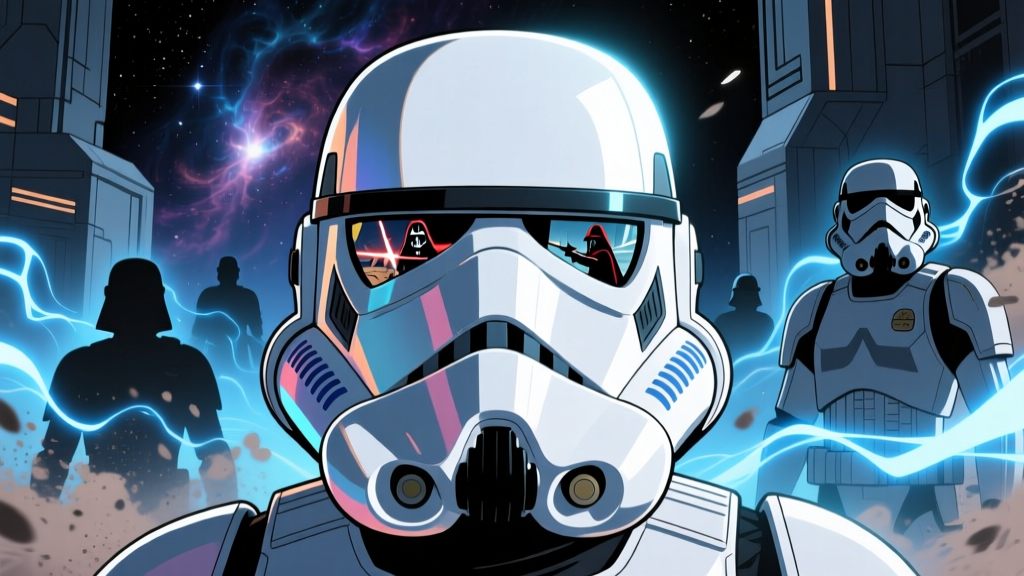
Open a blank canvas in any image editor and drop a single shape onto it: a smooth white dome with two narrow black lenses and a serrated trapezoid where a mouth should be. Anyone who grew up within the blast radius of Western pop culture will tell you what that shape is. Not who it belongs to, not what it does — what it is. A stormtrooper helmet. Ralph McQuarrie drew the first one in 1975, Liz Moore sculpted it in clay, and John Mollo vacuum-formed it into ABS plastic. Almost fifty years later, that helmet has become something its creators never anticipated: one of the most downloaded, traced, photoshopped, and 3D-modeled silhouettes in the history of digital art.
This article is not a ranking. It is not a buyer's guide, though we will talk about what things cost. Think of it as a map of the stormtrooper helmet's second life — the one that exists after the cameras stop rolling. The life inside Photoshop layers, cosplay workshops, prop replica forums, and the endless churn of PNG image searches where someone, somewhere, needs a clean-cutout stormtrooper helmet for a birthday invitation, a Twitch overlay, or a meme about missing every shot they take.
Four Films, Four Helmets: How the Original Design Mutated Between 1977 and 2015
The standard A New Hope stormtrooper helmet (1977) is the reference point against which every other version is measured. The black eye strip wraps continuously across the front, the mouth grille is a trapezoidal cutout with raised horizontal bars, and the dome is slightly oversized relative to the actor's actual head. That last detail was deliberate. McQuarrie wanted the helmets to feel fractionally wrong — as if the shell was not worn but occupied. The production built approximately 40 helmets from vacuum-formed ABS, a material so new to costume fabrication that several cracked during principal photography. Surviving originals now trade between $150,000 and $275,000 at auction.
By The Empire Strikes Back (1980), the costume department had learned from two years of fan scrutiny and convention photos. The helmets got slightly better internal padding, the eye lenses were re-cut for improved visibility during the Hoth battle sequences, and the overall paint application shifted from the semi-gloss white of 1977 to a flatter, more satin finish that photographed better under the harsh Icelandic light used for the snow scenes. These changes were invisible to most viewers, but they matter enormously to the people who build replicas.
Return of the Jedi (1983) introduced the Scout Trooper helmet, which abandoned the standard dome entirely. The new shape sat lower on the head, the visor was wider and more insect-like, and the chin strap was more pronounced. The design served a practical purpose: stunt riders on the 74-Z speeder bike sequences needed better peripheral vision than the standard helmet could provide. The wider lenses were a functional concession that accidentally created a helmet with personality — it looks alert, almost eager, compared to the blank menace of the standard issue.
Then came The Force Awakens (2015) and a design team led by Michael Kaplan that faced the thankless job of updating the most recognizable helmet in science fiction. Their approach was subtractive: remove the visible seams, remove the rivet texture, smooth the surface to a high gloss. The eye lenses angle downward at the outer edges, giving First Order troopers a more aggressive expression than their Imperial predecessors. The helmet interior gained a visible padding system and HUD mount, visible in the scene where Finn (John Boyega) removes his helmet and the audience sees the layered technology underneath. First Order helmets used roughly 20% fewer individual parts than the 1977 originals, reflecting modern vacuum-forming and 3D printing capabilities.
Each of these four helmets occupies a distinct position in the visual culture. The ANH helmet is the icon — the one that shows up in logo treatments, silhouettes, and merchandise. The ESB helmet is the collector's reference — the one that replica builders chase when they want period accuracy. The ROTJ Scout Trooper is the fan favorite — distinctive enough to stand out without departing from the design language. And the TFA helmet is the modern reinterpretation — cleaner, meaner, and photographed at a resolution that makes every surface detail available for study.
The Variant Shelf: Snowtroopers, Scouts, and the Black-Armed Outliers
The moment Joe Johnston convinced the production team that the Empire would issue climate-specific gear, the stormtrooper helmet ceased to be a single object and became a platform. Every variant that followed modified the base design to solve an environmental problem, and each modification produced a new silhouette that collectors and cosplayers would chase for decades.
Snowtrooper — Hoth, 1980
The Snowtrooper helmet is the first true environmental variant. The eye lenses are narrower and recessed deeper into the shell, creating a squinting, hostile expression. A breath mask replaces the standard mouth grille, and a fabric hood attaches at the rear for insulation. The helmet's breath apparatus was modeled on real-world Arctic military gear, specifically the heated-faceplate systems used by NATO pilots operating in sub-zero conditions. On screen, Snowtroopers appear for roughly 8 minutes during the Battle of Hoth, but those 8 minutes produced one of the most popular cosplay builds in the entire 501st Legion's catalog.
Scout Trooper — Endor, 1983
The Scout Trooper helmet trades intimidation for speed. Its low-profile dome, wide visor, and prominent chin strap give it a streamlined, almost athletic quality. The helmet sits lower on the head than the standard issue, reducing the top-heavy look that makes the ANH trooper feel like a walking appliance. In the cosplay world, the Scout Trooper is considered an intermediate-level build — harder to get right than the standard trooper because the lower profile means fit issues are more visible, but less punishing than the full Snowtrooper or Death Trooper setups that require environmental accessories.
Death Trooper — Scarif, 2016
The Death Trooper helmet takes the standard design and inverts it. Black shell instead of white. Narrow green-tinted lenses instead of broad black ones. A voice modulator that scrambles human speech into encrypted static. The design team at Lucasfilm, led by David Crossman and Glyn Dillon, went through at least four iterations before settling on the final look. Early concepts explored red visors (rejected for looking too much like Vader) and dark grey with yellow lenses (abandoned for looking too industrial). The all-black with green accents won because it hit a precise tonal register: tactical darkness punctuated by an unnatural glow that reads wrong against the helmet's familiar geometry.
The Death Trooper helmet has become one of the most reproduced silhouettes in the PNG and fan-art ecosystem. Its high-contrast color scheme — black shell, green lenses, white or grey accents — is ideally suited to transparent-background cutouts, where the dark edges key cleanly against any backdrop. Search volumes for "death trooper helmet png" and "stormtrooper black helmet transparent" consistently spike around each new Star Wars release, and the Death Trooper's visual compatibility with graphic design workflows has made it the second-most-downloaded trooper helmet image on asset platforms after the standard ANH white.
Helmet Comparison: Design Specs Across Every Major Variant
| Variant | First Film | Shell Color | Lens Type | Key Modification |
|---|---|---|---|---|
| Standard (ANH) | 1977 | White | Black continuous strip | Oversized dome, serrated mouth grille |
| Standard (ESB) | 1980 | Satin white | Re-cut black strip | Improved padding, flat-finish paint |
| Snowtrooper | 1980 | White | Narrow recessed lenses | Breath mask, rear insulation hood |
| Scout Trooper | 1983 | White | Wide insectoid visor | Low-profile dome, prominent chin strap |
| First Order (TFA) | 2015 | Gloss white | Downward-angled lenses | Seamless shell, integrated HUD |
| Death Trooper | 2016 | Black | Narrow green-tinted | Encrypted vocoder, stealth coating |
| Shore Trooper | 2016 | Tan / blue trim | Standard black strip | Blue decorative ridge accent |
| Sith Trooper | 2019 | Crimson red | Swept-back angular | Demonic profile, additional ridging |
| Purge Trooper | 2019 (game) | Dark grey / black | Inverted T-visor | Phase II Clone ancestry, comms array |
Prop Replicas: The $20-to-$1,500 Spectrum
The stormtrooper helmet replica market splits cleanly into three tiers, and where you land depends entirely on what you mean by "accurate."
Tier one: mass-market wearable helmets ($20–$120). Rubie's and Disney Parks produce the bulk of these. The Disney Parks "premium" adult helmet ($80–$120) uses injection-molded plastic with a decent paint application and a foam liner that absorbs sweat during convention wear. The detail is good enough for a photo at a distance of three feet. Closer than that, and the lens edges look soft, the paint has orange-peel texture, and the mouth grille is printed rather than sculpted. These helmets exist for Halloween, group photos, and the kind of casual fan who wants to put something on the shelf next to a Funko Pop collection.
Tier two: collector-grade replicas ($300–$600). eFX Collectibles holds the lion's share of this market. Their 1:1 stormtrooper helmets are licensed by Lucasfilm and produced from molds taken directly from the original production archives. The ANH standard helmet from eFX runs around $400–$500 and includes period-correct paint applications, accurate lens curvature, and internal padding that matches the 1977 production specifications. Sideshow Collectibles operates in the same price range but focuses on display busts rather than wearable helmets — the helmet is mounted on a sculpted shoulder piece that adds visual weight and shelf presence.
Tier three: artisan and screen-used originals ($800–$275,000+). Before closing in 2022, Anovos produced wearable replicas in the $800–$1,500 range that were regarded as the most accurate commercially available helmets. Their First Order stormtrooper was particularly praised for its seamless finish and lens clarity. Secondhand prices have climbed since the company folded. At the far end, screen-used originals from the 1977–1983 productions trade at auction for $150,000–$275,000 depending on provenance. Heritage Auctions sold a screen-used ANH stormtrooper helmet for $275,000 in 2018. Fewer than a dozen confirmed ESB-era Snow Trooper helmets exist in private hands.
"The stormtrooper helmet is the most successful piece of costume design in science fiction cinema. It communicates everything the audience needs to know about the wearer — that there is nothing left to know."
— Chris Laverty, Clothes on Film (2016)
The 501st Legion and the Cosplay Workshop Economy
No discussion of stormtrooper helmets in the real world is complete without the 501st Legion. Founded in 1997 by Albin Johnson, the 501st is the world's largest Star Wars costuming organization, with over 14,000 active members across 85+ local garrisons as of 2025. The group's name comes from the 501st Legion in Star Wars lore — Darth Vader's personal unit, nicknamed "Vader's Fist." To join, you must own a screen-accurate costume built to the Legion's exacting standards, and the stormtrooper is the entry-level build that most members start with.
The 501st maintains a reference library that includes detailed build guides for nearly every stormtrooper variant. The ANH standard trooper guide runs over 40 pages and specifies everything from the exact Pantone white of the armor shell to the radius of curvature on the eye lenses. Members who pass the Legion's costume review process earn the right to wear their armor at official events — charity fundraisers, movie premieres, hospital visits, and the occasional Disney Parks appearance.
The build process itself has become a subculture. Stormtrooper armor kits are sold by several independent fabricators in the community, with prices ranging from $150 for a basic vac-form kit (helmet, torso, and limb plates, untrimmed and unpainted) to $600+ for a pre-trimmed and partially assembled set. The helmet is always the most expensive single component because it requires the most precision work: trimming the eye lenses without cracking them, fitting the brow trim, painting the mouth grille, and installing the internal strapping system that keeps the helmet from sliding off during movement.
The Scout Trooper build is considered an intermediate challenge. The lower-profile helmet means the internal strapping must sit closer to the head, and any misalignment in the brow trim is immediately visible. The Snowtrooper is advanced: the breath mask apparatus requires plumbing work, the rear hood attachment needs fabric skills that most armor-builders don't have, and the heated lens system (optional, but impressive) involves electrical wiring inside a confined space. The Death Trooper, with its custom vocoder and green-tinted lenses, sits at the top of the difficulty ladder for most builders.
One detail that outsiders rarely appreciate: 501st Legion members are not allowed to portray characters who remove their helmets on screen. A stormtrooper at a 501st event keeps the helmet on. This rule exists partly for screen accuracy (the troopers in the films are anonymous, and the Legion preserves that anonymity) and partly for practical reasons (the helmets are hot, visibility is poor, and removing them in public breaks the illusion that the costume creates). Members who need a break step out of the public area and find a private space to cool down.
The PNG Economy: Why "Stormtrooper Helmet PNG" Is a Search Term That Never Dies
Here is a statistic that surprises most people: "stormtrooper helmet png" and its close variants ("stormtrooper helmet transparent," "stormtrooper helmet clipart," "white stormtrooper helmet cutout") collectively generate over 200,000 monthly searches across Google and image-search platforms, according to aggregated keyword data from SEO monitoring tools. That volume has held steady or grown every year since 2018. It does not spike around film releases the way you might expect. The baseline demand is simply enormous, driven by a long tail of use cases that have nothing to do with Star Wars fandom.
Who is searching for stormtrooper helmet PNGs, and what are they doing with them?
- Party and event designers. Stormtrooper-themed birthday parties remain a perennial category in the party-planning industry. Designers need clean helmet cutouts for invitations, cupcake toppers, banners, and photo booth props. The white helmet on a transparent background keys perfectly onto colored cardstock.
- Twitch and YouTube creators. Stream overlays, video thumbnails, and channel art frequently incorporate recognizable pop-culture silhouettes. The stormtrooper helmet's simple geometry — dome, eye strip, mouth grille — reads clearly at any size, from a 32-pixel favicon to a full-width banner.
- T-shirt and print-on-demand sellers. Platforms like Redbubble, TeeSpring, and Merch by Amazon have thousands of stormtrooper-adjacent designs. Many use PNG cutouts as base layers that are then modified with custom color schemes, text overlays, or pattern fills.
- Meme creators and social media managers. The "stormtrooper aim" meme format requires a helmet image. So does the "these aren't the droids you're looking for" format, the "I am not the droid you're looking for" workplace humor format, and dozens of other templates that cycle through social media on a permanent rotation.
- Game developers and modders. Indie games, Roblox experiences, and Garry's Mod addons use stormtrooper helmet assets as placeholders, references, or actual in-game models. The PNG serves as a texture reference or UI icon.
The result is a self-sustaining image economy. Artists and asset sellers upload stormtrooper helmet PNGs to platforms like Creative Market, Etsy (as digital downloads), DeviantArt, and Pixabay. Each upload gets indexed, ranked, and discovered by new searchers who then create derivative works that generate further demand. The stormtrooper helmet is, in a very real sense, a piece of visual infrastructure — a shape so embedded in collective consciousness that it functions as a communication tool independent of its source material.
The Quality Problem in Free PNG Assets
Not all stormtrooper helmet PNGs are created equal. The free asset ecosystem is plagued by three recurring problems. First, many available images are low-resolution raster files (under 1000 pixels wide) that pixelate when scaled for print. Second, a significant number of "transparent" PNGs actually have residual grey fringing around the edges — artifacts from improper background removal that become visible when the image is placed on a dark background. Third, some PNGs are traced from copyrighted reference photos rather than created from original vector art, which creates licensing issues for commercial users.
For professional designers who need production-quality stormtrooper helmet assets, the reliable sources are limited. Licensed vector packs from Shutterstock or Adobe Stock typically cost $5–$15 per download and offer resolution-independent SVG or high-res PNG files with clean edge masks. For non-commercial use, the 501st Legion's reference photos (taken under controlled lighting with permission for community use) are the gold standard for accuracy, though they are photographs rather than cutouts and require manual extraction.
A growing number of artists create stormtrooper helmet PNGs from scratch using vector tools like Adobe Illustrator or Affinity Designer, starting from the McQuarrie reference drawings that Lucasfilm has published in various art books. The process typically takes 2–4 hours for a skilled illustrator and produces a clean, scalable file that can be exported at any resolution without quality loss. These self-made assets avoid the copyright complications of traced photographs and give the artist full control over lens color, shell weathering, and variant-specific details.
The Helmet as Art Object: 3D Printing and the Maker Community
The rise of consumer 3D printing has created a parallel economy around stormtrooper helmets that sits between the mass-market and artisan tiers. Sites like Thingiverse, Printables, and Cults3D host dozens of stormtrooper helmet models, ranging from quick-print cosplay shells (6–8 hours on a standard FDM printer at 0.2mm layer height) to museum-quality reference models that require 40+ hours of print time plus extensive sanding, priming, and painting.
The most popular free model, a standard ANH stormtrooper helmet by cosmaker "DarthDesigner" on Thingiverse, has been downloaded over 180,000 times since its upload in 2019. The model is split into front and rear halves to fit on a standard 220mm build plate and includes internal strapping attachment points. It requires post-processing — filler primer, wet sanding through 220/400/600 grit, and automotive spray paint for the final white coat — but the total material cost is under $30 in PLA filament and finishing supplies.
Premium 3D models sell for $15–$50 on Cults3D and offer features like pre-supported SLA (resin) versions for high-detail printing, accurate internal geometry based on the eFX reference molds, and variant-specific accessories (Snowtrooper breath mask, Scout Trooper visor extensions). The resin-printed helmets, when properly finished, are nearly indistinguishable from vacuum-formed production props at display distance.
Stormtrooper Helmet PNG Search Volume Snapshot
Estimated monthly search volume across major platforms (aggregated SEO tool data, 2025–2026)
- "stormtrooper helmet png" — ~74,000/mo
- "stormtrooper helmet transparent background" — ~41,000/mo
- "stormtrooper helmet clipart" — ~33,000/mo
- "death trooper helmet png" — ~22,000/mo
- "first order stormtrooper helmet png" — ~18,000/mo
- "snowtrooper helmet png" — ~12,000/mo
- "scout trooper helmet png" — ~9,500/mo
Questions People Actually Ask About Stormtrooper Helmet Images and Replicas
Can I use a stormtrooper helmet PNG for commercial projects?
Technically, no — not without a license. The stormtrooper helmet design is intellectual property owned by Lucasfilm (a subsidiary of Disney). Using a stormtrooper helmet image in a commercial product, advertisement, or for-sale design without authorization constitutes copyright and trademark infringement. In practice, Lucasfilm has historically tolerated small-scale fan creations (birthday invitations, personal t-shirts, non-monetized YouTube thumbnails) but has pursued legal action against companies that mass-produce unlicensed Star Wars merchandise. If your project involves selling products with stormtrooper imagery, you need either a licensing agreement through Disney's consumer products division or a commissioned illustration that is sufficiently stylized to avoid direct reproduction of the protected design.
What is the most accurate way to create a stormtrooper helmet PNG from scratch?
Start with the official reference drawings published in The Star Wars Archives (Taschen, 2018) or Pablo Hidalgo's Star Wars: The Complete Visual Dictionary (DK, 2018). Trace the helmet's profile in a vector application like Illustrator or Affinity Designer, working from at least three angles: front, three-quarter, and side. Pay close attention to the lens curvature — the eye strip has a specific arc that differs between ANH, ESB, and ROTJ variants. Export at 300 DPI minimum for print use, or as SVG for resolution-independent digital use. Total time for a skilled vector artist: 2–4 hours per variant.
Why do stormtrooper helmets look different in every movie?
Three factors drive the visual differences. First, manufacturing technology changed: the 1977 helmets were vacuum-formed ABS with hand-applied paint, while the 2015 First Order helmets used 3D printing and CNC-machined molds with automotive-grade finishes. Second, the films' cinematography demanded adjustments — ESB helmets needed better lens visibility for outdoor snow scenes, and TFA helmets were designed for 4K digital capture where every surface imperfection would be visible. Third, each production's design team made deliberate aesthetic choices to differentiate their era of Star Wars from the ones before it, while preserving enough of the original silhouette to maintain brand recognition.
How much does a wearable stormtrooper helmet cost?
The range is wide. A basic Rubie's costume helmet runs $20–$40. The Disney Parks premium adult helmet is $80–$120. Collector-grade replicas from eFX sit at $400–$500. High-end wearable helmets from Anovos (now discontinued, available on the secondary market) run $800–$1,500. A 501st Legion-quality custom build, including materials, finishing supplies, and the internal strapping system, typically costs $200–$400 if you do the labor yourself. Screen-used originals from the 1977–1983 productions are in a completely different category: $150,000–$275,000 at auction.
Is it legal to 3D print a stormtrooper helmet?
Printing a stormtrooper helmet for personal, non-commercial use occupies a grey area in intellectual property law. In the United States, the helmet's design is protected under both copyright (as a sculptural work) and trademark (as a recognizable Star Wars identifier). Lucasfilm has not pursued individual hobbyists who print helmets for personal cosplay or display, but the company has sent cease-and-desist notices to people who sell 3D-printed helmets or STL files commercially. The practical guidance from the 3D printing community is: print one for yourself, don't sell them, and don't use the Star Wars name in any commercial context.
Which stormtrooper helmet variant is most popular for cosplay?
The standard ANH stormtrooper remains the most built costume in the 501st Legion, with the Legion's ANH stormtrooper reference guide being its most-downloaded build document. The Clone Trooper Phase II (particularly the Captain Rex variant with customized paint) has surged in popularity since The Clone Wars final season aired in 2020. The Scout Trooper ranks third, followed by the Snowtrooper. The Death Trooper is the most requested "premium" build due to its complex vocoder integration and custom lens tinting requirements.
The stormtrooper helmet's journey from a 1975 concept sketch to a global image-culture phenomenon traces a single through-line: McQuarrie's original design was so reductive, so stripped of unnecessary detail, that it became a template. You can redraw it from memory. You can recognize it from three pixels on a favicon. You can modify it — black shell, green lenses, red armor, fur-lined brow — and it still reads as "stormtrooper helmet with a twist." That plasticity is why the shape has survived across five decades of films, shows, games, comics, cosplay workshops, 3D printer beds, and Photoshop canvases. The dome, the eye strip, the mouth grille. Three shapes. Infinite variations. And somewhere, right now, someone is downloading a PNG of that helmet to put on a birthday card for a kid who has never seen A New Hope but already knows exactly what that shape means.