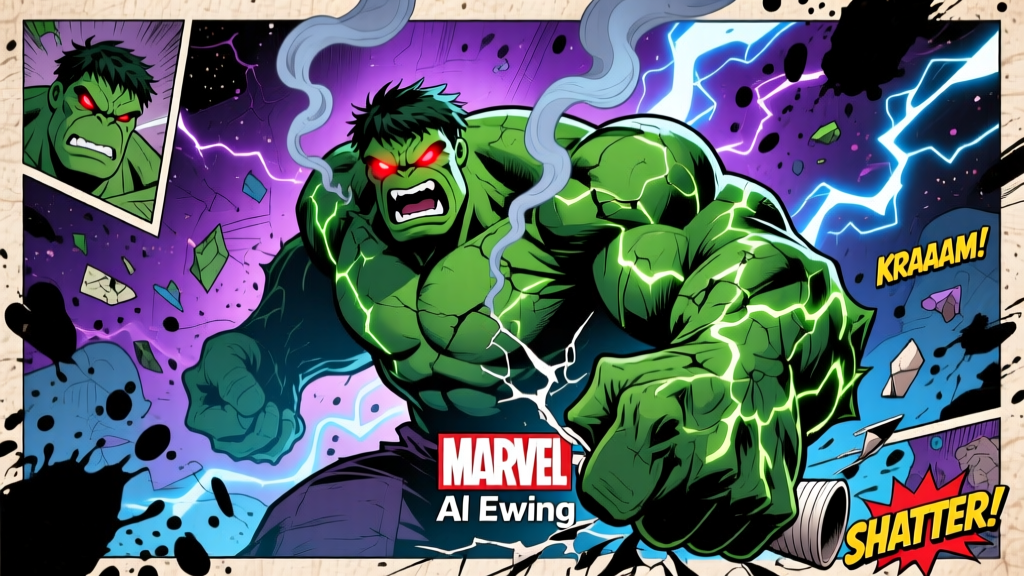
Picture this: Bruce Banner is dead. Shot through the skull by Hawkeye during Civil War II, buried six feet under, and yet—when the sun goes down, his corpse crawls out of the grave. No triumphant orchestral swell. No heroic narration. Just rotting flesh knitting itself back together under a sickly green glow while Banner's half-decomposed face stares out at the reader with something between confusion and hunger. That single image, from The Immortal Hulk #1 (June 2018), announced to every comic reader paying attention that this was not their parents' Hulk book.
Writer Al Ewing, paired with artist Joe Bennett, launched the immortal hulk comic series as part of Marvel's "Fresh Start" initiative, but what emerged over 50 issues and nearly three years was something far stranger and far more ambitious than a typical superhero relaunch. Ewing fused body horror, cosmic theology, psychological fragmentation, and social commentary into a run that critics and fans now routinely rank alongside Peter David's legendary 12-year Hulk tenure and Greg Pak's Planet Hulk saga.
The Green Door: Death Is No Longer an Exit
At the heart of Ewing's mythology sits a concept so elegantly simple it feels like it should have existed all along: the Green Door. Every gamma-mutated being on Earth is connected to it. When a gamma creature dies, they don't stay dead. They pass through the Green Door and come back—changed, angrier, and often physically distorted in ways that reflect whatever psychological wound defined them in life.
The Green Door is not a metaphor. Within the comic's internal logic, it functions as a literal gateway between the living world and the Below-Place—a dimension of pure, primordial gamma energy that predates the Marvel Universe itself. Ewing positioned it as older than the One Above All, older than the cosmic hierarchy that governs entities like Eternity and the Living Tribunal. The Below-Place is the basement of reality, and the Green Door is its only entrance.
Banner discovers this the hard way. Across the first arc, he dies multiple times—shot, dismembered, dissolved in acid—and each time he returns through the Green Door, his body reassembled but subtly wrong. A finger too long. A jaw that unhinges. Eyes that glow faintly in the dark even when Banner is in human form. The horror isn't just that he can't die. It's that every resurrection erodes whatever boundary still separates Bruce Banner from the thing living inside him.
"I used to think the Hulk was the monster and Bruce Banner was the man. But the Green Door showed me the truth. The Hulk was always the one behind the wheel. Banner was just the cage." — Bruce Banner, The Immortal Hulk #12
The Below-Place and Marvel's Cosmic Hierarchy
Before Ewing's run, gamma radiation in the Marvel Universe was treated as a scientific phenomenon—dangerous, unpredictable, but fundamentally explicable through physics. Ewing reframed it as something closer to a religious force. The Below-Place is not simply a dimension; it is the source of all gamma energy, a realm of raw, unfiltered rage that existed before creation and will persist after it ends.
This theological reframing had consequences that rippled through the broader Marvel continuity. The One Below All—the malevolent entity dwelling at the bottom of the Below-Place—was established as the dark counterpart to the One Above All, Marvel's stand-in for a supreme creator deity. Where the One Above All creates, the One Below All devours. And the Hulk, it turns out, is its chosen instrument.
Ewing layered this mythology gradually. Early issues drop only oblique references: a shadow in the corner of a panel, a whispered phrase ("He who is below"), a recurring symbol that looks like a gamma-irradiated ouroboros. By issue #25, the full architecture is visible, and it recontextualizes everything that came before. Banner isn't just cursed with an anger problem. He is a cosmic pawn in a war between creation and annihilation that has been running since the first atoms fused.
The Devil Hulk: The Persona Nobody Expected
Among the most startling additions to Banner's already crowded internal parliament was the Devil Hulk—a persona that manifests not as a raging beast or a mindless brute, but as a calm, articulate, and deeply sinister figure who speaks in measured sentences and views Banner with something resembling paternal contempt. The Devil Hulk is the Below-Place's direct avatar, and he wants Banner to stop fighting and simply let go.
What makes the Devil Hulk genuinely unsettling is that he makes reasonable arguments. He points out that Banner's life has been one long parade of suffering, betrayal, and self-destruction. He offers an end to the pain. He doesn't roar. He negotiates. And in several issues, he's the most sympathetic voice in the room—which is precisely what makes him dangerous.
Joe Bennett's Artwork: Flesh as Landscape
No discussion of this run works without centering Joe Bennett's contribution. Bennett drew the majority of the 50-issue run, and his art style shifted dramatically to match Ewing's escalating horror. Early issues feature relatively conventional superhero anatomy. By the middle arcs, bodies twist, stretch, and rupture in ways that recall H.R. Giger more than Jack Kirby. Bennett's Hulk becomes less a man and more a geography of muscle, sinew, and exposed bone—a walking wound that refuses to close.
The color work by Paul Mounts deserves separate mention. The palette leans heavily into bruised purples, jaundiced yellows, and that signature gamma green, which Mounts renders not as a heroic glow but as something closer to radiation sickness. The Below-Place sequences abandon recognizable color altogether, opting for voids of flat black interrupted only by the faintest suggestion of green light at impossible distances.
Storylines That Redefined the Character
Ewing structured the run around several extended arcs, each one peeling back another layer of the Hulk mythology while pushing Banner into progressively more extreme situations.
"Or Die" (Issues #1–5) established the new status quo. Banner is murdered on live television by a gamma-powered villain, resurrects that night, and goes on a revenge spree that reads more like a slasher film than a superhero comic. The arc ends with the revelation that the Green Door exists and that Banner is no longer the only one aware of it.
"The Green Door" (Issues #6–11) introduced the concept of gamma cults—groups of humans who deliberately expose themselves to radiation in pursuit of immortality. Ewing used this arc to explore the intersection of faith, addiction, and body horror, with Banner caught between stopping the cults and understanding why their belief system isn't entirely wrong.
"Hell in a Cell" (Issues #12–20) saw the U.S. government weaponize the Green Door concept, creating a military program designed to produce immortal soldiers. The arc features some of the run's most graphic body horror sequences, including a scene where a gamma-enhanced soldier's body attempts to regenerate while simultaneously being incinerated—a visual that stays with you.
"The One Below All" (Issues #25–33) is where the mythology fully crystallizes. Banner descends into the Below-Place itself, confronts the entity at its core, and learns that every gamma mutation in Marvel history traces back to a single cosmic event. This arc also features the return of several classic Hulk villains—the Leader, the Abomination, the U-Foes—all reimagined through Ewing's horror lens.
"The Best Defense" and Final Arc (Issues #40–50) brought the run to a close with a cosmic-scale confrontation that pitted Banner against the full weight of the One Below All's plan. The ending is ambiguous, tragic, and strangely hopeful—a tonal tightrope that Ewing walks with the confidence of a writer who has been building toward this moment since page one.
Across the full 50-issue span, the run produced ten trade paperback volumes, each collecting five issues. The recommended reading order, along with each volume's primary thematic focus:
- Vol. 1 — Or Die (Issues #1–5): Resurrection mechanics, revenge narrative
- Vol. 2 — The Green Door (Issues #6–10): Gamma cults, faith, and addiction
- Vol. 3 — Fantastic Book (Issues #11–15): Government weaponization, body horror
- Vol. 4 — Abomination (Issues #16–20): Classic villain returns, psychological fracture
- Vol. 5 — Breakthrough (Issues #21–25): Mythology expansion, cosmic foreshadowing
- Vol. 6 — Perspective (Issues #26–30): The Below-Place revealed, moral ambiguity
- Vol. 7 — Hulk in Hell (Issues #31–35): Direct confrontation with the One Below All
- Vol. 8 — Arms and the Devil (Issues #36–40): Devil Hulk ascendant, Banner's identity crisis
- Vol. 9 — The One Below All (Issues #41–45): Cosmic-scale confrontation
- Vol. 10 — The End (Issues #46–50): Resolution, sacrifice, and the open door
Critical Reception and Industry Impact
The immortal hulk comic was a critical darling almost from the moment it launched. The series earned an Eisner Award nomination for Best Continuing Series in 2019, and Ewing received a separate nomination for Best Writer. Individual issues consistently appeared on year-end "best of" lists from outlets including IGN, Polygon, and The Beat.
Sales data told an equally compelling story. According to Diamond Comic Distributors, the series opened at approximately 86,000 copies for issue #1 and maintained unusually strong retention through its first year, averaging above 50,000 copies per issue—a remarkable figure for a character title in the late 2010s direct market, where most ongoing series struggled to hold 30,000 readers past their sixth issue.
Trade paperback collections performed even better. The first volume, Or Die, appeared on the New York Times graphic books bestseller list for four consecutive weeks in early 2019, and subsequent volumes maintained strong bookstore and online sales through the run's conclusion in 2021.
| Detail | Information |
|---|---|
| Writer | Al Ewing |
| Primary Artist | Joe Bennett (issues #1–47, #50) |
| Colorist | Paul Mounts |
| Issues Published | 50 (June 2018 – October 2021) |
| Publisher | Marvel Comics |
| Genre | Superhero / Body Horror / Cosmic Theology |
| Eisner Nominations | Best Continuing Series (2019), Best Writer — Al Ewing (2019) |
| First Issue Sales | ~86,000 copies (Diamond, 2018) |
| Collected Editions | 10 trade paperbacks; 2 omnibus editions |
How It Stacks Up Against Other Hulk Runs
Comparing Ewing's immortal hulk comic to its predecessors reveals just how dramatically the series departed from convention. Peter David's run (1987–1998) leaned into humor, psychological complexity, and the "Professor Hulk" merged-personality concept. It treated Banner's dissociative identity disorder as a puzzle to be solved. Greg Pak's Planet Hulk (2006–2007) reframed the character as a gladiator-king, exploring themes of empire and revolution on an alien world. Both were celebrated for expanding what a Hulk comic could be.
Ewing's contribution was to ask a question neither predecessor had fully confronted: What if being the Hulk is actually horrifying? Not tragic. Not complicated. Viscerally, existentially horrifying. The body horror elements—Banner's flesh splitting open to reveal the Hulk underneath, gamma mutations warping human anatomy beyond recognition, the dead walking—aren't just aesthetic choices. They're the thesis statement. This is a comic about what happens when the superhero body becomes a prison, and the only escape route leads through a door you'd rather not open.
The tonal contrast is stark. Where David's Hulk could be funny and Pak's Hulk could be noble, Ewing's Hulk is a monster in the classical sense—something you encounter in the dark and pray you survive. And yet, across 50 issues, Ewing never loses sight of the fact that the monster is also Bruce Banner, a man who has spent his entire life trying to do the right thing despite every force in the universe conspiring to make that impossible.
The Ensemble Beyond Banner
While Banner anchors the narrative, Ewing built a supporting cast that elevates the run from a strong character study to a fully realized world.
- Jackie McGee — A reporter for a small-town newspaper who pursues Banner across the country. She functions as the reader's surrogate, asking the questions we want answered and reacting with appropriate horror when she gets them. McGee's own arc—from skeptic to reluctant believer to active participant—is one of the run's most satisfying character trajectories.
- The Leader (Samuel Sterns) — Reimagined as a far more threatening presence than his traditional portrayal. Ewing's Leader is less a mad scientist and more a gamma prophet, a man who has seen the Below-Place and returned with a plan that is simultaneously brilliant and insane.
- Betty Ross / Red Harpy — Betty's transformation into the Red Harpy is one of the run's most visually striking developments. Bennett's design—part bird, part woman, part gamma nightmare—became an instant fan favorite and a staple of Marvel merchandise almost immediately.
- Rick Jones — Banner's oldest friend returns in a role that is equal parts tragic and pivotal. Jones's connection to gamma energy, established decades earlier in Incredible Hulk #1, takes on new significance in Ewing's cosmology.
- General Fortean — The government antagonist who pursues Banner with a zeal that borders on religious obsession. Fortean represents the institutional response to gamma phenomena: control it, weaponize it, or destroy it.
The Social Commentary Beneath the Horror
Ewing has never been a writer who shies away from politics, and the immortal hulk comic embeds social critique in ways that feel organic rather than preachy. The series opens with Banner being killed by a celebrity superhero (Hawkeye) in front of a live audience—a scene that reads as a direct commentary on the spectacle of violence in American culture. Throughout the run, gamma mutations disproportionately affect marginalized communities: the poor, the unhoused, immigrants. The government's response to gamma threats consistently mirrors real-world failures in disaster response and public health policy.
One particularly pointed arc involves a small town where a gamma leak from a military facility has been quietly poisoning residents for years. The cover-up, the bureaucratic stonewalling, and the eventual exposure by investigative journalism echo the Flint water crisis and the Camp Lejeune contamination scandal with uncomfortable specificity. Ewing doesn't name these events directly, but the parallels are unmistakable—and they ground the cosmic horror in recognizable, lived experience.
The run also engages with Banner's own identity in ways that reflect shifting cultural conversations. Earlier Hulk comics treated Banner's transformation as a metaphor for repressed male anger. Ewing expands this, framing Banner's multiplicity—his many Hulks, his fractured selves—as something closer to a genuine exploration of dissociative identity disorder, informed by contemporary psychiatric understanding rather than the pop-psychology shortcuts of earlier eras.
Legacy and Influence on the Hulk Character
Since the run's conclusion in October 2021, the mythology Ewing established has become foundational to how subsequent writers approach the Hulk. The Green Door, the Below-Place, and the One Below All are now permanent fixtures of Marvel's cosmic architecture, referenced in titles ranging from She-Hulk to Ghost Rider to the 2023 Incredible Hulk relaunch by Phillip Kennedy Johnson.
More importantly, Ewing proved that a Hulk comic could be literary. Not just well-written—many Hulk runs have featured strong prose—but genuinely literary in its ambitions: a work that uses superhero genre conventions to explore questions about mortality, identity, faith, and the nature of evil. The critical conversation around the run consistently invokes names like Alan Moore and Grant Morrison, and that comparison is not hyperbole. Ewing did for the Hulk what Moore did for Swamp Thing: took a character that most readers had written off as simple and revealed the depth that had been there all along, waiting for someone willing to dig.
Trade collections of the immortal hulk comic continue to sell steadily. As of 2025, the complete omnibus editions remain in print—a rarity for modern Marvel runs, many of which go out of print within a few years. The series has been translated into at least nine languages, with particularly strong sales in the French and Japanese markets, where the horror elements resonated with readers already steeped in those countries' rich traditions of body horror manga and bande dessinée.
Frequently Asked Questions
Do I need to read previous Hulk comics before starting The Immortal Hulk?
No. Ewing designed the series as an accessible entry point. While longtime readers will catch references to classic storylines (particularly Peter David's run and World War Hulk), the narrative provides enough context within its own pages that new readers can follow the story from issue #1 without feeling lost. That said, familiarity with Civil War II—where Banner is killed—adds emotional weight to the opening arc.
Is The Immortal Hulk appropriate for younger readers?
Not particularly. The series is rated T+ (Teen and Up) by Marvel, but the body horror content is intense and sustained. Dismemberment, regeneration sequences, psychological torture, and graphic violence appear regularly. Parents should exercise judgment; this is closer to a Stephen King novel than a typical superhero comic in terms of content intensity.
What is the reading order for the collected editions?
The series was collected into ten trade paperbacks, released sequentially: Or Die, The Green Door, Fantastic Book, Abomination, Breakthrough, Perspective, Hulk in Hell, Arms and the Devil, The One Below All, and The End. Two omnibus volumes collect the complete series with additional material. Reading in publication order is strongly recommended, as the mythology builds cumulatively.
How does the Green Door connect to other Marvel cosmic entities?
Ewing positioned the Below-Place as the foundation beneath Marvel's entire cosmic hierarchy. The One Below All is the dark counterpart to the One Above All (the supreme being in Marvel cosmology). The Green Door connects to other gamma-powered characters across Marvel, including She-Hulk, the Abomination, the Leader, and the Red Hulk. This framework has since been adopted by other writers, making it a permanent element of Marvel's cosmic mythology.
Will there be a continuation or sequel to The Immortal Hulk?
As of mid-2026, there is no officially announced direct sequel. However, Ewing has continued to write Hulk-adjacent stories, and the mythology established in this run remains active in Marvel continuity. The 2023 Incredible Hulk series by Phillip Kennedy Johnson explicitly builds on Ewing's framework, particularly the Green Door and Below-Place concepts. Fans hoping for Ewing's return to the character should follow his ongoing work, as he has expressed interest in revisiting the mythology.
The Immortal Hulk proved that a green rage monster could carry a horror masterpiece. Fifty issues later, the door is still open—and something beneath it is still watching.