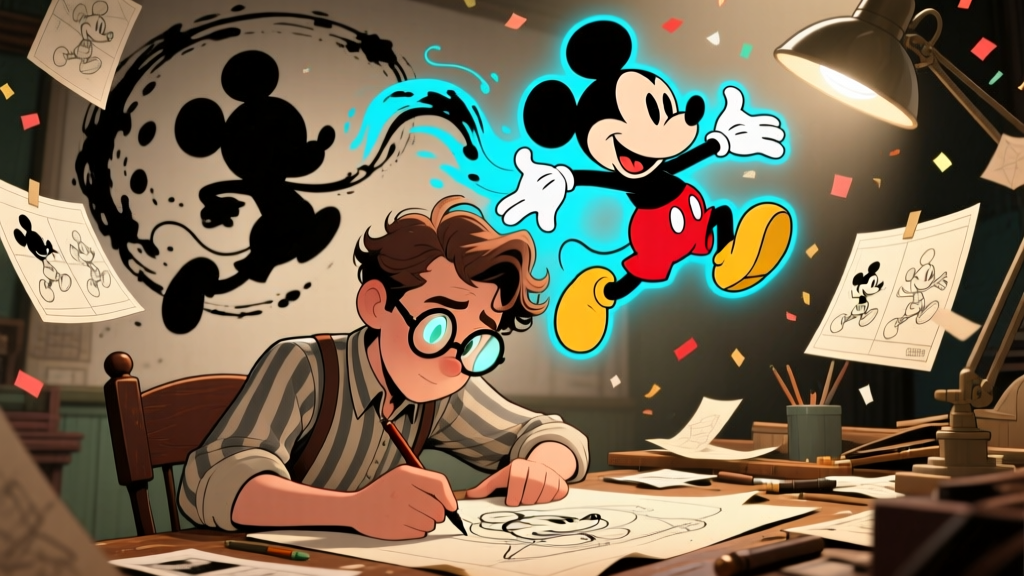
The photograph is black and white, probably from 1932 or 1933. Walt Disney sits at a drafting table, pen in hand, surrounded by stacks of glossy 8x10 prints. On each print, a small Mickey Mouse grins with the pie-cut eyes and rubber-hose limbs of the early shorts. Walt signs them one after another — not his legal signature, but a version of it, looser and rounder, the letters almost bouncing off the page. He would do this for hours some days, fulfilling requests from fans who had written to the Hyperion Avenue studio by the thousands.
That image — a man signing a cartoon mouse into existence over and over — captures something essential about the relationship between creator, character, and audience. The signature mickey is not one thing. It never was. It is a knot of handwriting, commerce, fandom, and corporate identity that has been unraveling and retying itself for nearly a century.
What follows is an attempt to untangle that knot.
The Hands Behind the Autograph: Walt, His Secretaries, and the Ghost Signers
Here is the first uncomfortable fact about Mickey Mouse signatures: Walt Disney did not draw Mickey Mouse. Ub Iwerks, the Kansas City animator who co-created the character, designed Mickey's original appearance and animated the earliest shorts almost single-handedly. Walt provided the voice and the vision, but the pencil work belonged to Iwerks. So when fans began asking for "a drawing of Mickey by Walt Disney" in the early 1930s, the studio faced a problem.
Walt could sign his name. He could even produce a passable sketch of Mickey — a simplified, publicity-friendly version with round ears and a crescent smile. But he could not draw the character at the quality fans expected from the man whose name was on the door. The solution was a system of delegation that would become one of the most fascinating (and occasionally controversial) practices in entertainment memorabilia history.
Four categories of Disney signatures
According to autograph authentication experts and the research compiled by Disney historian Brad Kay, there are effectively four distinct categories of "Walt Disney" signatures that appear on Mickey Mouse artwork and memorabilia:
- Walt's own hand — The genuine article. Walt personally signed items, particularly in the 1930s and early 1940s, often inscribing photos and prints with short dedications. His handwriting was distinctive: a flowing script with an exaggerated capital "D" and a long, sweeping underline. He reportedly practiced his signature as a young man, studying the penmanship styles popular in early 20th-century America.
- Secretary signatures — As fan mail volume exploded (the studio received an estimated 8,000 letters per week by 1935, per the Walt Disney Family Museum), Walt's secretaries began signing his name on photographs and printed cards sent to fans. These secretary-signed items were considered "authorized" but were not autopen or stamp reproductions — they were hand-written by staff who had been trained to mimic Walt's script.
- Artist signatures (Hank Porter, Bob Moore) — When fans requested original Mickey Mouse drawings, the studio assigned artists to produce them. Hank Porter, a Disney ink-and-paint artist, became so skilled at replicating Walt's signature on Mickey Mouse sketches that his hand is nearly indistinguishable from the real thing. Bob Moore, a later studio artist, served a similar role. Both men signed "Walt Disney" on artwork they themselves had drawn.
- Corporate/stamped signatures — Beginning in the 1950s, and accelerating after Walt's death in 1966, the Disney corporation used rubber stamps, autopen machines, and eventually digital reproductions of Walt's signature on merchandise, lithographs, and promotional materials.
"Walt's signature is very complicated for collectors. You have to understand the era, the medium, and who was working in the ink-and-paint department at the time. A 1934 Mickey sketch with a secretary's signature is still a genuine Disney studio product — it just wasn't signed by Walt himself." — Brad Kay, Disney signature researcher, 2018
This layered system means that authentication of a "signed Mickey Mouse" item requires understanding not just handwriting analysis but studio production history. A sketch from 1931 with a simplified Mickey and Walt's genuine signature is a different artifact entirely from a 1952 publicity still signed by Bob Moore on Walt's behalf — even though both carry the name "Walt Disney."
Mickey Mouse Autographs at the Parks: A Culture Built on Pen and Paper
When Disneyland opened in July 1955, the autograph tradition moved from the mailroom to the midway. Character performers — cast members in Mickey Mouse, Goofy, and Cinderella costumes — began signing autograph books for guests as part of the meet-and-greet experience. Mickey's autograph, rendered in a bouncy, oversized script with a distinctive looped "M," became the most requested signature in the park.
The practice was never officially mandated by Walt, but it fit his philosophy of guest interaction. "Disneyland is like a movie set," he told a reporter in 1959. "Every guest should feel like they're part of the show." A personalized autograph from Mickey Mouse — handed across a table to a five-year-old by a cast member in a four-fingered glove — was theater of the most intimate kind.
By the 1970s, Disney parks were selling branded autograph books at every gift shop. The standard book, priced at roughly $2.50 in 1975 (about $14.50 in 2026 dollars after inflation), contained blank pages with Mickey and friends printed on the cover. Guests would carry these books from land to land, collecting signatures the way philatelists collected stamps. The culture was self-sustaining: children watched other children get autographs and demanded the same.
The training behind each signature
Every character performer underwent specific autograph training. Mickey's signature, for instance, was taught as a sequence of strokes — not freehand lettering. Performers learned a prescribed pattern: a looping "M," a rounded "i" dot, a sweeping "y" tail. The result was remarkable consistency across thousands of performers and millions of signatures, though subtle variations still existed. Experienced collectors can sometimes identify which "era" of a performer's tenure produced a given autograph based on stroke weight and letter proportions.
Disney's internal training materials — occasionally surfaced through former cast members — described the character signatures as performance art in miniature. Each signature had to look like the character "wrote" it. Mickey's was cheerful and round. Donald Duck's was scratchy and slightly chaotic (a nice touch given his temperament). Goofy's was loose and almost illegible. The design logic was sound: if a guest's experience was supposed to feel like meeting the actual character, the autograph needed to reinforce that illusion down to the pen strokes.
"A personalized autograph from Mickey Mouse — handed across a table to a five-year-old by a cast member in a four-fingered glove — was theater of the most intimate kind."What Signed Mickey Mouse Items Actually Sell For
The market for Mickey Mouse autographs and signed memorabilia spans an enormous range, from $20 commemorative prints to five-figure auction lots. The value depends on a matrix of factors: who signed it, when, on what medium, and whether the item carries provenance documentation.
Heritage Auctions and RR Auction, two firms that regularly handle Disney memorabilia, have published results that sketch the landscape. A signed dye transfer print of Mickey Mouse, personally inscribed by Walt Disney in the 1940s, sold through Nate D. Sanders Auction for $7,753. A signed Disney studio check — not Mickey-specific, but bearing Walt's genuine hand — realized $8,750 at the same house. On the lower end, limited-edition Mickey Mouse lithographs with stamped "Walt Disney" signatures typically sell in the $150–$400 range at auction, while original production animation cels from Mickey shorts (unsigned, but studio-authenticated) have crossed $10,000 at Sotheby's.
| Item Type | Signature Type | Approximate Era | Sale Price / Est. Value |
|---|---|---|---|
| Dye transfer print, personally inscribed by Walt | Walt Disney (hand-signed) | 1940s | $7,753 (Nate D. Sanders Auction) |
| Studio check with signature | Walt Disney (hand-signed) | 1950s–60s | $8,750 (auction record) |
| Mickey Mouse publicity drawing | Artist-signed (Hank Porter era) | 1930s–40s | $2,500–$5,500 |
| Limited-edition Mickey lithograph | Stamped / printed signature | 1980s–90s | $150–$400 |
| Production animation cel (unsigned) | Studio-authenticated, no signature | 1930s–50s | $5,000–$15,000+ |
| Theme park autograph book page (Mickey) | Cast member in-character signature | 1970s–present | $15–$75 (secondary market) |
| Walt Disney signed personal letter | Walt Disney (hand-signed) | Various | $4,538–$8,750 |
| Mickey Mouse Christmas card (studio-issued) | Walt Disney or secretary | 1930s–40s | $800–$3,000 |
The gap between a genuine Walt-signed Mickey item and a secretary-signed one is significant in dollar terms — often a factor of three to five — but both categories remain actively collected. The secretary-signed items are not considered "fakes" in the traditional sense; they were authorized studio products. The distinction matters to serious collectors but less so to casual buyers who simply want a piece of the Mickey Mouse legacy on their wall.
The Signature as Brand: From Handwriting to Corporate Identity
There is a second meaning to "Mickey Mouse signature" that has nothing to do with ink on paper. The stylized Walt Disney script — that looping, instantly recognizable lettering — is itself one of the most valuable signatures in commercial history. And it may not actually be Walt's handwriting at all.
The Disney logo font, widely known as "Waltograph," was adapted from a stylized interpretation of Walt's signature, but typographic historians note that the version used on film titles and park signage was refined by graphic artists. The flowing script with its exaggerated loops and connected letterforms became the corporate identity of The Walt Disney Company, appearing on everything from film opening credits to resort hotel facades. Disney filed trademark applications for the Mickey Mouse character design as early as the 1930s, but the signature-as-logo became a formal brand asset decades later.
This creates an interesting overlap in collector culture. A piece of paper bearing the "Walt Disney" script could be:
- An actual autograph by Walt Disney himself
- A signature by one of his trained secretaries
- A reproduction used as a corporate branding element
- A modern printed logo that bears no relationship to any human hand
All four versions look remarkably similar to the untrained eye. Authentication services like PSA/DNA and JSA (James Spence Authentication) have developed specific protocols for Disney material, often requiring comparison against known exemplars from particular time periods. Walt's signature evolved noticeably between the 1930s and the 1960s — the later version was more compact, with a smaller "D" and tighter letterforms — which provides at least some chronological anchors for authentication work.
Signature art and the Mickey Mouse aesthetic
Beyond authentication and commerce, the Mickey Mouse signature occupies a genuine place in American graphic art. The image of Walt's pen hovering over a Mickey sketch — reproduced in countless biographies, documentaries, and museum exhibits — has become a visual shorthand for the creative act itself. The Walt Disney Family Museum in San Francisco displays original signed sketches as centerpiece artifacts, treating them with the same curatorial care given to animation cels and production backgrounds.
Contemporary calligraphers and lettering artists have studied the Disney signature style as a case study in personal branding through penmanship. The exaggerated "D," the sweeping underline, the connected letterforms that suggest both playfulness and authority — these are deliberate design choices, whether Walt made them consciously or simply developed them through years of repetition. Typography classes at design schools sometimes use the Disney script as an example of how a signature can transcend its author to become a standalone visual symbol.
The Slow Fade: How Mickey Autograph Culture Changed
Something shifted in the 2010s. Disney parks began reducing character meet-and-greet opportunities, partly due to staffing costs and partly due to a strategic pivot toward ride-based experiences and digital engagement. The tradition of carrying an autograph book through the parks — once as ubiquitous as wearing mouse ears — declined noticeably. A 2023 analysis by WDWInfo.com noted that despite Disney continuing to sell autograph books at park gift shops, the actual practice of collecting character signatures had diminished to the point where many younger visitors had never participated in it.
The pandemic accelerated this trend. When Disney parks reopened in 2020 and 2021, character interactions were initially limited to distanced wave-and-photo encounters. No autographs. No hugs. By the time full meet-and-greets returned, the habit had partly broken. A generation of children had grown up without the autograph book ritual.
But here is where the story takes an unexpected turn: the decline of the in-park autograph has increased the value and cultural weight of older signed items. Mickey Mouse autograph books from the 1970s and 1980s — once considered kitschy souvenirs worth a few dollars at yard sales — now sell to collectors for $50 to $200, depending on the completeness and condition of the signatures inside. A fully filled book with legible Mickey, Minnie, Donald, and Goofy signatures from, say, a 1982 visit to EPCOT Center carries a specific kind of historical weight. It is a document of a ritual that may be disappearing.
What collectors look for now
The current market for Mickey Mouse signed items rewards specificity:
- Provenance matters more than ever. A signed Mickey sketch with a letter of provenance — identifying the original recipient, the circumstances of the signing, and ideally a photo of the signing event — commands premiums of 40% to 100% over comparable items without documentation.
- Era-specific signatures are in demand. Collectors who specialize in pre-1940 Disney material will pay more for a Hank Porter-era sketch, even knowing Walt didn't sign it personally, because the Porter sketches represent a specific chapter in studio history.
- Theme park autographs are a growing niche. As the tradition fades, early park autographs — particularly from the 1955–1970 period when Disneyland was new and the character performer program was still being refined — have attracted a new wave of collectors who view them as folk art.
- Condition and legibility drive value. A Mickey Mouse signature that is bold, complete (full character name, not just "Mickey"), and free of smudging will always outperform a faded or partial example of equivalent age.
The Mickey Mouse Signature in Popular Culture
The cultural footprint of the Mickey Mouse signature extends well beyond the collector's market. It appears in films, literature, and everyday conversation as a symbol — sometimes affectionate, sometimes sardonic — of American cultural dominance.
In legal and business contexts, the phrase "Mickey Mouse" has been used dismissively to describe something trivial or unserious ("a Mickey Mouse operation"). But the signature itself — Walt's flowing script, the character's round-eared silhouette — carries an opposite connotation: meticulous craft, obsessive quality control, and one of the most successful entertainment empires ever built. The tension between these two meanings is part of what makes the signature so culturally resonant.
When Walt Disney appeared on television in the 1950s and 1960s as the avuncular host of "The Wonderful World of Disney," he occasionally signed items on camera. These televised signings — rare, documented, and often preserved by viewers — have become some of the most sought-after items in the Disney autograph market. A photograph or film still capturing Walt in the act of signing a Mickey Mouse drawing carries the dual value of an authenticated signature and a documented provenance moment.
The signature also lives on in unexpected places. Disney resorts around the world incorporate Walt's script into architectural details — etched into glass, cast in bronze, carved into stone. At Shanghai Disneyland, which opened in 2016, the signature appears in design elements throughout the park, connecting a 21st-century Chinese theme park to a 1930s Los Angeles animation studio through nothing more than a handwritten name.
What Makes a Mickey Mouse Signature Worth Keeping
If you have inherited a signed Mickey Mouse item or are considering purchasing one, a few practical guidelines emerge from the collector community and authentication professionals:
- Do not clean or restore signed items. A smudged signature that has aged naturally is worth more than one that has been "touched up" or chemically treated. Conservation, not restoration, is the standard.
- Get a professional opinion before selling. PSA/DNA, JSA, and Beckett Authentication Services all evaluate Disney material. The cost of a written authentication ($50–$150 for most items) is almost always justified by the increase in sale price that accompanies a certificate of authenticity.
- Store signed paper items flat, in acid-free sleeves, away from direct light. UV exposure fades ink rapidly. A Mickey Mouse sketch signed in fountain pen ink in 1936 can remain vivid if stored properly, but a few months in a sunlit frame will cause irreversible fading.
- Document what you know. If the item has a family story — "my grandmother got this at a Disney studio tour in 1948" — write it down and keep it with the item. Oral history becomes provenance when committed to paper.
Frequently Asked Questions
How do I know if my Mickey Mouse signed item is authentic?
Authentication requires comparing the signature against known exemplars from the relevant time period. Professional services like PSA/DNA and JSA specialize in this. Key factors include ink type, paper stock, handwriting characteristics, and provenance. Items from the 1930s–40s may be signed by studio artists like Hank Porter rather than Walt himself — these are still genuine Disney studio products, just not personal Walt autographs.
Why didn't Walt Disney draw Mickey Mouse himself?
Walt was a visionary storyteller and businessman, but not a skilled draftsman. Ub Iwerks, his longtime collaborator, designed and animated Mickey's earliest appearances. Walt could produce a simplified sketch for publicity purposes, but the detailed drawings fans requested required professional animators. The studio system of having artists draw Mickey and Walt sign (or have someone sign for him) began in the early 1930s.
Are Disney park character autographs worth anything?
Yes, though values are modest compared to Walt-signed items. Individual Mickey Mouse signatures from theme park meet-and-greets typically sell for $15–$75 on the secondary market. Fully filled autograph books from earlier eras (1950s–1980s) can reach $50–$200. As the autograph tradition declines, these items are gaining interest among collectors who view them as cultural artifacts.
What is the "Waltograph" font, and is it Walt's real handwriting?
Waltograph is a typeface based on the stylized version of Walt Disney's signature, refined by graphic designers for corporate use. While inspired by Walt's handwriting, the version used in Disney's logo and film titles was cleaned up and standardized by artists. The actual Walt Disney signature evolved over his lifetime and looked different from the corporate font in several respects — notably in the proportions of the capital letters and the tightness of the connecting strokes.
Is it still possible to get Mickey Mouse autographs at Disney parks?
Yes, character meet-and-greets still exist at Disney parks worldwide, and performers still sign autograph books. However, the practice has declined significantly since its peak in the 1980s and 1990s. Availability varies by park, season, and character schedule. Some character dining experiences and special events offer more reliable autograph opportunities than standard park admission.
What is the most expensive Mickey Mouse signed item ever sold?
Among publicly reported sales, Walt Disney-signed Mickey Mouse items have reached the $7,000–$10,000 range at major auction houses. Original production animation cels from Mickey Mouse shorts — unsigned but studio-authenticated — have sold for $15,000 and above at Sotheby's and Heritage Auctions. Private sales of exceptionally rare items (such as signed early sketches from the Steamboat Willie era) are rumored to have exceeded these figures, but details are rarely disclosed.
The Mickey Mouse signature is, in the end, many things at once: a man's handwriting, a corporation's trademark, a performer's trained gesture, a child's treasure, and a collector's obsession. It began as one animator's attempt to meet an overwhelming demand — a flood of letters from people who believed that somewhere behind that cheerful mouse was a man who would take the time to write back. Maybe he did. Maybe his secretary did. Maybe it was Hank Porter, working the late shift at Hyperion Avenue, drawing Mickey's round ears one more time and signing another man's name at the bottom.
It doesn't diminish the magic to know the truth. If anything, it deepens it. The Mickey Mouse signature is proof that some symbols are bigger than the hands that make them — and that the impulse to reach across a table, or through a letter, or across a theme park midway, and leave a mark that says I was here, and you mattered — that impulse is as real as any autograph ever written.