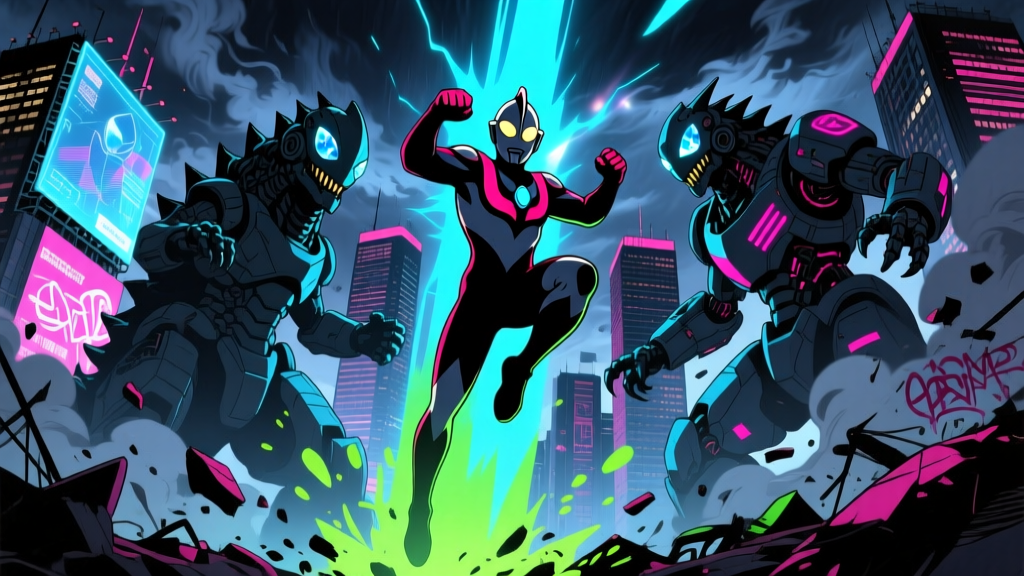
There's a shot early in Ultraman: Rising where Neronga tears through a Tokyo power substation, arcs of blue-white electricity whipping off its horn and scattering across wet asphalt like a downed power line in a typhoon. The camera sits low, almost street-level, and for three seconds you forget you're watching a Netflix CG animation. You're twelve years old again, cross-legged on the carpet, watching VHS grain make rubber suits look like nightmares. That's the trick Shannon Tindle and John Aoshima pulled off with this film: the kaiju feel real in a way that most live-action blockbusters haven't managed in decades.
When Netflix and Tsuburaya Productions announced a 3DCG-animated Ultraman feature handled by Industrial Light & Magic Vancouver, the tokusatsu community split roughly in half. One side saw potential. The other saw betrayal—no suitmation, no miniature cities, no guy in a wetsuit roundhouse-kicking a man in a foam lizard costume. But the film's June 14, 2024 debut silenced most skeptics, largely because the ultraman rising kaiju themselves carried so much of the film's emotional and visual weight. They weren't just threats to be punched. They were characters, some of them sympathetic, all of them designed with a specificity that honored sixty years of Tsuburaya's monster-making tradition.
Gigantron: The Weapon That Became a Mother
Let's start with the film's biggest creature and its most complicated one. Gigantron stands 42 meters tall and weighs 70,000 metric tonnes, according to the film's official specs on the Ultra Wiki. That puts it in the same weight class as the original Ultraman's heaviest adversaries from the 1966 series—deliberate, since the design team wanted audiences to feel the same gravitational dread that suitmation footage used to deliver when a monster's footstep shook the camera.
Gigantron's silhouette reads as a fusion between organic muscle mass and industrial plating. The chest cavity is armored, the shoulders are broad and angular, and the head features a blunt, almost shovel-shaped snout that recalls the bestial simplicity of classic Showa-era kaiju like Red King or Bemular. But where a rubber suit would have visible seams and zipper lines, ILM's CG work gives Gigantron a bio-mechanical texture that suggests something grown in a laboratory and then grafted with weaponry. The creature's origins in the film confirm that suspicion: Gigantron was engineered by the Kaiju Defense Force as a living weapon, an organism designed for military application rather than evolved through natural selection.
The narrative bomb drops when Gigantron's egg—yes, the weaponized kaiju laid an egg—falls into Ken Sato's hands. That egg hatches into Emi, an 8-meter, 12,000-tonne infant creature that imprints on Ultraman and turns a monster-fighting superhero story into a single-parent dramedy. It's the film's smartest move. Every tokusatsu fan has seen heroes punch kaiju until they fall down. Very few have seen a hero change a kaiju's diaper at 3 AM while the KDF is trying to confiscate it.
Mecha Gigantron: When the Weapon Gets Upgraded
The film's third act escalates in a way that feels earned rather than manufactured. Gigantron undergoes a forced mechanical augmentation, becoming Mecha Gigantron—a full-body weaponization that strips away the organic warmth and replaces it with cold, articulated steel. Think of it as the film's answer to the Mechagodzilla archetype: take something alive and make it a machine. The transformation is horrifying in context because the audience has spent the entire runtime watching Emi, Gigantron's offspring, learn to trust humans. Mecha Gigantron represents what happens when humans betray that trust.
From a design standpoint, Mecha Gigantron trades the original's earthy, moss-covered hide for gunmetal plating with exposed hydraulic joints. The color palette shifts from muted browns and greens to cold greys and weapon-bay blacks, with glowing red accents around the eye sockets that read as targeting systems. The Ultraman Wiki merchandise listings confirm that the Mecha Gigantron Ultra Action Figure includes an "Ultra Slash" right-hand attachment, reflecting the blade weapon integrated into its forearm in the film's climax.
Neronga: A 1966 Classic Gets a Voltage Upgrade
If Gigantron is the film's original creation, Neronga is its love letter to the source material. The original Neronga appeared in episode 3 of the 1966 Ultraman television series, where it fed on electricity and could render itself invisible by absorbing enough current. Tsuburaya's suit team built the creature with a transparent, frilled head crest and a single forward-pointing horn, giving it an appearance somewhere between a prehistoric ceratopsian and an overgrown gecko.
The Rising version keeps the horn and the electricity theme but rebuilds everything else for a modern animated format. The head crest is more defined, almost crystalline, and the body mass has been thickened to convey weight in a medium where characters don't have the natural heft of physical suits. Where the 1966 Neronga looked like it could be scared off by a bright light, the 2024 Neronga looks like it could level a city block by sneezing near a power grid. The electricity-absorption ability remains its signature move: in the film's early battle sequence, Neronga drains a Tokyo substation dry, plunging an entire district into blackout while Ultraman scrambles to fight in the dark.
This is where the animation format earns its keep. In live-action tokusatsu, electrical effects are traditionally achieved with sparklers, flash pots, and post-production compositing—effective on a 1966 budget, but always visibly artificial. ILM's CG pipeline lets electricity behave like actual electricity: branching, crackling, pooling in puddles and racing along metal surfaces with physically-accurate arc patterns. When Neronga fires a concentrated bolt from its horn, the light scatter on surrounding buildings is ray-traced, not composited. The result is a kaiju that looks like it belongs in its environment rather than being pasted on top of it.
Other Kaiju Appearances
The film doesn't limit itself to two monsters. Bemular, the very first kaiju Ultraman ever fought in the 1966 series premiere, makes an appearance as well. Its inclusion is pure fan service in the best sense—Bemular's original design was one of the most recognizable in tokusatsu history, a spiky, winged creature with a jaw that split open vertically. The Rising version respects those core features while adding articulated wing joints and more detailed scale texturing that you simply couldn't achieve with a rubber suit in a soundstage.
Gomora also appears, though in a more limited capacity. Gomora's crescent-shaped horns and burrowing abilities have made it one of Ultraman's most recurring adversaries since its debut in episode 25 of the original series, and its presence in Rising reinforces the film's commitment to pulling from the Showa-era roster rather than inventing an entirely new bestiary.
The Kaiju Defense Force: Bureaucracy With Claws
Every Ultraman story needs a human organization that either helps or hinders the hero, and the Kaiju Defense Force (KDF) fills that role in Rising with a moral ambiguity that elevates the material. Led by Mina Kuroda (voiced by Tamlyn Tomita), the KDF presents itself as Tokyo's shield against kaiju attacks. They've got the funding, the technology, the PR machine. They also created Gigantron.
That last detail is the film's central political tension. The KDF isn't simply defending against kaiju—they're manufacturing them. Gigantron was a KDF project: a bio-engineered kaiju weapon designed to give humanity a controllable deterrent. The ethical implications get brushed under the rug until Gigantron's egg hatches and the KDF wants Emi back. Suddenly the organization that's supposed to be protecting Tokyo is demanding custody of an infant creature that has bonded with its would-be rescuer.
This dynamic gives the kaiju battles a weight they wouldn't otherwise carry. When Ultraman fights a rogue kaiju, he's protecting the city. When he fights the KDF's attempts to reclaim Emi, he's protecting a child. The distinction matters, and the film knows it. The KDF's mecha and weapon systems are designed with a clean, militaristic aesthetic—sharp angles, matte olive color schemes, visible serial numbers—that contrasts with the organic, almost hand-crafted look of the kaiju themselves. It's a visual argument: the monsters are natural, the weapons are artificial, and the line between defending and exploiting has been crossed.
A production note worth mentioning: ILM Vancouver built over 1,300 individual assets for the film, including kaiju textures, city environments, and particle effects. Tania Richard from the ILM team described the approach as "embracing a more creative, painterly approach," specifically citing anime and manga as visual references. That cross-pollination between Western CG animation technique and Japanese visual storytelling tradition is visible in every kaiju design in the film.Design Philosophy: Old DNA in a New Medium
Tindle's background as a character designer for Kubo and the Two Strings and ParaNorman at Laika gave him an instinct for physicality in animation—the sense that characters occupy space and have mass. That instinct translated directly to how the ultraman rising kaiju move and interact with their environment. When Gigantron steps, the ground deforms. When Neronga whips its tail, debris scatters with directional momentum rather than generic explosion patterns.
The design team also made deliberate choices about scale communication. In classic tokusatsu, the 1/25 scale miniatures used for city sets gave kaiju an inherent sense of enormity because the camera was always looking up. CG animation loses that forced perspective unless the cinematography actively recreates it. Rising's camera department—virtual, obviously, since it's all CG—frequently positions the lens at street level or rooftop height during kaiju scenes, preserving the low-angle grandeur that defined the genre's visual grammar for fifty years. The kaiju don't just look big. They look tall.
Color palette decisions also bridge old and new. Gigantron's base form uses the earthy browns and mossy greens that dominated Showa-era kaiju costuming, colors chosen in the 1960s because they photographed well on film and suggested organic, prehistoric origins. Neronga's electric blue accents update the original's simpler palette but maintain the yellow-green base that made the 1966 design recognizable. Even Mecha Gigantron's cold grey-and-red scheme echoes Mechagodzilla's iconic 1974 colorway from Godzilla vs. Mechagodzilla. None of these choices are accidental. They're a design vocabulary that tokusatsu-literate audiences read instinctively.
Kaiju by the Numbers
| Kaiju | First Appearance | Height | Weight | Role in Rising | Signature Ability |
|---|---|---|---|---|---|
| Gigantron | Ultraman: Rising (2024) | 42 m | 70,000 t | Bio-engineered kaiju weapon; Emi's biological parent | Massive physical strength; bio-mechanical durability |
| Mecha Gigantron | Ultraman: Rising (2024) | 42 m (augmented) | 85,000 t (est.) | Forced mechanical augmentation of Gigantron; final boss | Ultra Slash arm blade; weaponized energy projection |
| Emi | Ultraman: Rising (2024) | 8 m | 12,000 t | Gigantron hatchling; Ken Sato's foster child | Energy projection (developing); emotional bond with Ultraman |
| Neronga | Ultraman Ep. 3 (1966) | ~38 m | ~40,000 t | Early antagonist; Tokyo power grid attack | Electricity absorption; invisibility via current drain |
| Bemular | Ultraman Ep. 1 (1966) | ~50 m | ~25,000 t | Supporting kaiju antagonist | Flight; energy beam emission from mouth |
| Gomora | Ultraman Ep. 25 (1966) | ~40 m | ~20,000 t | Limited appearance; classic roster inclusion | Burrowing; crescent horn shockwave attacks |
| Height and weight figures sourced from the Ultra Wiki and official film specifications. Classic kaiju stats reflect original 1966 series data; Rising versions may vary slightly in on-screen depiction. | |||||
Merchandise and Collectibles: Bringing the Kaiju Home
Bandai timed the Ultraman: Rising merchandise line to land in stores ahead of the film's June 14, 2024 Netflix premiere, a rollout strategy that mirrors how Tsuburaya has handled toy licensing since the original series in the 1960s. The kaiju have always been as much toy designs as they are film characters, and Rising is no exception.
Ultra Action Figure Line
The 6-inch Ultra Action Figure series anchors the collection at $24.99 per figure. Each figure includes 16+ points of articulation, which is a notable step up from the traditional 5-point articulation of the Ultra Hero Series sofvi figures. The Ultraman (Rising) figure ships with two beam effect accessories, while the Gigantron figure captures the creature's base form before its Mecha augmentation. A 1966 Ultraman figure rounds out the line, bridging the film's modern aesthetic with the franchise's roots. For collectors who've been buying Ultra Action Figures since the line's 2016 launch, the Rising entries sit comfortably alongside the broader collection while standing out visually due to their CG-model-based sculpting rather than the traditional suit-based sculpts.
Sofvi Series
At the budget-friendly end, the 5-inch Sofvi Series ranges from $10.99 to $12.99 and covers the widest kaiju roster from the film. Emi gets her own sofvi release, naturally, and she's the figure that sold fastest in most markets—the baby kaiju factor is real, and parents buying for younger children drove significant volume. Gigantron, Neronga, Gomora, and both versions of Ultraman (1966 and Rising) complete the lineup. The sofvi figures include hang tags designed to evoke vintage Bandai packaging, a nostalgia play that targets adult collectors who grew up with the toyline in the 1990s.
Deluxe Figures and Blind Boxes
For display-oriented collectors, the 12-inch Deluxe figures offer the most screen-accurate sculpts in the range, with larger accessories and more detailed paint applications. At the opposite end, 2-inch blind box figures provide an affordable entry point and encourage repeat purchases through randomized assortments. The blind box format has become standard practice for Bandai's character merchandise lines, and Rising's recognizable kaiju roster makes for satisfying pulls—nobody's getting stuck with a character they don't recognize.
Collector's note: The GigaBash video game added an Ultraman: Rising DLC pack featuring both Ultraman and Emi as a duo fighter, with Emi perching on Ultraman's shoulder and firing projectile attacks. The crossover between film, toys, and gaming gives the kaiju a merchandising footprint that extends well beyond the screen.Why the Kaiju Matter More Than the Hero
Here's something that might sound contrarian but isn't: the best Ultraman stories have always been more about the kaiju than about Ultraman himself. The 1966 series is remembered for its monster roster—Gomora, Red King, Zetton, Neronga—not for the Science Patrol's dialogue. Shin Ultraman (2022) generated most of its discussion around its reimagined kaiju designs, particularly the body-horror take on Mephilas. The franchise's cultural DNA lives in its creatures.
Ultraman: Rising understands this instinctively. Emi isn't a sidekick or a mascot. She's the film's emotional core, the reason Ken Sato's character arc resolves, and the creature that forces the KDF's moral contradictions into the open. Gigantron isn't just a boss fight. It's a parent separated from its child by a military bureaucracy that views living things as assets. Neronga isn't just a Thursday-night monster-of-the-week. It's a 58-year-old character given new life through animation technology that makes its electrical powers feel genuinely dangerous for the first time.
The film asks a question that most tokusatsu productions dance around: what happens to the kaiju after the hero wins? In a typical Ultraman episode, the monster dies or retreats, and the episode ends. Rising lingers. It asks what a kaiju's life looks like when it's not actively destroying a city, and the answer—it looks like a confused infant who wants to be held—is the most emotionally honest thing the franchise has produced since the original series ended in 1967.
Questions Collectors and Fans Actually Ask
Is the Gigantron in Ultraman: Rising the same as the original Gigantron from the 1960s?
No. The Gigantron in Rising is an original design created specifically for this film. The name evokes the classic tokusatsu naming convention (think Gigan, Magmatron, etc.), but the creature's bio-mechanical weapon origin and its role as Emi's parent are unique to this production. Don't go digging through 1960s episode guides looking for it.
Why does Neronga look so different from the 1966 version?
The original Neronga was a rubber suit built on a modified Baragon suit base, which gave it a somewhat lumpy, rounded appearance. The Rising version reinterprets those core features—the horn, the head crest, the electricity absorption—through CG modeling that adds crystalline texture detail and a more anatomically coherent body structure. It's the same character, just translated from foam latex to polygon meshes.
Will there be more Ultraman: Rising kaiju in future films or series?
Netflix has not confirmed a direct sequel as of early 2026, though the film's positive reception and the unresolved tension between the KDF and kaiju welfare leave obvious narrative doors open. Tindle has discussed the possibility of continuing the story in interviews, and the merchandise line's commercial performance supports further investment.
Where can I buy Ultraman: Rising kaiju figures outside Japan?
Bandai distributes the Ultra Action Figure and Sofvi lines globally through major retailers including Amazon, Walmart, and specialty hobby shops. The Japanese-market Bandai Toy releases sometimes feature different packaging or exclusive accessories, so collectors monitoring Bandai's official toy portal may spot variants not available through Western distribution channels.
Is Emi based on any classic Ultraman kaiju?
Emi is a Gigantron hatchling, so she inherits her biological design from the film's Gigantron rather than from any pre-existing kaiju in Tsuburaya's catalog. That said, the "cute baby kaiju" concept has deep roots in tokusatsu—think of the various baby Godzilla incarnations or the sympathetic creature-of-the-week format from the original Ultraman series (Pigmon being the most famous example). Emi is a spiritual successor to that tradition, even though her specific design is new.
How accurate are the Bandai figures to the on-screen designs?
The Ultra Action Figures are sculpted directly from ILM's CG models, which gives them a level of screen accuracy that suit-based sculpts can't always match. The trade-off is that CG-to-physical translations sometimes lose fine surface detail at 6-inch scale, particularly on Gigantron's bio-mechanical textures. The larger 12-inch Deluxe figures retain more of that detail, while the sofvi figures prioritize playability and durability over exact replication.