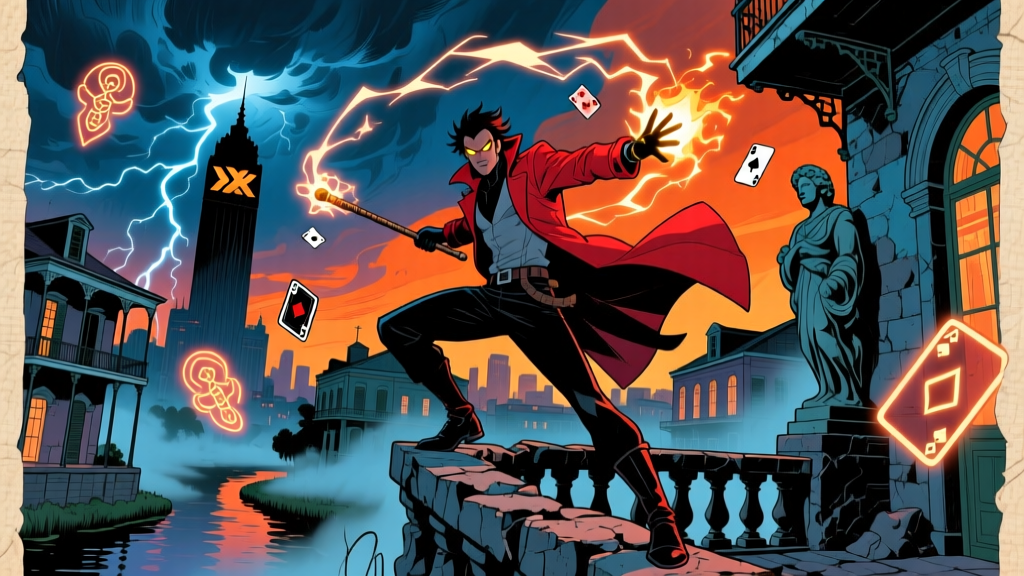
The first time you see him, he's leaning against a wall in a back-alley card game in Madripoor. Brown trench coat draped over his shoulders like he's got all the time in the world. A cigarette between his fingers. A deck of cards that glows faintly pink. He doesn't look like a hero. He doesn't look like a villain either. He looks like someone who's going to take your money and somehow make you thank him for it. That was August 1990, and nothing about the X-Men would feel quite the same again.
Gambit — Remy Etienne LeBeau — didn't arrive in the X-Men universe with a grand entrance or a moral speech about mutant rights. He showed up as a thief with a code, a Cajun accent thick enough to choke on, and a power set that turned a deck of Bicycle playing cards into some of the most visually explosive weaponry Marvel had ever put on a page. For a generation of readers who picked up Uncanny X-Men in the early '90s, Gambit was the character who made the book feel dangerous again. Three decades later, the phrase "uncanny x men gambit" still sends fans straight to their long boxes.
A Door Kicked Open in Madripoor: The Debut in Uncanny X-Men #266
Chris Claremont wrote the issue. Mike Collins did the pencils. But the character design — that long coat, those glowing red-on-black eyes behind the mask, the staff, the cards — that was Jim Lee's contribution, and it landed like a bomb. Uncanny X-Men #266 (cover-dated August 1990) introduced Gambit not as a new X-Man but as a wild card in the most literal sense: a thief working for the villain Mister Sinister, leading the Assassins Guild of New Orleans in the slaughter of the Morlocks beneath Manhattan.
The issue sold through enormous numbers. By most industry accounts, the X-Men titles in 1990 were already moving over a million copies per issue through the direct market, and Gambit's debut coincided with the franchise's commercial peak. Lee's art had a cinematic quality that made every panel feel like a storyboard — the way Gambit's kinetic-charged cards shattered against Storm's force field in that first Madripoor confrontation wasn't just an action sequence, it was a design statement. This character was built to look cool doing violence.
"I wanted someone who looked like he could walk out of a New Orleans jazz bar and into a knife fight without changing his expression. The trench coat gave him silhouette. The glowing eyes gave him mystery. The cards gave him something nobody else in the book could do visually." — Jim Lee, discussing Gambit's design in Wizard Magazine, 1992
What made #266 stick, though, wasn't the action. It was the voice. Claremont wrote Gambit with a dialect that was half-French, half-street, and entirely his own. "Don' be t'inkin' you can jus' walk away from Remy LeBeau," he told Rogue in their earliest exchanges — and somehow that ridiculous phonetic Cajun accent became one of the most recognizable character voices in all of comics. Readers didn't just want to see Gambit fight. They wanted to hear him talk.
The Jim Lee Factor: Red Eyes, Trench Coats, and '90s Excess
Let's be honest about what made Gambit a phenomenon in 1990 and 1991: it was at least 60% visual. Jim Lee was drawing the most commercially successful superhero art in the industry, and Gambit was his canvas for everything the '90s aesthetic demanded — long hair, sharp angles, impractical belts, and an attitude that said "I know something you don't."
Lee drew Gambit's kinetic energy as magenta and pink plasma — not the standard yellow or blue that most energy effects used in superhero comics at the time. That color choice was deliberate. It set Gambit apart on every page. When a card exploded, it didn't look like a Cyclops optic blast or a Phoenix flame. It looked like something alive, something that pulsed with a color you'd see on Bourbon Street neon at 2 AM. The kinetic charge effect became so iconic that later artists — from Steve McNiven to Clay Mann — treated it as sacred visual grammar. You don't draw Gambit's energy in any color but pink.
The character design also solved a practical problem. Gambit's eyes were hidden behind a red-on-black mask, which meant Lee didn't have to draw detailed eyes in every panel — a shortcut that worked in the character's favor because the blank, glowing eyes made him look inhuman and alluring at the same time. The brown trench coat allowed for dynamic silhouette work in action poses. The bo staff gave him a melee weapon that felt distinct from Wolverine's claws or Psylocke's blade. Every design choice served both function and style, which is why the look has barely changed in 35 years.
Visual Legacy Across Eras
- 1990–1992 (Jim Lee era): Defined the look — trench coat, mask, staff, glowing cards. Set the template everything else builds on.
- 1993–1999 (post-Lee, various artists): Slight refinements. The coat got longer in some runs. The hair got bigger. Peak '90s.
- 2001–2009 (modern era, various): Cleaner lines, less pouches. The mask became more streamlined. Kinetic effects got more detailed with digital coloring advances.
- 2019–present (Pepe Larraz, various): Krakoan-era redesigns added organic, plant-like elements to his costume. More regal, less street.
Charging Cards and Breaking Physics: How Gambit's Powers Actually Work
On paper, Gambit's mutant ability sounds almost boring: he can charge inanimate objects with kinetic energy, causing them to explode on impact. But the execution is what makes it interesting — and what has let writers find new applications for decades.
The kinetic charge isn't just "things go boom." Gambit converts potential energy into explosive kinetic force through bio-electric channeling. He touches an object — a playing card, a coin, a pool cue, a handful of gravel — and floods it with stored energy. The charged object glows with that signature pink-magenta plasma. When it strikes a target, the energy releases in a directed explosion. A single playing card can crack concrete. A full deck, thrown in sequence, can level a wall.
The constraint is contact. Gambit has to physically touch whatever he's charging, which means he needs to be close to his ammunition. This creates a built-in tension that writers have exploited endlessly: he's a ranged fighter who has to get his hands dirty first. It's why he carries a bo staff — when the cards run out or the enemy is too close, he needs a weapon that doesn't require charging.
Over the years, the power has been stretched in creative directions. He's charged the air around him to create concussive blasts. He's charged his own blood to create explosive projectiles. In the Dark Avengers run (2012–2013), a version of Gambit charged an entire building's structural supports, turning the architecture itself into a bomb. His upper limit, according to the Official Handbook of the Marvel Universe (revised edition, 2004), is approximately 268 kilojoules per charge — roughly equivalent to a small hand grenade from a single playing card.
| Application | Object Charged | Approximate Yield | First Notable Use |
|---|---|---|---|
| Standard throw | Single playing card | ~268 kJ (hand grenade equivalent) | Uncanny X-Men #266 (1990) |
| Area denial | Full deck (52 cards) | ~13.9 MJ (structural demolition) | Uncanny X-Men #273 (1991) |
| Melee enhancement | Bo staff | Concussive on contact, non-explosive | X-Men #4 (1992) |
| Improvised ordnance | Coins, gravel, debris | Variable (mass-dependent) | Gambit vol. 1 #1 (1999) |
| Structural charge | Building supports | Multi-megajoule (building collapse) | Dark Avengers #184 (2012) |
| Bio-charge (extreme) | Own blood / organic matter | Unstable, high personal cost | Gambit vol. 3 #17 (2000) |
Thieves, Guilds, and Bayou Blood: The New Orleans Backstory
Gambit's origin story is one of the more intricate character backgrounds in mainstream comics, and it took years for Marvel to reveal it in full. What we got in 1990 was a mystery: a Cajun thief with connections to the criminal underworld who wouldn't explain where he came from. What unfolded over the next decade was a story about family, guilt, and the impossible weight of a single bad decision.
Remy LeBeau was born in New Orleans. Abandoned at birth — or so the story initially went — he was taken in by the Thieves Guild, one of two rival criminal organizations (the other being the Assassins Guild) that had operated in the city for generations. The guilds were run by powerful families, and Remy was adopted by Jean-Luc LeBeau, patriarch of the Thieves Guild. He grew up learning to pick pockets before he could read, to run a con before he could drive. By his late teens, he was the best thief the guild had produced in a century.
The political machinations between the guilds eventually led to a peace arrangement: a marriage between Remy and Bella Donna Boudreaux, daughter of the Assassins Guild's leader. The wedding happened. Remy, by all accounts, genuinely loved her. But the marriage was a political tool, not a romantic choice, and when Bella Donna's brother challenged Remy to a duel and died, Remy was exiled from New Orleans. He left behind his guild, his wife, and his city.
Then came the deal with Mister Sinister. The villain approached the exiled Remy with an offer: assemble a team to clear out the Morlock tunnels beneath New York, and Sinister would wipe the exile debt clean. Remy agreed. He didn't know — or so he claimed for years — that Sinister intended to slaughter the Morlocks rather than simply relocate them. The resulting massacre, depicted retroactively in the X-Men #6 backup story (1991), haunted Gambit for the rest of his publication history. It was the stain he could never wash out, the reason his teammates looked at him differently when the truth came out during the Uncanny X-Men #350 reveal in 1997.
This backstory works because it gives Gambit a moral center that contradicts his swagger. He's not a hero who happened to learn thievery. He's a man who participated in genocide — even unknowingly — and has spent every issue since trying to prove he's more than his worst mistake. That tension is what keeps the character compelling across different creative teams and eras.
The Love Story That Couldn't Touch: Gambit and Rogue
If Gambit's debut was one of the great character introductions in '90s comics, his relationship with Rogue was one of the decade's defining romantic arcs — and it worked precisely because it was built on an impossibility.
Rogue's mutant power makes physical contact lethal: she absorbs the life force, memories, and abilities of anyone she touches. For Gambit, a character defined by charm, physicality, and seduction, this created an almost cruel dynamic. He could flirt with anyone in the room except the one woman he actually wanted. She could touch any surface in the world except his skin. The frustration was the point. Claremont and later writers — Scott Lobdell, Joe Kelly, and eventually Mike Carey — leaned into this tension relentlessly.
Their relationship developed slowly across 1991 and 1992, mostly in the pages of Uncanny X-Men and the relaunched X-Men title. What made it work wasn't grand romantic gestures. It was the accumulation of small moments: Gambit offering Rogue a card trick when she couldn't sleep. Rogue sitting closer to him on the Blackbird than she needed to. Gambit defending her from a Sentinel without hesitation, not for show, just because. The restraint made every interaction carry weight that other superhero romances lacked.
The relationship hit its dramatic peak in Uncanny X-Men #350 (November 1997), written by Scott Lobdell with art by Joe Madureira. Gambit's role in the Morlock Massacre was exposed, and Rogue — who had trusted him, who had slowly allowed herself to love him — walked away. The breakup wasn't caused by a villain or a misunderstanding. It was caused by the truth. Gambit had lied by omission, and Rogue's departure was the consequence. It was one of the more mature romantic beats Marvel had published, and readers responded to it because it didn't feel manufactured.
They reunited, of course. Superhero couples always do. The marriage finally happened in X-Men: Legacy #269 (2012), written by Mike Carey, in a ceremony on the X-Men's island nation of Krakoa — wait, no, that came later. The wedding actually took place in a small ceremony depicted in the X-Men franchise's annual, attended by a skeleton crew of characters because Marvel's editorial approach to the event was characteristically half-hearted. But the point was made: after 22 years of publication, they were married.
Key Relationship Milestones
- First meeting: Uncanny X-Men #266 (1990) — Gambit rescues Rogue from a hostile encounter in Madripoor.
- First genuine moment: Uncanny X-Men #278 (1991) — Gambit and Rogue share a quiet conversation about trust.
- First kiss: X-Men #25 (1993) — via Rogue temporarily absorbing Gambit's powers, allowing contact.
- The breakup: Uncanny X-Men #350 (1997) — Rogue learns about the Morlock Massacre.
- Reunion: Uncanny X-Men #423 (2003) — After Rogue's power fluctuation, they reconnect.
- Marriage: X-Men: Legacy #269 (2012) — Small ceremony, big payoff.
The Cajun in Other Media: Voice, Animation, and the Movie That Wasn't
Gambit's transition outside the comic page has been a story of near-misses and half-triumphs. He appeared in X-Men: The Animated Series (1992–1997), voiced by Chris Potter, and became a fan favorite despite inconsistent screen time. The show's budget couldn't always justify the kinetic card effects, so Gambit often ended up standing in the background while Wolverine did the fighting — a frustration fans vocalized loudly in the pre-internet era of letter columns and convention Q&As.
He fared better in X-Men: Evolution (2000–2003), where he was positioned as a morally ambiguous antagonist-turned-ally with a more prominent role in the show's Brotherhood-versus-X-Men dynamics. The animation style suited his kinetic effects, and the writers gave him more personality than the '90s series had managed.
But the real saga — the one that became almost mythic in its own right — was the Channing Tatum Gambit film. Announced in 2014 as a standalone solo picture, the project entered what would become one of the longest and most public development hells in modern superhero cinema. Tatum was attached to star and produce. Rupert Wyatt (Rise of the Planet of the Apes) was initially set to direct. Gore Verbinski signed on later. The script went through at least four complete rewrites. Filming dates were announced and postponed three separate times — October 2016, March 2018, and early 2019.
The film was supposed to be a heist-romance set in New Orleans, blending Gambit's guild backstory with a more grounded, street-level tone than the mainline X-Men movies. Tatum spoke publicly about his enthusiasm for the role in interviews at Comic-Con 2017, calling it "the most fun script I've read in years." The production budget was reportedly set at $154 million. Test footage leaked online in 2018 showed Gambit in the classic trench coat, charging cards in a French Quarter alley, and fan reaction was overwhelmingly positive.
Then Disney acquired 20th Century Fox in March 2019, and the film was canceled outright. The merger absorbed the X-Men film rights back into Marvel Studios, and every Fox-era X-Men project in development — Gambit, Multiple Man, X-Force, Alpha Flight — was scrapped. Tatum's reaction, posted to social media, was a single image of Gambit's playing card with the caption "RIP." It was, depending on your perspective, either the biggest missed opportunity in the X-Men film franchise or an inevitable casualty of corporate consolidation. Probably both.
Deadpool & Wolverine (2024): The Arrival Everyone Waited For
Thirty-four years after his comic debut, Gambit finally appeared in a live-action film. Channing Tatum got his shot — not in a solo movie, but in a scene-stealing supporting role in Deadpool & Wolverine (July 2024), directed by Shawn Levy. The film positioned Gambit as part of a team of Marvel characters pulled from alternate timelines and canceled projects, a meta-textual joke that the movie leaned into hard.
The casting was the story. Tatum playing Gambit after a decade of development hell was the kind of behind-the-scenes narrative that audiences connected with viscerally. His scenes in the film — particularly a sequence where he charges a deck of cards in slow motion while delivering a Cajun-accented one-liner — generated some of the movie's most shared clips on social media. The kinetic effects, rendered with modern VFX budgets, finally matched what Jim Lee had been drawing in 1990: pink-magenta plasma, cards spinning and exploding in sequence, that signature glow.
Tatum's Gambit appeared in approximately 22 minutes of screen time, according to industry tracking. It wasn't a lead role. It was a supporting turn in an ensemble film. But it was enough — enough to show what the solo movie could have been, enough to validate years of fan campaigning, and enough to establish the character in the Marvel Cinematic Universe for future appearances. The film grossed $1.338 billion worldwide, making it the highest-grossing R-rated film in history at the time of release.
The question now, as of mid-2026, is what Marvel Studios does with Gambit next. The character is established. Tatum has proven he can play the role. The MCU's mutant integration is ongoing. A solo film or Disney+ series feels inevitable — though in superhero entertainment, "inevitable" has a way of turning into "canceled" faster than a charged card hits a Sentinel's chest plate.
Gambit's Lasting Place in Uncanny X-Men — and Beyond
Strip away the trench coat and the accent and the kinetic fireworks, and what you're left with is a character built on contradiction. A thief who joined the good guys. A ladies' man who fell for the one woman he couldn't touch. A guild leader's son who spent his life running from the guild. A man who helped kill a community and dedicated himself to protecting the marginalized. Every era of Uncanny X-Men has found something different to do with those tensions, which is why Gambit hasn't faded the way other '90s characters have.
He's not Wolverine. He's not Cyclops. He's not even Storm, in terms of institutional importance to the franchise. But Gambit occupies a space that no other X-Man fills: the charming outsider, the guy who chose to be here, the mutant who had a perfectly functional (if morally complicated) life before the X-Men and decided the team was worth the trouble anyway. That choice — the decision to stay when staying is hard — is what separates a gimmick character from a lasting one. Remy LeBeau has been staying for 35 years. The cards keep glowing.
Gambit Across Publication History — By the Numbers
| Year | Title / Issue | Event / Significance | Writer / Artist |
|---|---|---|---|
| 1990 | Uncanny X-Men #266 | First appearance. Madripoor debut. | Claremont / Lee |
| 1991 | X-Men #1 | Joins Blue Team. Record-breaking issue (8.1M copies shipped). | Claremont / Lee |
| 1993 | Uncanny X-Men #297–#298 | Gambit and Rogue's early relationship development. | Lobdell / Brandon Peterson |
| 1997 | Uncanny X-Men #350 | Morlock Massacre secret revealed. Rogue leaves. | Lobdell / Madureira |
| 1999 | Gambit vol. 1 #1 | First solo series. New Orleans guild politics. | Fabian Nicieza / various |
| 2004 | Gambit vol. 2 #1 | Second solo ongoing. Heist-driven stories. | John Layman / various |
| 2012 | X-Men: Legacy #269 | Gambit and Rogue marry. | Mike Carey |
| 2012–2013 | Gambit vol. 4 (ongoing) | Solo heist adventures during AvX era. | James Asmus / various |
| 2019 | House of X / Powers of X | Krakoan era begins. Gambit's status reshaped. | Jonathan Hickman / Pepe Larraz |
| 2024 | Deadpool & Wolverine (film) | Live-action debut. Channing Tatum. $1.338B worldwide. | Shawn Levy (director) |
Frequently Asked Questions
What issue did Gambit first appear in?
Gambit debuted in Uncanny X-Men #266, cover-dated August 1990. The issue was written by Chris Claremont with pencils by Mike Collins, though the character's visual design is credited to Jim Lee, who was the primary artist on the X-Men titles at the time. Gambit appeared in a storyline set in the fictional Southeast Asian city of Madripoor, where he was introduced as a card-playing thief with connections to Mister Sinister.
What exactly are Gambit's mutant powers?
Gambit can charge inanimate objects with kinetic energy through physical contact. The charged objects — most commonly playing cards — glow with pink-magenta plasma and explode on impact. The energy output from a single card is approximately equivalent to a hand grenade (~268 kilojoules, per the Official Handbook of the Marvel Universe). He can also charge larger objects for proportionally bigger explosions, though doing so drains his stamina significantly. His powers do not work on living tissue, which means he cannot charge people or animals.
Why can't Gambit and Rogue touch each other?
Rogue's mutant power causes her to absorb the life force, memories, and abilities of anyone she makes skin contact with. Extended contact can be fatal. Since Gambit's powers require physical touch to activate and Rogue's powers trigger involuntarily on skin contact, any direct physical contact between them would be extremely dangerous. This dynamic was a central tension in their relationship from 1991 through their eventual marriage in 2012, and it's been used as a storytelling device by virtually every writer who has worked with both characters.
Did Channing Tatum ever play Gambit in a movie?
Yes — but not in the solo film that was originally planned. Tatum was attached to a standalone Gambit movie from 2014 through 2019, which went through multiple directors (Rupert Wyatt, Doug Liman, Gore Verbinski), several script rewrites, and three postponed filming schedules. The project was canceled when Disney acquired 20th Century Fox in March 2019 and reclaimed the X-Men film rights. Tatum eventually played Gambit in a supporting role in Deadpool & Wolverine (2024), directed by Shawn Levy, which grossed $1.338 billion worldwide.
Is Gambit part of the MCU now?
As of mid-2026, Gambit has appeared in one MCU-adjacent film (Deadpool & Wolverine) but has not been confirmed for any future Marvel Studios projects. The character exists within the MCU's multiverse framework, and Channing Tatum has expressed continued interest in the role. Marvel Studios has not announced a solo Gambit film or series, though industry reporting from The Hollywood Reporter and Variety has indicated that mutant-focused MCU projects are in active development as of 2025–2026.