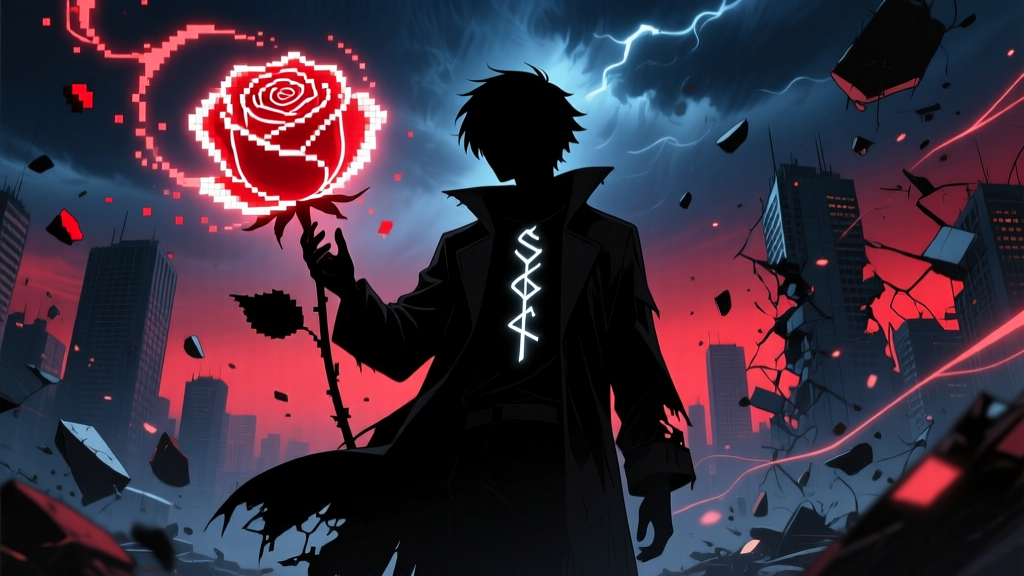
Picture this: a man who everyone assumed would die in the next five minutes walks out of a dungeon that slaughtered his entire raid party. His eyes glow blue. Shadows pool at his feet. And somewhere between 2018 and 2026, that image burned itself into the collective consciousness of roughly half the internet's anime and manga community.
Solo Leveling didn't just become popular. It became unavoidable. Scroll through any anime subreddit between 2020 and 2024 and you'd hit a Sung Jin-Woo edit within three swipes. Mention manhwa at a convention and someone, inevitably, would ask if you'd read it. The series crossed the boundary from "niche Korean webcomic" to "global cultural event" with a speed that surprised even people who'd been tracking the manhwa industry for years.
The question isn't whether Solo Leveling is big. It's why. What specific combination of storytelling, artistry, and cultural timing turned a serialized web novel from a Korean platform called Munpia into a phenomenon that packed theaters for anime screenings in North America, Europe, and Southeast Asia simultaneously?
A Web Novel That Nobody Expected to Explode
Before Solo Leveling was a manhwa or an anime, it was plain text on a screen. Chugong began serializing the web novel Na Honjaman Level Up (literally "Only I Level Up") on Munpia in January 2016, during a period when the Korean web novel market was already crowded with hunter-dungeon premises and system-based power fantasies. The concept wasn't novel. A world where portals to monster-filled dungeons had appeared, granting certain humans supernatural "hunter" abilities ranked from E (weakest) to S (strongest), was well-trodden ground by that point.
What Chugong did differently was narrow the focus ruthlessly. Instead of an ensemble cast or sprawling political intrigue, the novel locked onto one character: Sung Jin-Woo, an E-rank hunter so pathetically weak that his fellow raiders openly called him "the World's Weakest Hunter." The premise was a man at rock bottom who discovers he alone can grow stronger in a world where everyone else's power is permanently fixed.
The novel accumulated a loyal readership on KakaoPage, but the transformation into a cultural force didn't happen until March 2018, when Jang Sung-rak (pen name: DUBU) of Redice Studio began adapting it as a full-color webtoon. According to Kakao Entertainment's 2021 annual content report, the manhwa adaptation crossed 2.4 million paying readers on the platform before its first major arc concluded. The web novel had been a solid performer. The manhwa turned it into a juggernaut. And the gap between those two outcomes reveals almost everything about why Solo Leveling works.
The Man at Rock Bottom
Sung Jin-Woo's starting position is essential to understanding the series' grip on readers. He isn't a hidden genius or a reincarnated warrior. He's a 24-year-old E-rank hunter dragging himself into dangerous dungeons to pay his mother's hospital bills, fully aware that any given raid could kill him. His guildmates treat him as disposable. Monsters that other hunters dispatch casually will tear him apart.
This matters more than it might seem. Readers had consumed hundreds of power fantasy protagonists who were secretly overpowered from chapter one, or who inherited strength through bloodlines and divine blessings. Jin-Woo's weakness is genuine, his desperation is specific, and his motivation is painfully human: he needs money, and hunting is the only job available to someone with his qualifications in a world that doesn't offer alternatives to E-rank hunters easily.
Then the Double Dungeon incident happens. Jin-Woo is selected by a mysterious System after dying in a hidden dungeon, and he wakes up with a unique ability: a game-like interface that lets him level up. Quests appear in his vision. Stat points accumulate. Skills unlock. An inventory opens. In a world where every other hunter's rank is permanently fixed at awakening, Jin-Woo becomes the only person capable of growth.
"I was the weakest. Everyone said so. The System said so. But the System also said something else: I could change."
— The internal logic that makes Solo Leveling's premise click
Power Fantasy With a Progress Bar
Here's where Solo Leveling taps into something deeper than standard shonen escalation. The series is, at its structural core, a power fantasy, but it's a power fantasy built on the psychological architecture of video game progression systems. Every stat point Jin-Woo allocates mirrors the dopamine loop that keeps players grinding through Diablo, Path of Exile, or any MMORPG with a visible level counter. Numbers go up. The brain rewards you. Repeat.
The leveling System transforms the narrative into something resembling a roguelike run. Every dungeon raid is a calculated risk: do you push deeper alone, or retreat and wait for backup? Every stat allocation carries weight because there are no respecs. Every new skill unlock opens tactical possibilities that didn't exist three chapters ago. Readers don't just watch Jin-Woo get stronger — they mentally play the same game, debating stat distributions and skill priorities in comment sections that often ran longer than the chapters themselves.
| Game Mechanic | Solo Leveling Implementation | Psychological Hook |
|---|---|---|
| Level Progression | Jin-Woo alone can gain levels; all other hunters are permanently ranked | Exclusive growth creates investment and curiosity about what's next |
| Stat Allocation | Strength, Agility, Vitality, Intelligence, Perception — manually distributed | Reader engagement through personal optimization debates |
| Quest System | Daily mandatory quests with stat penalties for non-completion | Mirrors habit-loop psychology (cue → action → reward) |
| Class Advancement | Shadow Monarch unlock after specific questline completion | Long-term payoff that rewards sustained reader patience |
| Penalty System | Failed quests trigger punishment (e.g., survival in a hostile zone) | Stakes maintain tension even during downtime between arcs |
| Inventory & Equipment | Rare drops from bosses, upgradeable gear, rune system | Loot dopamine loop borrowed directly from action RPGs |
This structural overlap with game design isn't accidental. Chugong has acknowledged in interviews that MMO progression systems directly influenced the novel's framework. The result is a story that triggers the same compulsive satisfaction as watching a progress bar fill: you know Jin-Woo will hit the next level, but the anticipation of what unlocks keeps you scrolling through the next chapter, and the next, and the next.
Art That Redefined What Shadows Could Look Like
Competent art wouldn't have been enough. Plenty of action manhwa have solid illustrations and vanish after 40 chapters. What Redice Studio delivered — and what DUBU specifically drove as the lead artist — was an atmospheric visual language that made Solo Leveling instantly recognizable in a thumbnail, a GIF, or a meme. No other action manhwa has produced an equivalent visual signature since Tower of God established its own identity in the early 2010s.
The shadows are the obvious starting point. When Jin-Woo speaks the words "Arise" and a fallen enemy rises as a shadow soldier, DUBU renders the emergence from pure darkness with electric blue highlights cutting across negative space. The effect is genuinely striking — not decorative, but narrative. Each shadow soldier's emergence carries visual weight proportional to the enemy's importance. When Igris the Blood-Red Commander Knight rises, the panel breathes with darkness. When Beru the Ant King emerges, the shadows consume the entire frame.
Beyond the shadows, DUBU's command of the vertical scroll format — the native architecture of webtoon storytelling — is exceptional. The Double Dungeon arc uses vertical space to convey oppressive scale: stone statues tower above the raid party, and the reader scrolls upward to see their faces, mimicking the characters' helpless perspective. The Demon Castle arc stretches claustrophobic corridors across dozens of panels. The Ant Island (Jeju Island) arc, widely considered the manhwa's peak, fills panels edge-to-edge with swarms of enemies that communicate overwhelming scale through sheer density of rendered detail.
The color palette deserves separate mention. Where most action manhwa default to bright, saturated palettes to convey energy, Solo Leveling leans aggressively into darkness. Deep purples and blacks dominate. Electric blue accents guide the eye to critical elements — Jin-Woo's eyes, his shadow soldiers, key skill effects. This was deliberate design, not aesthetic accident. By making the default state dark, moments of intense brightness — a shadow soldier's emergence, a monarch's awakening, the final battle against the Monarch of Destruction — hit with exponentially more visual force.
DUBU passed away in July 2022 after completing the main serialization. The series' final chapters and side stories were completed by his studio team at Redice. His visual legacy — particularly the shadow aesthetic and the use of negative space as a storytelling tool — influenced dozens of subsequent manhwa series and fundamentally shifted reader expectations for what webtoon action art could achieve.
The Shadow Monarch Doesn't Give Speeches
Sung Jin-Woo occupies a specific niche in the protagonist landscape that's worth examining. The action manhwa and manga space is saturated with leads who share identical personality templates: hot-blooded, loyal to friends, driven by a simple moral code, prone to shouting attack names. Jin-Woo shares almost none of these traits, and that absence is precisely what makes him magnetic to an audience fatigued by the archetype.
He's quiet. He's calculating. He doesn't announce his attacks or deliver monologues about friendship. When someone threatens his family, he doesn't vow revenge through clenched teeth — he eliminates the threat with surgical efficiency and moves on. His defining characteristic isn't passion or idealism. It's competence paired with restraint.
There's also something specific about Jin-Woo's relationship with suffering. He didn't gain power without cost. The System accelerated his growth, but it didn't shield him from pain. He died multiple times before gaining meaningful strength. He watched allies fall in dungeons he couldn't clear. He carries the accumulated weight of being humanity's last line of defense against Monarch-level threats, and the narrative never lets him (or the reader) forget that burden. The Jeju Island arc illustrates this perfectly: Jin-Woo arrives after the S-rank hunters have been pushed to their limits, systematically dismantles the ant army, defeats Beru, and converts the fallen into shadow soldiers. He doesn't celebrate. He doesn't gloat. He does the job, because the job needs doing.
Readers respond to that restraint. Jin-Woo isn't cool because he tries to be cool. He's cool because he is competent, and he takes no pleasure in proving it. The black coat, the glowing eyes, the army of shadows — all of that is aesthetic packaging. What hooks readers is a protagonist who earned his power through genuine suffering, wields it without fanfare, and never once asks for recognition.
Crossing Over: The Anime That Broke the Containment Zone
Solo Leveling existed as a massive-but-contained phenomenon within the manhwa community until A-1 Pictures premiered the anime adaptation in January 2024. The anime did what anime adaptations do at their best: it took an already-compelling property and exposed it to an audience ten times larger than the source material's existing fanbase.
The production values justified the hype. A-1 Pictures, operating with a budget that reflected Sony's confidence in the IP, delivered animation that captured the scale of DUBU's art. Hiroyuki Sawano's orchestral-electronic score added a cinematic dimension to battles that static panels, no matter how beautifully drawn, couldn't fully convey. The Double Dungeon sequence — the series' defining set piece — translated into animated form with a sense of claustrophobic dread that converted viewers who'd never read a manhwa in their lives.
The numbers confirmed the crossover. According to Crunchyroll's publicly released Winter 2024 viewership data, Solo Leveling's premiere week accumulated over 45 million hours watched globally, making it the platform's dominant series for the season by a significant margin. Social media metrics told a similar story: the r/SoloLeveling subreddit surpassed 500,000 members within weeks of the premiere, and the series trended on Twitter/X in over 30 countries on premiere nights.
But the cultural impact extended beyond viewership metrics. Solo Leveling became one of the few manhwa-origin anime to achieve mainstream crossover recognition. Streamers who had never engaged with Korean comics — xQc, Asmongold, and others in the English-language streaming sphere — reacted to episodes live, exposing the series to gaming-adjacent audiences who didn't typically consume manga or manhwa content. Fan art production exploded across Twitter, Pixiv, and Reddit. Cosplay of Jin-Woo's shadow monarch outfit became a staple at anime conventions from Anime Expo to Comic Market.
Perhaps most significantly for the broader industry, Solo Leveling's anime success validated manhwa as source material for high-budget animation, opening acquisition pipelines for comparable Korean action series. Titles like Omniscient Reader's Viewpoint, Eleceed, and SSS-Class Suicide Hunter saw renewed international interest in the wake of Solo Leveling's performance, as studios and publishers recalibrated their assumptions about what Korean IP could achieve globally.
Putting the Appeal in Perspective
To understand Solo Leveling's specific appeal, it helps to compare it against the series it's most frequently mentioned alongside. Each occupies a different niche in the action manhwa ecosystem, and the distinctions reveal why Solo Leveling attracted the broadest audience.
| Series | Origin | Protagonist Archetype | Core Hook | Audience Reach |
|---|---|---|---|---|
| Solo Leveling | Korean manhwa (2018) | Quiet, calculating, earned power through suffering | Solo power progression with RPG-like System | Global mainstream crossover |
| The Beginning After the End | Web novel / comic (2018) | Reincarnated king with prior-life knowledge | Second-chance life in a magical world | Large English-speaking webcomic audience |
| Tower of God | Korean webtoon (2010) | Innocent, loyal, motivated by relationships | Tower climbing with expanding lore and large ensemble | Established webtoon community, anime crossover |
| Omniscient Reader's Viewpoint | Korean novel/manhwa (2018) | Meta-aware reader trapped inside a story | Narrative deconstruction; reader-becomes-character premise | Growing international, critically praised |
| Lookism | Korean webtoon (2014) | Dual-body teenager navigating social hierarchy | Social commentary through body-swap premise and fighting arcs | Massive in Asia, moderate Western presence |
The pattern is clear: Solo Leveling's combination of solo progression (no team dependency, no ensemble management), visual spectacle (shadows, scale, vertical composition), and protagonist restraint (quiet competence over loud idealism) occupies a space that no single comparable series fills in quite the same way. It's the series you recommend to someone who says "I don't usually read manhwa" — because it requires no prior genre literacy, delivers immediate visual impact, and builds momentum chapter by chapter in a way that feels more like playing a game than reading a comic.
Questions People Ask Before Picking It Up
Is the Solo Leveling anime actually faithful to the manhwa?
Remarkably so. A-1 Pictures adapted the first major arcs with close attention to DUBU's panel compositions, and several key scenes — the Double Dungeon statue's smile, Jin-Woo's first "Arise" moment, the Igris fight — are near frame-for-frame recreations. Minor pacing adjustments exist (some manhwa chapters are condensed), but the narrative substance is intact. If you've read the manhwa, the anime won't surprise you with deviations. If you haven't, the anime is a legitimate entry point that doesn't compromise the source material's core experience.
Why is Sung Jin-Woo so popular compared to other action protagonists?
Three factors converge. First, his starting position as the weakest hunter makes his ascent feel genuinely earned rather than inherited. Second, his personality — quiet, pragmatic, decisive — contrasts sharply with the extroverted, speech-giving archetype that dominates the genre. Third, the shadow monarch aesthetic (black coat, glowing purple eyes, an army of spectral soldiers rising from darkness at his command) is one of the most visually compelling character designs in modern action media. He looks like a protagonist people want to see on a poster, a wallpaper, a phone case. That aesthetic factor matters more than most analysis acknowledges.
Does the leveling system actually stay interesting for 179 chapters?
Mostly, yes. The early chapters generate excitement through visible stat increments and skill unlocks — the pure dopamine of watching numbers climb. The mid-series shifts emphasis from raw leveling to shadow army management and strategic deployment, which keeps the progression system fresh even after the raw stat-allocation novelty fades. The late game scales to monarch-tier battles where individual level numbers matter less than tactical positioning and narrative stakes. Some readers argue the final arc's power scaling compresses too aggressively, but the ride up to that point sustains momentum better than most serialized action series manage over comparable chapter counts.
Is Solo Leveling overrated, or does it genuinely deserve the hype?
This depends entirely on what you want from fiction. If you're looking for complex thematic exploration, morally ambiguous characters, or literary prose, Solo Leveling isn't attempting any of that, and it won't satisfy. But judged within its genre — action power fantasy with RPG elements — it executes at an exceptionally high level. The art is best-in-class for the medium. The pacing rarely stalls. The protagonist is more compelling than the vast majority of his peers. The System mechanic is the most satisfying progression framework in the manhwa space. Within those parameters, the hype is earned. Outside them, your mileage will vary.
How long is Solo Leveling, and is the web novel worth reading too?
The main manhwa runs 179 chapters across roughly three years of serialization (March 2018 to December 2021), with additional side stories completed afterward. The original web novel by Chugong spans approximately 270 chapters and is fully translated. The novel provides deeper internal monologue and world-building detail that the visual medium necessarily compresses, but DUBU's art adds a dimension that text alone cannot deliver. Most readers who've experienced both formats consider the manhwa the definitive version, with the novel as supplementary material for those who want expanded context on specific arcs — particularly the Monarch war and the post-main-story side narratives.
What should I read after finishing Solo Leveling?
The most common recommendations, each for different reasons: Omniscient Reader's Viewpoint if you want a more narratively complex Korean series with comparable production quality; The Beginning After the End if the progression fantasy element was your favorite component; SSS-Class Suicide Hunter if you want a protagonist who's equally compelling but operates in a completely different emotional register. Each series scratches a different part of the itch that Solo Leveling creates.
The Shadow Doesn't Fade
Solo Leveling didn't reinvent the action manhwa. It didn't subvert genre conventions, introduce narrative techniques that hadn't been attempted before, or challenge readers' expectations about what sequential art could accomplish at a structural level. What it did was simpler and, in practice, far more difficult: it took an existing formula and executed every single component — protagonist arc, visual design, progression mechanics, pacing, atmospheric tone — at such a consistently high level that the result became irresistible to a global audience far larger than the genre's traditional readership.
The web novel provided the skeleton: a tight premise, a sympathetic protagonist, and a progression system that borrowed the compulsive satisfaction of RPG leveling. DUBU and Redice Studio provided the flesh: art that redefined what shadows could communicate on a page, and visual compositions that exploited the vertical scroll format with a fluency that few artists have matched. The anime adaptation provided the megaphone: production values and distribution reach that transformed a popular manhwa into a cultural event visible to people who'd never opened a webtoon app.
People like Solo Leveling because it delivers, chapter after chapter, the specific satisfaction of watching a capable man become more capable — rendered in art that makes darkness itself a character, driven by a progression system that mirrors the compulsive loops of the video games its audience already loves, and paced tightly enough that the next dopamine hit is never more than one scroll away. That combination doesn't come together often. When it does, it tends to define a period. Solo Leveling defined the 2018–2024 stretch of manhwa history, and its influence on subsequent series, adaptations, and audience expectations will persist well beyond its final chapter.
Arise.