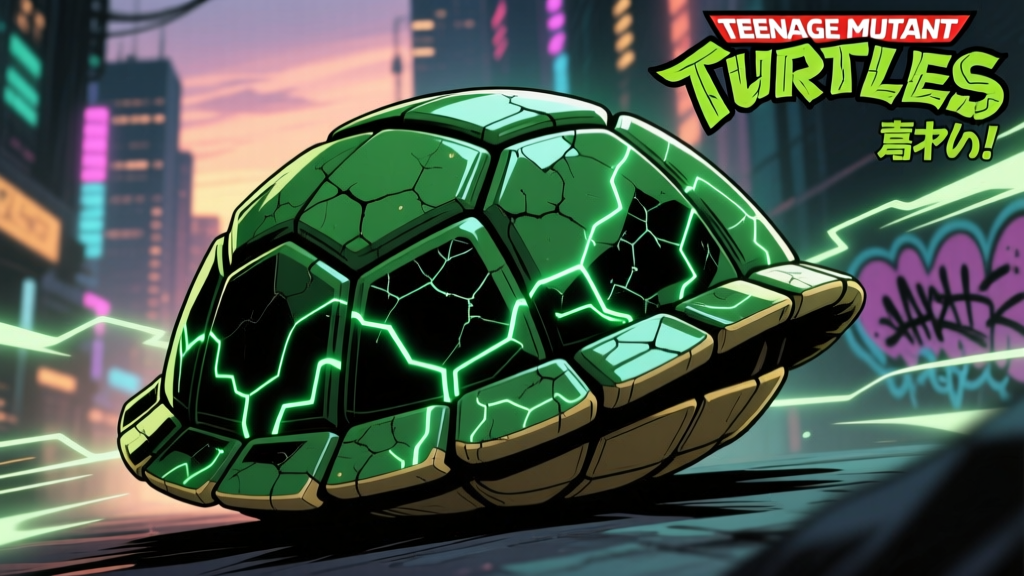
Kevin Eastman drew the first Teenage Mutant Ninja Turtle on a scrap of notebook paper in 1983, and the shell was the whole joke. A turtle. With nunchucks. The absurdity lived in the gap between the slow, dome-backed reptile and the lightning-fast martial artist. Forty years later, that shell has been redesigned, re-sculpted, re-rigged, and re-rendered more times than almost any other single prop in pop culture history — and every iteration tells you something about the era that produced it.
This is the story of the ninja turtle back: the carapace, the weapon sheaths, the plastron peek, the belt straps, and the sheer engineering headache of making a shell look good while a character does a backflip. If you've ever wondered why Raphael's shell looks different in every reboot, or why the 1987 cartoon shells look like painted footballs, you're in the right place.
What the Shell Actually Is (and Isn't)
Let's clear up a biological misconception first, because it matters for every design decision that follows. A real turtle's shell is not armor strapped to its back — it is the turtle's ribcage and spine, fused into a bony structure called the carapace (top) and plastron (bottom), connected by lateral bridges. The shell grows with the animal. You can't remove it any more than you can remove someone's thorax.
TMNT's designers have always taken creative liberties with this. In most continuities, the Turtles' shells are treated more like wearable gear or at least semi-detachable armor. The 2014 Michael Bay film went furthest in this direction, giving the Turtles shells that could split open and fold into makeshift shields. The 2012 Nickelodeon series introduced "shellraiser" backpacks — mechanical add-ons that strapped over the natural shell. These choices aren't arbitrary; they solve animation and storytelling problems that the original comics never had to worry about.
But the baseline design language has stayed remarkably consistent since Eastman and Peter Laird's first sketches: an oval, slightly domed carapace with visible scute (scale plate) segmentation, a lighter-colored plastron visible from the front, and a leather or cloth belt wrapping around the shell's equator. That belt is the anchor point for everything else.
Four Brothers, Four Shells: Individual Design Signatures
Here's something casual fans miss: in most TMNT continuities, the four turtles share the same species, the same mutation, and effectively the same body plan. That means the shell shape is nearly identical across all four. The differentiation happens through color coding, weapon placement, and subtle scarring or wear patterns — not through fundamentally different shell geometry.
Leonardo — The Clean Back
Leonardo's shell is almost always the most "textbook" of the four. Clean scute lines, minimal battle damage, and a symmetrical dual-katana sheath mounted diagonally across the upper carapace. The two sword hilts protrude over his right shoulder (or sometimes centered), and the sheaths themselves are typically wrapped in dark leather with steel or brass rivets. In the 2003 series, Leo's back scabbard was redesigned with a horizontal mounting system — both katanas lay flat across the upper back, handles pointing outward. This was a deliberate choice by the show's art director, Kenji Tsuruta, to make the silhouette read more clearly during fast-paced action sequences where diagonal lines can blur.
Raphael — The Scarred Carapace
Raph's shell tells the story the animators don't have to dialogue-explain. Across nearly every continuity, his carapace has more visible damage: chips along the rim, hairline cracks in the central scute, sometimes a chunk missing entirely from a fight with the Shredder. The 2012 Nickelodeon series made this explicit — by Season 3, Raph's shell had accumulated a specific fracture pattern from his bout with the Kraang that served as a visual continuity marker. His twin sais mount on the lower back, handles pointing down and outward in a V-shape, which is a more complex rigging challenge than Leo's swords because sais have pronged guards that need to clear the shell rim during draw animation.
Donatello — The Utility Back
Donnie's shell is where the franchise experiments with "gear" aesthetics. The bo staff is the simplest weapon to mount — a single horizontal or diagonal sheath across the upper back — but Donnie almost always carries additional tech strapped to or integrated into his shell. The 1987 cartoon gave him a secondary pouch system. The 2012 series added a modular tech-pack that clipped onto the shell's upper ridge, containing his retro-mutagen vials and various gadgets. IDW's comic run (2011–2018) took this further, depicting Donnie's shell with embedded circuitry channels that he'd etched himself — a detail that the artist Mateus Santolouco confirmed was inspired by real printed circuit board trace patterns.
Michelangelo — The Loose Mount
Mikey's nunchaku are the most awkward weapon to store on a shell, and every design team has dealt with it differently. Nunchaku are two sticks connected by a chain or cord, which means they can't be slid into a rigid sheath. Most solutions involve a looped holster on the belt or a soft pouch hanging from the shell's lower rim. The 1990 live-action film solved this by giving Mikey a fabric belt pouch rather than a back mount at all. The 2007 CGI film TMNT went the opposite direction and showed the nunchaku clipped into rigid cradle mounts on the lower carapace — which looks clean but makes zero mechanical sense since the chain link would rattle and slip. Sometimes the design just picks "cool" over "plausible," and that's fine.
"The shell is the character. Everything else — the mask, the weapons, the color — is decoration. If you can't identify the turtle from the shell silhouette alone, the design has failed."
The Weapon Sheath Problem: Engineering the Back Holster
Weapon sheaths on the ninja turtle back are one of those design elements that look effortless in a finished illustration and become a nightmare the moment you try to make them functional. Here's why: a turtle's carapace is a convex, curved surface. Strapping a rigid, cylindrical scabbard to a dome means you need a mounting system that conforms to the curvature — and that mount has to hold the weapon securely during acrobatic movement while still allowing a smooth, one-handed draw.
Real-world sword sheaths (saya) are designed for flat-body mounting against a hip or back with a relatively stable surface. The turtle shell introduces a 15–25° curvature offset that would make a traditional saya rattle, shift, or outright detach during movement. Design teams have addressed this in different ways:
- Friction-fit cradles — Used in the 1987 cartoon and early Mirage comics. The weapon sits in a form-fitted groove molded into the shell itself. Simple, but implies the shell is manufactured rather than organic.
- Leather strap tension mounts — The 2003 series and IDW comics default. Leather or nylon straps wrap around the shell's curvature, holding the weapon with adjustable tension. More realistic, and allows the "strapping on gear" animation beat.
- Magnetic/mechanical clips — The 2014 Bay film and 2012 Nick series tech-packs. Weapons snap into metal receivers bolted to the shell. Clean look, but raises questions about how you drill into a living bone structure without causing damage.
- Belt-hung soft holsters — The pragmatic solution used in the 1990 film and Rise of the TMNT. Weapons hang from the belt rather than the shell. Easiest to animate, most mechanically plausible, but sacrifices the iconic "weapons on the back" silhouette.
Shell Design Across Four Decades of Media
Tracking the shell's evolution is basically tracking the evolution of commercial illustration, animation technology, and 3D modeling — because each medium forced different compromises.
Mirage Studios Comics (1984–2009)
Eastman and Laird's original shell design was raw and inconsistent — which is exactly what you'd expect from two guys cranking out a black-and-white indie comic in a Massachusetts apartment. The early issues showed the shell as a relatively smooth dome with faint hexagonal scute patterning, almost like a cobblestone street. By issue #4, Laird had settled on a more defined 13-scute layout (mirroring the real red-eared slider turtle, the species the TMNT are based on). The plastron was rarely visible because the Turtles were almost always drawn from behind in action poses, which meant the back design got far more attention than the front.
The Mirage shell had no color, obviously, so texture was everything. Crosshatching did the heavy lifting. Laird would use dense parallel lines to create the illusion of a hard, curved surface catching light, and the belt was always a thick, utilitarian affair — wide leather with a rectangular buckle, more weightlifter's belt than martial arts sash.
The 1987 Animated Series
When Murakami-Wolf-Swenson adapted TMNT for Saturday morning television, the shell got simplified dramatically. Animation budgets dictated that each character could only be drawn with a limited number of line details — the fewer, the cheaper. The shell became a smooth oval with maybe four or five scute lines, painted a uniform brown-green that matched the skin. The plastron was a lighter yellow-green, and the belt was a thin rope or cloth sash rather than the chunky leather of the comics.
This era also locked in the weapon mounting convention that most fans still think of as "default": Leo's swords cross in an X on his back, Raph's sais sit low on his hips, Donnie's staff runs diagonally, and Mikey's nunchaku dangle from the belt. It was clean, readable at thumbnail size, and easy to animate across 65 episodes per season.
The 2003 Series and the Detail Push
4Kids Entertainment's 2003 series coincided with the industry's shift to digital ink-and-paint and higher resolution broadcast standards. Suddenly, those simple 1987 shells looked flat and lifeless on progressive-scan DVDs. The art team responded with significantly more detailed carapace designs — individual scutes had beveled edges, visible growth rings, and subtle color variation between the central vertebral scutes and the lateral costal scutes. The belt got pouches, buckles, and visible stitching.
This was also the first series to consistently animate the shell as a rigid body that didn't deform during movement. In the 1987 show, the shell would squash and stretch with the character. In 2003, it maintained its shape, which required more complex rigging but made the Turtles feel physically grounded — like they had actual mass and skeletal structure.
Live-Action: From Jim Henson Suits to Performance Capture
The 1990 Jim Henson Creature Shop suits built for the first live-action TMNT film deserve a section of their own. These were practical foam-latex shells worn over animatronic body frames, and they were heavy — approximately 14 kg (31 lbs) per suit, with the shell accounting for roughly 40% of that weight. The shells were sculpted by John Stephenson's team using a two-piece mold system: a rigid fiberglass inner shell for structure, and a flexible latex outer skin with hand-painted scute detail. The weapon sheaths were functional — the actors could actually draw prop weapons from them — but the mount points used industrial Velcro and hidden snaps rather than anything resembling the comic-book logic.
Jump to the 2014 Michael Bay reboot, and the shell was fully CG, designed by Industrial Light & Magic. The Bay film shells were the most anatomically detailed ever committed to screen: individual scutes with keratin-like translucency at the edges, visible muscle attachment points where the shell met the limbs, and a plastron that flexed slightly with breathing animations. ILM's creature supervisor, Pablo Helman, stated in a 2014 Cinefex interview that the shell rig used 847 individual blend shapes just for the carapace deformation during movement. That number alone tells you how complicated a "simple dome" becomes when photorealism is the target.
The 2016 sequel Out of the Shadows refined the design further, adding micro-scratches, algae staining along the lower rim (a nice touch suggesting the Turtles' sewer environment), and more pronounced battle damage on Raphael's shell that carried over from a specific fight sequence in the first film — a rare instance of shell-based continuity storytelling in live action.
Rise of the TMNT (2018–2022)
Nickelodeon's Rise took the biggest creative swing at shell design in the franchise's history. The Turtles were redesigned as different species — Leo as a red-eared slider, Raph as a snapping turtle, Donnie as a softshell, and Mikey as a box turtle. This meant fundamentally different shell geometries for the first time. Raph's snapping turtle shell was smaller, more jagged at the edges, and didn't fully cover his back. Donnie's softshell carapace was leathery and flexible rather than rigid. Mikey's box turtle shell was compact and highly domed with a hinged plastron. The weapon sheaths had to be redesigned for each shell type, and the animators had to build four completely different rig systems instead of cloning one base mesh.
It was ambitious, divisive, and — from a pure design standpoint — the most interesting thing that's happened to the TMNT shell since 1984.
Shell Design Comparison Across Major Adaptations
| Adaptation | Scute Detail | Belt Style | Weapon Mount | Shell Color |
|---|---|---|---|---|
| Mirage Comics (1984) | 13-scute hexagonal, crosshatched | Wide leather, rectangular buckle | Diagonal sheath, friction fit | B&W grayscale |
| 1987 Cartoon | 4–5 lines, minimal segmentation | Thin rope/cloth sash | X-cross back mount | Uniform olive-brown |
| 1990 Live-Action | Hand-sculpted foam latex, realistic | Thick rope belt, fabric wraps | Velcro/snap holsters | Dark olive, matte finish |
| 2003 Series | Beveled scutes, growth rings | Leather with pouches, buckles | Strap tension mounts | Varied brown-green per turtle |
| 2014 Bay Film (ILM) | 847 blend shapes, keratin edges | Tactical webbing, metal clips | Magnetic/mechanical receivers | Translucent-edge dark green |
| Rise of the TMNT | Species-specific (4 unique meshes) | Varied per character | Custom per shell geometry | Species-matched naturalistic |
The Animator's Backache: Why Shells Are a Technical Nightmare
Here's the part that most fans never think about. A shell is a rigid body attached to a character that needs to deform. Every time a Turtle bends forward, twists, or compresses during a landing, the area where the shell meets the body has to handle an enormous amount of geometric conflict. The shell can't bend (it's bone), but the body underneath must. This creates what riggers call the "rigid-envelope problem" — and it's one of the most annoying challenges in character animation.
In 2D animation (the 1987 and 2003 series), this is solved by simply redrawing the shell in each frame. The shell stays the same shape because the animator redraws it that way. There's no physics simulation, no collision detection, no deformation math — just a skilled artist with a stylus and a model sheet. The trade-off is labor: at 24 frames per second and roughly 12 unique drawings per second (animating "on twos"), a single 22-minute episode of the 2003 series required approximately 15,840 individual drawings, a significant portion of which included the shell.
In 3D animation (the 2007 CGI film, the 2012 Nick series, the Bay films), the problem explodes. The shell must be modeled as a rigid object that doesn't deform, but it's parented to a skeleton that does deform. At the junction — typically the neck opening, arm holes, and leg holes — you get mesh intersection artifacts where the body pokes through the shell during extreme poses. Riggers solve this with a combination of corrective blend shapes (pre-sculpted fixes for known problem poses), collision deformer systems that push the body mesh away from the shell in real time, and strategic clothing or straps that hide the seam lines.
The 2007 CGI film TMNT, produced by Imagi Studios, used a relatively primitive approach: the shell was a separate object attached to the spine joint, and the body mesh was simply painted to avoid the shell area. This worked for wide shots but fell apart in close-ups, where you could sometimes see the skin mesh clipping through the shell's inner surface during complex rolls. By the time ILM tackled the 2014 film, they'd developed a proprietary system they called "shell-space" — a secondary deformation pass that automatically repositioned the body mesh to stay inside the shell's volume, regardless of pose. According to Helman's Cinefex interview, this system added roughly 18% to the per-frame render time but eliminated intersection artifacts entirely.
And then there's the weapon sheath problem in 3D. Every weapon mount point is a potential collision nightmare. When Leonardo reaches back to draw his katana, his hand has to find the hilt, grip it, and pull it along a trajectory that clears both the shell's curvature and his own body geometry — all while the rig's IK (inverse kinematics) solver tries to keep his elbow from clipping through the shell. In the 2012 Nick series, the animation team built custom draw-cycle animations for each weapon that were essentially hand-keyed on top of the procedural IK solution, giving them manual control over the exact arc of the draw. It was more work, but it meant the weapons never ghosted through the shell geometry during the draw motion.
"Every time someone in the story meeting says 'let's have Leo sheathe his swords on his back,' a rigger dies a little inside. It's the single most expensive sentence in TMNT production."
The Plastron Problem: What's on the Flip Side
Any conversation about the ninja turtle back is incomplete without acknowledging the plastron — the flat, ventral (belly-side) plate that completes the shell structure. In real turtles, the plastron is made of several fused bones: the epiplastra, entoplastron, hyoplastra, hypoplastra, and xiphiplastra, arranged in a specific pattern that varies by species.
TMNT designs have been notoriously lazy about plastron anatomy. The 1987 cartoon rendered it as a simple lighter-colored oval with no segmentation. The Mirage comics, when they showed it at all, gave it a vague three-section layout. The 2014 Bay film was the first adaptation to render a plastron with anatomically accurate segmentation — all nine bones individually modeled, with visible suture lines between them. It was a detail that 99% of the audience never noticed, but herpetology fans spotted it immediately and praised the production for it on forums like TurtleForum.com and the Reptile & Amphibian subreddit.
The plastron matters for the back design because the two are structurally connected by the bridge — the lateral shell plates on each side of the turtle's body. In many TMNT designs, the bridge is either invisible (hidden by the arm) or simplified to a thin strip. The 2003 series was notable for giving the bridge actual width and showing it as a visible armored band between the carapace and plastron, which made the whole shell feel more like a real anatomical structure and less like a backpack.
Fan Culture and the Shell as Icon
It's worth noting that the ninja turtle back — specifically the silhouette of a shell with weapon hilts protruding — has become one of the most recognizable character outlines in entertainment history. A 2019 survey by YouGov found that 87% of American adults aged 18–44 could correctly identify which of the four Turtles was depicted based solely on a black silhouette showing the shell and weapon arrangement. That's a higher recognition rate than most Marvel and DC characters.
The shell's iconic status has spawned its own subculture in the fan community. Cosplayers have built hundreds of documented shell replicas, ranging from foam-and-fiberglass convention builds to 3D-printed masterworks with internal LED lighting and motorized weapon-deployment mechanisms. The subreddit r/TMNTcosplay has over 14,000 members as of early 2026, and shell construction tutorials consistently rank among the top-posted content. A particularly notable build by cosplayer Marcus "ShellBack" Rivera in 2022 used a vacuum-formed ABS plastic carapace with individually hand-painted resin scutes and a functional magnetic weapon mount system that let him draw and re-sheathe prop katanas with one hand — essentially solving the same engineering problem that ILM's digital artists had tackled eight years earlier, but in physical materials.
Toy manufacturers have also pushed shell design forward. Playmates Toys, which has held the TMNT action figure license since 1988, has iterated through at least nine distinct shell sculpt families. The "Classic Shell" (1988–1993) was a single-piece injection-molded carapace with painted scute lines. The "Movie Realistic" line (2014) introduced a two-piece shell with a separate plastron and individually textured scutes using a process Playmates called "micro-stipple molding" — a texturing technique that created a rough, keratin-like surface at the 1:12 scale. According to Playmates' then-VP of design Karl Aaronson, speaking at the 2014 Toy Fair in New York, the shell sculpting process for that line required 14 weeks of digital modeling and three rounds of physical prototype review before the tooling was approved.
Frequently Asked Questions
Are all four Turtles' shells the same shape?
In most continuities, yes — they're the same species and share the same base body plan. The differentiation comes from color coding, weapon placement, and accumulated battle damage rather than different shell geometry. The major exception is Rise of the TMNT (2018), which redesigned each Turtle as a different turtle species with a unique shell shape: Raph as a snapping turtle with a smaller, rougher shell; Donnie as a softshell with a flexible, leathery carapace; Mikey as a box turtle with a compact, high-domed shell; and Leo as the standard red-eared slider.
How do the Turtles put on and take off their weapon sheaths?
This varies enormously by adaptation. In the Mirage comics and 2003 series, the sheaths are typically strapped on with leather harnesses that wrap around the shell — implying the Turtles strap up before heading out, much like a soldier putting on a tactical vest. In the 1987 cartoon, the weapons seem to be permanently mounted, and the Turtles are never shown without them. The 2012 Nickelodeon series introduced the concept of "shellraisers" — mechanical backpacks that clip over the shell and include weapon mounts, tech storage, and communication gear. These are clearly detachable and the Turtles are frequently shown without them in casual scenes.
What real turtle species is the TMNT shell based on?
The Turtles are explicitly identified as red-eared sliders (Trachemys scripta elegans) in most continuities, including the original Mirage comics and the 2012 Nick series. A red-eared slider's carapace typically has 13 major scutes: 5 vertebral (center line), 8 costal (4 on each side), and a variable number of marginal scutes around the rim. Most TMNT designs approximate this layout, though the 1987 cartoon simplified it dramatically to reduce animation costs. The 2014 Bay film's ILM team studied actual red-eared slider specimens at the American Museum of Natural History in New York to get the scute pattern right.
Can the TMNT shell be damaged or cracked?
Absolutely, and it has been — many times. Shell damage is one of the franchise's most consistent visual storytelling tools. In the Mirage comics, a cracked shell is treated as a serious, potentially lethal injury (mirroring real turtle biology, where shell fractures can expose internal organs to infection). The 2012 series' "Shell Shocked" arc (Season 3, Episodes 16–17) centered entirely on Leonardo recovering from a shell crack inflicted by the Shredder. In the 1990 live-action film, the climactic fight shows visible shell scuffing and chips on all four Turtles after their confrontation with the Shredder. The comics have even explored scenarios where a Turtle's shell is severely damaged or partially destroyed, requiring Donatello to engineer prosthetic shell sections — a concept IDW's run explored in detail with the character Slash.
Why do some designs show the shell as part of the body and others as removable armor?
This comes down to the franchise's inconsistent treatment of the mutation's biological effects. In continuities that lean toward biological realism (Mirage comics, IDW run, 2014 Bay film), the shell is an integral part of the Turtles' mutated anatomy — it grew with them and can't be removed. In continuities that lean toward tech and gear (2012 Nick series, some video games), the shell is treated more like natural armor that can be augmented or accessorized. The 2014 Bay film attempted to split the difference by making the shell organic but adding tactical webbing and metal fittings bolted directly to it — which raised uncomfortable questions about drilling into living bone that the film wisely never addressed.
The Shell Endures
Forty years of redesigns, reboots, and retcons, and the basic formula hasn't changed: an oval dome, segmented plates, a belt, and weapons on the back. That formula works because it solves the core visual problem Eastman and Laird stumbled into in 1983 — how do you make a turtle look dangerous? You give it the silhouette of a warrior. The shell is the shield, the weapons are the declaration, and the belt is the humanizing detail that says "someone strapped this on and went to work."
Every generation gets the shell it deserves. The '87 cartoon's smooth, simplified dome was a product of broadcast animation economics. The 2003 series' beveled, textured carapace reflected the DVD era's demand for visual detail. ILM's 2014 photoreal shell was a showcase for what 847 blend shapes and a big VFX budget could achieve. And Rise's species-specific shells were the boldest creative swing the franchise has ever taken — four different answers to a question that most people assumed had only one.
The next iteration is already in development. Whatever form it takes, you can bet the shell will still be there — curved, segmented, belted, and loaded. Because some designs are just right, and this one has been right since a kid in Northampton, Massachusetts, picked up a pencil and drew a turtle with a sword on its back.