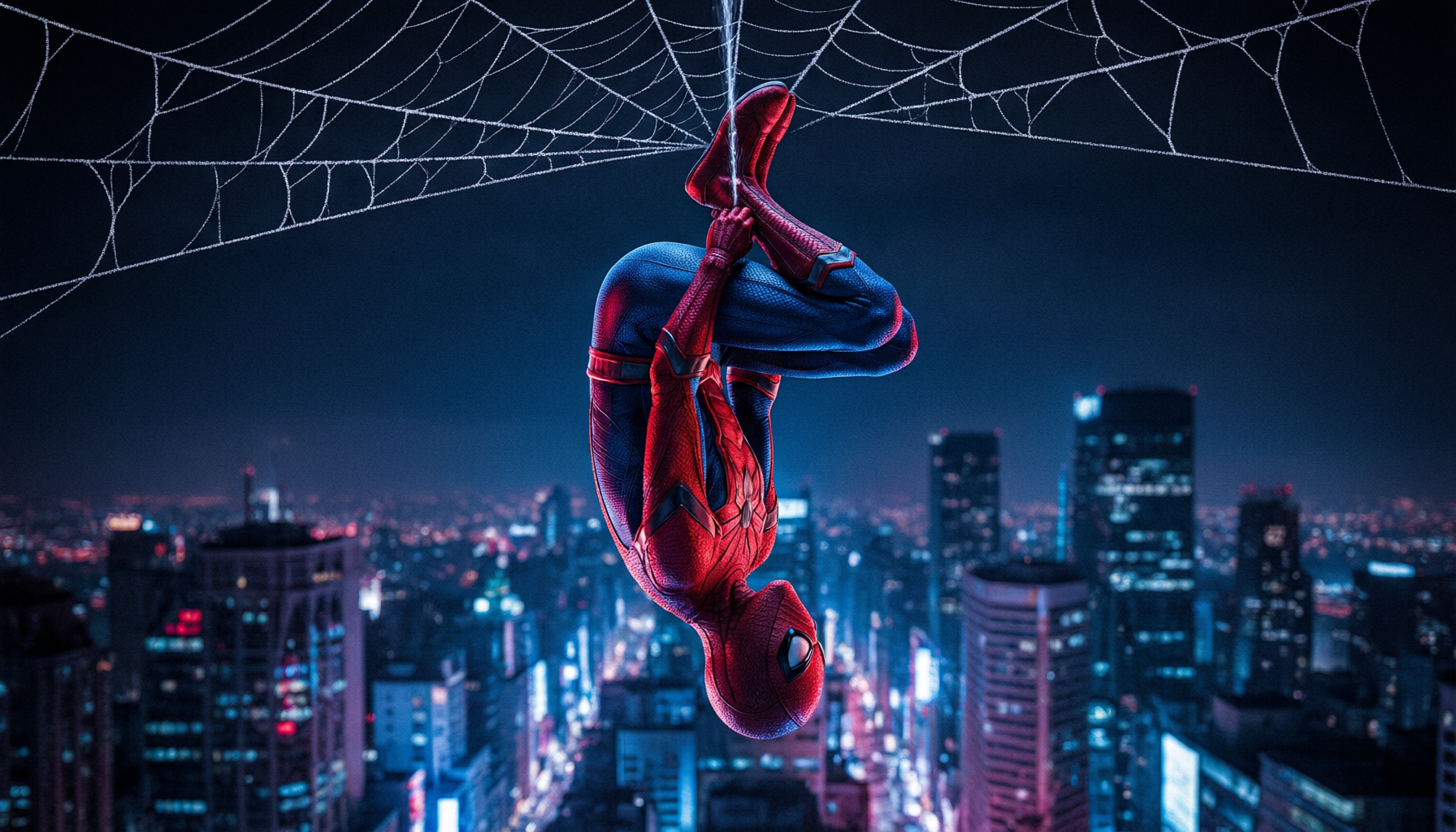
A rainy alleyway. A dumpster. A young woman leaning forward to peel back a mask, revealing half a face. And a young man, suspended upside down, water streaming toward his forehead, about to receive what would become the most talked-about kiss in superhero cinema history. When Spider-Man hit theaters in May 2002, audiences walked out buzzing about web-slinging action and Tobey Maguire's earnest performance. But the image that stuck—the one that appeared on dorm room posters, magazine covers, and eventually every corner of internet culture—was that single frame of a hero hanging upside down in the rain.
More than two decades later, the spiderman upside down pose remains the single most recognizable superhero image in modern pop culture. It has been parodied by animated sitcoms, recreated by thousands of cosplayers, referenced by rival superhero franchises, and debated by film critics who disagree on whether it's genius or kitsch. Understanding how one inverted figure became shorthand for an entire character requires tracing a path from four-color comic panels to Hollywood soundstages, and eventually into the collective visual memory of a generation.
Before the Rain: The Upside-Down Hero in Marvel Comics
Spider-Man didn't start hanging upside down in a movie theater in 2002. The pose has roots stretching back to the earliest days of the character's comic book life, and its evolution tracks closely with how artists solved a peculiar visual problem: how do you make a guy in a full-body spandex suit look expressive?
Steve Ditko and the Language of Webs
When Steve Ditko co-created Spider-Man in 1962, he established the character's physical vocabulary—crouching on rooftops, swinging between buildings, clinging to walls at odd angles. Ditko's panels in Amazing Fantasy #15 and the early issues of The Amazing Spider-Man frequently showed Peter Parker suspended from a web line in inverted or semi-inverted positions, though these were action poses rather than iconic character statements. The upside-down angle served a practical purpose in Ditko's storytelling: it reinforced Spider-Man's difference from ground-bound heroes like the Fantastic Four or the Hulk. This was a character who lived vertically.
John Romita Sr. and the Birth of an Icon
The real transformation happened when John Romita Sr. took over art duties from Ditko beginning with The Amazing Spider-Man #39 (cover-dated August 1966). Romita brought a graphic-design sensibility to Spider-Man's world, and he understood something Ditko hadn't prioritized: the power of a single, repeatable image. Across Romita's run—which extended through the early 1970s and defined the character's visual identity for a generation of readers—Spider-Man appeared in inverted positions on multiple covers and splash pages.
The pose became Romita's go-to composition when he wanted to convey Spider-Man's playful, acrobatic nature. Rather than standing heroically like Captain America or brooding like Batman, Spider-Man dangled. He swung. He hung from one hand with the casual ease of a teenager lounging on a fire escape. Interior panels throughout issues #39–95 showed the hero suspended upside down from web lines, often with one hand on his hip or a wisecracking thought bubble, establishing the inverted pose as character shorthand rather than mere action staging.
"Romita didn't just draw Spider-Man; he designed the way the character occupied space. The upside-down hang was his signature move—it said everything about Peter Parker that dialogue couldn't." — Sean Howe, Marvel Comics: The Untold Story (Harper, 2012)
It's worth noting that no single comic cover from this era presented the definitive upside-down Spider-Man image the way the 2002 film would. Instead, the pose accumulated power through repetition. Readers who grew up on Romita's run internalized the association: Spider-Man = upside down. By the time later artists like Todd McFarlane pushed the character's anatomy into more extreme contortions in the late 1980s and early 1990s, the inverted pose was already baked into Spider-Man's visual DNA.
The Pre-2002 Kiss Connection
Comic historians have debated whether the upside-down kiss specifically existed before Raimi's film. Some point to panels in The Amazing Spider-Man #292 (September 1987, written by Jim Salicrup) as a precursor, though the kiss depicted there between Peter and Mary Jane doesn't precisely mirror the inverted arrangement that later became famous. The broader point is that Marvel's artists had spent decades associating Spider-Man with upside-down positioning, creating a visual vocabulary that any filmmaker could draw from—whether consciously or not.
• • • • •The Scene That Ate Pop Culture: Raimi's Rain-Soaked Masterstroke
Here's something that surprises most people: the upside-down kiss was never in the script. Screenwriter Alvin Sargent's draft for Spider-Man contained a different version of the post-alley-fight encounter between Peter Parker and Mary Jane Watson. According to multiple behind-the-scenes accounts, including statements from the cast and crew, director Sam Raimi conceived the inverted kiss during pre-production as a way to merge the character's comic-book physicality with the film's romantic through-line.
How They Actually Shot It
The logistics were far less romantic than the finished product suggests. The scene was filmed on a backlot set designed to replicate a New York City alleyway, with Tobey Maguire strapped into a harness that suspended him upside down from a rig above the set. Industrial rain machines—the kind used for large-scale outdoor shoots, not gentle garden sprinklers—poured water onto the scene from multiple angles.
Maguire later described the experience in blunt terms during promotional interviews: "I couldn't breathe. Rain was pouring up my nose." The inverted position meant that water pooled in his nasal passages and sinuses with every take. Kirsten Dunst, who had the comparatively comfortable position of standing upright, recalled on The Graham Norton Show that the shoot was "miserable" and described it as "not a good way to kiss" anyone. Multiple takes were required, stretching the shoot across several hours of sustained inversion for the lead actor.
The technical setup involved more than just hanging an actor from a wire. The production team had to account for the way water behaves when someone is upside down—droplets run toward the face rather than off it, creating a visual effect that reads differently on camera than standard rain footage. Cinematographer Don Burgess and his team adjusted lighting angles to ensure the water remained visible against the dark alley backdrop, using backlighting techniques that turned individual raindrops into glowing streaks around Maguire's suspended figure.
One frame of film. Zero script pages. A generation's defining romantic image.The Moment It Connected
When Spider-Man opened on May 3, 2002, it grossed $114.8 million in its opening weekend—a record at the time. The film earned mostly positive reviews, with particular praise for its willingness to treat superhero romance as something other than an afterthought. But it was the upside-down kiss that escaped the film's boundaries and entered the broader culture. Within weeks, the image appeared on the covers of Entertainment Weekly, People, and dozens of international publications. It was the shot that marketing departments used for every subsequent home video release, and it remains the most-shared frame from the film across social media platforms.
The scene earned Spider-Man the MTV Movie Award for Best Kiss in 2003, beating out competitors including The Quiet American and Sweet Home Alabama. For a superhero film to win a romance category at a mainstream awards show was genuinely unusual in 2003—the genre was still years away from the cultural saturation it would achieve with the Marvel Cinematic Universe.
Becoming Visual Shorthand: The Pose as Spider-Man's Signature
After 2002, the upside-down pose stopped being just a scene from a movie and became something closer to a logo. Designers, advertisers, and other filmmakers began treating the inverted Spider-Man figure as an instantly recognizable glyph—one that could communicate "Spider-Man" without showing a face, a logo, or a costume detail.
Other Spider-Man Films and the Inversion Legacy
Each subsequent Spider-Man film has had to reckon with Raimi's upside-down kiss, whether by embracing it, subverting it, or sidestepping it entirely:
- Spider-Man 2 (2004) — Raimi returned to the upside-down motif during the train sequence, where an exhausted Peter collapses in an inverted position after stopping the runaway train, arms spread in a quasi-crucifixion pose that recalled the earlier alley scene's visual language.
- The Amazing Spider-Man (2012) — Marc Webb's reboot sidestepped direct recreation but included multiple scenes of Andrew Garfield's Spider-Man hanging upside down during conversations, treating the position as casual character behavior rather than a set-piece moment.
- Spider-Man: Homecoming (2017) — Jon Watts gave audiences an almost-kiss between Tom Holland's Peter and Zendaya's MJ, with the two characters in a near-inverted arrangement during the homecoming dance sequence that deliberately evoked the Raimi scene while pulling back at the last second.
- Spider-Man: No Way Home (2021) — The film included a direct recreation with Holland and Zendaya, this time with MJ hanging upside down from a web after a fall, swapping the gendered positioning of the original. The scene was one of the film's most-discussed moments among fans, precisely because it inverted the inversion.
- Spider-Man: Across the Spider-Verse (2023) — The animated sequel included visual Easter eggs referencing the upside-down kiss in background graffiti and mural art within Miles Morales' Brooklyn, confirming that the pose had crossed from live-action into the broader Spider-Man visual mythology.
The pattern across these films reveals something interesting: the upside-down pose functions less as a specific scene and more as a recurring visual motif that each new creative team feels obligated to address. It has become Spider-Man's equivalent of Superman ripping open his shirt or Batman standing on a gargoyle—a pose that audiences now expect, even when the narrative doesn't strictly require it.
• • • • •Parodies, Homages, and the Cosplay Industrial Complex
An image doesn't reach true iconic status until people start making fun of it. The upside-down Spider-Man kiss crossed that threshold fast, and it has never come back.
Screen Parodies That Landed
The most prominent parody arrived in Shrek 2 (2004), where the animated fairy-tale franchise recreated the alley kiss with Shrek and Fiona in the Spider-Man and Mary Jane positions, rain and all. The gag worked because audiences immediately recognized the reference—no explanation needed, no setup required. Two years after the original film, the pose was already fluent visual language.
Television followed quickly. The O.C. recreated the scene as a romantic comedy beat. Family Guy, Robot Chicken, and The Simpsons each took their own swings at parodying the kiss, with varying degrees of affection. The animated series Ultimate Spider-Man (2012–2017) included self-referential nods to the pose within its own episodes, effectively having the character parody his own most famous image.
Cosplay: The Pose Everyone Attempts
Walk through any comic convention—San Diego Comic-Con, New York Comic Con, MCM London, or any of the hundreds of regional shows worldwide—and you will find cosplayers recreating the upside-down Spider-Man pose. It has become one of the most requested photo-op setups at conventions, to the point where some events have designated "upside-down photo spots" with suspended props or angled backdrops that simulate the inverted position without requiring anyone to actually hang from a harness.
The pose's popularity in cosplay stems from a practical reality: it's one of the few superhero images that reads clearly in a static photo. Most superhero poses require motion—jumping, swinging, running—to feel authentic. The upside-down hang works in a still image because the original context (hanging from a web) already implies stasis. A cosplayer suspended from a convention center rafter, or more commonly propped against a wall at an angle that suggests inversion, communicates the reference instantly. Instagram hashtags related to the spiderman upside down pose have accumulated hundreds of thousands of posts, with recreations ranging from professional studio shoots to dorm-room improv.
Professional cosplayers have pushed the recreation further. Some have rigged actual harness systems for convention appearances, while others use forced-perspective photography to simulate the upside-down positioning without physical risk. Ice skating troupes and circus performers have incorporated the pose into routines, and gymnasts have produced viral videos combining the inverted hold with acrobatic routines in Spider-Man costumes.
| Media / Appearance | Year | Type | Notable Detail |
|---|---|---|---|
| Amazing Spider-Man comics (Romita Sr. era) | 1966–1973 | Comic panels & covers | Established inverted pose as character shorthand across ~95 issues |
| Spider-Man (Raimi) | 2002 | Film — live action | Upside-down alley kiss; won MTV Best Kiss 2003 |
| Shrek 2 | 2004 | Film — animated parody | Shrek and Fiona recreate the rain kiss scene |
| Spider-Man 2 | 2004 | Film — live action | Train sequence inversion; cruciform arm spread |
| The O.C. | 2004 | TV — homage | Romantic comedy recreation in Season 1 |
| Spider-Man: Homecoming | 2017 | Film — near-recreation | Almost-kiss at homecoming dance, inverted arrangement |
| Spider-Man: No Way Home | 2021 | Film — gender-swap recreation | MJ hangs upside down instead of Spider-Man |
| Spider-Man: Across the Spider-Verse | 2023 | Film — animated Easter egg | Kiss reference in background graffiti and murals |
Why This Particular Image Stuck When Others Didn't
Superhero films have produced dozens of memorable images over the past two decades. Captain America lifting Mjolnir. The Snap in Avengers: Infinity War. The Batpod chase in The Dark Knight. Yet none of these have achieved the same crossover recognition as the spiderman upside down pose. The reasons are worth examining, because they reveal something about how visual icons function in mass culture.
Simplicity and Reproducibility
The image requires exactly two elements: an inverted figure and a rain-soaked or romantic context. There's no complex CGI, no ensemble cast, no narrative setup required. A child can draw it. A cosplayer can recreate it with a friend and a wall. A parody can invoke it with two characters and a garden hose. This simplicity is not accidental—the most durable visual icons in pop culture tend to be the ones that reduce to their essentials without losing meaning. Think of the Jaws poster, the E.T. finger-touch, or the lightsaber pose from Star Wars. Each one communicates its entire franchise in a single silhouette.
Emotional Resonance Over Spectacle
Most superhero images that achieve wide recognition are action-based: a hero fighting, flying, or standing victorious. The upside-down Spider-Man pose is unusual because it captures a moment of vulnerability. Peter Parker, the character behind the mask, is defined by his anxieties, his self-doubt, and his complicated relationship with the people he loves. The inverted kiss crystallizes all of that in a single frame. He's literally exposed—half his face unmasked, his body helpless in suspension, rain falling on him rather than around him. It's a superhero image that communicates tenderness rather than power, and that emotional contrast gives it staying power that a punch or an explosion never could.
The Romance Factor
Let's not overthink this part. The image is romantic, and romantic images travel farther across demographics than action images. The upside-down kiss appealed to audiences who had zero interest in comic books, who didn't know Spider-Man's origin story, and who couldn't have named a single villain from the franchise. It appeared on Valentine's Day cards, wedding photography mood boards, and couples' social media posts. By escaping the superhero genre entirely and entering the broader visual vocabulary of romance, the pose ensured its own longevity in a way that, say, Wolverine's claw-spread never could.
• • • • •The Pose at 20+: Cultural Aftershocks and Lasting Weight
More than twenty years after Raimi's film debuted, the spiderman upside down pose occupies a specific and somewhat paradoxical position in popular culture. It's simultaneously one of the most recognized superhero images ever created and one that audiences associate primarily with a single film rather than the broader Spider-Man franchise. Ask a random person on the street to describe Spider-Man, and they're likely to mention the upside-down kiss before they mention web-shooters, Uncle Ben, or the Daily Bugle.
The pose has influenced how subsequent superhero films approach romantic imagery. The "inverted kiss" has become a recognizable trope that writers and directors reference when constructing romantic beats in genre films, and the broader principle—that a superhero's most iconic image might be a moment of intimacy rather than combat—has shaped how studios market these films to wider audiences. The marketing campaigns for Wonder Woman (2017), Black Panther (2018), and The Batman (2022) all included prominent romantic imagery in their promotional materials, a strategy that traces at least partially to the proven crossover appeal of the Raimi kiss.
For cosplayers, content creators, and fan artists, the pose remains an evergreen subject. New interpretations appear weekly across social platforms, from polished digital paintings to quick TikTok recreations. The pose has been reimagined with different Spider-People (Miles Morales, Spider-Gwen, Spider-Man 2099), in different settings (space, underwater, during historical events), and in different artistic styles (watercolor, pixel art, minimalist line drawing). Each new version adds another layer to the image's accumulated cultural weight, reinforcing the upside-down Spider-Man as something closer to a folk-art motif than a corporate trademark.
"The great superhero images work because they reduce an entire mythology to a posture. Superman's fist raised. Batman's silhouette against lightning. Spider-Man, upside down, in the rain. You don't need the backstory. The image is the backstory." — Scott McCloud, Understanding Comics: The Invisible Art (HarperCollins, 1993; applied to superhero iconography)
Whether the pose will continue accumulating meaning or eventually settle into comfortable nostalgia is an open question. What's certain is that a position conceived by comic artists in the 1960s as a convenient way to draw a web-slinging teenager—and transformed by a horror-film director into a rain-drenched romantic gesture in 2002—has outlasted three different Spider-Man film franchises, countless comic book reboots, and the entire trajectory of the superhero genre's rise to cultural dominance. That's not bad for a guy hanging from a string.
Questions People Actually Ask About the Spiderman Upside Down Pose
Was the upside-down kiss in the original Spider-Man script?
No. Screenwriter Alvin Sargent's original draft included a different version of the post-fight encounter between Peter and Mary Jane. Director Sam Raimi conceived the inverted kiss during pre-production, and it was added to the shooting script specifically to merge Spider-Man's comic-book physicality with the film's romantic arc. The decision was made relatively late in the production process.
Did Tobey Maguire actually hang upside down for the kiss scene?
Yes. Maguire was suspended in a harness from a rig above the set for the duration of the shoot. He later stated publicly that the rain machines poured water directly up his nose and that he had difficulty breathing between takes. Kirsten Dunst, standing upright on the ground, described the filming conditions as miserable despite the romantic final product.
What comic issue first showed Spider-Man in the upside-down pose?
There's no single definitive "first." Steve Ditko showed Spider-Man in inverted positions from the character's earliest appearances in 1962, but John Romita Sr. made the upside-down hang a recurring visual motif during his run on The Amazing Spider-Man #39–95 (1966–1973). The pose accumulated meaning through repetition rather than originating from one landmark cover or splash page.
How many Spider-Man movies have recreated the upside-down kiss?
The scene has been directly or indirectly referenced in Spider-Man 2 (2004), Spider-Man: Homecoming (2017, as a near-kiss), Spider-Man: No Way Home (2021, with gender-swapped positioning), and Spider-Man: Across the Spider-Verse (2023, as background art). The 2012 reboot The Amazing Spider-Man included upside-down hanging scenes but did not recreate the specific kiss.
Why is the upside-down Spider-Man pose so popular in cosplay?
The pose works in a static photograph, unlike most superhero poses that require implied motion. A cosplayer can simulate the inverted position against a wall or with a simple harness setup, and the reference is immediately recognizable to other fans. The image's simplicity—inverted figure plus romantic or rain-soaked context—makes it reproducible without expensive equipment or elaborate staging.
Has the upside-down kiss won any awards?
The scene won the MTV Movie Award for Best Kiss in 2003, competing against romantic scenes from both superhero and non-superhero films. It has also appeared on numerous "most iconic movie kiss" lists published by Entertainment Weekly, Empire, and the American Film Institute's various pop-culture retrospectives.
Sources: Howe, Sean. Marvel Comics: The Untold Story. Harper, 2012. · McCloud, Scott. Understanding Comics: The Invisible Art. HarperCollins, 1993. · Cast and crew interviews from Spider-Man (2002) DVD bonus features and press junket transcripts. · MTV Movie Awards archives, 2003.