Character Analysis
Up Characters: Every Soul Who Flew, Fell, and Found Their Way Home
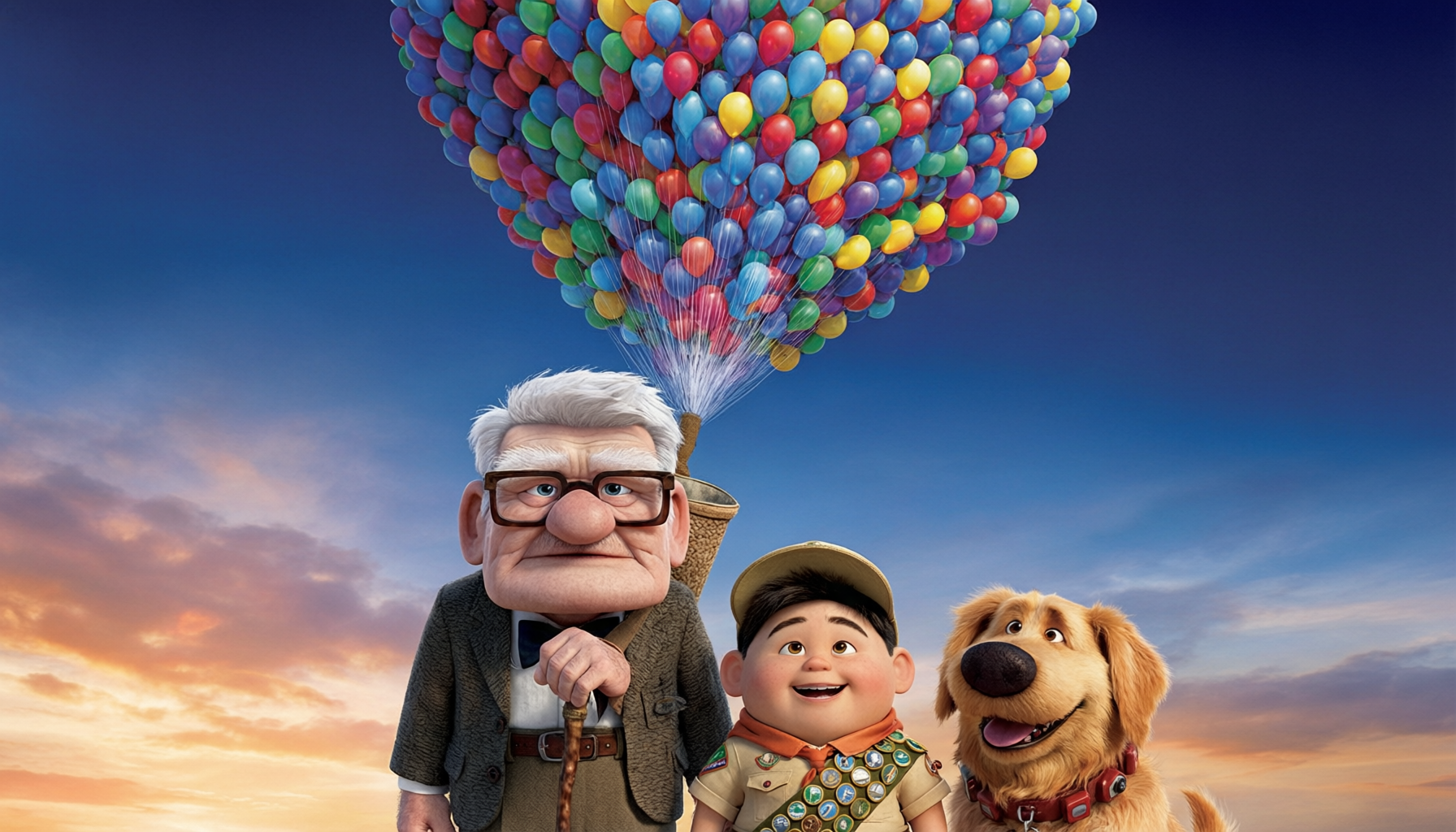
Pixar gave us a house lifted by balloons and a boy who would not take no for an answer. But the real story was always about the people — broken, stubborn, loyal, and wild — who climbed aboard.
Some animated films give you characters you remember. Up gives you characters you feel. Released in 2009, Pixar's tenth feature did something few family films attempt: it opened with a love story, a miscarriage, a death, and a man shutting the world out — all before the title card faded. Then it sent that grieving widower into the sky with an overeager eight-year-old, a dog who could talk, and a bird the size of a minivan. The result was not just a movie. It was a quiet reckoning with what it means to keep living after the person who made life worth living is gone.
This is a look at every significant character in Up — not just who they are on screen, but why they work, why they stick with you, and how a film about an old man chasing a promise managed to build one of the most emotionally honest ensembles in animated cinema.
Carl Fredricksen
The Widower Who Refused to Let Go
Carl is not your typical Pixar hero. He is 78 years old, square-jawed, square-bodied, and square in temperament. He has spent decades selling balloons from a cart, watching a city grow around the small house he refuses to sell, and quietly nursing a grief so deep it has calcified into stubbornness. When we meet the adult Carl, he has already decided that the world has nothing left to offer him. He is not wrong, exactly. He is just incomplete.
What makes Carl extraordinary as a character is not his grand gesture — flying a house to South America with thousands of helium balloons. It is the smallness of his habits. He talks to his late wife Ellie through her photograph. He sets two places at the breakfast table out of muscle memory. He wears the same suit he wore to her funeral. These are not the actions of a man in adventure mode. They are the rituals of someone who has turned mourning into a vocation.
His arc is not about learning to love again. Ellie was not a lesson. His journey is about recognizing that the adventure she wanted for him was never about Paradise Falls — it was about the people he would meet along the way. The scene where Carl finally removes Ellie's belongings from the house, lightening the load so it can fly again, is one of the most devastating and hopeful moments in animation. He is not letting her go. He is letting himself move.
Key Moment: The montage of Carl and Ellie's life together in the opening ten minutes — widely regarded as one of the greatest sequences in animated film history. No dialogue. Just music and decades of shared joy, loss, and quiet devotion.
Russell
The Wilderness Explorer Who Would Not Be Left Behind
Russell is eight years old, Asian-American, and absolutely relentless. He shows up on Carl's porch looking for an elderly person to assist — it is a Wilderness Explorer merit badge requirement — and ends up being accidentally kidnapped when Carl's house lifts off. He is loud, clumsy, earnest to a fault, and carries a backpack that seems to contain everything except good judgment.
But here is the thing about Russell that people miss on first viewing: he is lonely. His father, who was supposed to attend his Wilderness Explorer ceremony, does not show up. We catch fragments — a phone call, a mumbled excuse — and the picture that emerges is painfully familiar. Russell is a kid who fills his schedule with badges and activities not because he loves them all, but because achievement is the only currency his absent father seems to accept.
Russell's role in the story is twofold. On the surface, he is comic relief — the kid who accidentally starts a fire, who names a giant bird "Kevin" without checking its gender, who believes chocolate melts at exactly 37 degrees. Beneath that, he is the person Carl never planned to love. Russell forces Carl out of his grief-cocoon not through persuasion, but through sheer, inescapable presence. You cannot mourn in peace when an eight-year-old is asking you if the bird can keep the dog.
Key Moment: The final ceremony scene, where Carl — not Russell's father — pins the "Assisting the Elderly" badge on Russell. Russell's face shifts from proud to confused to quietly heartbroken in the span of three seconds. Then Carl adds Ellie's grape-soda pin. "This is from my wife," he says. The audience is already crying.
Dug
The Dog Who Chose Love Over Obedience
Dug is a Golden Retriever fitted with a collar that translates his thoughts into human speech. His internal monologue is exactly what you would expect from a Golden Retriever: enthusiastic, easily distracted, and governed almost entirely by affection. "I have just met you, and I love you," he tells Carl, and means it with every fiber of his being.
It would be easy to write Dug off as a gag character. The talking-dog jokes write themselves, and the film certainly indulges. Squirrel! But Dug's narrative function runs deeper than comic timing. He belongs — originally — to Charles Muntz, the film's villain. Muntz created the talking collars. Dug is, in a sense, Muntz's invention, his property. And yet Dug defects. Not out of rebellion or self-interest, but because Carl and Russell showed him kindness. He simply walked away from the man who owned him and toward the people who treated him like a friend.
That choice is the emotional spine of Dug's character. He is proof that loyalty is not the same as ownership. Muntz built the collars to command his dogs. Carl earned Dug's devotion by sharing his sandwich and letting him sleep on the porch. The contrast is subtle, but it cuts.
Key Moment: "I was hiding under your porch because I love you. Can I stay? Please?" — possibly the most emotionally direct line any dog has ever delivered in a mainstream animated film.
Kevin
The Mythical Bird With Three Babies Waiting at Home
Kevin is a thirteen-foot-tall, iridescent flightless bird — a species that Muntz has spent decades trying to capture. Russell names her Kevin before anyone determines her sex. She eats chocolate with alarming enthusiasm, runs at improbable speeds, and turns out to be a mother of three.
Kevin is interesting because she functions as a mirror for Carl. Both are creatures trying to get home to the ones they love. Both are being pursued — Kevin literally, Carl emotionally — by forces that want to possess or control them. Muntz sees Kevin as a trophy, proof of his genius. Carl initially sees Kevin as an inconvenience, a complication delaying his pilgrimage to Paradise Falls. Neither man initially recognizes her as a mother who has wandered too far from her nest.
The moment Carl understands that Kevin has babies waiting for her is also the moment he begins to see beyond his own mission. Helping Kevin is not part of the plan. It is not what Ellie asked for. But it is what the situation demands, and Carl — rusty, reluctant Carl — rises to it. Kevin's capture by Muntz forces Carl to choose between his promise to Ellie and the living creature who needs him now. He chooses the present. That is the entire movie in one decision.
Key Moment: The reunion at the end, when Kevin's three chicks come bounding out of the jungle to greet their mother. It is played without fanfare, and it wrecks you.
Charles Muntz
The Explorer Who Became the Trap
Muntz is Carl's childhood hero — the swashbuckling adventurer whose motto, "Adventure is out there!", inspired young Carl and Ellie to dream of Paradise Falls in the first place. When the scientific establishment discredited Muntz's claim of discovering a giant bird, he vanished into the South American wilderness with a fleet of dirigibles, an army of dogs, and a grudge that would outlast his sanity.
Muntz is one of Pixar's more psychologically complex villains. He is not evil in the way that, say, Syndrome is evil. He is a man consumed by obsession. He has spent so long chasing one goal — capturing Kevin's species and dragging it back to civilization as vindication — that he has become indistinguishable from the wilderness he is trying to conquer. His dogs are tools, not companions. His airship is a mobile fortress, not a vessel of exploration. The adventure is out there, but Muntz forgot why he was looking for it.
What makes Muntz devastating is that he is Carl's dark future. Both men are defined by a singular devotion — Carl to Ellie's memory, Muntz to his own reputation. Both have isolated themselves from the world. Both are, in different ways, trapped in their own homes. The difference is that Carl has Russell to pull him back. Muntz has no one. He chose obsession over connection decades ago, and the film shows the result without flinching: a brilliant man, alone in the clouds, barking orders at dogs who would leave him in a heartbeat if someone offered them a kind word.
Key Moment: Carl finds Muntz's "Spirit of Adventure" dirigible for the first time and meets his hero face to face. His awe curdles into unease over the course of a single dinner, as Muntz's charm reveals itself as a thin mask over something fractured and desperate.
Ellie Fredricksen
The Woman Who Was the Whole Adventure
Ellie appears on screen for roughly ten minutes. She is the most important character in the film.
As a child, Ellie is a force of nature — gap-toothed, wild-haired, and absolutely certain that the quiet boy in the explorer goggles is going to be her husband. She bursts into Carl's life like weather, rearranging everything. She is the one who proposes adventure, who scrapbooks their dreams, who pins a "Spirit of Adventure" badge on Carl and tells him to cross his heart.
As an adult, Ellie is quieter but no less vital. She and Carl build a life together that is ordinary and extraordinary in equal measure. They paint their mailbox. They sell balloons. They save coins in a jar labeled "Paradise Falls." They try for a baby and learn, in a scene scored by Michael Giacchino's now-iconic waltz, that they cannot. Ellie does not crumble. She redirects. The trip to Paradise Falls becomes the dream that sustains them — until time runs out before the money does.
Ellie's final gift to Carl is her scrapbook. For most of the film, Carl believes the pages after their childhood adventures are blank. He thinks Ellie died with her dream unfulfilled, that she never got the adventure she deserved. When he finally opens the book in the film's emotional climax, he discovers that she had filled those pages with photos of their life together — their marriage, their home, their quiet Tuesday mornings. She had written, at the bottom of the last page: "Thanks for the adventure — now go have a new one."
Ellie understood something Carl did not: the adventure was never Paradise Falls. The adventure was him.
Alpha, Beta, and Gamma
Muntz's Dog Army — Loyal Until Someone Is Kinder
Muntz's pack of talking dogs serves as both comic ensemble and thematic device. Alpha (a Doberman), Beta (a Rottweiler), and Gamma (a bulldog) are the most prominent. They carry out Muntz's orders with military precision — tracking Kevin, patrolling the airship, attempting to capture intruders. They are well-trained, obedient, and faintly ridiculous.
The joke, of course, is that beneath the collars and the tactical formations, they are still dogs. Alpha's menacing delivery is undercut when he announces, "I was hiding under your porch because I love you" — wait, that was Dug. Alpha's version is more like: commanding authority delivered through a collar that makes him sound like a disgruntled middle manager. The humor works because it exposes the gap between what Muntz has built (a paramilitary canine unit) and what the dogs actually are (animals who really, really want to chase squirrels).
The pack's collective defection at the end of the film is a small but important moment. Once Dug introduces them to Carl — and once Carl, in exasperation, tells them to sit and they actually listen — the dogs transfer their allegiance almost instantly. Not because Carl is a better commander, but because Carl is the first person to treat them like pets rather than soldiers. They were never loyal to Muntz. They were loyal to the idea that someone would love them.
Tom (and the Construction Crew)
The World That Wants to Move On Without Carl
Tom is the construction foreman trying to buy Carl's house. He is not a villain. He is a guy doing his job — a job that happens to require demolishing a home that a grieving widower is still living in. Tom is polite, patient, and visibly uncomfortable. He brings Carl a brochure for Shady Oaks retirement community. He tries to negotiate. He eventually gives up, because you cannot negotiate with grief.
Tom and his crew represent the world's indifference — not cruelty, just the relentless forward motion of a society that expects everyone to keep pace. The city has grown around Carl's house. Skyscrapers shadow his garden. The construction company has legal authority to force him out. None of this is malicious. It is simply what happens when one person stops moving and everything else keeps going. Carl's decision to fly the house away is, among other things, a rejection of a world that has decided he is in the way.
Character Comparison at a Glance
How the cast of Up stacks up across key dimensions.
| Character | Primary Trait | Role in Story | Relative Screen Time | Fan Favorite? |
|---|---|---|---|---|
| Carl Fredricksen | Stubborn devotion | Protagonist | Highest | Yes |
| Russell | Relentless optimism | Deuteragonist / emotional catalyst | High | Yes |
| Dug | Unconditional love | Comic relief / thematic mirror | Medium | Yes (top) |
| Kevin | Protective motherhood | Plot engine / Carl's moral test | Medium | Moderate |
| Charles Muntz | All-consuming obsession | Antagonist / Carl's dark mirror | Medium | Moderate |
| Ellie Fredricksen | Adventurous warmth | Emotional anchor / Carl's "why" | Low (opening) | Yes (beloved) |
| Alpha | Begrudging authority | Henchman / comic foil | Low | Moderate |
| Tom | Patient pragmatism | World-building / narrative pressure | Minimal | Low |
Why These Characters Work Together
Carl and Russell: The Grump and the Spark
The Carl-Russell dynamic is the beating heart of the film, and it works because neither character is a caricature. Carl is not mean. He is walled off. Russell is not annoying. He is persistent in the way that children are persistent — because stopping would mean accepting that no one is coming to his ceremony. Their relationship builds through friction, not instant bonding. Carl finds Russell exhausting. Russell finds Carl confusing. But they share something neither fully articulates until the end: a desperate need to be needed. Carl needs someone to protect on the journey Ellie never finished. Russell needs someone who will actually show up for him. They are each other's answer, even when they are driving each other crazy.
Carl and Muntz: The Road Not Taken
Muntz is the ghost of Carl's possible future. If Carl had no Russell, no Dug, no Kevin — if he had only his obsession with fulfilling Ellie's wish — he could have become Muntz. Both men retreated from a world that disappointed them. Both men fixated on a physical destination as a substitute for emotional resolution. The film's climax, in which Carl abandons the house (his last tangible link to Ellie) to save Kevin (a living creature in present danger), is the moment he definitively diverges from Muntz's path. Muntz cannot make that choice. He falls — literally and spiritually — because he has nothing to fall toward.
Dug and Kevin: Loyalty Without Language
It is easy to overlook, but Dug and Kevin share a quiet parallel. Both are non-human characters who communicate in limited ways — Dug through his collar's charmingly literal translations, Kevin through squawks and physical comedy. Both choose to protect Carl and Russell despite having no obligation to do so. Both are, at their core, motivated by family: Dug by his need for a master who loves him, Kevin by her need to return to her chicks. Together, they represent the film's argument that love does not require words to be understood. Sometimes it just requires showing up.
Ellie's Presence in Absence
The most remarkable thing about Ellie as a character is how thoroughly she shapes the narrative without being present for 90 percent of it. Every decision Carl makes is filtered through his memory of her. The house is her house. The dream is her dream. Even the grape-soda pin he carries is hers. Ellie is the rare character who exerts gravitational pull through absence alone. Her influence is so strong that the film's emotional climax is not an action sequence — it is a man turning pages in a book and realizing his dead wife was happy. That is the adventure. That was always the adventure.
What Makes This Ensemble Special
Animated films often struggle with character economy. There are too many sidekicks, too many comic-relief characters competing for attention. Up avoids this trap by giving every character a clear emotional function. Carl grieves. Russell seeks belonging. Dug seeks a master worth loving. Kevin seeks home. Muntz seeks vindication. Ellie sought adventure and found it in a life she did not expect.
No character exists purely to serve another character's arc. Russell is not just "the kid who makes Carl soften up." He has his own wound — the absent father, the ceremony no one attends. Dug is not just "the funny dog." He is a creature making a moral choice about who deserves his loyalty. Even Kevin, who has the least dialogue of any major character, has a clear motivation that the film respects enough to resolve.
This is why Up resonates fifteen years later. Not because of the balloons or the flying house or the talking dogs — though all of those are wonderful — but because every character in the story is trying to answer the same question: What do I do with the love I have when the person I want to give it to is not here?
Carl answers it by learning to redirect his love from a memory to a living boy. Dug answers it by choosing new people. Russell answers it by finding someone who will finally pin the badge his father never pinned. Muntz fails to answer it and is destroyed by the failure. Ellie answered it long before the film began, and left the answer in a scrapbook for Carl to find when he was ready.
Frequently Asked Questions About Up Characters
Who is the main character in Up?
Carl Fredricksen is the protagonist. A 78-year-old retired balloon salesman, Carl embarks on a journey to Paradise Falls to fulfill a promise he made to his late wife, Ellie. The film follows his emotional transformation from a grief-stricken recluse to a man who opens himself to new relationships.
Is Russell from Up autistic?
Pixar has never officially confirmed a diagnosis for Russell. However, many viewers and autism advocates have noted that his intense focus on collecting badges, his difficulty reading social cues, and his enthusiastic information-dumping are traits commonly associated with autism spectrum presentation. Whether intentional or not, Russell's character has been embraced by many in the neurodivergent community as a positive representation.
What kind of dog is Dug from Up?
Dug is a Golden Retriever. His breed choice is deliberate — Golden Retrievers are known for their friendliness and eagerness to please, which matches Dug's personality perfectly. His talking collar, invented by Charles Muntz, translates his thoughts into speech, revealing an inner monologue that is enthusiastic, easily distracted, and deeply affectionate.
What is Kevin from Up?
Kevin is a giant, colorful, flightless bird — a fictional species native to the area around Paradise Falls (loosely based on the Tepui plateaus of Venezuela). She is thirteen feet tall, iridescent, and the mother of three chicks. Charles Muntz has spent decades trying to capture her species as proof of his exploratory discoveries.
Why is Charles Muntz the villain in Up?
Muntz is not evil in a traditional sense. He is a once-celebrated explorer who was discredited by the scientific establishment and retreated into obsessive isolation, spending decades trying to capture Kevin's species to prove himself right. His villainy comes from obsession — he has become so fixated on his goal that he will harm anyone who stands in his way, including Carl and Russell. He serves as a cautionary figure: what Carl could become if he let his devotion to the past consume his present.
What happened to Ellie in Up?
Ellie dies before the main events of the film. The opening montage shows her entire life with Carl — from childhood friendship to marriage to old age — and her eventual illness and death. Her passing is the catalyst for Carl's journey. However, Ellie's final message in her adventure book — "Thanks for the adventure — now go have a new one" — reveals that she considered their life together to be the greatest adventure of all.
Does Carl Fredricksen die at the end of Up?
No, Carl is alive at the end of the film. A popular fan theory suggests that Carl dies when the house falls from the sky and that the final scenes represent his reunion with Ellie in the afterlife. However, director Pete Docter has stated that this was not the intention. The ending is meant to be taken literally: Carl has completed his journey, made peace with Ellie's memory, and begun a new chapter of his life with Russell and Dug.
Who voices the characters in Up?
Ed Asner voices Carl Fredricksen in one of his most celebrated roles. Jordan Nagai voices Russell, marking his first and only film role — he was cast after auditioning for a different Pixar project. Christopher Plummer voices Charles Muntz with elegant menace. Bob Peterson, who also co-directed the film, voices both Dug and Alpha. Ellie is voiced by Elie Docter, the daughter of director Pete Docter, in the opening montage.
Why is Dug the most popular Up character?
Dug consistently ranks as the fan-favorite character from Up, and the reasons are layered. On the surface, he is hilarious — his squirrel distractions and earnest declarations of love generate genuine laughs. But Dug also represents the purest emotional idea in the film: love without conditions. He does not care about Paradise Falls, or badges, or adventures. He loves Carl because Carl was kind to him, and that is enough. In a film about grief and loss, Dug is the character who reminds the audience that sometimes, the simplest form of love is the most powerful.
Fifteen years after it first lifted audiences off the ground, Up remains one of the few animated films that treats its characters as fully realized emotional beings rather than vehicles for jokes and plot mechanics. Carl is not a grumpy-old-man trope — he is a man whose grumpiness is a scar, not a personality trait. Russell is not a precocious-kid trope — he is a child performing competence because competence is the only thing that has ever earned him attention. Dug is not a talking-dog gimmick — he is a creature exercising the only real freedom any of us have: the freedom to choose who we love.
The next time you watch Up, pay attention to the small things. The way Carl touches Ellie's chair before he makes a big decision. The way Russell keeps looking over his shoulder for a father who is never there. The way Dug leans his head against Carl's knee during quiet moments, not asking for anything, just present. That is where the real characters live — not in the dialogue or the action sequences, but in the spaces between.
Adventure is out there. But so are the people worth coming home to.