Ralph McQuarrie drew a helmet in 1975. What he actually drew was four hundred years of Japanese warrior tradition — and it changed science fiction forever.
In the spring of 1975, a freelance illustrator sat in a cramped studio in Los Angeles, flipping through reference books on feudal armor. Ralph McQuarrie had been hired by a young filmmaker named George Lucas to visualize a space opera that no studio wanted to touch. The brief for one particular character was almost absurdly vague: a dark lord, a fallen knight, something menacing but noble. Lucas had tossed out words like "samurai" and "space knight" without much elaboration. What McQuarrie produced in those early sketches would become one of the most recognizable silhouettes in cinematic history — and it was, from the dome of its helmet to the drape of its cape, a love letter to Japanese warrior aesthetics.
Nearly fifty years later, fans still debate the darth samurai connection. Was it intentional? Was it coincidence? The answer is neither simple nor singular. Vader’s design is a collision point where Kurosawa cinema, Sengoku-period armor craft, Bushido philosophy, and Western medieval knight imagery all crashed together in McQuarrie’s sketchbook. Tracing each thread reveals just how deeply Japanese culture is embedded in the DNA of Star Wars’ most iconic villain.
The Sketch That Started It All: McQuarrie’s 1975 Concept
The earliest McQuarrie concept painting for Darth Vader — dated roughly mid-1975 — shows a figure that looks more wandering ronin than galactic enforcer. The helmet is rounded and smooth, closer to a suji-kabuto (a ridged samurai helmet from the Edo period) than the angular, flared dome we know today. The figure wears a flowing cloak, carries a lightsaber that resembles a katana more than a broadsword, and stands in a pose that echoes woodblock prints of lone warriors.
McQuarrie’s reference library at the time included books on Japanese armor, European plate mail, and Nazi military design (Lucas specifically wanted an authoritarian visual language for the Empire). But the samurai elements dominated Vader’s early iterations. In one famous painting, Vader duels a lightsaber-wielding opponent across a rocky landscape that could be Tatooine or could just as easily be the volcanic plains of Kyushu.
“George said he wanted something that looked like it could be a samurai helmet, but also something from the future. I tried to merge those two ideas — the old and the unknown.” — Ralph McQuarrie, interview quoted in The Art of Star Wars, Ballantine Books, 1979
Costume designer John Mollo took McQuarrie’s paintings and built the actual 1977 film costume from a grab bag of real-world components: a German WWII motorcycle helmet, a rubber gas mask, a monk’s robe, and chest armor made from vacuum-formed plastic that Mollo shaped by hand. The result was a figure that read as simultaneously medieval, futuristic, and unmistakably Eastern. Audiences in 1977 had no frame of reference for it. They’d never seen anything like it. But Japanese viewers — and anyone familiar with samurai armor — saw the lineage immediately.
The Kabuto in the Helmet: Anatomy of a Borrowed Crown
Strip away the sci-fi surface of Vader’s helmet and what remains is a kabuto — the iconic helmet worn by Japanese samurai from the Kamakura period (1185–1333) onward. The parallels aren’t vague. They’re anatomical.
A traditional kabuto consists of several distinct structural elements, and Vader’s helmet mirrors nearly every one:
- Hachi (dome) — The rounded skull bowl of the kabuto maps directly to Vader’s smooth, domed cranium. McQuarrie’s early concepts were even rounder than the final film version, closer to a momonari (peach-shaped) kabuto from the late Sengoku period.
- Maedate (front crest) — Samurai helmets frequently featured a decorative crest mounted on the forehead. Vader’s helmet has a subtle but distinct raised ridge running from the crown to the brow — a geometric echo of the maedate, particularly the kuwagata (horned) style seen on Date Masamune’s famous crescent-moon helmet.
- Fukigaeshi (turnbacks) — These are the small wing-like flaps folded back on either side of a kabuto’s brim. Vader’s helmet flares outward at the cheekbones in a shape that functions identically, framing the face and providing a visual "wing" silhouette.
- Menpo (face guard) — Samurai face armor ranged from half-masks covering the lower face to full-face guards with demon motifs. Vader’s breathing apparatus and triangular mouth grill are a direct analog — mechanical rather than mythological, but occupying the exact same real estate on the face.
- Shikoro (neck guard) — The laminar plates dangling from the back and sides of a kabuto protect the neck. Vader’s helmet extends into a flared neck curtain of layered material that serves the same protective (and visual) function.
The Denver Art Museum’s 2016 exhibition catalog noted that "the dark helmet and mechanical mask of Darth Vader take their shapes directly from those of the samurai," and that early McQuarrie drawings included "near-direct quotations of samurai gear, including specific pieces of body armor." This wasn’t loose inspiration. It was close reading of historical forms, translated into a science fiction context with just enough modification to feel alien.
Black Lacquer and Life Support: The Armor’s Body
Vader’s helmet gets the most attention, but his full-body armor is equally saturated with samurai references. The chest plate, shoulder guards, and layered lower-body draping all recall the construction of a tosei-gusoku — the "modern armor" style that dominated Japanese battlefields from the 1540s onward.
The Color of Authority
Vader wears black. Not dark gray, not midnight blue — pure, flat, lightless black. This is no accident. The most famous black-armored samurai in Japanese history was Date Masamune (1567–1636), the one-eyed daimyo of Sendai Domain who fought in the Battle of Sekigahara (1600) and became one of the most powerful warlords of the early Edo period. Masamune’s signature look was a full suit of black-lacquered armor topped with a helmet bearing an enormous crescent-moon maedate. He was known as the Dokuganryu — the One-Eyed Dragon.
Lucas has never publicly confirmed Masamune as a direct reference, but the convergence is striking enough that Japanese historians and Star Wars fans alike treat it as established fact. Both figures are brilliant military commanders who lost the use of one eye (Masamune to smallpox, Vader metaphorically through his scarred visage). Both wear all-black armor that communicates power through restraint rather than ornament. Both lead from the front lines, sword in hand, inspiring a mixture of terror and loyalty.
Lamellar Construction
Traditional samurai armor used a technique called kozane — small overlapping scales of iron or leather laced together with silk or leather cords. This lamellar construction provided flexibility without sacrificing protection. Vader’s body glove and layered armor panels operate on the same principle: articulated plates over a flexible underlayer. The shoulder pauldrons on Vader’s suit, in particular, mirror the sode (large shoulder shields) of Sengoku-era armor — flat, wide, and angled to deflect strikes from above.
The waist-to-knee draping of Vader’s costume — what costume historians sometimes call his "skirt" — corresponds to the kusazuri of samurai armor: suspended panels of lamellar scales that protected the hips and upper thighs while allowing freedom of movement on horseback. Vader doesn’t ride horses, but the visual grammar is identical: a figure designed to look powerful in motion, robes flowing with each stride.
| Design Element | Darth Vader (Film) | Samurai Armor (Historical) | Period / Style |
|---|---|---|---|
| Helmet dome | Smooth, flared polycarbonate dome | Hachi — riveted iron or steel bowl | Suji-kabuto, Edo period |
| Face mask | Triangular respirator, skull-like grill | Menpo — iron half-mask with demon or warrior motifs | Tosei-gusoku, 1540s+ |
| Forehead crest | Subtle raised center ridge | Maedate — crescent, horn, or clan symbol | All kabuto styles |
| Shoulder guards | Wide, angular pauldrons | Sode — large rectangular shoulder shields | O-yoroi / Tosei-gusoku |
| Chest plate | Molded control panel, flat black | Do — riveted or lamellar torso armor | Tosei-gusoku, Sengoku |
| Lower draping | Flowing robes, layered skirt | Kusazuri — suspended lamellar panels | All major styles |
| Neck protection | Flared helmet extension, fabric drape | Shikoro — tiered neck guard plates | All kabuto styles |
| Color scheme | Matte black, minimal highlights | Black lacquer (kuro-urushi), sometimes with gold inlay | All periods, especially Date clan |
Hidden Fortress and the DNA of a Space Opera
If Vader’s armor carries the visual weight of samurai culture, the story of Star Wars carries its narrative weight. And that story’s deepest root is a 1958 Akira Kurosawa film called The Hidden Fortress (Kakushi-toride no san-akunin).
Lucas has acknowledged the influence openly and repeatedly. In a 1999 interview for the Criterion Collection release of the film, he described The Hidden Fortress as "the primary influence" on the original Star Wars treatment he wrote in 1973. The parallels are specific enough to map scene by scene:
- The two bickering peasants who narrate The Hidden Fortress became R2-D2 and C-3PO — comic-relief characters through whose eyes the audience discovers a larger conflict.
- General Rokurota Makabe, the grizzled warrior protecting a princess in disguise, splits into Obi-Wan Kenobi and (in later drafts) elements of Han Solo.
- Princess Yuki, hiding behind a false identity to cross enemy territory, is the direct ancestor of Princess Leia’s "I’m on a diplomatic mission" gambit.
- The fortress itself — a hidden stronghold surrounded by enemy forces — maps to the Rebel base on Yavin IV.
But the samurai influence goes deeper than plot structure. Kurosawa’s filmmaking style — his use of weather as emotional punctuation, his wipe transitions, his framing of warriors against vast landscapes — became part of Star Wars’ visual vocabulary. The binary sunset on Tatooine, with Luke staring at the horizon, is a shot that could exist in any Kurosawa jidaigeki (period drama). The rain-soaked duel between Obi-Wan and Vader in Revenge of the Sith channels the muddy, rain-drenched climax of Seven Samurai (1954).
“I was always a huge fan of Kurosawa. The Hidden Fortress was the inspiration for Star Wars. The fact that the story is told from the point of view of the two lowest characters — the peasants — was something I thought was brilliant.” — George Lucas, Criterion Collection interview, 1999
From Chanbara to Lightsaber
The lightsaber itself deserves attention in this context. While it’s become the defining weapon of the franchise, its combat philosophy draws directly from Japanese swordsmanship. The two-handed grip, the emphasis on precision over brute force, the idea of a weapon as an extension of spiritual discipline rather than mere technology — these are principles from kenjutsu (the art of sword fighting) and kendo (the way of the sword).
Vader’s fighting style across the original and prequel trilogies mirrors the jigen-ryu school of Satsuma swordsmanship: powerful overhead strikes delivered with explosive speed, minimal wasted movement, and an emphasis on ending a fight in a single decisive cut. When Vader boards the Tantive IV in the opening of A New Hope, his first lightsaber swing — a clean, downward diagonal — is a textbook kesa-giri, the signature cut of traditional Japanese sword arts.
Bushido and the Force: The Philosophy Beneath the Armor
The samurai connection isn’t only visual and structural. It’s philosophical. The Jedi Order — and by extension, the Sith who broke from it — operates on principles that mirror Bushido, the ethical code of the samurai class that crystallized during the Edo period (1603–1868).
Consider the overlap:
- The Force as ki/chi — The idea of an invisible energy field that flows through all living things, which trained warriors can sense and manipulate, is a concept drawn directly from East Asian martial philosophy. The Japanese term ki (equivalent to Chinese qi) describes precisely this: vital energy that skilled practitioners learn to channel. Jedi training sequences — blindfolded lightsaber drills, sensing enemies through meditation — are martial arts montages wearing a sci-fi costume.
- Master-apprentice bonds — The Jedi padawan system, with its formal pairing of a young student to an experienced knight, mirrors the shitei (master-disciple) relationship central to samurai education. A padawan’s braid is functionally identical to a young samurai’s chonmage topknot — a visible marker of rank and training status.
- The fall from honor — Vader’s arc — a brilliant warrior seduced by power, who betrays his order and becomes a tyrant’s enforcer — is a classic samurai tragedy. It echoes the story of Akechi Mitsuhide, the general who betrayed his lord Oda Nobunaga in the 1582 Honno-ji Incident, one of the most famous acts of treachery in Japanese history. Both men were trusted, talented, and ultimately consumed by ambition.
- Redemption through sacrifice — Vader’s final act in Return of the Jedi — destroying the Emperor to save his son — is pure Bushido. The concept of seppuku (ritual suicide to restore honor) isn’t a perfect match, but the underlying principle is the same: a warrior reclaiming his honor through self-destruction. Vader dies as Anakin Skywalker, the Jedi he was meant to be.
The Sith Lord Who Walked Out of Edo Japan
There’s a reason the darth samurai connection resonates so deeply with fans across cultures. It’s not just that McQuarrie borrowed a helmet shape or that Mollo referenced feudal armor construction. It’s that the samurai archetype — the lone warrior bound by a code, carrying a weapon that represents something larger than itself, standing between order and chaos — is one of the most durable character templates in human storytelling. Lucas didn’t just copy Japanese aesthetics. He recognized that the samurai and the Jedi (and the Sith) were telling the same fundamental story in different costumes.
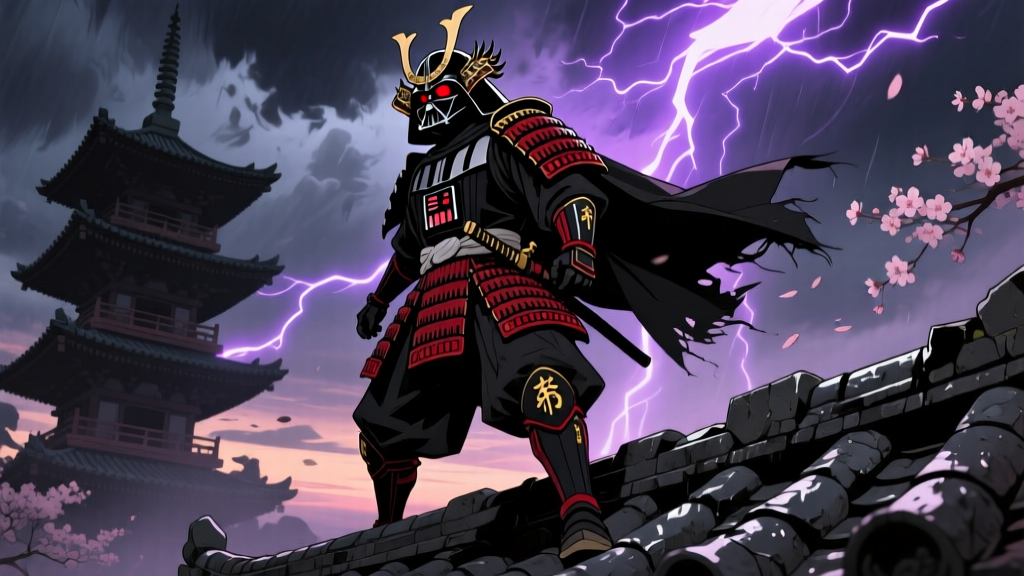
When Bandai released a series of Star Wars figures reimagined as samurai in their Star Wars: Samurai line, it felt less like a novelty and more like a reunion. Vader in full samurai regalia, lightsaber reimagined as a katana, standing in a pose borrowed from ukiyo-e woodblock prints — the circle completed itself. The costume that McQuarrie had stitched together from kabuto helmets and knight’s armor in a Los Angeles studio was finally wearing what it had always been referencing.
George Lucas once said that he wanted Star Wars to feel like a "used future" — a world that had been lived in, fought over, and worn down by centuries of history. He got more than he bargained for. Through Vader, he channeled four hundred years of Japanese warrior culture into a single figure, and that figure became the most compelling villain in the history of cinema. The mask was always a kabuto. The sword was always a katana. The code was always Bushido. It just took a galaxy far, far away for the rest of the world to finally see it.
Questions Fans Keep Asking
Did George Lucas directly base Darth Vader on a specific samurai?
No single samurai has been officially confirmed as the direct model. However, the visual parallels to Date Masamune (1567–1636) — particularly the all-black armor and the crescent-moon helmet crest — are widely recognized by historians and Star Wars production designers alike. Lucas himself has cited general samurai aesthetics and Kurosawa films as influences, without naming a specific historical figure.
Was Ralph McQuarrie familiar with Japanese armor when he designed Vader?
Yes. McQuarrie’s personal reference library included books on both European and Japanese armor. His earliest Vader concept art from 1975 shows clear kabuto helmet influences. He described the design process as merging "samurai" elements with futuristic concepts at Lucas’s request. The Denver Art Museum’s exhibition catalog confirms that early drawings contained "near-direct quotations of samurai gear."
How did Kurosawa’s The Hidden Fortress influence Star Wars beyond Vader’s design?
The plot structure, character archetypes, and even specific camera techniques in A New Hope trace back to Kurosawa’s 1958 film. The two peasants (Tahei and Matashichi) became R2-D2 and C-3PO. The hidden princess (Yuki) became Leia. General Makabe split into Obi-Wan and elements of Han Solo. Lucas adopted Kurosawa’s wipe transitions, weather-as-emotion technique, and wide landscape framing.
Is the lightsaber combat style based on Japanese swordsmanship?
Partially. The two-handed grip, the spiritual discipline framing, and specific cuts (like the diagonal kesa-giri) draw from kenjutsu and kendo. However, Star Wars stunt coordinator Bob Anderson also incorporated Western fencing (particularly saber and broadsword techniques) into the original trilogy’s choreography. The prequel trilogy expanded the styles to include elements from multiple martial arts traditions.
Why does the samurai connection matter to understanding Darth Vader as a character?
Understanding the samurai roots reframes Vader’s entire arc. He’s not just a "fallen hero" in the Western literary tradition — he’s a warrior who betrays his code, serves a corrupt lord, and ultimately reclaims his honor through self-sacrifice. That narrative maps almost perfectly onto the Bushido-influenced stories of samurai redemption that Kurosawa spent his career perfecting. The mask, the armor, and the sword aren’t just costume choices. They’re a cultural language that Japanese audiences read instinctively and that Western audiences absorbed without knowing it.
— — —