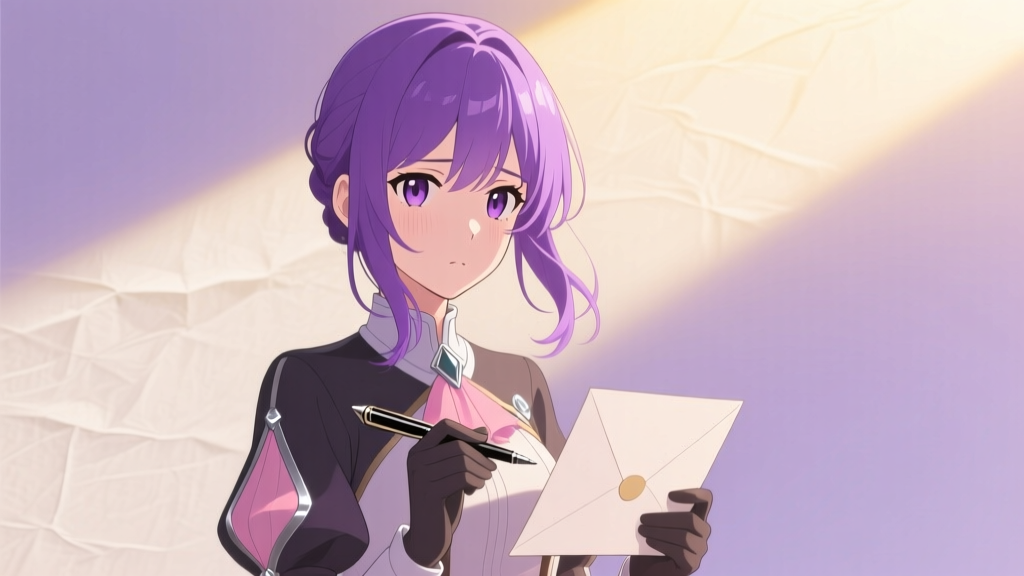
Violet Evergarden didn’t learn to love by being held—she learned it by folding paper, sealing envelopes, and pressing her thumb too hard on ink-stained stationery.
That’s the brutal, beautiful irony at the heart of Violet Evergarden: a girl who killed with surgical precision—sniping officers from 1,200 meters, disassembling rifles blindfolded at age 12—spends her postwar life learning how to say “I miss you” in cursive. Not as propaganda. Not as command. As truth.
Her first scene isn’t tender—it’s mechanical. Episode 1 opens on Violet’s hands: gloved, steady, reloading a Mauser under artillery fire while blood drips from her temple onto the bolt. She doesn’t flinch. She doesn’t blink. She doesn’t *feel*, not in any way the narrative treats as legible. The war didn’t break her; it erased her. What remained wasn’t trauma so much as vacancy—a body trained to obey, a voice calibrated for battlefield reports, a heart that had been surgically excised and replaced with duty.
Then comes Gilbert Bougainvillea’s last words: “I love you.” Not “Stay alive.” Not “Avenge me.” Not even “Remember me.” Just those three words—and Violet, who has never heard them directed at her, who has never parsed their syntax or weight, stands frozen in the rain like a doll whose strings have snapped. That moment isn’t the start of her healing. It’s the first crack in the dam—and she doesn’t even know water is supposed to be behind it.
Writing letters isn’t metaphor here. It’s physical therapy for the soul.
At CH Postal Company, Violet isn’t hired as a secretary. She’s assigned as a *tool*: a beautiful, precise, emotionally inert vessel for other people’s feelings. Her job is to transcribe what clients *mean*—not what they say. Mrs. Cordelia’s trembling request to write to her dead husband isn’t “Tell him I’m lonely.” It’s “Describe the lilacs blooming where we sat in ’03. Mention how the teacup still has his chip on the rim.” Violet repeats the instructions back, toneless. Then she writes it—perfectly. But she doesn’t understand why the client sobs when she reads it aloud. She copies the shape of grief without recognizing its shadow.
This is where most anime would soften her with montage and music. Violet Evergarden does something sharper: it makes her fail. Repeatedly. In Episode 4 (“The Letter That Could Not Be Delivered”), she delivers a letter to a grieving mother—only to learn the child it’s addressed to is already buried. Violet stands there, holding the unopened envelope, and says, flatly: “This letter has no recipient.” The mother doesn’t rage. She whispers, “No… it has *too many*.” Violet walks away, but the line sticks in her throat like glass. For the first time, her precision becomes a liability—not because she misdelivered, but because she *understood the facts* and missed the wound.
That’s the pivot. Not empathy dawning like sunrise—but confusion settling like frost. Violet begins to notice discrepancies: between what people say and how their hands shake; between the cheerful script of a birthday letter and the hollow exhaustion in the sender’s eyes; between the word “love” and the way Gilbert’s voice cracked when he said it—not with passion, but with terror. That terror, she realizes later (in Episode 13, during her confrontation with Claudia), was fear of losing her. Not as a weapon. As a person.
The typewriter isn’t a symbol of progress. It’s a cage she learns to dismantle, one key at a time.
Violet’s transition from handwriting to typewriting mirrors her internal shift—from mimicry to authorship. Early on, she copies phrases verbatim from sample letters. “With deepest affection,” “Yours faithfully,” “Until we meet again.” They’re incantations. Empty shells. Then, slowly, she starts *editing*. In Episode 7, she rewrites a soldier’s clumsy draft to his fiancée—not to polish grammar, but to embed subtext: changing “I am safe” to “I watched the sunrise today and thought of how you’d scold me for staying up too late to see it.” The fiancée cries—not because it’s poetic, but because it’s *true*. And Violet watches her cry, then looks down at her own hands, flexing her fingers as if testing new muscles.
But here’s what the show refuses to romanticize: Violet doesn’t suddenly *get it*. Her breakthroughs are halting, often backward. After writing a letter for a dying boy to his sister (Episode 9), she returns to the office and mechanically polishes the same brass nameplate for twenty minutes—her version of panic attack. In Episode 11, she tries to write *her own* letter to Gilbert and crumples seventeen drafts. Not because she lacks words—but because every sentence feels like treason against the silence he left behind. The act of writing her own emotion isn’t liberation. It’s excavation. And excavation hurts.
Which brings us to the letters she *doesn’t* send. The ones she keeps folded in her drawer: the unsent reply to Cattleya’s confession; the half-finished apology to Benedict; the single line she writes to Gilbert over and over: “I don’t know what ‘I love you’ means—but I know what your hand felt like when it held mine.” These aren’t failures. They’re evidence of rewiring. Every unsent letter is a synapse firing for the first time—not toward obedience, but toward ambiguity, vulnerability, the terrifying luxury of *uncertainty*.
Her trauma isn’t resolved. It’s translated.
Let’s be blunt: Violet Evergarden never gets over being a child soldier. She doesn’t “move on.” She translates. Her PTSD manifests not in flashbacks (though there are flickers—gunfire syncing with typewriter keys, the smell of cordite rising from hot metal), but in somatic memory: her left arm spasming when she hears sudden noise; her instinct to scan rooftops before entering a room; the way she blinks exactly three times before answering a question—just like she did before taking a shot. The show doesn’t pathologize this. It contextualizes it. Her body remembers war because her mind was never allowed to unlearn it.
Writing becomes the counter-rhythm. Where combat demanded suppression, letter-writing demands amplification—not of volume, but of nuance. To write Mrs. Rowland’s letter to her estranged daughter (Episode 12), Violet must sit with the woman’s silence for ten full minutes, watching her trace the rim of a teacup, noticing how her knuckles whiten when she mentions “the day I sent her away.” Violet doesn’t ask questions. She *watches*. And in that watching—patient, nonjudgmental, relentless—she practices the first skill war stripped from her: presence.
That’s why the final arc—the confrontation with the automail engineer, the return to Leidenschaftlich, the letter to Gilbert—isn’t about closure. It’s about *continuity*. When Violet finally writes to Gilbert—not as a ghostwriter, not as a soldier, but as Violet—she doesn’t declare love. She writes: “I am learning to live. Not as your weapon. Not as your memory. As myself. And sometimes… that feels like the bravest thing I’ve ever done.”
She mails it. Doesn’t wait for a reply. Doesn’t need one.
Here’s what the series understands that most trauma narratives don’t: healing isn’t the absence of pain. It’s the expansion of capacity—to hold grief and gratitude in the same breath, to feel anger and tenderness toward the same person, to write “I love you” not as a desperate question, but as a quiet, daily practice.
I remember watching Episode 13—the train sequence—and realizing Violet wasn’t crying because she’d “found love.” She was crying because she’d finally *recognized* her own heartbeat beneath the rhythm of the wheels. Not as a pulse to monitor. Not as a target to protect. As something warm, irregular, stubbornly alive.
So no—Violet Evergarden doesn’t become a writer to express herself. She becomes one to *reclaim language* from the generals who taught her to use it only for commands, from the medics who used it only for triage, from the world that treated her voice as either weapon or ornament. Every letter she pens is an act of linguistic reclamation. Every envelope sealed is a small rebellion against the idea that some people are born only to deliver messages—not to originate them.
And that’s why the final shot isn’t of her holding a pen, or typing, or even reading. It’s of her hand—bare, scarred, resting lightly on the cover of a blank notebook. Not open. Not closed. Simply *there*. Waiting. Not for instruction. Not for permission. For the next sentence she’ll choose to speak, in her own voice, on her own terms.