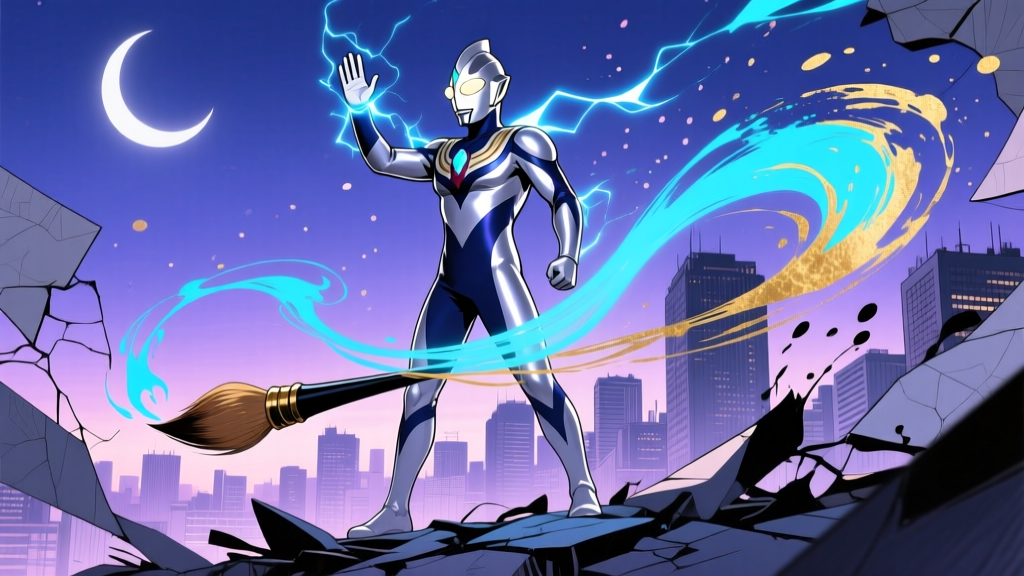
The comic book world stopped scrolling on June 16, 2020. That morning, Marvel Comics dropped a single image on Twitter: a fully painted cover showing Ultraman rendered not in flat ink lines or digital gradients, but in layers of hand-applied gouache and watercolor. The artist was Alex Ross, and within hours the image had been shared over 40,000 times. For fans who grew up watching the Ultra Series on Japanese television and reading Ross's work in American comic shops, the collision felt overdue — like two hemispheres of superhero culture finally meeting at the seam.
Ross himself had been waiting for this moment longer than most people realized. He'd been painting Ultraman privately for years, testing compositions, experimenting with how his photorealistic technique could capture a character built from rubber suits, silver paint, and practical effects rather than spandex and CGI.
A Painter Who Grew Up Watching Kaiju on Saturday Mornings
Alex Ross was born in Portland, Oregon in 1970 and raised on a diet of superhero mythology that crossed the Pacific without most Americans noticing. While his peers were reading Spider-Man and drawing Batman, Ross was absorbing the visual language of tokusatsu — the Japanese genre of practical-effects television that includes Ultraman, Kamen Rider, and the various Godzilla productions.
His mother, Lynette Ross, was a commercial artist who taught him color theory and paint handling before he turned twelve. By his late teens, he'd developed the technique that would make him famous: building figures in gouache and watercolor over detailed pencil layouts, using photographic references for anatomy and lighting, then layering transparent washes to achieve a luminosity that flat inking simply cannot produce. His breakthrough came with Marvels (1994), a four-issue series that reimagined Marvel's Silver Age through the eyes of an ordinary photographer. The Harvey Award for Best Artist followed that same year.
Two years later, Kingdom Come cemented his reputation. That 1996 DC miniseries — a story about aging heroes in a fractured future — sold over a million copies and established Ross as the artist you called when you wanted superheroes to look like they could actually exist in physical space, casting real shadows on real ground.
The Ultraman fandom, though, remained a separate thread. Tsuburaya Productions' flagship character had existed since 1966, when Eiji Tsuburaya — the special effects wizard behind Godzilla's original suit — designed a silver-and-red giant from "the Land of Light in Nebula M78." The character's look was pure industrial design: a smooth, featureless face with two elliptical eyes, a central fin running from forehead to crown, and a body covered in alternating silver and red patterning that suggested musculature without depicting it. Three-minute time limits, Color Timer warnings on the chest, and the iconic Specium Ray pose gave the character a visual grammar that Ross understood intuitively.
The Rise of Ultraman: Marvel's Gamble and Ross's Cover
In April 2020, Marvel Comics announced a partnership with Tsuburaya Productions to publish The Rise of Ultraman, a five-issue limited series written by Kyle Higgins and Mat Groom. The series would reinterpret the Ultraman mythology for Western comic readers while maintaining continuity with the broader Ultra canon. Interior art was handled by Francesco Manna and Michael Cho, but the marquee assignment — the cover that would define the series' visual identity — went to Ross.
The cover for issue #1 depicts Ultraman in a three-quarter pose against a cosmic backdrop. Ross painted the character's silver surfaces with cool titanium whites and pale blues, letting the red accents burn with cadmium warmth. The Color Timer on Ultraman's chest glows with an inner light that Ross achieved through multiple transparent glazes — a technique he'd perfected on characters like the Silver Surfer, whose metallic skin required similar handling. The background isn't empty black space; it's a nebula field rendered in deep indigos and violet washes, suggesting the M78 origin without literal depiction.
What makes this cover function so well is how Ross translated a character designed for a 1960s rubber suit into something that reads as genuinely three-dimensional. The original Ultraman suit, worn by actor Bin Furuya, had visible seams and limited facial articulation. Ross's painted version maintains the smooth, mask-like face but adds subtle environmental reflections across the silver surfaces — starlight catching the curve of a shoulder, atmospheric haze softening the edges of the fin. The result feels like you're looking at an actual being standing in actual space, not a costume on a soundstage.
"Ultraman was one of those designs that I was always sketching as a kid — that simplicity of form, the way the silver and red divide the body into these clean geometric zones. When I finally got to paint him professionally, I wanted the light to feel like it was coming from somewhere real, not just studio lighting."
— Alex Ross, discussing his approach to the character
Translating Tokusatsu Into Paint: The Technical Challenge
Painting Ultraman presents a specific technical problem that doesn't exist with most Western superheroes. Characters like Superman or Captain America wear fabric — capes that fold, muscles that stretch cloth, faces that express emotion. Ultraman is essentially a full-body helmet. There's no hair, no visible skin, no mouth. The eyes are opaque white ovals. The entire emotional register has to come from pose, lighting, and the subtle interplay of reflection across metallic surfaces.
Ross solved this problem the same way he'd handled similar challenges with characters like the Vision or the Silver Surfer: by treating the metallic body as a landscape of reflected light. On his Ultraman, the silver sections pick up ambient color from the environment — blues from the cosmic background, warm amber from distant suns, cool greens from planetary atmospheres. The red bands across the torso and legs absorb light differently, creating a visual rhythm that breaks the figure into readable segments even at thumbnail size.
The Gouache Technique Up Close
Ross works primarily in gouache — an opaque watercolor that allows both broad washes and precise detail. His typical process begins with a detailed graphite drawing on illustration board, often built over photo references he shoots himself. He then blocks in large color areas with diluted gouache, gradually building opacity through successive layers. Highlights are applied last, often with a fine sable brush and nearly pure titanium white.
For the Ultraman cover, this layering approach was essential. The character's silver surfaces needed to read as metallic without looking like chrome — they needed warmth, depth, and the suggestion of organic material rather than polished steel. Ross achieved this by underpainting the silver areas in pale blue-gray, then adding warmer tones in the areas where light would naturally collect: the ridge of the central fin, the curve of the pectorals, the knuckles of the clenched fists.
| Piece | Year | Medium | Format | Availability |
|---|---|---|---|---|
| The Rise of Ultraman #1 Cover | 2020 | Gouache/watercolor on board | Comic book cover | Marvel Comics (standard + variants) |
| Ultraman Limited Screen Print | 2021 | Screen print on cotton rag | 18" x 24" edition of 250 | Signed/numbered, sold out |
| Ultraman Signed Art Print | 2022 | Archival giclée | 16" x 20" limited edition | Licensed release (~$250) |
| The Trials of Ultraman #1 Variant | 2021 | Gouache/watercolor on board | Comic book variant cover | Marvel Comics |
| Ultraman Original Painting (1966 tribute) | 2020 | Gouache on illustration board | Original art, private collection | Not commercially available |
Where Ultraman Meets the Marvel Universe
The Marvel/Tsuburaya partnership that produced The Rise of Ultraman was itself unusual — a major American publisher licensing a character from a Japanese production company with no existing Marvel history. Previous Ultraman comics had been published by Dark Horse (1990s), Harvey Comics (1960s, aimed at children), and various Japanese manga publishers, but never by Marvel's main line.
Ross's involvement lent the project immediate credibility with the direct market — the network of comic shops and collectors who drive variant cover sales. His name on a cover signals a specific kind of quality: hand-painted, compositionally ambitious, rooted in the character's visual history rather than trendy redesigns. For readers unfamiliar with Ultraman, the Ross cover communicated that this was serious superhero material, not a novelty license.
The Crossover Aesthetic
One of the more interesting aspects of Ross's Ultraman work is how it sits alongside his Marvel and DC paintings. When you place his Ultraman cover next to his iconic Kingdom Come Superman or his Marvels Spider-Man, the visual consistency is striking. Ross treats Ultraman with the same painterly gravity he brings to Western icons — the same attention to light falloff, the same commitment to making the impossible look physically plausible. This isn't Ultraman rendered in anime style or manga linework; it's Ultraman painted as if he'd always existed in the same visual universe as Ross's other subjects.
That consistency matters. It tells Western readers that Ultraman deserves the same artistic respect as Superman or Batman. It tells Japanese fans that their flagship character translates across cultural boundaries without losing visual power. And it demonstrates that tokusatsu design — built from practical constraints, rubber suits, and stage lighting — can hold its own against characters designed for the printed page.
The Collectibles Market: Prints, Posters, and Original Art
Ross's Ultraman work has generated a small but active secondary market. The limited edition 18" x 24" screen print, produced in an edition of 250 on archival acid-free cotton rag paper, sold out quickly through authorized dealers. Each print was hand-signed and numbered by Ross, and the production quality — thick stock, precise color registration, and the subtle texture that screen printing preserves — made it a step above typical comic art reproductions.
A separate 16" x 20" signed limited edition giclée print followed, priced around $250 through licensed galleries. These archival pigment prints capture more tonal subtlety than offset lithography, though they lack the physical texture of the screen print edition. Trends International also released a mass-market poster of the Rise of Ultraman #1 cover at 22.375" x 34", bringing the image into dorm rooms and convention center vendor tables at a fraction of the limited edition cost.
Original Ross paintings — the actual gouache-on-board pieces — rarely surface on the secondary market. When they do, Heritage Auctions typically handles the sales, and prices for his major cover work routinely reach five figures. A Ross-painted cover for a prominent character can sell for $20,000 to $100,000 depending on the subject, condition, and provenance. His Ultraman originals, given the character's growing Western profile and the limited number of pieces Ross has painted, are likely to appreciate.
What Collectors Should Verify
- Authentication: Legitimate Ross prints include a certificate of authenticity from either the artist's studio or the licensed publisher. Beware of unsigned reproductions marketed as "limited editions" without edition numbers.
- Paper quality: The 250-count screen print uses 100% cotton rag, acid-free stock. If the paper feels glossy or thin, it's likely a later unauthorized reproduction.
- Signature consistency: Ross signs in pencil or archival ink, typically in the lower margin. His signature has remained consistent for three decades — flowing cursive with a distinctive capital R.
- Provenance: Original paintings should come with documentation from Ross's studio or a reputable auction house. Private sales without provenance carry significant forgery risk.
Why This Matters for Tokusatsu Art
For decades, tokusatsu characters existed primarily in three visual contexts: on television screens, in toy photography, and in Japanese illustration styles that emphasized clean linework and flat color. Western comic art — with its emphasis on painted realism, dramatic lighting, and physical weight — rarely touched these characters. When it did, the results often felt awkward, like the artist didn't understand what made the design work.
Ross understood. His Ultraman isn't trying to be something the character isn't. There's no attempt to add texture that doesn't belong, no forced musculature beneath the suit, no anime-style exaggeration of the eyes or proportions. Instead, Ross treats the 1966 design as a finished piece of industrial design and asks: how does this object exist in light? How do these silver and red surfaces respond to an environment? What does this figure look like when you render it with the same seriousness you'd bring to a Caravaggio study?
The answer, it turns out, is extraordinary. Ross's Ultraman paintings demonstrate that great character design transcends its original medium. A hero conceived for a 1966 Japanese television production, built from rubber and aluminum paint and practical ingenuity, can stand alongside any character in global comics when the artist respects the source material and applies genuine technical skill.
Whether Ross returns to Ultraman for future projects remains an open question. His schedule includes ongoing cover work for both Marvel and DC, gallery exhibitions, and occasional original character projects. But the door between his studio and Tsuburaya's universe is open now, and the work he's already produced suggests this is a collaboration with room to grow.
Questions Collectors and Fans Actually Ask
Has Alex Ross painted other tokusatsu characters besides Ultraman?
Ross has confirmed in interviews that he's a tokusatsu fan broadly, but Ultraman remains his primary publicly exhibited subject from the genre. He's expressed admiration for Godzilla's design and the broader kaiju aesthetic, though no commissioned Godzilla paintings from Ross have surfaced in authorized releases. Given the Marvel/Tsuburaya partnership's success, additional tokusatsu crossover work seems plausible if licensing arrangements align.
How does Ross's Ultraman compare to his Superman or Batman work?
Technically, the approach is identical — gouache and watercolor on illustration board, photo-referenced figures, layered glazing for metallic surfaces. The compositional challenge differs, though. Western superheroes typically have faces, capes, and fabric costumes that provide visual variety. Ultraman's featureless mask and unitary bodysuit force Ross to generate visual interest entirely through lighting, pose, and environmental reflection. Many collectors consider his Ultraman work technically superior to his DC output for precisely this reason: it's harder to make a smooth, expressionless figure compelling, and Ross pulled it off.
Are there variant covers beyond the main Rise of Ultraman #1?
Yes. Marvel produced multiple variant covers for the series, and Ross contributed to at least one additional variant beyond the primary cover. The Trials of Ultraman (2021), the follow-up series, also featured Ross variant covers. The variant market for these issues has been active, with some Ross variants trading at significant premiums over cover price on the secondary market.
Where can I see the original painting?
Ross's original cover paintings are typically retained by the artist unless specifically commissioned as work-for-hire with original art return provisions. Marvel's standard practice with prominent cover artists often includes returning originals, but Ross's contracts have historically allowed him to retain his paintings. The Ultraman originals are believed to be in Ross's personal collection. They occasionally appear in gallery exhibitions — Ross has shown work at galleries including the Charles Scott Gallery and Van Eaton Galleries — but permanent public display is unlikely unless a museum acquires them.
What's the best entry point for someone new to Ultraman comics?
The Rise of Ultraman (2020) collects into a single trade paperback and is the most accessible starting point for Western readers. It's a self-contained story that introduces the core mythology — the Science Patrol, the kaiju threats, the M78 origin — without requiring decades of Ultra Series viewing. The Ross cover on issue #1 makes it visually distinctive on shelves, and the interior art by Francesco Manna is solid if more conventional than Ross's painted work. From there, The Trials of Ultraman (2021) continues the story and expands the roster of Ultra characters.
Further viewing: Ross's official site (alexrossart.com) periodically updates with new releases and exhibition schedules. Tsuburaya Productions' global site maintains news about the Marvel comic partnership and upcoming Ultraman media. Heritage Auctions (ha.com) catalogs past Ross sales with realized prices for collectors tracking market values.