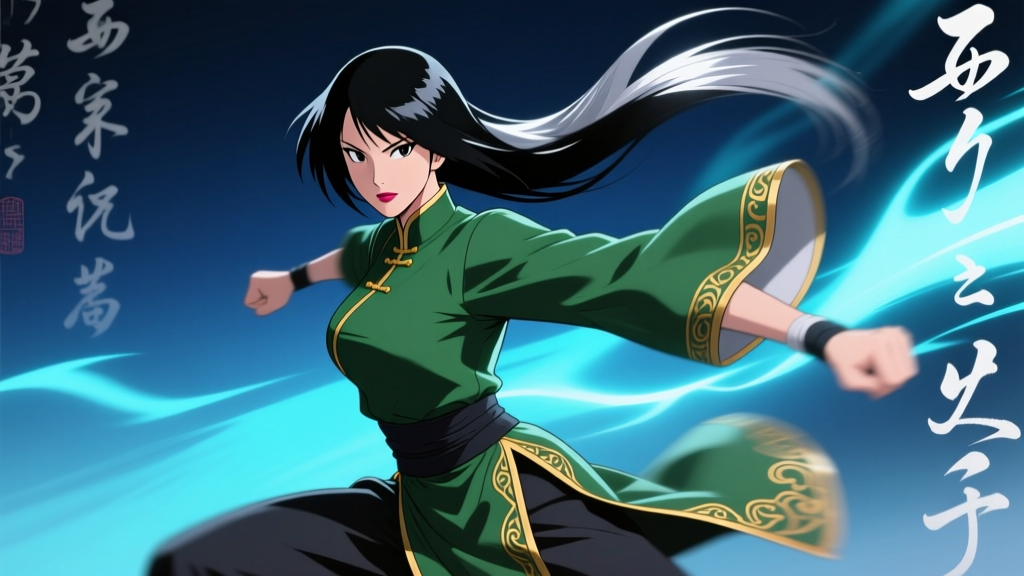
Yoruichi Shihoin Doesn’t Run—She Unmakes Distance
Calling Yoruichi’s Flash Step “speed” is like calling a shikigami scroll “paper.” It’s technically true, but it misses the violence of the omission—the way her movement erases the very premise of pursuit.
I remember watching Episode 35—the first time she appears in human form after decades in cat shape—and feeling a jolt that had nothing to do with power scaling. She doesn’t appear behind Byakuya; she’s just… already there, arms crossed, bare feet silent on stone, as if the space between them had never existed as a thing to be crossed. That’s not acceleration. That’s jurisdiction.
Chapters 110–114—the Soul Society arc’s quiet storm—don’t showcase Flash Step as spectacle. They document it as protocol. In Chapter 112, page 14, Yoruichi disarms two Kido Corps officers mid-incantation: not with a kick to the jaw, but by stepping *inside* their guard radius, fingertips brushing the hollows beneath their clavicles—precisely where the kyusho point shōmon intersects with the sternocleidomastoid’s tension line. Her foot placement? A narrow, forward-weighted hira-dachi, knees bent just past 90°, weight balanced over the balls of her feet—not for springing, but for *withdrawing*. She touches. She unbalances. She is gone before their spines register the shift in centerline. No blood. No broken bone. Just two men kneeling, gasping, their kido half-formed and useless in their throats.
This isn’t fantasy physics. It’s onna-musha pragmatism, rendered in Kubo’s panel grammar. Look at the layout on Chapter 113, page 6: three vertical panels, each narrower than the last—12mm, then 8mm, then 4mm—stacked like a densho scroll’s margin notes. In the first, Yoruichi’s left foot lifts, sole visible, toes flexed—not pointed, but *curled*, gripping air like tatami. In the second, her right knee bends *inward*, collapsing her stance laterally, not forward—a deliberate negation of momentum. In the third, empty space. Not a blur. Not motion lines. Just the faintest impression of displaced dust motes near a shoji screen’s lower rail. That’s the ma-ai collapse made visual: distance isn’t bridged. It’s administratively dissolved.
Kubo said it plainly in that 2006 V-Jump interview: *“Women’s movement in old Japan wasn’t about being fast enough to win a race. It was about being light enough to leave no trace of the race having happened.”* He wasn’t romanticizing. He was citing. Nakano Takeko didn’t carry a naginata because it was elegant—it was the only weapon that let a woman control a 3-meter radius without needing upper-body mass to swing it. Her footwork in the Battle of Aizu (1868) wasn’t about dodging bullets (she died from one); it was about using the terrain’s micro-contours—uneven paving stones, rice bale edges, rain-slicked eaves—to force male opponents into overextended stances, then exploiting the split-second lag when their heavier torsos corrected. Yoruichi’s retreat from Soi Fon in Chapter 114 isn’t evasion. It’s the same calculus: she lets Soi Fon commit to a lunge, then shifts her weight *laterally*—not back, not up—just sideways, like water parting around a reed—so Soi Fon’s follow-through carries her past, off-balance, while Yoruichi pivots, bare heel pressing down *exactly* where Soi Fon’s trailing foot *should have been*. Sovereignty isn’t holding ground. It’s deciding which ground gets to exist in the first place.
Modern shonen speed tropes fail this test. When Ichigo or Kenpachi “flash step,” the panels scream: *Look how far he went!*—wide-angle shots, speed lines like shattered glass, impact craters. It’s masculine velocity: linear, declarative, exhausting. Yoruichi’s Flash Step has no sound effect in the manga. Not shun!, not shishun!. Just silence, and the soft, almost imperceptible shhhk of silk against skin as she moves—Kubo’s notation for frictionless intention. Her power isn’t in how fast she arrives. It’s in how thoroughly she refuses to acknowledge the journey as real.
That’s why the cat form matters. Not as gag. Not as fanservice delay. As archive. For over 100 years, Yoruichi moved through Seireitei unseen—not because she was hiding, but because her movement pattern matched the ambient rhythm of servants, messengers, healers: low-to-the-ground, economical, non-confrontational in silhouette. The onna-musha didn’t vanish from history because they were weak. They vanished because their tactics were designed to leave no forensic trace—no broken weapons, no named duels in official records, no victory monuments. Their legacy lives in negative space: in the absence of certain kinds of violence, in the preserved integrity of certain thresholds, in the fact that some doors—like the Senkaimon—simply *could not* be forced open without her consent.
So no. Yoruichi doesn’t master Flash Step.
She remembers what it was for.