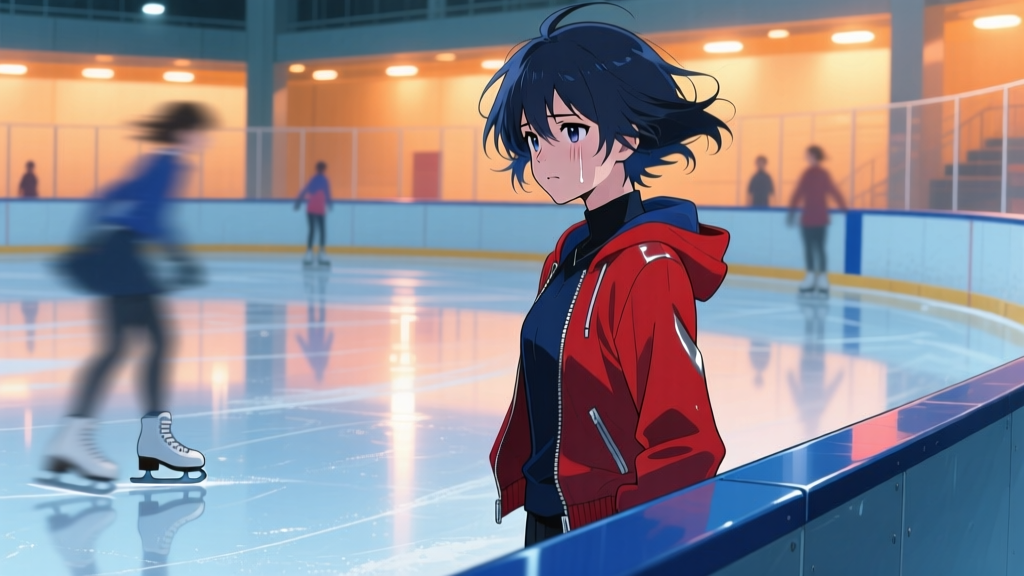
Yuri Plisetsky’s Skating Rink as Emotional Containment Field in Yuri on Ice (2016)
I remember watching Episode 7—“The Champion”—for the third time and pausing at the 4:12 mark: Yuri’s triple axel attempt, failed, then repeated. Not the jump itself, but the camera. It doesn’t follow his arc—it shatters it. Three simultaneous low-angle shots, each framing a different fragment of him mid-air: left profile, back of the neck, the hollow beneath his collarbone—all reflected in separate patches of ice. No cutaways to the crowd. No Victor’s face. Just Yuri, multiplied, unmoored, frozen in split-second stasis. That’s not choreography. That’s Lacan’s mirror stage made visible—and violently unstable.
The rink isn’t background. It’s infrastructure. In Wit Studio’s production notes for Season 1, Masayuki Oki cites their deliberate avoidance of “ambient warmth” in Yuri’s solo sequences: no lens flares, no soft focus, no ambient light bleeding onto the ice. Instead, they used high-contrast LED lighting calibrated to maximize specular reflection—so every surface behaves like a polished obsidian slab. The result? A space that doesn’t absorb emotion; it bounces it back, distorted, inescapable. This isn’t metaphor. It’s material psychoanalysis.
The Ice as Literalized Imaginary Register
Lacan’s Imaginary isn’t about illusion—it’s about misrecognition structured by visual coherence. In Seminar II, he insists the mirror stage isn’t a moment but a perpetual relay: the subject forever triangulating between body-in-motion, reflected image, and the Other’s gaze. Yuri’s rink literalizes this triangulation. Its surface is both mirror and barrier: reflective enough to show him, but cold and unyielding enough to deny integration. When he lands a jump cleanly—as in Episode 5’s short program—the camera holds a single, centered reflection: full-body, symmetrical, stable. But when he falters—as in Episode 7—the ice fractures his image across overlapping planes: one reflection catches his grimace, another his trembling hand, a third only his skates, blurred and inverted. There’s no unified “Yuri” there—only a constellation of partial objects, each demanding interpretation he can’t yet perform.
This isn’t just stylistic flourish. It’s diagnostic. Yuri’s early routines are dominated by technical precision—tight rotations, minimal upper-body deviation—not because he lacks artistry, but because he’s attempting ego-formation through control of the Imaginary field. Every clean landing is a temporary suturing of self-image; every fall, a rupture that exposes the gap between the ideal-I (the champion he must become) and the fragmented body-in-time (the 19-year-old who still flinches at his own reflection). His rink doesn’t contain him; it holds him in suspension, forcing repetition until the Symbolic order—language, law, recognition—can intervene.
Victor’s Off-Ice Fluidity as Symbolic Intrusion
Contrast this with Victor Nikiforov’s spatial grammar. Watch Episode 2: he enters the rink not from the gate, but from the judges’ box, descending stairs—literally stepping down from the position of symbolic authority. His coaching isn’t delivered on the ice; it happens in the locker room, over tea, on park benches. He moves through non-reflective spaces: wood grain, fabric, skin. His presence destabilizes the rink’s Imaginary monopoly because he operates within the Symbolic Order—not as lawgiver, but as signifier. When he tells Yuri, “You skate like you’re apologizing,” he doesn’t correct technique—he names a symptom. He introduces language where only image previously reigned.
Crucially, Victor never mirrors Yuri’s fragmentation. In Episode 8’s practice session, the camera tracks Victor gliding backward, arms open, no reflection emphasized—just motion, breath, continuity. His body isn’t interrogated by the surface; it negotiates with gravity, air, time. He embodies what Lacan calls the “subject of the signifier”: not fixed, not unified, but constituted through speech-acts (“I believe in you”), promises (“I’ll stay”), and symbolic gestures (the scarf, the kiss on the forehead). His off-ice fluidity isn’t escape—it’s the very condition that allows Yuri’s Imaginary prison to become permeable.
Containment vs. Confinement: The Rink’s Dual Function
Here’s where most readings stall: they call the rink “oppressive” or “liberating” as if those were mutually exclusive. They’re not. Lacan’s containment fields—like the maternal body, the analyst’s couch, the classroom—are neither benevolent nor hostile. They’re necessary structures that hold desire long enough for it to acquire symbolic form. The rink contains Yuri’s shame—not to punish it, but to make it legible. When he vomits after his disastrous free skate in Episode 3, the camera lingers on the puddle spreading across the ice—not as degradation, but as material surplus. That vomit is the Real erupting into the Imaginary field: unassimilable, unrepresentable, yet undeniably present. The rink holds it. Doesn’t absorb it. Doesn’t erase it. Just… contains it, until language arrives.
That arrival happens in Episode 10. Not during a routine—but in the empty rink at dawn, Yuri alone, skating without music, without audience, without reflection emphasized. The camera stays wide, level, steady. For the first time, the ice isn’t reflecting him—it’s supporting him. He’s not performing for the mirror or the judges or even Victor. He’s moving *with* the surface, not against its demands. This isn’t mastery. It’s alignment. The Symbolic has taken root: his desire is no longer “to be seen as perfect” but “to move as myself.” The rink hasn’t changed. His relation to it has.
Why This Matters Beyond Anime Studies
What makes Yuri on Ice exceptional—not just aesthetically, but theoretically—is how rigorously it maps Lacanian topography onto embodied practice. Most sports anime treat training as discipline-as-moral-improvement: sweat equals virtue. Yuri on Ice treats it as ego-formation-as-linguistic-event. Every fall, every reflection, every whispered correction is a node in a symbolic network. And the rink? It’s the unconscious made architectural.
Oki’s 2019 seminar at Kyoto University zeroes in on this: he argues that sports anime rarely depict the “pre-symbolic body” except as raw potential—muscle, speed, instinct. Yuri on Ice does something rarer. It shows the pre-symbolic body as traumatic residue: the way Yuri’s shoulders tense before takeoff, the micro-flinch when Victor touches his waist, the way he avoids eye contact with his own reflection in the arena glass. These aren’t character quirks. They’re Lacanian “points de capiton”—knots where signification fails, where the Real leaks through. The rink contains those leaks—not to silence them, but to give them shape, weight, duration.
Which brings us back to Episode 7’s fractured angles. That shot isn’t just about failure. It’s about the precise moment when fragmentation becomes legible as structure. When Yuri sees himself broken across three reflections, he isn’t seeing weakness—he’s seeing the architecture of his own subjectivity. And the rink, cold and bright and utterly indifferent, holds that sight long enough for him—and us—to name it.
That’s why the final episode’s gold medal feels so quiet. No fireworks. No slow-motion leap. Just Yuri standing still, breathing, looking—not at the crowd, not at Victor, but down at the ice. Not at his reflection. At the surface itself. The container has become ground. The Imaginary has ceded space—not to transcendence, but to speech, to touch, to time. The rink didn’t disappear. It finally let him leave.