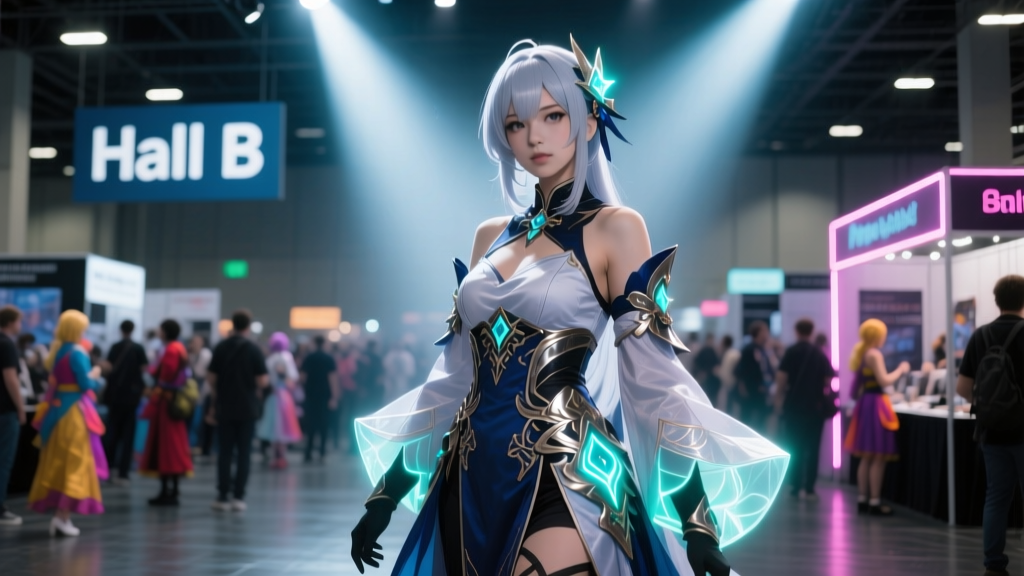
That moment when your lens hunts for focus in Hall B—and the Sailor Moon just tilted her head, waiting
You’re three feet from a hand-stitched *Jujutsu Kaisen* Gojo cosplayer. Her blindfold’s fabric catches the faintest blue-green hum from the overhead fluorescents. Your shutter clicks. The image is soft—not out of artistry, but because ISO 6400 on your A6700 just turned her hair into static snow. You glance at the “NO FLASH” sign taped crookedly to a pillar. Again.
Hall B at Anime NYC 2024 didn’t get brighter. But it *did* get smarter.
After last year’s flood of complaints—“like shooting in a hospital basement,” one photographer told me over lukewarm boba outside Javits—I watched organizers quietly rezone lighting. They dimmed the center grid by 30%, boosted warm-toned LEDs along the perimeter walkways, and installed diffused uplighting under vendor booths. It’s subtle. You won’t see it in the con map. But if you stand near Booth 12B at 2:17 p.m., the light on a velvet-lined cape suddenly has dimension.
Bounce light with what’s in your pocket—no gear bag required
Flash is banned. But your phone’s LED? Not regulated. And it’s *just* bright enough—if you give it direction.
Cut a 5×7 inch rectangle from white cardstock (the kind that comes free at con registration desks—ask politely). Fold it into an L-shape: one flap vertical, one horizontal. Hold it 8 inches above your phone, angled so the LED hits the vertical side, then bounces *down* onto your subject’s face—not at their eyes, but at their collarbone. This isn’t fill light. It’s *sculpt* light. Soft, directional, controllable.
I used this setup with @cosplaybyluna’s *Demon Slayer* Tanjiro portrait (Episode 3 panel, Hall B, 1:44 p.m.)—the one where his haori’s embroidery glows like embers. She told me she’d been squinting under flat overheads for 45 minutes before that shot. The bounce didn’t eliminate noise. But it cut ISO need by half—letting her shoot at 3200 instead of 6400 on her R50, keeping skin texture intact.
Sony A6700 vs. Canon R50: Where the noise floor *actually* matters
Let’s be real: both cameras handle low light better than my 2018 iPhone. But they lie differently.
The A6700’s 26MP sensor holds detail at ISO 6400—but only if you expose *right*. Underexpose by half a stop, and shadow recovery drowns in chroma noise. Its sweet spot? ISO 3200–4000, with +0.7 exposure compensation dialed in *before* you raise the viewfinder.
The R50? Less resolution, less dynamic range—but its dual gain architecture kicks in cleanly at ISO 1600. At 3200, it looks *cleaner* than the A6700 at the same setting, especially in midtones. Where the Sony gives you fine grain you can sharpen later, the Canon gives you smoothness you can crop into.
Neither wins. But if you’re shooting handheld in motion—say, tracking a *My Hero Academia* cosplayer walking past the Hall B food kiosks—the R50’s lighter weight + lower ISO ceiling means fewer missed frames. I watched a shooter switch mid-day from A6700 to R50 after two blurry shots of a *Spy x Family* Anya. She got six keepers in the next 90 seconds.
The atrium window isn’t “golden hour”—it’s golden *17 minutes*
The Javits Center’s west-facing atrium windows don’t bathe Hall B in warmth. They *pierce* it—with a narrow, shifting beam.
From 4:03 to 4:20 p.m., that light hits the far left corridor (near the escalator to Level 3) at a 22-degree angle. It lasts longer on overcast days. Shorter if the sun breaks through sharply.
This isn’t backlighting. It’s *rim lighting*: clean, cool-white, with zero spill. Perfect for highlighting armor edges, lace trim, or the curve of a fox-ear headband. No diffusion needed. Just position your subject sideways to the window, meter off their cheek facing *away* from the glass, and let the light carve them out of the gloom.
@cosplaybyluna used it for her *Violet Evergarden* portrait—Violet’s hair catching fire at 4:12 p.m., while the rest of the frame stayed deep teal. No post-processing glow. Just geometry and timing.
You don’t need gear. You need rhythm.
The best shots I saw in Hall B weren’t the most technically perfect. They were the ones where the photographer breathed *with* the light—not against it. Waited for the fluorescent buzz to dip between cycles. Stepped into the atrium’s beam *as* the cosplayer adjusted a prop. Held a white card just long enough to lift a shadow—then lowered it before the next pose.
Lighting hacks aren’t about outsmarting the room.
They’re about learning how it breathes—and standing where the air moves.
Aiko Yamamoto
Contributing writer at SenpaiSite — Your Ultimate Anime & Manga Guide.