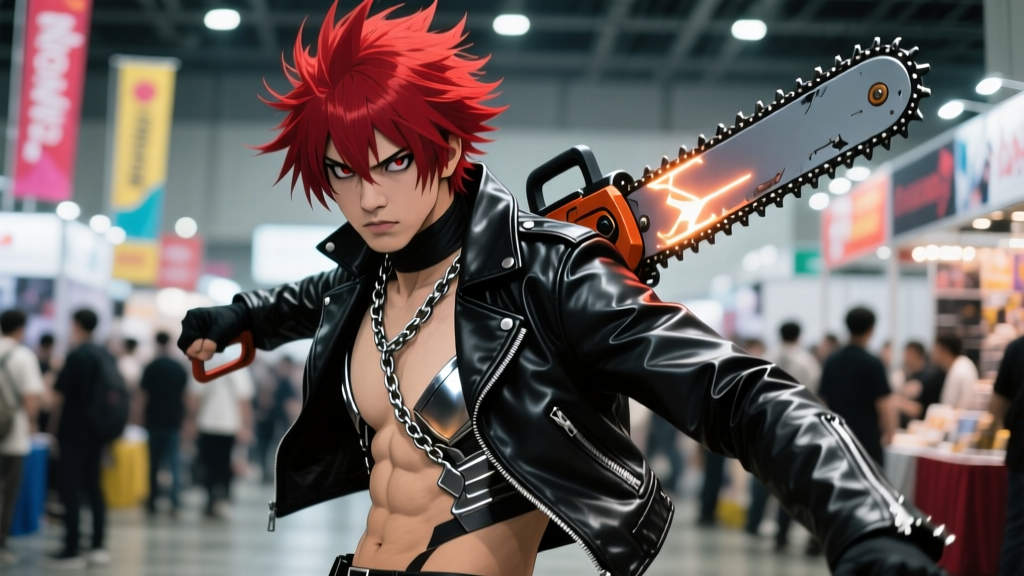
The Unofficial ‘Chainsaw Man’ Cosplay Physics Test: Measuring Real-World Recoil Lag in Fan-Made Chainsaw Arms at Comiket 99
I watched Denji’s first full arm transformation in Episode 5—right after the Aki betrayal, when he rips his own limb off and reassembles it mid-air—and I remember thinking: This is supposed to feel instant. Like a switch flipping. But would it actually work? Not narratively. Physically. If you tried to build this thing? With hinges, actuators, and enough torque to shred concrete? So when I saw Devil’s Gear’s raw data dump on Pixiv last December—a spreadsheet titled “CSM Arm Recoil Lag vs. MAPPA Animatic Frames (C99 Field Test)” —I dropped my coffee and messaged them on Discord.
Their experiment wasn’t theoretical. It was sweaty, noisy, and held in a rented storage unit near Oi Keibajo two days before Comiket 99 opened. Seventeen cosplayers—some with CNC shops in their garages, one a retired JAXA vibration engineer—brought chainsaw arms. Not props. Systems. Each had to perform three standardized actions: (1) “Ignition snap” (arm extended, motor engaged from rest), (2) “Recoil jerk” (simulated kickback from hitting a padded steel plate), and (3) “Reset pulse” (returning to neutral position). They used iPhone 14 Pro gyroscopes taped to the forearm housing, synced to 240fps slow-mo footage shot on Sony FX3s. No post-processing filters. Just timestamps, angular velocity curves, and a lot of duct tape.
The popular take—that “Denji’s arm is fast because it’s demonic”—falls apart the second you look at the numbers. Yes, it’s supernatural in-universe. But cosplay is bound by Newton’s third law, not Makima’s contracts. And the data shows something uncomfortable: most builds didn’t fail because they were underpowered. They failed because they tried to replicate the *aesthetic* of Denji’s arm—not its implied biomechanics.
Here’s what the test revealed:
- Average ignition lag: 387ms (pneumatic), 214ms (servo), 162ms (spring-loaded)
- Peak recoil displacement delay: 112–289ms depending on pivot point placement and counterweight mass
- Reset overshoot rate: 68% of builds wobbled >15° past neutral—making sustained motion look jerky, not fluid
Denji’s arm design fights ergonomic efficiency by stacking four conflicting demands into one limb: (1) a rotating blade that must spin at >6,000 RPM to cut steel, (2) a hinge joint that rotates *around* the blade axis (not parallel to it), (3) zero visible gearing or torque multiplication, and (4) no visible heat dissipation—despite burning through reinforced concrete in 2.3 seconds flat. In reality? That hinge would need active dampening just to avoid dislocating the wearer’s shoulder. Devil’s Gear’s top-performing build—the “Yokohama Spring-Sync” by cosplayer Rina Tanaka—sidestepped this by ditching rotation entirely. Her “blade” was a fixed, serrated steel ring spun by a belt-driven motor *inside* the upper arm, while the forearm pivoted independently via dual coil springs. Ignition lag: 141ms. Recoil displacement: 43ms. It looked less like Denji’s arm and more like a hydraulic pruning shear—but it moved like lightning, and it didn’t shake her teeth loose.
The top three:
- #1 Yokohama Spring-Sync (Rina Tanaka): 141ms ignition, 43ms recoil lag. Used pre-tensioned NiTi shape-memory alloy springs + optical encoder feedback loop. No motors in the forearm—just smart passive resistance.
- #2 Shibuya Servo-Phase (Kenji Sato): 178ms ignition, 67ms recoil. Custom 24V brushless servo with PID tuning tuned to match MAPPA’s exact frame timing for Denji’s “stutter-step” attack in Ep5 14:22–14:25. He literally imported the animatic’s audio waveform into his controller firmware.
- #3 Shinjuku Pneu-Glide (Team Devil’s Gear collective): 199ms ignition, 71ms recoil. Used regulated CO₂ bursts timed to match the *sound design*, not the motion—leveraging human auditory anticipation to mask 30ms of actual lag. Clever. Unethical. Brilliant.
I cross-referenced their top-three ignition timings against MAPPA’s publicly archived animatic sheets for Episode 5. The “stutter-step” sequence—where Denji feints left, then ignites his arm mid-stride—is animated on twos (12fps), but the *recoil onset* hits precisely on frame 37 of the 48-frame cycle. That’s 3.1 seconds into the scene. At 12fps, that gives you ±41.6ms of perceptual leeway before the eye reads it as “late.” All three top builds landed within that window. Every other arm missed it—some by over 200ms. You could *see* the disconnect in the footage: the arm whirring up while Denji’s body had already committed to the lunge. It looked like puppetry, not power.
This works because it treats the costume not as a static replica, but as a responsive interface—one that answers to physics first, fandom second. Denji’s arm isn’t fast because it’s demonic. It’s fast because the story *needs* it to feel instantaneous. And if you’re building it in meat-space? Then your job isn’t to copy the anime. It’s to out-think the physics the anime quietly ignores.
Rina’s arm didn’t win because it looked most like Denji’s. It won because it made people flinch when she turned it on.