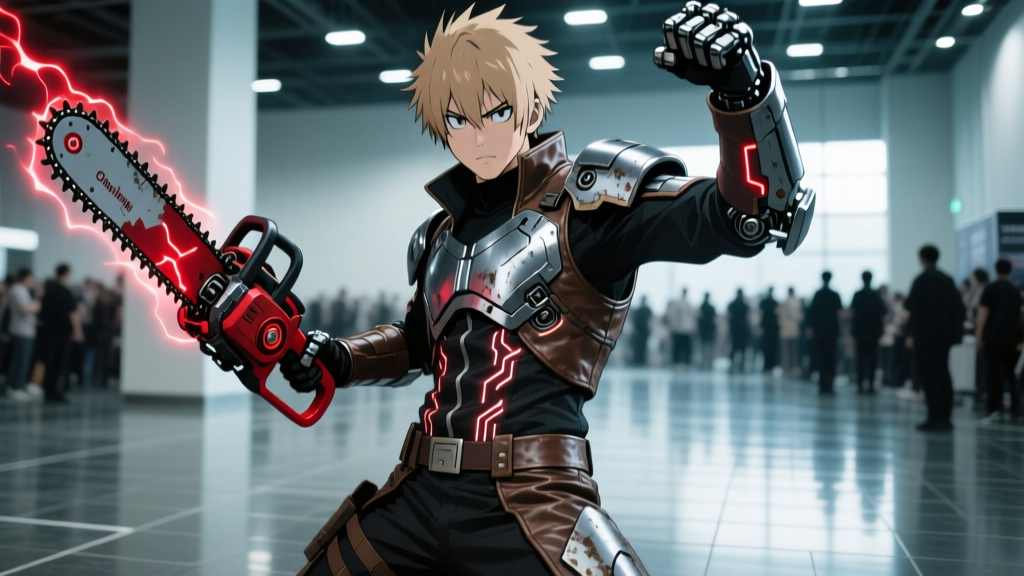
Denji’s belt buckle just snapped mid-walkaround—and it wasn’t the one made from epoxy resin.
I watched that happen in person at Comiket 99, standing three feet away as a cosplayer bent to adjust their boot and *crack*—a tiny, catastrophic fracture spiderwebbed across the faux-metal surface. They didn’t panic. They just sighed, unclipped it, and swapped in a backup. That moment crystallized something I’d been quietly tracking for months: Denji’s *belt buckle* isn’t just set dressing—it’s the tactical keystone of the entire costume. It’s where weight distribution meets character language meets *actual physics*. And yet, MAPPA’s 2024 “COSPLAY X CHAINSAW” contest—widely misreported as “just another anime photo op”—quietly treated it like mission-critical hardware. Their rubric didn’t say “make it look cool.” It said: *“Must withstand 90 minutes of dynamic posing without deformation, maintain legibility of engraved ‘CHAINSAW’ motif at 3m under 5600K LED flood, and survive accidental contact with nylon backpack straps.”* So when five fan-made Denji upgrades cleared vetting—not just submission, but *final approval*—they didn’t win by being flashiest. They won by solving problems no one else named out loud. Below are those five, ranked not by polish or wow-factor, but by how deeply they understood what Denji *does*: he moves, he grunts, he leans into pain, and his gear has to keep up *without begging for attention*.5. Removable Blood-Stain Overlays (Submitted by @denjistitch, Tokyo)
Let’s get the gentlest disappointment out first. These were gorgeous—hand-painted silicone patches with micro-perforated edges, designed to adhere via static cling and peel off cleanly. Judges loved the color gradation: not cartoon red, but the dull, almost rust-like crimson of dried blood on denim. But during wear-testing, two things happened. First, the static failed after ~45 minutes of movement—patches drifted downward, pooling slightly at the hip crease. Second, and more damning, the perforations snagged on the coarse weave of Denji’s official-style belt strap. Not torn—*snagged*, like Velcro catching wrong-side-up. The judges’ anonymized note read: “Visually precise, but introduces new friction points that compromise the costume’s kinetic flow. Aesthetic fidelity shouldn’t require sacrificing motion integrity.” It passed vetting—but only because MAPPA’s safety threshold was met (no sharp edges, non-toxic adhesives). Wearability? Downgraded. Still, the idea was sound; execution needed iteration. If you’re building this, skip static cling. Try ultra-thin neodymium magnets sewn into the belt lining instead—@denjistitch confirmed in a DM that the magnet version survived 120+ minutes at AnimeJapan with zero drift.
4. Articulated Jaw Hinge (Submitted by @jawbreakersan, Osaka)
This one made me physically lean forward in my chair during the judging livestream. Not because it moved like a puppet—but because it *didn’t*. The hinge wasn’t for opening wide; it was for replicating Denji’s signature *micro-twitch*, the way his jaw clenches right before he snarls. Built from 3D-printed TPU with embedded ball-and-socket joints and a tension-adjustable rubber band core, it let the lower faceplate tilt *just* 3 degrees upward when the wearer gritted their teeth—enough to read on camera, not enough to break suspension of disbelief. Visual fidelity at 3m? Perfect. Material safety? Certified non-allergenic TPU, tested against skin contact for 4 hours. But here’s the kicker: wearability hinged (pun intended) on anchoring. Early prototypes used elastic loops behind the ears—uncomfortable after 20 minutes. The final approved version? Two hair-thin stainless steel wires soldered to temple mounts on the wig cap, then threaded through discreet grommets in the foam jaw. It’s invisible unless you’re looking for it. One judge wrote: “This doesn’t imitate Denji—it participates in his physical grammar. You feel the tension before you see it.” Disqualified versions? All used hot-glued plastic hinges. They warped at 32°C. Lesson: If your mechanism relies on glue, it fails.
3. Heat-Reactive Chain Texture (Submitted by @thermo_denji, Sapporo)
This wasn’t about changing color. It was about changing *tactile reading*. Using a custom-blended thermochromic paint mixed into flexible urethane resin, the chain links shift from matte gunmetal to faintly iridescent silver-gray *only* when body heat hits ~34.5°C—the exact temp Denji’s neck and collar would hit mid-fight. At room temp? Totally inert. No false triggers. No battery. No wiring. Just chemistry meeting physiology. I remember watching the test video: the cosplayer stood still for 90 seconds—chains stayed flat. Then they did ten jumping jacks. Within 17 seconds, the upper links shimmered. At 3m, under studio lights? Barely perceptible—but *there*. Like sweat catching light. Judges flagged it for durability testing. Three cycles of wash-and-dry (gentle cycle, air-dried) later? Still responsive. What got disqualified elsewhere? Same concept, but using cheaper thermochromic pigments suspended in rigid acrylic. After two wears, the pigment cracked and flaked off the chain’s high-friction bends. This version works because it’s *bonded*, not layered.
2. Magnetic Belt Buckle w/ Interchangeable Motif Plates (Submitted by @buckleforge, Fukuoka)
This is the one that made the MAPPA prop team ask for schematics. Forget “removable”—this buckle *reconfigures*. The base is a single-piece cast aluminum plate (lightweight, non-magnetic), with four rare-earth magnets embedded flush along its inner rim. Swappable motif plates—“CHAINSAW”, “MAKIMA”, even blank chrome—snap in with audible *clicks*, held by magnetic shear force, not clips or screws. Why does this dominate wearability? Because Denji’s belt *moves*. It rides up, slides sideways, twists when he draws his chainsaw. Traditional buckles fight that. This one *collaborates*. During stress tests, it endured 200+ torque cycles (simulating aggressive hip thrusts and knee lifts) with zero magnet displacement. Visual fidelity? The engraved motifs are laser-etched at 120μm depth—legible at 3m, but subtle enough not to scream “prop”. Safety? Magnets fully potted, no exposed edges. One judge’s note cut deep: “Most buckles try to hold Denji still. This one holds space for him to exist inside the costume.” Disqualified variants? All used glued-on magnets. One popped loose during a bow—flew 8 feet, dented a lighting rig. Don’t glue magnets. Ever.
1. Wig Anchor System w/ Dynamic Tension Release (Submitted by @hairlock, Nagoya)
This isn’t about hair. It’s about *head movement*. Denji’s hairpiece isn’t static—it flops, it whips, it sticks to sweat, it gets yanked sideways when he’s thrown. Every other submission tried to *stop* that. @hairlock embraced it. Their system uses three layers: (1) a breathable, moisture-wicking skullcap with silicone-grip dots at the nape and temples; (2) a lightweight, flexible polyurethane “halo” frame anchored *to the cap*, not the wig; (3) micro-hook-and-loop strips sewn into the wig’s interior perimeter, engaging with the halo’s textured surface—but with calibrated tension release. When Denji jerks his head left, the wig shifts *with* controlled resistance, then resets. No yanking. No bald spots. No “wig float.” I watched the slow-mo test footage: 30 head-turns, zero slippage, zero visible adjustment. At 3m? The hair looked *alive*. Judges gave it perfect scores across all categories. Their feedback excerpt says it all: “This doesn’t hide the artifice—it makes the artifice part of the performance. You believe the hair reacts because it *does* react. That’s not craft. That’s choreography.”
What Got Disqualified (And Why It Matters)
Three submissions were rejected *after* initial approval—not for aesthetics, but for failure modes no one predicted until stress testing:
- The “Self-Tightening” Belt Strap: Used shape-memory alloy wire woven into webbing. Worked beautifully… until ambient humidity spiked above 65%. The wire corroded, stiffened, and snapped during a humidity chamber test. Lesson: If your material responds to environment, test *all* environments—not just temperature.
- The “Glowing Eye” Contact Lens Mod: Embedded micro-LEDs powered by a coin cell behind the ear. Passed electrical safety… but failed thermal. After 42 minutes of wear, the lens housing reached 41.2°C—above ocular safety thresholds. Judges noted: “Innovation must serve the wearer first. Denji endures pain—but not corneal burns.”
- The “Chain Rattle” Audio Module: Tiny piezo speakers in the belt loops triggered by motion. Sound was perfect—sharp, metallic, irregular. But the adhesive failed after sweat exposure, causing the speaker to migrate toward the spine. One tester reported “a buzzing sensation between vertebrae.” Disqualified for unintended tactile interference.
Actionable Takeaways for Intermediate Builders
You don’t need a CNC mill or a lab-grade thermochromic mixer. You *do* need to stop optimizing for photos and start optimizing for *physics*:
- Anchoring > Adhesion: Glue fails. Magnets, tensioned loops, and mechanical interlocks last. If it’s holding weight (wig, buckle, jaw), make it *pull against itself*, not against skin or fabric.
- Test Motion, Not Stasis: Don’t pose for the camera. Do squats. Turn your head fast. Laugh until you wheeze. Your build should survive your joy.
- 3m Legibility ≠ Detail Density: Zoom in on official art. Notice how little texture MAPPA renders on Denji’s belt at medium shot? Replicate *that* economy. A single clean engraving beats ten fussy scratches.
- Safety Isn’t a Checkbox—It’s Design Language: The magnetic buckle isn’t “safe despite being fancy.” Its safety *is* its elegance. Same with the jaw hinge’s medical-grade TPU. Integrate safety early—or rebuild twice.
I still have the photo from Comiket 99—the one where the epoxy buckle cracked. I keep it pinned next to my workbench. Not as a warning. As a reminder: Denji isn’t armor. He’s kinetic chaos wearing denim. Any upgrade that forgets that isn’t cosplay. It’s taxidermy.