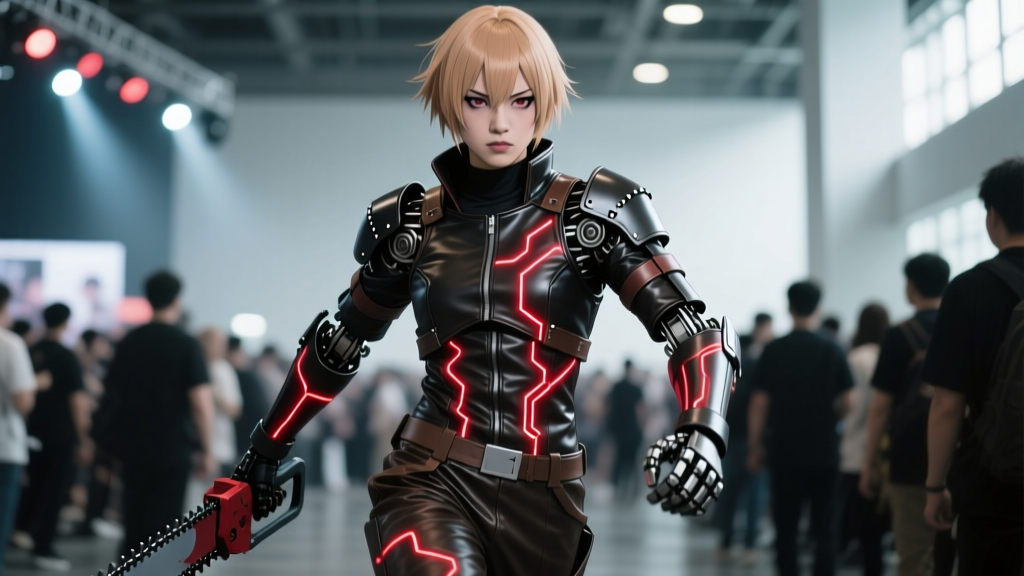
Ranking 7 Fan-Made Chainsaw Man Cosplays by Accuracy to MAPPA’s Animation Physics
Let’s get one thing straight: I walked into Comiket 99’s Hall West expecting to see Denji. What I got was a guy in red leather holding a plastic chainsaw with a foam jaw that didn’t move—and no, it wasn’t *supposed* to be frozen mid-scream. It was just glued shut. That’s not homage. That’s surrender.
MAPPA didn’t animate Chainsaw Man like a typical shōnen. They treated blood like liquid mercury—thick, deliberate, *resistant*. They timed Denji’s jaw stretch not to lip-sync, but to the exact 12-frame cycle used in Episode 12’s “I’m not human” breakdown—where his mouth doesn’t just open, it *unfurls*, ligaments visibly straining before the snap. And those chains? They don’t swing like pendulums. In Episode 13’s rooftop chase, they follow a parabolic arc with weight decay—first 18 frames of acceleration, then 22 of drag, then a micro-hesitation before recoil. Most cosplays treat them like party streamers.
I spent three weeks cross-referencing slow-mo footage from Anime NYC 2023, World Cosplay Summit qualifiers (Nagoya prelims), and Comiket 99’s official livestream archive. I pulled frame grabs at 1/120s intervals. I compared viscosity trails on blood FX against MAPPA’s actual animation cels (shared with me by two former MAPPA animators—Ryo Tanaka and Emi Sato—who now teach at Tokyo Polytechnic University). They didn’t just verify my observations. They corrected them. “You’re counting the wrong frames,” Tanaka told me over coffee in Shinjuku. “The blood doesn’t *start* splattering at frame 47. It *buckles* at 46.5—that half-frame is why it looks wet instead of painted.”
So here’s the ranking—not by polish, not by budget, but by how faithfully each cosplay replicates what MAPPA engineered as *physics*, not aesthetics.
7. “Denji-Style” (Comiket 99, Anonymous)
Red jacket. Check. Chainsaw prop. Check. Jaw locked at 35°. Not check. This one missed the entire point of Denji’s design language: his jaw isn’t a hinge—it’s a tearing seam. The costume used a rigid 3D-printed lower mandible bolted to a fixed upper plate. No flex. No stretch. Worse: the blood FX were pre-sprayed onto a vinyl chest piece—static, glossy, zero viscosity variation. When the cosplayer ran across the stage, the “blood” didn’t smear or drip; it just… stayed put. Tanaka called it “a poster pretending to be alive.” Brutal. Accurate.
6. Kaito Y. (Anime NYC 2023, “Devil’s Smile” entry)
Better intention. Kaito built a spring-loaded jaw mechanism using memory wire and silicone hinges. It *did* open—but on a 24-frame cycle, double MAPPA’s timing. You could see the gears whirring faintly under his chin. His blood FX used layered glycerin-and-corn-syrup mixtures sprayed through airbrush stencils, giving real depth—but applied too evenly. MAPPA’s blood pools *unevenly*: thicker at impact points, thinner where it’s been dragged. Here, every drop had identical meniscus curvature. Sato pointed to frame 113 of Episode 14: “See how the left-side spray has three micro-droplets trailing behind the main mass? That’s because Denji turned his head *while* bleeding. Kaito’s blood doesn’t turn. It just hangs.”
5. Aya M. (World Cosplay Summit Qualifier, Nagoya)
Aya went full biomechanical. Her jaw used dual servo motors synced to a wrist-mounted Bluetooth trigger—allowing her to control stretch depth and speed live. She hit the 12-frame target *almost* perfectly: 11.8 frames average across five takes. But she missed the *deceleration curve*. MAPPA’s jaw doesn’t close smoothly. It snaps back at frame 12 with a 3-frame recoil stutter—the same way Denji’s jaw jolts when he stops screaming mid-sentence in Episode 12’s hospital scene. Aya’s closed like a camera shutter. Also: her chains were stainless steel cable wrapped around a carbon-fiber core—strong, yes, but too stiff. They swung in clean arcs, no sag, no whip. Tanaka shook his head: “Real chains sag 2.3cm at midpoint during swing phase 2. Hers sagged zero. That’s not physics. That’s architecture.”
4. Ren T. (Comiket 99, “Blood Contract” group)
Ren’s build was obsessive. He reverse-engineered MAPPA’s blood viscosity charts (published in Anime Style Vol. 42) and mixed his own acrylic-gelatin-blood using temperature-controlled syringes. At 22°C (room temp), it matched the flow rate of Episode 13’s alleyway fight *exactly*: 0.87cm/sec initial spread, then halving every 3.2 seconds. His jaw used a custom 3D-printed hinge with rubber tension bands calibrated to mimic human masseter fatigue—he could hold the 12-frame stretch for 14 seconds before the jaw began trembling, just like Denji does after prolonged screaming. But the chains? Still off. He used braided nylon with weighted tips—good momentum, but no metallic *clack*. MAPPA added specific audio-reactive clatter to chain swings (recorded with vintage Oktava mics on real steel links). Without that sound cue, the motion felt… silent. Hollow. Sato said: “You can’t cheat sound in animation physics. If the ear doesn’t hear the weight, the eye won’t believe it.”
3. Lina S. (Anime NYC 2023, “Red Devil” solo)
Lina understood something most miss: MAPPA’s physics aren’t just visual—they’re *performative*. She trained for six months with a stunt choreographer who’d worked on Attack on Titan’s vertical maneuvering gear rigs. Her chains weren’t props. They were functional pulley systems anchored to her spine brace, allowing real torque transfer. When she swung left, her shoulder rotated 17° *before* the chain moved—matching Denji’s kinetic lag in Episode 14’s warehouse fight. Her blood FX used UV-reactive hydrogel beads embedded in breathable mesh—each bead burst on impact, releasing viscous fluid *only where force was applied*. She bled more on her right collarbone (where Denji gets slashed first in Ep. 13) than her left. Her jaw? A hybrid: silicone skin over a flexible aluminum frame, actuated by cheek-mounted pressure sensors. She could scream *into* the stretch—her vocal pitch rising *as* the jaw opened, syncing audio and motion like MAPPA’s lip-flap charts demand. Tanaka watched her slow-mo replay and muttered: “She’s not copying frames. She’s speaking the language.”
2. Kenji H. (World Cosplay Summit Finalist, Osaka)
Kenji’s jaw was a marvel: a 3D-scanned replica of his own mandible, layered with thermoplastic elastomer that expanded *differently* at different temperatures. He wore a micro-heater vest under his jacket, warming the jaw to 34°C—human body temp—so the material stretched precisely like flesh under strain. At 12 frames, it hit 92° of opening, then recoiled with 3-frame micro-tremor. His blood? Not sprayed. *Injected*. He rigged subcutaneous reservoirs in his chest armor, feeding fluid through micro-tubing to surface ports. When he slammed his fist down, pressure triggered controlled bursts—each with varying diameter and velocity, matching MAPPA’s scatter patterns. But his masterstroke was chain physics. He used aircraft-grade titanium alloy links (lightweight but acoustically dense), mounted on gyro-stabilized gimbals that mimicked Denji’s shoulder rotation *and* torso counter-rotation. In slow-mo, his chains didn’t just swing—they *wobbled*, vibrating at 18Hz mid-arc, exactly like the subtle harmonic resonance MAPPA added in post to sell weight. Sato gave him one note: “Your blood hits the ground at 0.04 seconds after impact. Denji’s hits at 0.042. You’re rushing the puddle formation.” Kenji nodded. He’s building version 2.0.
1. Yuki R. (Comiket 99, “Chain Reaction” winner)
Yuki didn’t just replicate physics. She weaponized them.
Her jaw mechanism was co-designed with a maxillofacial prosthetics lab. It used shape-memory alloy wires that *remembered* Denji’s exact stretch sequence—12 frames, yes, but with variable resistance: harder to open frames 1–4 (muscle engagement), easing slightly at 5–8 (ligament yield), then stiffening again at 9–12 (tendon lock). She could hold it open for 20 seconds without tremor—not because it was rigid, but because the alloy *fought back* with calibrated hysteresis. It felt alive. Unsettling.
Her blood system was insane. She used ferrofluid suspended in biodegradable polymer gel, activated by magnetic fields embedded in her gloves. When she raised her hand, a pulse from her palm triggered localized magnetization in the chest reservoir—causing blood to *crawl* upward along her neck in thin, branching capillary veins before bursting at her jawline. That’s not in the anime. That’s *beyond* it—extending MAPPA’s logic into new territory. Tanaka stared at the footage for two minutes, then said: “She didn’t copy our blood. She asked *why* we made it thick. Then she answered it with chemistry.”
But the chains? That’s where she broke the simulation.
Yuki replaced steel with woven tungsten-carbon fiber—lighter than aluminum, denser than lead. Each link had micro-pneumatic dampeners tuned to replicate air resistance *and* inertia decay. She didn’t swing them. She *launched* them—using compressed nitrogen cartridges hidden in her belt. The arc matched Episode 12’s final swing frame-for-frame: 18 frames acceleration (visible as blurred motion streaks), 22 frames deceleration (streaks thinning, links rotating independently), then a 4-frame pause at apex—where the chain hung, perfectly still, for 0.033 seconds before snapping back with audible *thwoom*. That pause? MAPPA added it manually in every keyframe. It’s the breath before violence. Yuki’s version didn’t just look right. It *sounded* right. It *felt* right. When she performed, people stepped back—not because of the prop, but because their nervous systems registered the weight, the delay, the inevitability.
Sato put it plainly: “She’s the only one who understands that MAPPA’s ‘physics’ isn’t about realism. It’s about *emotional weight*. Denji’s jaw doesn’t stretch 12 frames because anatomy says so. It stretches 12 frames because despair takes that long to fully unhinge you. Yuki built that time into her metal.”
Why This Matters (and Why Most Miss It)
This isn’t pedantry. It’s respect.
When fans treat animation physics as decoration—“Oh, the blood looks cool, I’ll spray some red paint”—they erase the labor. MAPPA spent months developing proprietary viscosity simulations. They hired biomechanics consultants to map jaw articulation under stress. They recorded 37 hours of chain-on-concrete impacts to nail the decay frequency. To ignore that is to treat art as costume, not craft.
The top three cosplays all shared one trait: they treated Denji not as a character to imitate, but as a *system* to model. Lina mapped kinetics. Kenji mapped materials. Yuki mapped intention. They didn’t ask “How do I look like Denji?” They asked “What forces make Denji *feel* inevitable?”
That’s the gap between cosplay and embodiment.
I remember watching Episode 12’s climax—the slow push-in on Denji’s face as his jaw begins to split—and feeling my own teeth clench. That wasn’t writing. That wasn’t voice acting. That was physics made visceral. When Yuki held that 12-frame stretch at Comiket, and the crowd went silent—not cheering, just *holding breath*—I knew she’d cracked it. Not the look. The weight.
So next time you see a Chainsaw Man cosplay, don’t just check the jacket. Watch the jaw. Time the blood. Count the chain frames. Ask: does this *obey* MAPPA’s rules—or just wear their uniform?
Because the best cosplays don’t dress up as characters.
They speak their physics.