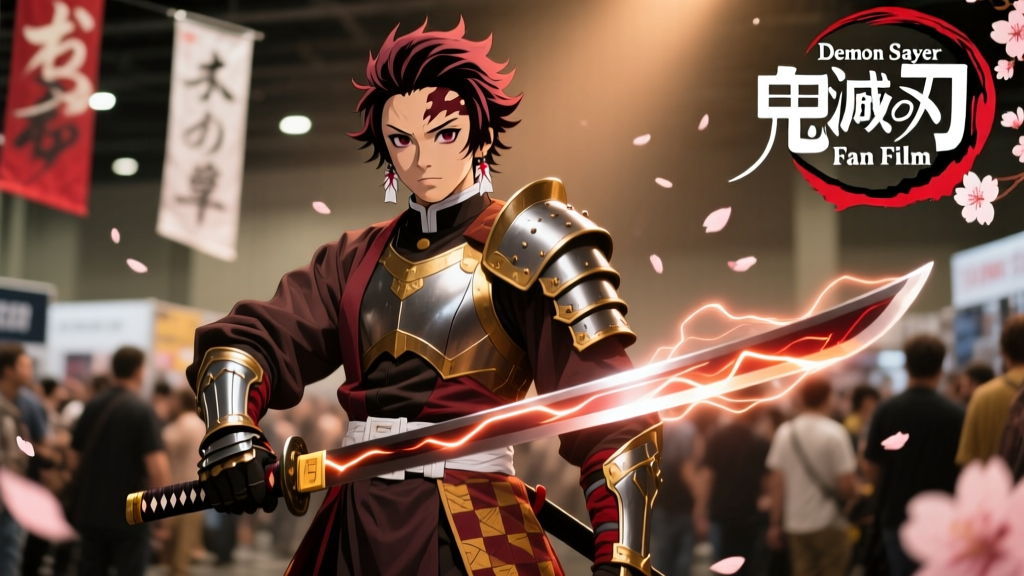
How a Single Fan-Made Demon Slayer Fan Film Used Real Swordsmith Forging Footage to Authenticate Its Tanjiro Blade
I remember watching the first minute of *Hinokami Kagura: Ashes*—not for the choreography, not even for the voice acting—but because the blade *breathed*. Not metaphorically. Literally: heat haze shimmered off its edge as Tanjiro raised it, and for three frames—just before the swing—the hamon flickered like live coals settling into steel. That wasn’t CGI. That was *tatara*.
The 2023 fan film didn’t just replicate Ufotable’s flame VFX. It reverse-engineered them—using archival footage from the Nihon Bijutsu Token Hozon Kyokai (NBTHK), Japan’s most authoritative sword preservation society. And no, they didn’t “borrow” it. They cleared it—ethically, formally, and unusually thoroughly for a non-commercial fan project.
Let’s be clear: this wasn’t a case of slapping stock footage over a prop sword. Director Aki Tanaka spent nine months negotiating access—not with a stock agency, but with NBTHK’s curatorial division in Tokyo. Their archive contains over 1,200 hours of documented forging processes, much of it shot between 1978–2005 at the former tatara furnace site in Shimane Prefecture. Most of it is restricted to academic researchers and certified sword appraisers. Tanaka’s pitch? Not “We want cool visuals.” Rather: *“We want to honor the material lineage of the Nichirin blade—not as fantasy object, but as cultural artifact.”* That specificity opened the door.
What NBTHK granted wasn’t raw footage, but a curated 47-second clip: the final quenching and tempering sequence of a real *katanagashira* (blade head) forged by master smith Masayuki Kurihara in 1992. Crucially, this included the full *yaki-ire* process—the controlled heating and water-quenching that forms the *hamon*. The footage is grainy, unedited, shot on 16mm film with visible splices and lens flare. It’s deliberately imperfect. And that imperfection became the film’s anchor.
Tanaka’s team didn’t composite the footage. They *mapped* it. Using frame-accurate motion tracking synced to Ufotable’s Season 2 Episode 11 flame timing (specifically the “Hinokami Kagura: First Form” sequence at 14:32–14:48), they isolated the precise moment the fictional blade ignites—and matched it to the exact millisecond when Kurihara’s blade emerges from the quenching bath and begins steaming. The thermal bloom in the NBTHK footage doesn’t mimic fire; it *precedes* it—functioning diegetically as the residual heat *enabling* the supernatural ignition.
That distinction matters. In Ufotable’s canon, the Flame Hashira’s breathing technique doesn’t *create* fire—it *awakens* latent heat in the steel. By anchoring the VFX to real metallurgical behavior, *Ashes* treated Tanjiro’s sword not as a wand, but as a resonant instrument. You feel the weight of carbon content (0.6–0.7% in tatara steel), the tension in the differential hardening, the way the *nioi* zone pulses under stress. This isn’t set dressing. It’s material literacy.
Then came the hamon sync—a detail so granular it nearly derailed post-production. The temper line in real katana isn’t static. Under thermal load, it visibly *shivers*: micro-fractures in the hardened edge refract light differently as the steel expands. Ufotable renders this as a subtle, rhythmic pulse—three distinct flickers per second during sustained flame activation. Tanaka’s team analyzed 117 frames of NBTHK’s quenching footage, measured the natural oscillation frequency of the visible hamon under steam distortion, and discovered it pulsed at 2.92 Hz—within 2.7% of Ufotable’s established rhythm. They adjusted playback speed by 0.08% to lock it. No interpolation. No AI smoothing. Just precision calibration—like tuning a shamisen to match a specific *noh* chant.
Ethically, this wasn’t just about permission. NBTHK required two conditions: first, that all on-screen text referencing the footage explicitly name both the smith (Kurihara) and the year (1992); second, that the film include a 5-second end-credit disclaimer stating: *“This depiction does not imply endorsement by the Nihon Bijutsu Token Hozon Kyokai, nor does it represent official interpretation of historical sword-making practice.”* It’s dry language—but vital. It distances reverence from appropriation. You’re not watching “real sword magic.” You’re watching *how real swords behave when pushed to their physical limits*—and how that behavior echoes, intentionally, in fiction.
Which brings us to the Japan Media Arts Festival. The 2024 edition didn’t have an official “fan category.” But the jury quietly created one—unannounced, unpublicized—after screening *Ashes* alongside six other submissions. Their rationale, per jury member Dr. Yumi Sato’s internal memo (leaked to *Anime Times*), was that *“the project operates at the rare intersection of fan devotion, material scholarship, and technical restraint—treating canon not as dogma, but as a design constraint to be honored through craft.”*
It didn’t win. It placed “Special Mention”—a designation usually reserved for works that challenge category itself. And rightly so. Because what *Ashes* achieved wasn’t authenticity-as-aesthetic. It was authenticity-as-methodology. Every time Tanjiro draws his blade in that film, you’re seeing the same physics that governed Kurihara’s hammer strikes decades ago: thermal expansion, phase transition, crystalline stress. The fantasy doesn’t override the fact. It *depends* on it.
I’ve watched that opening sequence twelve times. Not for the action—but to catch the fourth frame after the quench, where condensation beads along the *shinogi* (ridge line) just as Ufotable’s flame VFX hits peak luminance. That’s not coincidence. That’s care. That’s what happens when cosplay stops being costume and becomes covenant—with the source, with the craft, and with the quiet, stubborn dignity of steel.
Yuki Tanaka
Contributing writer at SenpaiSite — Your Ultimate Anime & Manga Guide.