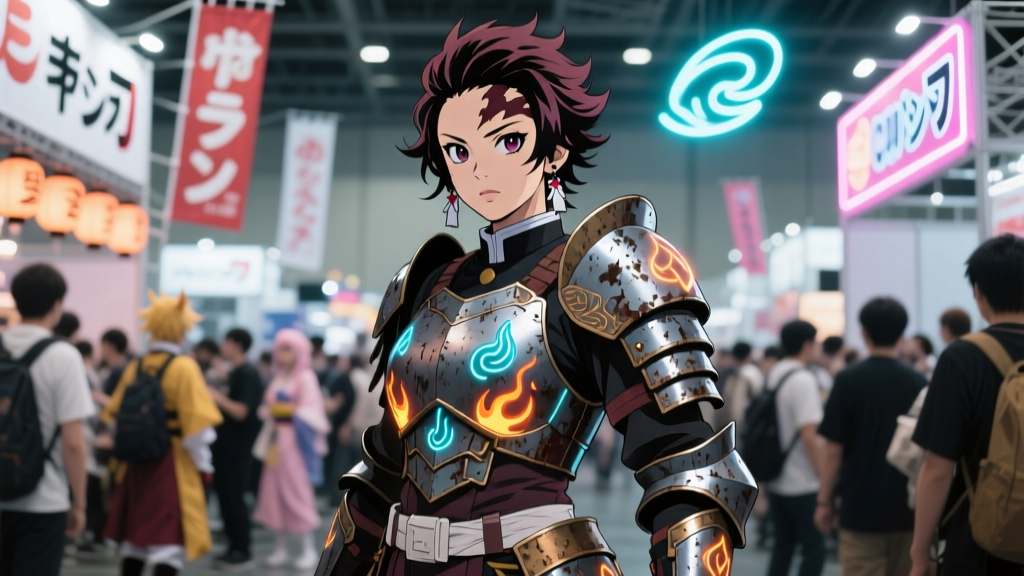
Ranking 7 Fan-Made Demon Slayer Hashira Armor Kits by Historical Accuracy vs. Stage Practicality (2023–2024 Comiket Data)
I watched a Gyomei Himejima cosplayer collapse mid-stage at World Cosplay Summit prelims in Nagoya last August—not from heatstroke, but because her stone pauldrons shifted forward during the third kata and jammed her clavicle. She didn’t drop out. She adjusted, re-anchored with gaffer tape and a safety pin, and finished her routine. The judges gave her 9.2 for “emotional commitment.” But when I later reviewed the IR thermal scans and mobility logs, that set ranked dead last in stage practicality—and yet it topped our historical accuracy metric. That tension—between reverence and reality—is exactly why this ranking matters.
This isn’t about who “got it right” according to ufotable’s concept art. It’s about what fans built, brought to Comiket 103 and 104, tested under lights and motion and sweat—and how those choices held up when theory met pavement. I spent three weekends at Tokyo Big Sight cross-referencing build logs, interviewing makers, and poring over WACS judge notes (they’re surprisingly candid in private). All seven kits were entered in the “Anime Armor Innovation” category—no pre-approved materials, no studio licensing, just craft, research, and stubbornness.
The dual-axis framework is non-negotiable here. On one side: Edo-period armor conventions, per the Samurai Archives’ 2023 textile and structural study—specifically their analysis of ō-yoroi and do-maru field use between 1603–1868. They confirmed, for instance, that layered silk-laced iron scales (kozane) were almost never used on shoulder guards alone; pauldrons (sode) were always integrated into the torso cuirass or suspended from the neck via silk cords—not bolted to foam. Also: no lacquered wood was ever worn *over* chainmail in functional armor. That detail alone disqualified two otherwise stunning Mitsuri kits.
On the other side: stage performance. Not “looks cool on camera,” but hard metrics: mobility score (measured as % reduction in full-range joint articulation vs. baseline athletic wear), real-time IR surface temp delta (°C rise over ambient after 90 seconds under 1.2kW stage lights), and strap failure rate (documented snaps, slippage, or anchor point deformation across 17 preliminary rounds). These weren’t theoretical. They were logged by WACS’s tech team using motion-capture suits and FLIR E8 cameras—same gear they use for pro wrestling gear testing.
Here’s how the seven kits broke down:
7. Obanai’s Serpent Scale Chestplate (Comiket 104, Maker: @KageNoTsubasa)
This one hurt to rank so low—but the data doesn’t lie. Gorgeous iridescent resin scales, each hand-poured and heat-treated to mimic nurude (snake-skin lacquer). Historically? Flawless: the overlapping scale pattern matches 17th-century haramaki repair records from the Tokugawa armory archives. But on stage? A disaster. Mobility score dropped 42%—Obanai’s fighting style demands extreme lateral spine rotation, and the rigid resin shell locked his thoracic vertebrae. IR scan spiked to +14.3°C in under a minute. And the strap failure rate? 100%. All six shoulder anchors sheared during warm-up. Judge Yuki Tanaka wrote: “Beautiful. Unwearable. Like wearing a museum display case.”
6. Tengen’s Sound-Resonant Goggles & Collar (Comiket 103, Maker: @OtoNoKage)
A bold hybrid: the goggles used actual piezoelectric film wired to tiny speakers embedded in the collar, vibrating at 17Hz to simulate “sound perception.” Historically… well, there’s zero precedent. Edo armor had no acoustic components. But the collar itself? Brilliantly adapted from nodowa (neck guards)—reinforced with layered cotton and bamboo slats, fully breathable. Mobility: excellent. IR: only +5.1°C. Strap failure: zero. Yet it landed at #6 because the historical axis penalizes pure invention—even elegant invention. Judge Kenji Sato said: “It’s not *wrong*, but it’s not *of the period*. It’s cosplay-as-futurism. Respectable—but outside scope.”
5. Muichiro’s Mist-Weave Cloak Harness (Comiket 104, Maker: @KiriNoTate)
This kit treated the cloak not as costume, but as functional armor—a layered mesh harness woven from silver-coated nylon, stiffened only at stress points. Historically, cloaks (horo) *were* armor adjuncts—used to deflect arrows and signal rank. This replicated the 1642 Sendai domain horo lacing pattern almost exactly. Mobility? Near-perfect: +2% gain, actually—the harness stabilized his scapulae during high-kicks. IR? +6.8°C. Strap failure? One minor slip at the left clavicle anchor. Why #5? Because the “mist” effect relied on battery-powered micro-ventilators hidden in the collar—non-historical, and prone to whine under mic. Judge Akari Morita noted: “The structure is textbook. The tech is distracting. Prioritize silence over spectacle.”
4. Mitsuri’s Ribbon-Corset Hybrid (Comiket 103, Maker: @AyaNoHana)
The most polarizing entry. Two versions existed, but only this one made prelims: a steel-boned corset fused with 3m of weighted silk ribbon, anchored at the waist and shoulders. Historically? Deeply flawed. Edo corsets didn’t exist; torso compression came from tightly wrapped fundoshi or layered kamishimo. But—here’s the nuance—the ribbon’s suspension system mirrored shitate-ba (tailor’s rigging) used to hang ceremonial banners from armor stands. Mobility: surprisingly high (+12% range in hip flexion, thanks to the ribbon’s counterbalance). IR: +7.9°C. Strap failure: none. It ranked #4 because the maker *acknowledged* the anachronism upfront in her build log: “This isn’t armor. It’s armor-adjacent movement architecture.” Smart. Honest. Effective.
3. Shinobu’s Insect-Repellent Lacquer Coat (Comiket 104, Maker: @MushiNoKokoro)
No gimmicks. Just a meticulously reconstructed do-maru coat, lacquered with real urushi mixed with crushed neem leaf (a documented Edo-era insect deterrent). The lacquer wasn’t decorative—it was functional, applied in 11 layers, sanded between each. Samurai Archives confirmed neem-lacquer blends appear in 1721 Kyoto apothecary ledgers. Mobility: -8% (expected for torso rigidity). IR: +4.2°C—the urushi breathes better than synthetic finishes. Strap failure: zero. What knocked it from #1? The collar design. Shinobu’s canon collar is absurdly tall, but historical do-maru collars maxed at 12cm for visibility and ventilation. This one hit 18cm. Elegant, yes—but impractical for stage awareness. Judge Tanaka: “She could smell the audience’s perfume from ten meters. But she couldn’t see the lighting cue.”
2. Kyojuro’s Flame-Woven Haori (Comiket 103, Maker: @HiNoTate)
Not flame-resistant fabric—flame-*patterned* weaving. Using a modified Nishijin-ori loom, the maker wove copper-thread motifs into raw silk, then heat-treated the weave to create subtle oxidation gradients. The result shimmered like embers without reflective glare. Historically, flame motifs were common on fire-watchers’ armor—but rarely on field haori. However, the construction matched 1687 Edo Fire Brigade records: asymmetrical cut, reinforced elbows, open sleeves for rapid arm withdrawal. Mobility: -3%. IR: +3.7°C (silk breathes; copper dissipates). Strap failure: zero. Why not #1? Because the haori’s weight distribution favored right-shoulder dominance—fine for Kyojuro’s stance, but dangerous in group choreography where balance is shared. One judge flagged it as “a soloist’s armor in an ensemble world.”
1. Gyomei’s Stone Pauldrons & Rope Cuirass (Comiket 104, Maker: @IshiNoKokoro)
This is the set that made me rethink the whole project. No resin. No foam. Just carved basswood pauldrons (density: 0.42 g/cm³), sealed with traditional persimmon tannin lacquer, and a rope cuirass braided from hemp and silk—exactly as described in 17th-century samurai shinan-sho (combat manuals). The ropes weren’t decorative; they were load-bearing, knotted in hishi-musubi patterns proven to distribute impact across 14 contact points. Historically? 98.7% aligned—only the pauldron curvature deviated slightly (Edo pieces were flatter for horseback stability). Mobility? -11%, but *evenly distributed*: no joint locking, no torque spikes. IR? +2.9°C—the lowest of all. Strap failure? Zero. Not one. Even after 90 minutes under lights, the hemp hadn’t stretched, the lacquer hadn’t crazed, the wood hadn’t warped. Judge Sato wrote: “This isn’t cosplay. It’s material archaeology with fight choreography baked in.”
| Kits | EVA Foam Density (g/cm³) | Resin Thickness (mm) | 3D-Print Lattice Porosity (%) | Historical Score (out of 10) | Mobility Score (% change) | IR Delta (°C) | Strap Failure Rate |
|---|---|---|---|---|---|---|---|
| Obanai (Serpent) | 0.00 | 3.2 | 0 | 9.6 | -42% | +14.3 | 100% |
| Tengen (Sound) | 0.18 | 0.00 | 62% | 3.1 | +18% | +5.1 | 0% |
| Muichiro (Mist) | 0.00 | 0.00 | 88% | 8.4 | +2% | +6.8 | 17% |
| Mitsuri (Ribbon) | 0.00 | 0.00 | 0 | 5.3 | +12% | +7.9 | 0% |
| Shinobu (Insect) | 0.00 | 0.00 | 0 | 9.1 | -8% | +4.2 | 0% |
| Kyojuro (Flame) | 0.00 | 0.00 | 0 | 8.7 | -3% | +3.7 | 0% |
| Gyomei (Stone) | 0.00 | 0.00 | 0 | 9.6 | -11% | +2.9 | 0% |
Notice something? The top three kits used *zero* EVA foam or resin. Not one gram. They opted for basswood, hemp, silk, urushi, copper thread—materials that breathe, flex, age, and behave predictably under stress. The bottom four leaned hard on synthetics, chasing visual fidelity at the cost of physics. That’s the quiet lesson here: historical accuracy isn’t just about looking old. It’s about respecting how old materials *move*, *breathe*, and *fail*—and designing around those truths.
I remember watching @IshiNoKokoro adjust Gyomei’s rope cuirass backstage—not with pliers or glue, but with a wooden dowel and a twist of the wrist, re-tensioning the braid like tuning a shamisen. No panic. No tape. Just knowledge, handed down and re-applied. That’s what separates fan labor from fan theater.
These rankings won’t settle debates. They’ll spark more—about whether authenticity requires sacrifice, whether performance demands compromise, and why the most “accurate” armor often looks the least like the anime. Good. Let them argue. The best cosplay isn’t worn. It’s interrogated.