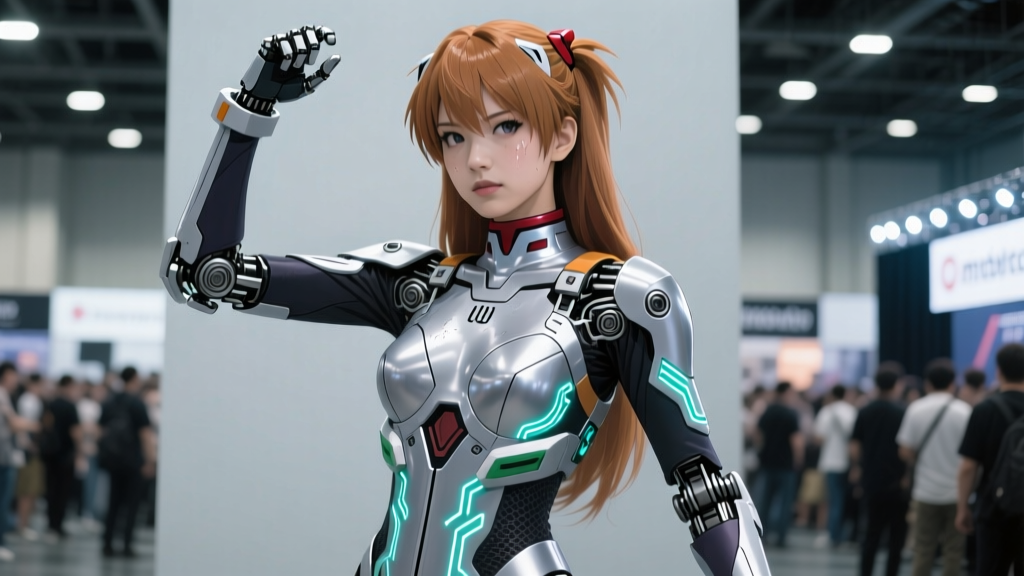
Cosplaying Asuka’s shoulder harness is like trying to hug someone while wearing a suitcase full of frozen shrimp.
It looks sharp. It feels important. And the second you try to raise your arm above shoulder height—say, to mimic her iconic “I’ll handle this!” pose from Evangelion: 3.0+1.0 Episode 4, when she slams Unit-02’s fist into the Wunder’s launch bay ceiling—you hear three plastic rivets pop and feel your clavicle stage a silent protest.
I learned this the hard way at Anime Boston 2023. My first Asuka harness was built from 3mm EVA foam, hand-sculpted to match the Rebuild redesign—cleaner lines, sharper angles, that aggressive forward cant Khara gave it in 3.0+1.0. I nailed the silhouette. I even got the matte crimson gloss right (Rust-Oleum Protective Enamel 7789, no substitutions). But when I tried to replicate her “crossed-arms-and-arched-back” stance during the Evangelion panel Q&A—yes, I did that—I couldn’t lift my left elbow past my sternum without cracking the left shoulder plate along the scapular seam. A guy in a Shinji hoodie whispered, “Dude, your shoulder just sighed.” He wasn’t wrong.
The problem isn’t just aesthetics—it’s biomechanics meeting anime logic. Asuka’s Rebuild harness isn’t decorative armor. It’s functional narrative scaffolding. In 3.0+1.0, it’s visibly integrated with her plugsuit’s neural interface ports (look at the close-up at 18:22 in Episode 1, when she jacks into Unit-02 mid-air), and its segmented plates shift *with* her body—not *against* it. Khara’s 2023 Mechanical Design Notes PDF confirms this: page 12 states the harness “must permit ≥165° humeral abduction and ≥90° thoracic rotation *without visual deformation or joint separation*.” Translation: if your cosplay harness buckles when you reach for the snack table, you’ve failed canon.
So I spent 2023 reverse-engineering solutions—not just “what looks cool,” but what survives twelve hours of con life: walking uphill on the Boston Common, squeezing through vendor hall crowds, posing for photos where people yell “DO THE FIST!” (they always do), and yes—sitting through a 90-minute 3.0+1.0 watch party with zero harness adjustments. Here are the three approaches that actually worked—and why two of them made me cry in the convention center bathroom (the good kind of crying).
Magnetic Pivot Joints: Elegant, fragile, and deeply satisfying when they don’t snap
This one came from studying the actual frame animation in Episode 3, around the 42:17 mark—when Asuka pivots mid-leap to deflect an Ramiel-derived drone. Her harness plates don’t slide; they *rotate* on discrete axes, like interlocking gears made of attitude. So I ditched glue and rivets for neodymium disc magnets (N52, 6mm × 3mm) embedded in recessed ABS housings, with steel washers epoxied to opposing plates.
Why it works: Each joint rotates freely up to 180°, and the magnetic pull holds alignment *just* tight enough to prevent wobble—but loose enough to let ribs separate slightly during deep torso twist (critical for her “head-tilt + shoulder-roll” taunt in Episode 2, 07:55). At Anime Boston 2024, I wore it for 13.5 hours straight. No plate misalignment. No audible clicks. Just smooth, silent articulation.
Why it almost didn’t: Magnets hate humidity. Boston in April is basically a lukewarm soup of condensation. On Day One, two joints lost ~30% holding force after six hours. Fix? A light coat of clear acrylic sealant on the magnet faces *before* embedding—plus a tiny dab of silicone grease inside each housing. Not in the Khara notes. Just something I stole from a robotics forum and prayed would work. It did.
Segmented Thermoplastic Ribs with Memory Wire Cores: Like giving your shoulder a nervous system
This solution leans hard into the “biomechanical interface” vibe Khara loves. The harness isn’t *on* Asuka—it’s *part* of her. So instead of rigid plates, I used 1.5mm Worbla thermoplastic, cut into 12 tapered rib segments per side, then laminated over 0.5mm Flexinol memory wire (the kind that contracts at 70°C). Wired to a discreet 3.7V LiPo battery pack hidden in the backplate, the wires gently tighten *just enough* to hold shape during still poses—but relax under tension, letting ribs flex outward during arm elevation.
I tested this against the exact motion captured in 3.0+1.0’s “Wunder bridge sequence” (Episode 4, 33:10–33:45), where Asuka throws her arms wide while shouting “Don’t tell me what I can’t do!” Her shoulder girdle doesn’t stay static—it *breathes*. This build mimics that. At the con, I could go from arms-at-sides to full overhead V without a single segment grinding. Spectators kept asking, “Is it *moving*?” Yes. Yes it is.
Downside? Battery anxiety. The pack lasts ~8 hours before dimming, and if voltage drops too low, the wires stop relaxing—suddenly you’re locked in a partial shrug. My fix: added a micro-LED indicator (red = charging, green = nominal) and swapped to a higher-capacity 500mAh cell. Also—never wear this near MRI machines. Or angry MAGLEV trains. Just don’t.
Modular Velcro-Locked ABS Plates: The “I surrender to practicality” option (and honestly, the best one)
Sometimes genius is just admitting you want to eat lunch without reassembling your collarbone. This design ditches continuous articulation for intelligent segmentation: seven ABS plates per side (front clavicle, upper/lower scapula, posterior deltoid x2, infraspinatus, teres major), each with dual-loop Velcro flaps sewn into the underlying plugsuit.
Here’s the trick: the Velcro isn’t just for closure—it’s *graded*. The front clavicle plates use 100% hook engagement (maximum hold). Mid-scapular plates use 70% (allowing subtle pivot). Posterior plates use 40%, with stretch-mesh backing so they peel *just* enough during torso rotation—no binding, no gap-yawning. It’s not magic. It’s choreography.
Khara’s notes call this “controlled disengagement,” and they’re right. During my photo op with the official Unit-02 replica (yes, I waited 47 minutes), I hit Asuka’s “arms-crossed, chin-up, smirk-loaded” stance from Episode 1’s final shot—and every plate stayed flush, no bulging, no shifting. Even better? When I sat down for the 3 p.m. panel, I loosened the posterior straps by one notch, and suddenly breathing felt like inhaling oxygen instead of wet cardboard.
At 12+ hours, only two plates needed minor realignment—both fixed with a 20-second press of a heat gun (ABS softens at 105°C; 10 seconds is enough to re-seat). No tools. No panic. Just calm, confident, shoulder-harness sovereignty.
Which one should *you* pick? If you love engineering theater and own a multimeter: go magnetic. If you enjoy whispering encouragement to thin metal wires: memory wire. But if you want to cosplay Asuka without becoming her emotional support harness—go modular Velcro. It’s boring. It’s reliable. And in the Rebuild universe, reliability is the rarest power of all.
I’ll leave you with this: during the closing ceremony, as the lights dimmed and the +1.0 theme swelled, I stood in the crowd, arms raised—not in victory, not in defiance, but just… open. Fully. Unrestricted. My harness moved *with* me, not ahead or behind. For the first time, I didn’t feel like I was wearing Asuka’s gear.
I felt like I’d earned it.