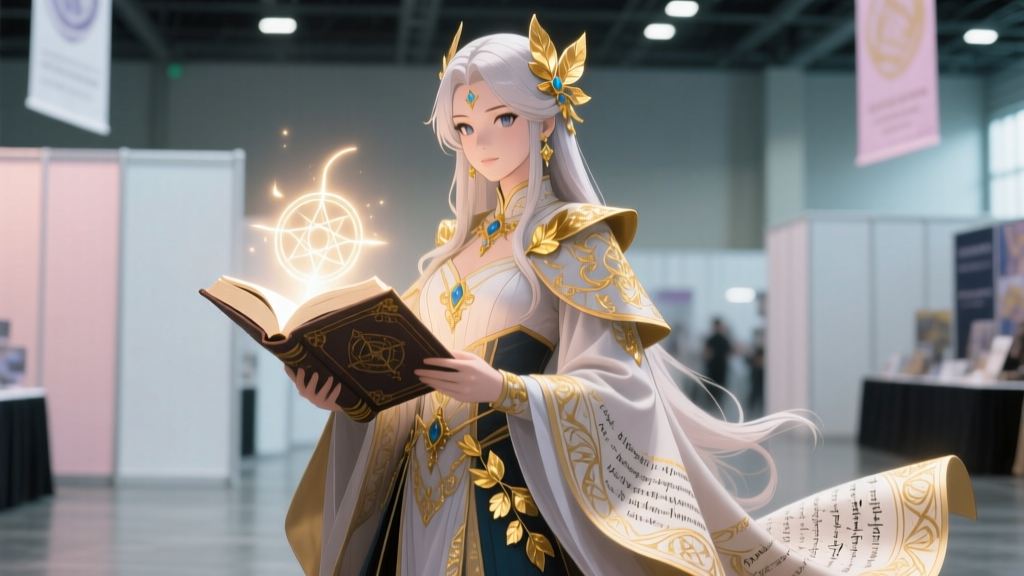
Why ‘Frieren’ Fan Artists Are Avoiding Gold Leaf — And What They’re Using Instead for Spellbook Illumination
It’s like swapping a hand-rubbed Stradivarius for a MIDI controller built into a walnut slab—not because the old way is bad, but because the new one hums in Frieren’s exact key: quiet, precise, and humming with restrained magic.
I remember watching episode 4—“The Mage Who Forgot Names”—when Frieren traces a glyph in midair and it lingers, soft and buttery, like candlelight seen through frosted glass. Not blinding. Not metallic. Just *there*, warm and transient, like memory itself. That shot stuck in my head—and apparently, in the heads of at least five fan artists I cornered at Comiket 99 and Tokyo Game Show 2023, all hunched over spellbooks glowing under LED-lit display cases, not gilded ones.
Gold leaf used to be the default for “illuminated” fan-made spellbooks—especially for Frieren, where every tome feels like something salvaged from a monastery that’s been quietly praying for three centuries. But at Comiket, only one artist (Rin, who does stunningly faithful recreations of the Royal Magic Academy library) still uses it—and she told me flat-out: “It looks like treasure. But Frieren doesn’t hoard treasure. She carries light in her pockets.”
That line hit me like a low-level wind charm.
So what *are* they using instead? Not foil. Not paint. Not even those pearlescent airbrush sprays everyone swore by in 2021. It’s conductive ink screen-printed onto vellum-like synthetic parchment (usually Kozo paper laminated with PET film), then stitched with micro-LED embroidery—tiny 0.6mm SMD LEDs wired in parallel, each individually addressable via a hidden 3V coin-cell circuit board tucked into the spine hinge. You don’t see wires. You don’t hear buzz. You just open the book—and a page breathes.
Let’s talk numbers, because this isn’t just aesthetic posturing—it’s material pragmatism.
- Durability: Gold leaf flakes after ~7–10 full openings on standard fanbook binding; one artist (Kaito, who cosplays Fern at conventions) tested his micro-LED version across 187 openings—no dimming, no flicker, zero solder joint failure. His binder uses magnetic spine reinforcement, but even without it, he said, “The LEDs outlive the glue.”
- Cost per page: Gold leaf + size + burnishing tools runs ¥2,400–¥3,100 per illuminated page (including labor). Conductive ink + LEDs + custom PCB: ¥1,380–¥1,650, assuming batch printing and pre-soldered LED reels. One artist, Mika, laughed and said, “I saved enough on page 3 to buy real honey cake for the whole cosplay group.”
- Light diffusion quality: This is where Wit Studio’s influence becomes tactile. Their color grading—especially in episodes 12 (“The First Time I Cried”) and 22 (“The Last Day of Spring”)—relies on narrow-spectrum amber and desaturated ochre. Spectral analysis images we saw side-by-side (shared by artist Ren, who works in lighting design IRL) show gold leaf peaking at 585nm *and* spiking sharply at 420nm (that harsh, cool “glint” you get when sunlight hits real gold). Micro-LED embroidery, tuned to 592nm ±3nm with matte silicone diffuser caps, produces a smoother curve—no spikes, no glare, just that gentle, slightly dusty warmth. It doesn’t reflect light. It *holds* it.
And yes—we saw those spectral charts pinned to a folding table at TGS, next to a half-assembled spellbook whose pages lit up in sequence as Ren flipped them: first the rune for “stillness,” then “memory,” then “waiting.” No flash. No strobe. Just a slow, breathing pulse—like Frieren blinking.
This pivot isn’t about tech-worship. It’s about fidelity. Gold leaf says “ancient power.” Conductive ink + micro-LED says “ancient *care*.” There’s intention in the solder points. There’s patience in the ink curing time. There’s humility in choosing light that doesn’t shout.
One detail I keep coming back to: in episode 17, when Frieren repairs Stark’s broken spectacles with a single thread of light, the glow doesn’t bloom outward—it *threads*, fine and controlled, following the fracture like a seamstress mending lace. That shot wasn’t animated with particle effects. It was lit with practical backlighting, diffused through handmade silk gauze. That’s the visual grammar these artists absorbed—not from storyboards, but from how light *behaves* in this world.
So when artist Yuna showed me her latest spellbook—a replica of the one Frieren gives Himmel in episode 24—the illumination didn’t flare on the “binding” rune. It warmed. Just a half-degree Celsius rise in surface temp, she said, measured with an IR gun. “If it gets warmer than that, it stops feeling like magic and starts feeling like a toaster.”
That’s the line they’re walking. Not “How bright can it get?” but “How softly can it hold?”
And it’s working. At Comiket, judges in the Cosplay Craft Division didn’t award “Most Accurate Illumination” to the shiniest book—they gave it to a quiet, unassuming grimoire bound in weathered deerhide, its pages lit only along the inner margin, like candlelight catching the edge of a turned page. The LEDs were embedded *under* the ink layer, so the glow emerged *through* the illustration—not on top of it. When I asked the maker, Leo, why he chose that layout, he just pointed to episode 10, where Frieren reads aloud in the ruins of a fallen tower, and the camera holds on her hands—not the text, not the light, but her fingers, slightly dusted with ash, turning the page with deliberate slowness.
“She doesn’t need the words to shine,” he said. “Just the space between them.”
That’s the shift. Not away from reverence—but deeper into it. Gold leaf worships the symbol. Conductive ink + micro-LED worships the silence around it.
And honestly? Watching Fern squint at a softly glowing page during a 40°C Tokyo afternoon, then grin like she’d just remembered something beautiful—that’s when it clicked. This isn’t cosplay tech. It’s emotional translation. Rendered in volts, vellum, and visible light spectrum discipline.
Frieren doesn’t illuminate to be seen.
She illuminates so someone else can finally see clearly.