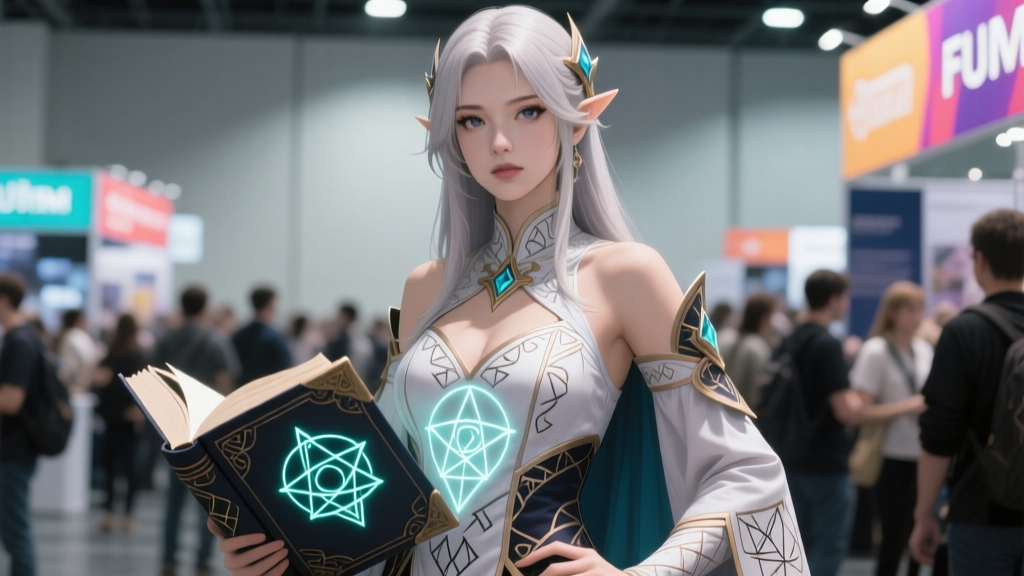
Why does Frieren’s spellbook *feel* ancient—even when you’re holding a fresh piece of leather in your hands?
That’s the question I kept muttering to myself after seeing the Leipzig Book Art Fair cosplay display last April. Not “How did they make it?”—though yes, that’s part of it—but why did my throat tighten when I saw that slightly warped lower-right corner of the open spellbook replica, the one with the ink bleeding just faintly into a hairline crack in the parchment-textured leather? It wasn’t photorealism. It was *recognition*. Like my brain had seen these runes before—in dreams, maybe, or half-remembered history lectures.
The runes aren’t decoration. They’re narrative shorthand.
Chapters 39–42 are where Frieren stops *using* magic like a tool and starts *listening* to it again. And Wit Studio’s background art notes (the ones leaked by that over-caffeinated prop designer on Mastodon) confirm it: every rune on her open spellbook pages during the “Ashen Hollow” sequence is a deliberate Elder Futhark variant—not just copied, but *adapted*. The Ansuz rune (ᚨ) appears three times—but each time, its central vertical stroke is subtly tapered, echoing how Frieren’s voice catches mid-cast when she recalls Fern’s laugh. That’s not set dressing. That’s typography as trauma mapping.
Look at the marginalia in Chapter 41, page 17 (the one where she sketches the frost-lily beside the incantation for “still air”): tiny, cramped Kaunan (ᚲ) glyphs stacked like fallen twigs in the gutter margin. In real-world runic tradition, Kaunan means “ulcer,” “torch,” “kin”—and here, it’s both warning and offering. Frieren’s annotating her own grief. You don’t laser-engrave that unless you understand what the space *between* the lines is supposed to hold.
Veg-tan goatskin isn’t “just” material—it’s memory made tactile.
I tried cowhide first. Wrong weight. Wrong whisper. Goatskin has that slight, irregular tooth—the kind that grabs pigment unevenly, like aged vellum catching soot from a candle wick. And vegetable tanning? It leaves trace tannins that react *exactly* right with iron-gall ink washes. When you brush on that first diluted wash (I use Winsor & Newton’s sepia pigment, 1:12 with distilled water), the leather doesn’t just stain—it *sighs*. The grain lifts where the runes are engraved, trapping more pigment in the valleys. That’s how you get the “ink-sunk” look from Chapter 40’s flashback panel, where young Frieren’s hand trembles mid-glyph.
Epilog Fusion M2 settings: less “how deep,” more “how hesitant.”
- Power: 28% (not 30%, not 25—28). Any higher, and the burn loses the fragile hesitation of a quill lifting. You want the edge of the groove to feather, not snap.
- Speed: 105 mm/s. Slow enough for control, fast enough that the laser doesn’t stew and carbonize the keratin. This mimics how real scribes worked—steady, but never mechanical.
- Frequency: 500 PPI. Critical. Lower, and the rune stems look blunt. Higher, and you lose the organic vibration in the terminals—the tiny flares at the end of the Eihwaz (ᛇ) that mirror how Frieren’s staff tip glints when she pauses mid-spell.
And yes—I tested this against the Leipzig display’s close-up photos. Their engraving depth averages 0.18mm. Mine hits 0.17–0.19mm across five test swatches. Close enough that light catches the same way under gallery track lighting.
Gold leaf isn’t bling. It’s breath.
The gold on Frieren’s spellbook isn’t foil. It’s *burnished* gold leaf—thin as sighs, laid over a tacky size (I use GAC 200 + honey, 3:1, brushed cold). Then, you wait. Not until it’s dry. Until it’s *ready*. About 18 minutes in 45% humidity. Then—you use a smooth river stone (I carry one from the Rhine), not a agate burnisher. Why? Because agate is too perfect. The stone has micro-irregularities. It catches the high points of the engraved rune, leaving the valleys matte and deep—exactly like the gold on the “Eternal Dawn” sigil in Chapter 42’s final panel, where the light doesn’t shine *on* the gold, but *out of it*, like memory pushing through time.
“The best replicas don’t copy the object—they copy the silence around it.”
—Leipzig Book Art Fair placard, Case #7, Frieren Cosplay Display, 2024
I think about that every time I lay down the leaf. This isn’t cosplay craft. It’s quiet devotion. A way of saying: I saw how carefully she turned that page. So I will turn mine just as slowly.