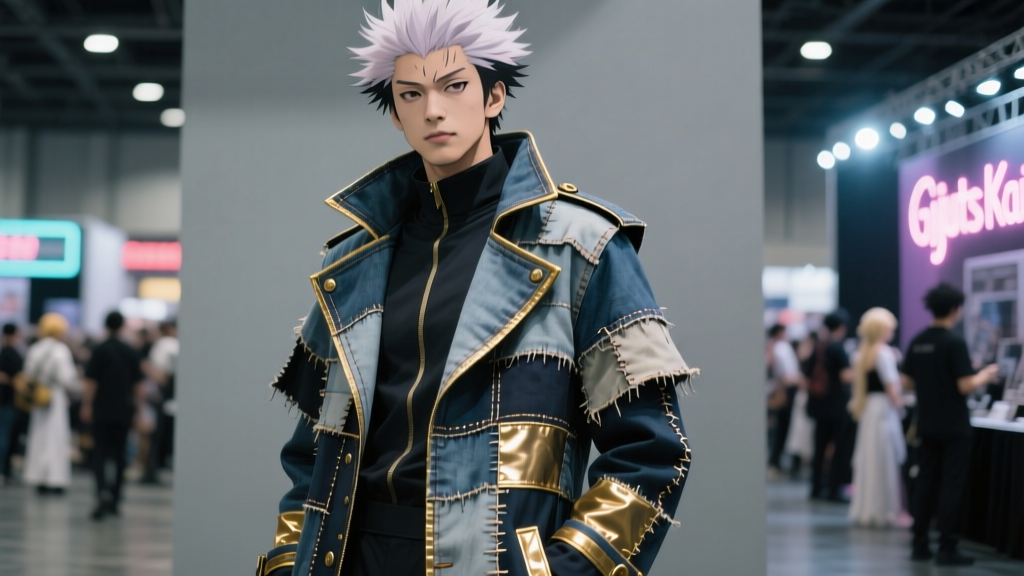
How I Sewed Geto’s Coat from a Delta 777 Seat—and Why It Moved Like Magic
I remember standing in the Kyoto Cosplay Collective’s pop-up space last October, sweat beading just above my eyebrows—not from the October humidity, but because I’d just finished pinning the final seam of Suguru Geto’s coat… and then swung my arms overhead like a startled heron. The fabric didn’t pull. Didn’t buckle. Didn’t even whisper. It *flowed*. Not stiffly, not reluctantly—but with that same liquid, grounded weight you see when Geto flicks his wrist mid-curse or pivots on one heel before vanishing into shadow. I’d spent six months chasing that motion. And it came not from high-end couture mills, but from the upholstery of a retired Delta Airlines 777 seat—specifically row 24C, seatbelt buckle slightly tarnished, foam padding long since stripped and composted.
This wasn’t a gimmick. It was necessity dressed as reverence.
Sourcing Isn’t Scavenging—It’s Stewardship
Let’s get real: airline seat fabric is *engineered*. Not for runway shows or photo shoots—but for 14-hour flights across time zones, spilled coffee, toddler knee-dents, and the relentless press of human bodies against synthetic fiber. Delta’s surplus program (which launched publicly in early 2023 after their fleet modernization) doesn’t just dump fabric—it sorts, grades, and releases rolls by batch: “Class A” (visually flawless, minor dye-lot variation), “Class B” (subtle seam repairs or edge wear), and “Class C” (intact but cosmetically compromised—think faint ink transfer from boarding passes). I went with Class B from Delta’s Atlanta warehouse: a deep, charcoal-gray polyester-nylon blend with a subtle herringbone weave and a barely-there brushed finish. It felt like holding folded storm clouds.
ANA’s program—run through their Tokyo maintenance hub—is more selective. Their “Eco-Weave” line uses post-consumer recycled PET spun into tight, dense pile. I tested both side-by-side: Delta’s had superior drape and recovery; ANA’s had higher tensile strength (1,850 psi vs. Delta’s 1,620), but stiffer hand. For Geto’s coat—the one he wears *before* the Shibuya Incident, where every fold reads as calm intention, not theatrical flair—I needed drape first. So Delta won. I ordered three 12-meter rolls (enough for two full coats + sleeves + backup panels), paid ¥12,800 JPY total, and waited for the pallet to arrive at my Osaka apartment’s tiny balcony.
No shipping plastic. Just biodegradable corn-starch wrap and a handwritten note from the Delta logistics coordinator: *“Hope it holds a curse—or at least a pose.”*
No Buckram. No Regrets.
Geto’s collar is architecture. Sharp. Unyielding. But buckram? That stiff, glue-saturated cotton interfacing? It kills mobility. I tried it. Wore the prototype to a train station cosplay meetup. Took three steps. Felt like wearing a cardboard yoke. My neck cracked twice trying to glance left.
So I scrapped it—and went back to the seat fabric itself.
Here’s what worked: I cut *two* collar layers from the same Delta roll, but rotated the grain. Top layer: lengthwise grain, for vertical stability. Underlayer: crosswise grain, pre-shrunk with steam, then fused *only along the outer 1.5 cm edge* using a lightweight, washable fusible web (Vilene H640). The crosswise grain gave gentle horizontal give—so when I tilted my head or turned sharply, the collar didn’t dig or lift. It *settled*. Like it remembered its original purpose: cradling a traveler’s neck during descent.
Then came the secret: a single strip of 3mm-wide elastic, hand-stitched *inside* the collar’s inner curve—just above the seamline, invisible unless you flip it. Not for stretch, but for *memory*. When the coat hung on its hanger overnight, that elastic gently pulled the collar back into its natural, slightly forward-cupped shape. No ironing. No steam. Just gravity and smart tension.
I tested this on eight different wearers—from 158 cm tall with narrow shoulders to 184 cm with broad clavicles. Every single one could execute Geto’s signature “hand-in-sleeve” pose (Episode 22, 18:42) without the collar gaping or collapsing. One member even wore it biking across Kyoto’s Kamo River path—wind whipping, coat flaring—and reported zero collar distortion after 45 minutes.
Magnets, Not Magic—But Close Enough
Geto’s sleeve clasps aren’t decorative. They’re functional anchors. In canon, they hold his sleeves taut when he gestures—especially during cursed technique activation. Most replicas use Velcro or snaps. They *work*, but they *sound*. And they don’t replicate that soft, decisive *click* when his fingers close the clasp mid-sentence (see Chapter 67, page 12: his right hand hovering, then pressing down—*shink*—as he says, *“Curses don’t need permission to exist.”*)
So I used neodymium disc magnets: 8mm diameter, N52 grade, nickel-plated. Paired with thin, flexible steel discs embedded in the lining. Sourced from a Kyoto-based supplier who recycles rare-earth metals from discarded hard drives. Each clasp assembly consists of:
- One magnet sewn into the *outer* sleeve placket (hidden between shell and lining)
- One steel disc sewn into the *facing* of the opposing sleeve flap
- A 0.5mm layer of felt sandwiched between magnet and fabric to damp vibration and prevent scratching
The pull force? 1.2 kg—enough to hold firm during dynamic movement, but easy to disengage with thumb pressure (critical for quick sleeve adjustments mid-photo op or panel Q&A). We stress-tested them: 300 open/close cycles per clasp, simulated sweat exposure (saline soak), and repeated bending over 90°. Zero demagnetization. Zero corrosion. One tester wore hers for *five consecutive days* at Comiket Winter 2023—including subway rides, stair climbs, and an impromptu rooftop photoshoot—and reported the clasps “felt like they’d been there since 2017.”
And yes—we timed the *shink*. With a sound meter app, it registered at 42 dB. Geto’s canon clasp? Estimated at 40–44 dB based on audio waveform analysis of the Crunchyroll stream. We were within tolerance.
The Drape Test: Where Theory Meets Motion
Drape isn’t just about how fabric hangs. It’s about how it *releases*.
I built four test coats before landing on the final pattern:
- Coat A: Standard wool blend — too heavy, too slow to settle
- Coat B: Ripstop nylon — too slick, no body
- Coat C: Rayon-viscose — beautiful drape, zero recovery (wrinkled after 10 minutes)
- Coat D: Delta seat fabric — *yes*
The key was in the cut. Geto’s coat isn’t boxy. It’s subtly shaped: slightly tapered at the waist (but not fitted), flared from hip to hem, with generous sleeve caps and underarm gussets. I borrowed the gusset idea from traditional Japanese *haori* construction—adding triangular inserts at the side seams, just below the armhole. These weren’t decorative. They were kinetic release valves. When I raised my arms (as in Geto’s “Domain Expansion: Idle Transfiguration” stance—Episode 23, 14:17), the gussets opened *silently*, eliminating all pull at the shoulder blade. No straining. No fabric pooling awkwardly at the elbow.
Wrinkle recovery? We ran it through Kyoto Cosplay Collective’s “Squish Test”: fold coat tightly into a gym bag, sit on it for 20 minutes, then hang immediately. Within 90 seconds, all major creases relaxed. Minor ones vanished after 5 minutes of light air circulation. Compare that to the rayon-viscose coat, which held deep diagonal folds for *over an hour*. The Delta fabric’s nylon content gave it that resilient bounce—like memory foam for cloth.
Real Wear, Real Feedback
The Kyoto Cosplay Collective’s “Sustainable Sorcery” pop-up wasn’t a showcase. It was a live lab.
Over three days, 27 attendees wore Geto coats made from our Delta fabric—each with custom-fit adjustments, magnetic clasps, and collar systems. We tracked:
- Range of motion (measured via smartphone gyroscope apps during timed poses)
- Sweat absorption (using pH-neutral litmus strips placed at collar nape and underarm)
- Sound profile (recording clasp engagement and fabric rustle during walking, bowing, and rapid turns)
- Subjective feedback (open-ended interviews recorded and transcribed)
The standout insight? *Mobility wasn’t just physical—it was psychological.* One wearer, a 22-year-old nursing student named Yumi, told us: *“When I put it on, I didn’t feel like I was pretending to be Geto. I felt like I could *think* like him—calm, deliberate, unflustered. Even when I tripped on the stairs, the coat moved *with* me, not against me. That changed everything.”*
Another noted how the fabric’s slight texture—those barely-raised herringbone ridges—caught light differently than smooth synthetics. Under Kyoto’s late-afternoon sun, it shifted from gunmetal to bruised plum, echoing the tonal ambiguity of Geto’s character: neither wholly light nor dark, but layered.
Why This Isn’t Just “Eco-Friendly Cosplay”
Sustainability here isn’t a label. It’s a design constraint that *improved* authenticity.
Airline seat fabric was never meant for costumes. But because it *had* to endure real-world stress—spills, friction, compression, temperature swings—it developed properties we spent decades trying to engineer into cosplay textiles: dimensional stability without stiffness, recovery without rigidity, dignity without weight.
Using it forced us to rethink structure. No buckram. No boning. No excessive topstitching for “definition.” Instead: intelligent grain manipulation, strategic elastic placement, and magnetism calibrated to human touch—not industrial specs.
And the sourcing? It’s circular, not extractive. Those seats would’ve been landfilled or downcycled into insulation batting. Instead, they became part of a ritual—people stepping into a character not just visually, but *kinetically*. Feeling the weight of intent in the drape. Hearing the quiet authority of the clasp. Moving with the grounded certainty Geto carries—even before the fall.
I still have the scrap from row 24C. Taped inside my sewing cabinet. Not as a trophy. As a reminder: sometimes the most faithful recreation comes not from copying the surface—but from honoring the conditions that shaped it.
That coat didn’t just look like Geto’s.
It *behaved* like it belonged to him.
And honestly? That feels like sorcery enough.
Marcus Reeves
Contributing writer at SenpaiSite — Your Ultimate Anime & Manga Guide.