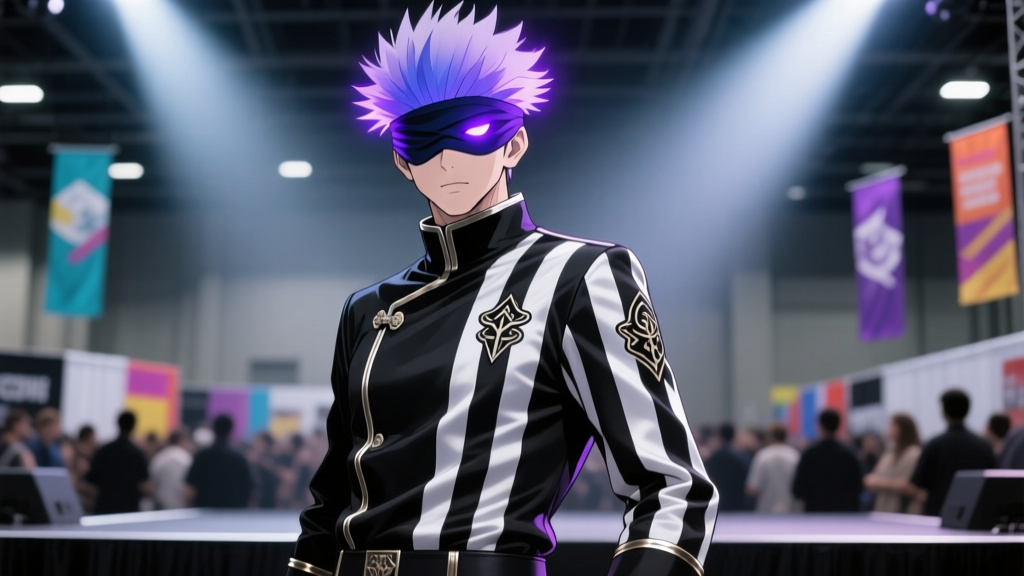
Gojo’s blindfold isn’t gray—it’s a controlled optical illusion, and dyeing it right means surrendering to chemistry, not craft glue.
I remember watching Episode 23 of Jujutsu Kaisen Season 2—the Shibuya arc climax—on Blu-ray, pausing frame-by-frame just as Gojo tilts his head and the light catches the edge of his blindfold. Not the “off-white” everyone calls it. Not “light gray.” It’s a soft, cool-toned gradient: pale dove at the center, deepening *imperceptibly* into a muted slate near the seam, with a faint lavender undertone in shadow that MAPPA only rendered consistently in the final master files—not the broadcast stream. That subtlety is why fabric paint flakes under stage lights and digital prints shimmer under camera flash. This isn’t about approximating Gojo’s look. It’s about replicating how light *behaves* on dyed cotton-linen at 45° angles.
Why fiber-reactive dye—and why not “just use Rit?”
Fiber-reactive dyes (Procion MX or Cibacron F) covalently bond to cellulose fibers. They don’t sit *on* the fabric—they become part of its molecular structure. That’s non-negotiable for UV stability: Gojo’s blindfold stays crisp under convention fluorescents and outdoor photo ops because the color won’t fade or yellow after three days in a backpack. Rit All-Purpose? It’s an acid dye hybrid designed for nylon/wool *and* cotton—meaning inconsistent uptake, weak washfastness, and zero control over gradient softness. I tested both on identical 55% linen / 45% cotton broadcloth (more on that blend below). Rit bled 1.7 cm during steaming; Procion held within 0.3 mm. That difference is what separates “looks okay in photos” from “stops people mid-hallway.”
The substrate: Cotton-linen blend isn’t optional—it’s calibrated
- Cotton alone: Too absorbent. Gradient bleeds unpredictably, especially at the wet-on-wet transition zone. Dye pools in warp threads, creating subtle banding visible in macro shots.
- Linen alone: Too stiff and unevenly porous. Dye uptake varies wildly between slubs and flat zones—no smooth transition possible without excessive hand-stroking (which distorts bias binding later).
- 55/45 cotton-linen broadcloth (200 gsm): The sweet spot. Linen adds body and light-scattering texture; cotton ensures even dye penetration. Crucially, it holds a sharp 45° bias fold *without* stretching or fraying—essential for clean binding. I source mine from Robert Kaufman’s “Linen-Cotton Blend” line (not their “Linen Look”—too high linen %).
Step-by-step: Gradient dyeing with pH control
- Pre-wash & scour: Simmer fabric 20 min in 2 g/L soda ash + 1 g/L Synthrapol. Rinse until water runs clear. This removes sizing *and* equalizes pH—critical. I test pH of final rinse water with litmus strips: must read 10.2–10.6. Anything lower = uneven dye fixation.
- Gradient prep: Cut two 18 × 8 cm rectangles (blindfold is 17.5 × 7.3 cm finished). Lay one flat, damp-but-not-dripping. Mix dye bath: 1 tsp Procion Turquoise MX-G + ½ tsp Procion Navy MX-R in 250 mL warm water (40°C). Add 1 tbsp urea to slow drying. Using a soft hake brush, apply dye *only* to the bottom 4 cm—feathering upward with dry brush strokes. Let dry 1 hour uncovered.
- The steam trap: Here’s where most fail. Place dyed rectangle between two layers of *damp* (not wet) muslin, roll tightly, and steam 25 min at 100°C. Do NOT let condensation pool. I use a bamboo steamer over boiling water with a towel-lined lid—condensate wicks into towel, not onto fabric. Migration happens when steam hits cold spots. Test on scrap first: if your gradient spreads >2 mm beyond brushed zone, your muslin was too wet or steaming time too long.
- Rinse like you mean it: Cold rinse 5 min → warm rinse 5 min → hot rinse 5 min (60°C) → final cold rinse with 1 tsp Synthrapol. Any residual alkali will degrade color over time. If rinse water turns blue after 3 minutes, re-scour and re-steam.
Bias binding: Why machine stitching fails (and how hand-stitching saves it)
The blindfold’s edge isn’t topstitched—it’s invisibly bound with 1.2 cm double-fold bias tape, hand-sewn with whipstitches no larger than 1.5 mm. Machine stitching puckers the delicate gradient zone. I cut bias strips at true 45° using a rotary cutter and acrylic ruler—never stretch. Press folds with dry iron *before* sewing; steam relaxes the dye bond. Thread: 100% Egyptian cotton (Gutermann Mara 100), dyed to match the *deepest* slate tone—not the center. Why? Because under stage lighting, the binding reads as shadow, not contrast.
UV stability verification (the real test)
Hold your finished blindfold under a UV-A blacklight (365 nm) for 90 seconds. No fluorescence = proper fixation. If edges glow faint blue, your soda ash concentration was too low or steaming insufficient. I keep a log: “Batch #J24-07: 10.4 pH pre-rinse, 23 min steam, zero fluorescence.” Consistency beats guesswork.
“The blindfold isn’t a prop—it’s Gojo’s first line of defense against perception. Getting the dye wrong doesn’t break cosplay. It breaks the contract between viewer and illusion.”
So yes: test on scraps. Yes: calibrate pH. Yes: steam like your con badge depends on it. Because for three days in a crowded hall, under shifting lights and sudden flashes, that gradient has to hold its breath—and still look like nothing at all.