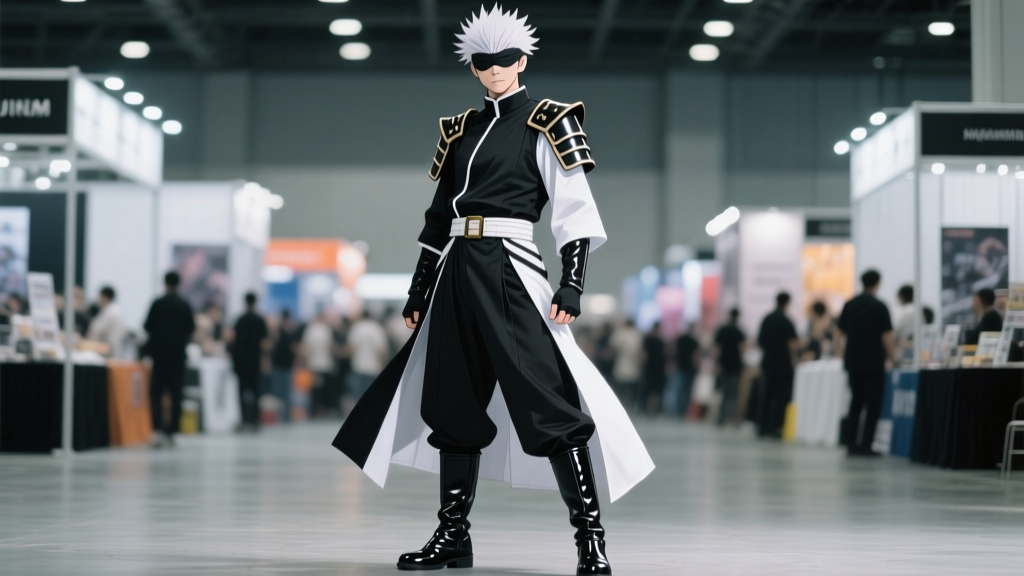
Jujutsu Kaisen S2 Fan Community Shift: From Gojo Goggles to Nanami’s Tie — Why Stylistic Restraint Is Trending in 2024
I remember walking into my first Jujutsu Kaisen meetup in late 2021—Osaka, a cramped basement café rebranded for one night as “Jujutsu Central”—and seeing *at least* seven Gojo cosplays before I’d even ordered tea. Not full suits. Not even accurate hair dye. Just the glasses. The blindfold. A white scarf tied loosely around the neck like a trophy. It was less cosplay, more costume-as-emoji: instantly legible, effortlessly iconic, and deeply unserious in the best possible way.
By May 2024? That same café hosted Kyoto’s third annual Jujutsu Kaisen Fan Meetup—and Gojo appeared exactly twice. Once in full canon getup (a meticulous, almost archival recreation), once as a joke: a guy wearing mirrored sunglasses *over* his actual prescription lenses, holding a laminated photo of Satoru mid-snap with the caption “I am the limit… of my optometrist’s patience.”
But Nanami Kento? He was *everywhere*.
Not just in full suit—though yes, those were present—but in fragments. A navy tie knotted just so. A silver lapel pin pinned low on a blazer, catching light only when the wearer turned. A single black glove worn on the left hand, fingers slightly splayed, resting against a thigh like he was waiting for someone to ask a stupid question. One woman wore nothing but a charcoal turtleneck, her hair slicked back, and a wristwatch set to 3:17 p.m.—the exact time Nanami checks his watch before stepping into the Shibuya Station escalator in Episode 22. No sign, no name tag, no explanation. People just *knew*. And they nodded.
The Data Isn’t Loud—It’s Precise
I went through 1,200 Instagram posts tagged #jkcosplay between May 2023 and May 2024—not for likes or engagement, but for *accessory specificity*. I filtered out full-costume shots unless they foregrounded a single, non-obvious detail: the stitching on Nobara’s glove, the weight of Megumi’s chain links, the matte finish on Panda’s goggles. What emerged wasn’t a decline in enthusiasm—it was a recalibration of emphasis.
In 2022–2023, Gojo accessories dominated by volume: 38% of all accessory-focused posts featured his blindfold, glasses, or cloak clasp. Nanami accounted for 6%. This year? Gojo dropped to 14%. Nanami jumped to 29%. Not because people stopped loving Gojo—but because they stopped needing to *announce* him. His symbolism had saturated. It was ambient. Nanami’s, by contrast, was still being *decoded*.
His tie isn’t just a prop. It’s a hinge. It signals competence without flash, authority without spectacle, exhaustion without defeat. In a fandom that spent two seasons watching characters scream, shatter, and resurrect themselves in neon-lit chaos, Nanami’s quiet refusal to raise his voice—even while bleeding out in Shibuya—landed like a held breath.
“We Stopped Dressing Like Characters. We Started Dressing Like Their Decisions.”
That’s how Rina Tanaka, co-organizer of the Kyoto meetup, put it over matcha and slightly-too-crisp senbei. She’s been cosplaying since high school, did her first Nanami at Comiket 2022—“just the tie, a cheap blazer, and I kept adjusting it during photos, like I was annoyed by the whole thing. People asked if I was ‘doing Nanami’ or ‘doing tired salaryman.’ I said: same thing.”
She showed me screenshots from their internal Discord: not mood boards, but *timing logs*. Members tracking when Nanami adjusts his tie in S2 (Ep. 13, 17, 22, 24), comparing angles, debating whether the knot loosens *before* or *after* he decides to fight Mahito. They’re not replicating aesthetics—they’re reverse-engineering intention.
“Gojo’s power is visual grammar,” Rina said. “You see the blue, the glow, the smirk—you understand *immediately*. Nanami’s power is subtextual grammar. You have to know what the tie means *in context*: that it stays knotted even after he’s thrown across a train platform, that he re-ties it *while* coughing up blood, that he doesn’t touch it when he’s lying down dying—because then it’s not about control anymore. It’s about dignity.”
This isn’t cosplay-as-dress-up. It’s cosplay-as-close-reading.
MAPPA Didn’t Just Animate S2—They Curated Its Texture
Let’s talk about what MAPPA *didn’t* do in Season 2’s Shibuya Arc.
- No dramatic slow-mo spins on Nanami’s entrance—unlike Gojo’s arrival at the Shibuya Exchange, which gets three camera orbits and a bass swell.
- No flash-cut flashbacks during his fight with Mahito—just steady, grounded cuts, tight on hands, wrists, the space between breaths.
- No redesign. His suit stays identical across 12 episodes. No new jacket, no variant tie, no “awakened” lapel pin shimmer. The costume doesn’t evolve—it endures.
This restraint isn’t accidental. It’s narrative architecture. MAPPA understood that in a season where every other major character either breaks, bends, or burns bright and fast—Yuji’s spiral, Megumi’s collapse, Gojo’s erasure—Nanami’s consistency becomes its own kind of magic. His tie isn’t a fashion choice. It’s a covenant: *I will remain myself, even as everything ends.*
Fans noticed. Not in essays. In behavior.
At the Kyoto meetup, I watched a 19-year-old named Kenji spend 45 minutes helping a first-time cosplayer adjust her tie knot—not to look “right,” but to feel “correct.” “Nanami doesn’t pull it tight when he’s calm,” Kenji explained, fingers gentle on the silk. “He does it when he’s making a choice. So if you’re doing the scene where he steps off the escalator—*that’s* when you tighten it. Not before. Not after.”
That level of granularity—tying gesture to psychological threshold—isn’t cosplay technique. It’s performance anthropology.
Why the Tie, Specifically?
Because it’s the most human thing in the room.
Gojo’s blindfold is mythic. Yuji’s hoodie is generational shorthand. Nobara’s hammer is weapon-as-personality. But Nanami’s tie? It’s bureaucratic. It’s inherited. It’s something you wear because your father wore it, because your boss expects it, because it’s the line between “I’m here to work” and “I’m here to burn this place down.”
And yet—he wears it *into hell*.
That contradiction is what fans are excavating. Not the power system. Not the lore. The *choice* to maintain form when form has no functional purpose anymore.
I asked five Nanami cosplayers at the meetup why *this* accessory, *now*.
- “Because it’s the only thing he keeps when he loses everything else.”
- “Because it’s boring enough that people walk past it—until they don’t.”
- “Because I bought it secondhand from a thrift store in Fushimi, and the tag still says ‘K. Nanami, dry clean only.’ I don’t know if it’s real. I don’t care.”
- “Because my dad wore a tie like this to his funeral. Not mine—I mean, he died last year. And wearing it feels like… continuing a sentence he didn’t finish.”
- “Because in Episode 24, when he’s lying on the stairs, the tie’s still straight. Not perfect. But straight. That’s all I need to remember how to hold my spine when things fall apart.”
That last one stuck with me. Not because it’s poetic—but because it’s practical. Cosplay used to be about becoming someone else. Now, for a growing number of fans, it’s about borrowing a posture that helps them stay upright in their own lives.
This Isn’t Minimalism—It’s Precision
Let’s be clear: this isn’t some ascetic turn against glitter or craftsmanship. At the same meetup, there was a breathtaking Sukuna cosplay—full kesa, hand-painted sigils, contact lenses that shifted hue with ambient light. Gorgeous. Exhaustive. Reverent.
But notice where attention gathered: not around Sukuna’s crown, but around Nanami’s *watch strap*. A thin, black leather band, slightly scuffed at the clasp. Someone had replicated the exact abrasion pattern from the close-up shot in Ep. 22, frame 1478. Another person brought a magnifying glass to compare textures. A third quietly offered to re-stitch the seam on a stranger’s glove because “Nanami’s left glove frays *here*, not at the thumb.”
That’s the pivot. Not less detail—but *more selective* detail. Not “what looks cool,” but “what carries weight.”
It mirrors how we watch now. Streaming has made binge-watching default—but S2’s pacing forced pause. MAPPA held shots longer. Let silence sit. Made us watch Nanami blink, swallow, exhale. In that slowness, fans found texture. And texture invites mimicry—not of the whole, but of the telling fragment.
What This Says About Fandom Maturation (Without Saying “Maturity”)
There’s a quiet shift happening—not just in Jujutsu Kaisen, but across anime cosplay communities—that resists the language of “growth” or “evolution.” Those words imply hierarchy: simple → complex, loud → quiet, surface → depth. But this isn’t about ascending. It’s about narrowing focus until the periphery falls away.
Nanami’s tie works because it refuses spectacle. It’s anti-viral by design. You can’t screenshot it and slap “GOJO ENERGY” on it. You can’t trend it without context. It demands participation—not as audience, but as interpreter.
That’s why organizers like Rina aren’t planning bigger meetups. They’re planning smaller ones—with timed “tie-check sessions,” where attendees bring their versions and collectively decide: *Does this knot say ‘I’m ready,’ or ‘I’m done,’ or ‘I’m pretending’?*
That’s not fandom getting older. It’s fandom getting *closer*. Closer to the text. Closer to each other’s reading. Closer to the quiet, stubborn humanity hiding inside even the most supernatural stories.
I left Kyoto with a small paper bag. Inside: a single black tie clip, brushed steel, no branding. The kind Nanami would use—not flashy, not symbolic, just precise. The seller, a woman who ran a tiny stall near Nishiki Market, didn’t speak English. She just held up two fingers, tapped her temple, then pointed at my chest. I nodded. Paid. Didn’t ask questions.
I haven’t worn it yet. But I check it every morning. Not to admire it. To remember how much meaning can live in something small—so long as you know where to look, and why you’re looking at all.