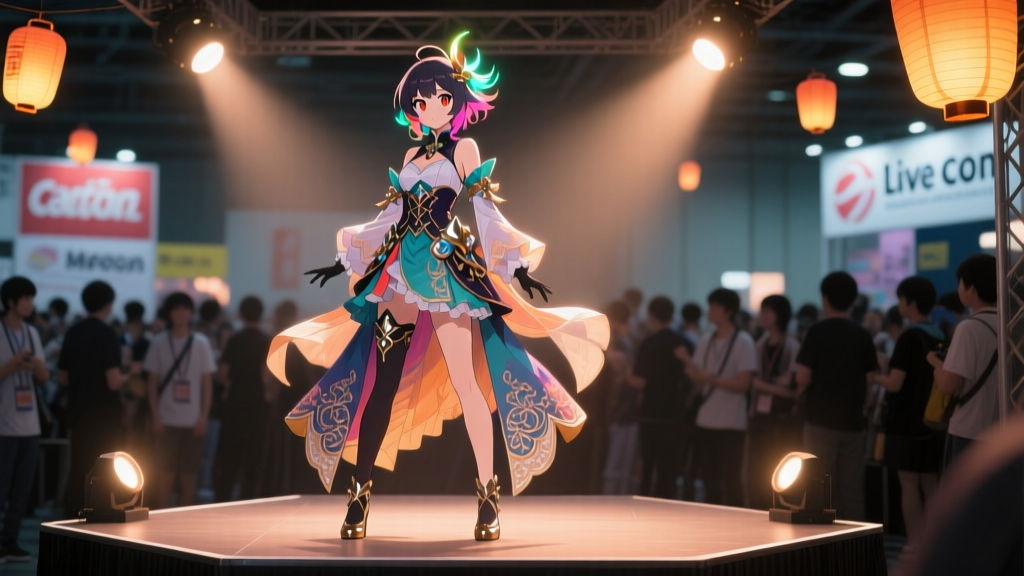
“It’s not about how big the stage is—it’s about how loud your heart is.”
—Yui Hirasawa, K-On! Season 1, Episode 12 (paraphrased)
I remember watching that final live scene in the clubroom—the one where the lights dim, the red curtain parts just enough, and Yui strums that first chord with her eyes closed—not because she’s nervous, but because she’s already there. No smoke machine. No rigging. Just a folding table, some fairy lights taped to a bookshelf, and four girls who turned a school supply closet into something sacred.
That’s the magic of K-On!’s live house: it’s scrappy, sincere, and built from what’s already on hand. Which means—yes—you can recreate it in your dorm room. Not as a replica, but as an echo. A little shrine to that feeling when music makes your chest hum louder than your thoughts.
The Frame: Cardboard That Doesn’t Look Like Cardboard
Forget “building a set.” Think framing a moment. Start with two 36”×48” pieces of corrugated cardboard (IKEA’s FRAKTA boxes, flattened, work perfectly). Cut vertical slits 2” apart along one long edge, then slide them together like interlocking teeth to form a shallow L-shape corner—your “stage wing” and back wall. Reinforce the seam with gaffer tape (not duct tape—duct tape yellows and peels under LED heat).
Paint both sides matte black *before* assembly—use cheap acrylic craft paint mixed with a spoonful of dish soap (it helps coverage on porous cardboard). Let dry fully. Then, with a dry brush, lightly drag burnt umber over the edges and corners. This mimics Kyoto Animation’s subtle shadow grading—how the light doesn’t hit the wood grain evenly, how real stage flats get scuffed over time.
No space for wings? Flip the frame inward: stand one panel upright, lean the second at a 30° angle behind it like a low-slung roofline. It reads as depth, not width.
The Glow: LEDs That Breathe, Not Blind
Kyoto Animation didn’t use even lighting. Watch Episode 12 again: the key light hits Yui’s face and guitar neck, but Mio’s bass strings catch only a sliver of reflection—and Ritsu’s cymbals? Almost lost in silhouette. Recreate that with intention, not wattage.
Use a single 5m warm-white (2700K) LED strip—cut to 1.2m. Stick it *under* the top edge of your cardboard frame, facing upward and slightly inward. Cover the strip with a diffuser: cut a 2” strip from a white plastic folder (the kind with matte finish), bent into a shallow U-shape and taped loosely over the LEDs. This softens the line, creates a gentle spill—not a spotlight, but a suggestion of overhead stage wash.
For the “backlight glow” on hair and shoulders (that halo effect Kyoto uses so beautifully), tape a second, shorter (30cm) strip *behind* the frame, aimed at the wall—not the cosplayers. Let the wall bounce it back. Bonus: if your wall is light beige or pale gray, it’ll replicate the color grade from the episode’s clubroom scenes almost exactly.
The Mic Stand: One Tripod, Three Characters
You don’t need four mic stands. You need one sturdy phone tripod (Amazon Basics is fine), a $6 mic clip (search “universal boom arm clip”), and three 12” lengths of black PVC pipe (½” diameter, cut with a hacksaw—sand the edges smooth).
Screw the clip onto the tripod’s center column. Insert one PVC pipe vertically into the clip. Now—here’s the Tokyo Comic Con 2023 Mini Stage winner trick: wrap each pipe with black electrical tape, then twist a single strand of thin red LED string around it twice, starting 3” from the top. Plug it into a USB power bank hidden in your pocket or taped under the tripod base. When lit, it looks like a tiny, pulsing mic stand—no wires visible, no clutter.
Rotate the pipes between shots: Yui gets the front-center, Mio the left (slightly angled down—she’s shy, so her mic leans *away*), Ritsu the right (tilted up, like she’s shouting over the noise), Azusa the far right, mic held low and close—like she’s still learning to project.
Posing: Energy Is Choreographed Silence
K-On!’s band doesn’t “perform” in stiff concert poses. They breathe together.
- Yui: Weight on her back foot, knees loose, guitar tilted high—but her eyes are half-closed, head tilted *just* left of center. She’s listening more than playing.
- Mio: One hand on her bass strap, the other hovering near the strings—not plucking, just *ready*. Her shoulders are down, but her chin lifts when she glances up at Yui. That glance is the shot.
- Ritsu: Drumstick raised mid-air, frozen before the crash. Not arms wide—elbows bent, wrists cocked. Her grin is sharp, but her eyebrows are relaxed. It’s confidence, not bravado.
- Azusa: Slightly behind the others, leaning in—not to be seen, but to *connect*. Her left hand grips her guitar strap; her right hand rests lightly on Yui’s shoulder. Not touching, just *near*. That proximity is the quietest beat in the whole scene.
Shoot in natural light if possible—late afternoon sun through a sheer curtain gives you Kyoto’s soft contrast. If not, use your phone’s Pro mode: ISO 100, shutter speed 1/60, focus manually on Yui’s eyes. Tap to lock exposure, then recompose. And—this is critical—shoot in bursts. Not for action, but for micro-expressions: the split-second Yui opens her eyes after a chord, Mio’s exhale as she shifts weight, Ritsu’s laugh caught mid-breath.
You’re not building a stage.
You’re holding space for joy that fits in a shoebox.
And somehow, that’s bigger than any arena.