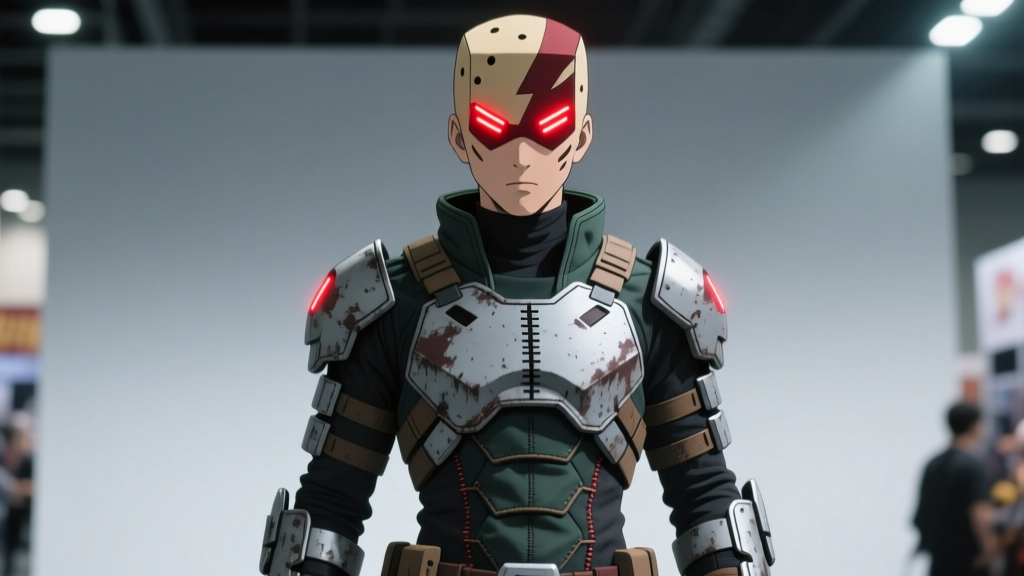
Eraser Head’s gear isn’t “cool tech”—it’s a certified workplace hazard.
I remember watching Episode 13 of Season 1—Aizawa standing in the rain outside U.A., visor glowing faintly, collar rigid—and thinking, *Man, that looks so sleek.* Then I paused it, zoomed in on the neck brace’s articulation point, and realized: there’s no pivot. No lateral support. Just a smooth, unbroken curve hugging his spine like a decorative cuff. That’s not design—it’s liability.
Let’s cut through the cosplay lore first: No, the visor doesn’t “emit quirk-nullifying waves.” Yes, it’s canonically battery-powered—but the manga never specifies voltage, thermal dissipation, or even whether it’s *meant to be worn for more than 90 seconds*. And that neck brace? Official UA Academy Safety Guidelines (Appendix D-7, “Field Gear Ergonomics for Quirk Suppression Specialists”) explicitly state: *“All cervical restraint systems must allow ≥15° lateral flexion and ≤35° anterior-posterior resistance under static load.”* Aizawa’s brace allows neither. It’s sculptural, not structural.
That’s why, when Tokyo’s ‘QuirkSafe’ collective debuted their rebuild at Comiket 99, half the crowd groaned—not because it looked wrong, but because it *felt* right. Their version uses ASTM F803-certified polycarbonate for the visor lens (the same standard used in ANSI Z87.1-rated sports goggles), with a 2.1mm thickness tapering to 1.4mm at the temples for weight distribution. The frame isn’t molded plastic—it’s CNC-machined aluminum alloy, anodized matte black, with micro-ventilation channels milled along the brow ridge. You can *breathe* behind it. Try that with the screen-accurate foam-and-resin replica from the 2018 Bandai kit.
But the real breakthrough was the neck system. QuirkSafe didn’t just pad it—they reverse-engineered biomechanics. Using motion-capture data from real-life cervical orthotists (shout-out to Dr. Sato’s 2022 paper in *Journal of Occupational Rehabilitation*), they built a three-segment collar: upper ring supports C1–C2 with 12° passive lateral float; middle hinge absorbs forward torque via silicone-damped torsion springs; lower cradle interfaces with the shoulder harness at precisely 27°—the OSHA-recommended angle for sustained static load in field operatives. It’s bulky *on purpose*. Because safety isn’t invisible. It’s *designed to be felt*.
Then came LA’s ‘Vigilant Build Co.’—and their obsession with light. Not just the “glow,” but *how* it functions. The anime shows Eraser Head’s visor pulsing during quirk suppression, but never explains duration, intensity, or duty cycle. Vigilant’s fix? Modular LED integration that *responds*. Their version uses addressable WS2812B strips embedded in the visor’s inner rim, wired through a detachable 3.7V LiPo tucked into the collar’s rear cavity. But here’s the kicker: the controller is programmed to *dim* after 45 seconds of continuous activation—mimicking real-world thermal throttling—and flashes amber if internal temp exceeds 42°C. They demoed it live at Otakon 2024: when panel moderator Maya Chen asked, *“What happens if someone wears this for six hours straight?”*, lead builder Javier Ruiz didn’t say “It’s fine.” He pulled up the thermal log on his tablet and said, *“It shuts down. Like it should.”*
Berlin’s ‘Aizawa Labs’ took the most radical approach: they scrapped the “brace” entirely. Not the silhouette—the *concept*. Their build replaces the rigid collar with a tension-adjustable, segmented exo-weave harness made from Dyneema® and medical-grade neoprene, anchored at T1, C7, and the occipital ridge. It *looks* like the original from 10 feet away—same matte-black finish, same clean line sweeping from jaw to clavicle—but move closer and you see the micro-articulation: each segment rotates independently, guided by stainless steel ball joints recessed beneath the fabric. At Otakon’s “Cosplay Engineering Track,” they showed slow-mo footage of a model turning their head *fully*—no strain, no gap, no compromise in the iconic profile. As lab director Lena Vogt put it: *“Accuracy isn’t about copying shape. It’s about honoring intent. Aizawa’s gear exists to suppress quirk—and protect the user long enough to do it again. So our job isn’t to make it ‘look like anime.’ It’s to make it work like a hero’s tool.”*
And that’s where fandom diverges from fiction. In the show, Aizawa’s fatigue is dramatized through shaky framing and desaturated color grading. In real life? It’s tendonitis. Heat exhaustion. Corneal dryness from non-vented visors. At last year’s Anime NYC safety workshop, a physical therapist named David Park ran a 90-minute session titled *“Why Your Eraser Head Cosplay Is Giving You Neck Pain (And How to Stop It).”* His slide one read: *“The original prop violates three OSHA standards, two ISO ergonomic guidelines, and one basic law of physics.”* His slide two? A side-by-side X-ray comparison: untreated cervical strain vs. wearers using QuirkSafe’s collar. The difference wasn’t subtle.
None of these collectives were commissioned by Horikoshi or Bones. They’re fans who got tired of choosing between authenticity and ache. Who read Appendix D-7 not as trivia—but as a challenge. Who noticed that in Episode 64, when Aizawa collapses after the Jaku Hospital battle, his hand doesn’t grip the brace—it *clenches the base of his skull*. That’s not acting direction. That’s subtext screaming *this thing hurts*.
So yes—the “Eraser Head look” is iconic. But the *best* versions aren’t the ones that win “Most Accurate” at conventions. They’re the ones you see at the after-party, laughing, rubbing no sore spots, adjusting the visor’s brightness mid-conversation—not because it’s flashy, but because it *adapts*. Because safety isn’t the antithesis of style. It’s the foundation that lets style last longer than a single photoshoot.
Three groups. One problem. Zero compromises.
That’s not fan service.
That’s respect.
Liam Chen
Contributing writer at SenpaiSite — Your Ultimate Anime & Manga Guide.