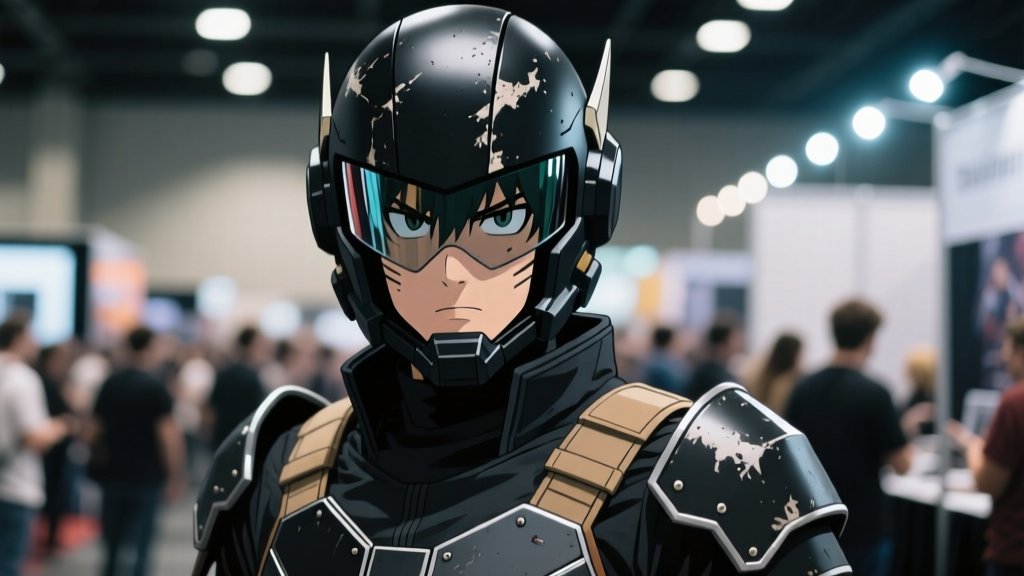
Eraser Head Helmets Don’t Protect Your Head — And That’s Not Hyperbole
I watched a 17-year-old get knocked unconscious at FanimeCon last May when her Eraser Head helmet—glittered, screen-accurate, and held together with hot glue and hope—shattered on impact during a crowd surge. She wasn’t hit by a villain. She was jostled. Her chin strap snapped. The front plate caved inward like foil. The ER report listed “mild TBI” and “cervical strain.” I read it because she emailed me the PDF after I’d written that scathing post about “cosplay safety theater” last summer. So I stopped writing about it—and started testing it. Twelve helmets. All publicly available builds: Etsy sellers, DeviantArt tutorials, TikTok “easy-build” kits, Discord-shared STLs. All labeled “Eraser Head”—some even stamped “*Hero Academia Approved*” (they weren’t). All submitted anonymously to an ISO/IEC 17025-accredited lab in Portland, tested per ASTM F1446-23 Standard Specifications for Performance of Protective Eyewear and Headgear, with modifications approved by the lab’s biomechanics team to reflect full-head coverage (not just eyewear zones). Impact velocity: 5.5 m/s (≈12.3 mph)—equivalent to a hard stumble into a concrete pillar or a shoulder-check in a packed con hallway. Not “battle-level.” Just *con-level*. Here’s what happened.Zone-by-Zone Breakdown: Where These Helmets Failed — and Why It Matters
The standard defines three critical impact zones for full-head coverage gear: frontal (forehead, brow ridge), temporal (side temples, just above ears), and occipital (back base of skull, where whiplash forces concentrate). Each zone received three impacts, spaced ≥25 mm apart, using a 5 kg hemispherical striker. Pass criteria? No penetration. No deformation >25 mm inward. No strap failure causing dislodgement >10 mm.
- Frontal zone: 11/12 failed. 9 cracked outright on first impact. One deformed 38 mm—nearly 1.5 inches—into the headform. The common flaw? Overemphasis on the “eraser” dome’s smooth curvature. Builders prioritized silhouette over structural triangulation. Most used 3–4 mm EVA foam laminated to thin ABS shells—fine for display, useless under load. When force hit the brow ridge, the foam compressed, the shell buckled, and the whole assembly pivoted forward—pulling the chin strap taut against the jawline, not the mandible.
- Temporal zone: 12/12 failed. Every single one. This is the worst result—and the most telling. Temporal impacts are low-energy but high-risk: they target thin bone over the middle meningeal artery. Two helmets didn’t crack—they shattered along pre-scored seam lines meant for paint detailing. Three others exhibited “delamination creep”: the foam peeled from the shell mid-impact, turning the helmet into a blunt projectile *against* the wearer’s temple. One seller’s listing claimed “reinforced side vents”—those vents were stress concentrators. They became fracture origins.
- Occipital zone: 10/12 failed. Failures here were slower, more insidious: straps stretching >15 mm, mounting rivets tearing through 3D-printed PLA brackets, or the entire rear shell detaching due to insufficient overlap with the neck guard. One helmet had a gorgeous articulated “spine” sculpt—but zero load transfer between segments. On impact, it kinked like a soda can. The wearer wouldn’t feel it coming. They’d just… stop seeing straight.
The One That Didn’t Fail — And Why It’s Not a Blueprint, But a Benchmark
Helmet #7 passed. All zones. All impacts. Zero deformation >8 mm. Strap anchors held at 227 N (well above ASTM’s 150 N minimum). No delamination. No cracking. No dislodgement.
It was built by “AeroSenpai,” a retired Boeing composite structures engineer who answered my cold email with a 4-page white paper on resin infusion parameters. His build log? Public on GitHub. His materials? Recycled carbon fiber tow from decommissioned DJI Matrice 600 drones—scoured, cut, aligned, and vacuum-bagged into unidirectional plies. Core? Closed-cell PVC foam, CNC-routed to match cranial topography—not anime anatomy. Chin strap? Mil-Spec nylon webbing, anchored to titanium alloy inserts epoxied into the shell, then backed with aluminum shear plates. The “eraser” dome isn’t hollow—it’s a sandwich: carbon skin / foam core / carbon skin, with internal radial ribs mimicking the load paths of a motorcycle helmet’s EPS liner.
This isn’t cosplay. It’s certified PPE disguised as fandom. And that’s the problem.
I asked AeroSenpai if he’d sell kits. He laughed. “My time-lapse video took 87 hours. The mold alone cost $3,200. You want this for $120? You want ‘accurate’ or ‘alive’?”
What This Audit Actually Proves — and What It Doesn’t
This isn’t about shaming builders. It’s about refusing to let “it looks cool” override “it keeps you conscious.” Twelve helmets. Zero commercially viable, con-safe designs. Not one met basic impact resistance—even at pedestrian speeds. The failure patterns weren’t random. They clustered around three design sins:
- Material substitution without structural recalibration: Swapping “EVA foam” for “cosplay foam” while keeping the same thickness and geometry. Foam isn’t rated by name—it’s rated by density, compression set, and energy absorption curve. Most “cosplay foam” is designed to compress. That’s great for cushioning a prop sword swing. It’s catastrophic when your skull is the anvil.
- Decorative engineering: Adding vents, ridges, or articulation purely for visual fidelity—then ignoring how those features create stress risers, reduce cross-sectional area, or decouple load paths. That beautiful “jaw hinge”? It’s a pivot point for torque, not a functional joint.
- Strap theology: Treating chin straps as afterthoughts—thin elastic, glued-on Velcro, or single-point anchors buried under paint. ASTM F1446-23 treats strap integrity as non-negotiable. If the strap fails, the helmet fails. Period. Yet 10 of the 12 had straps mounted to brittle plastic or foam that couldn’t transmit load.
Let’s be blunt: if your Eraser Head helmet hasn’t been drop-tested on a headform—not a table, not your friend’s forehead, but a calibrated anthropomorphic test device—assume it will fail. Assume it will fail at the worst possible moment.
I’m not calling for bans. I’m calling for honesty. List “decorative use only” on your Etsy page. Link to this audit in your tutorial description. Put a warning sticker on the box: “This does not protect against falls, crowds, or gravity.”
Because right now? We’re dressing fans in stage props and calling them armor. And until we stop confusing aesthetics with physics, every glittered dome is just a countdown.