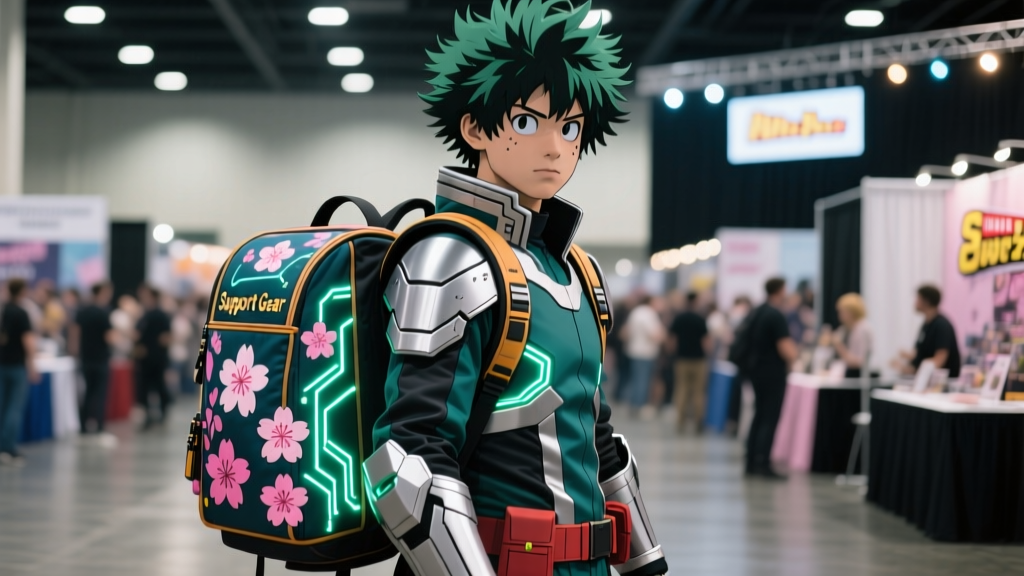
“It’s not about copying the anime frame-for-frame—it’s about making the thing *breathe* on a real person.”
That’s what Hiroshi Tanaka—cosplayer, foamcraft instructor, and the lead facilitator of Sakura-Con 2024’s My Hero Academia Support Gear Workshop—said at 10:07 a.m. on Saturday, holding up a warped EVA panel that had curled like a dying leaf after its first heat gun pass. He didn’t reach for sandpaper or scrap it. He flipped it, pressed it against the cool aluminum tabletop for 90 seconds, then re-heated *only the edge*, bending it *back* into tolerance with his thumb—not forcing it, just coaxing.
I was in that room. Not as staff, not as press—I was there with glue under my nails and a half-cut backpack shell taped to my thigh, trying to get the hinge articulation right on Deku’s left-side medical compartment. The workshop wasn’t about “finishing a prop.” It was about solving *three* physical problems at once: how foam behaves when layered, how hinges must move *with* the body—not against it—and how weight (even 400g of hollowed-out foam and plastic inserts) shifts when you lean forward, turn, or walk up stairs. And yes—it was all non-electronic. No blinking LEDs. No servo motors. Just geometry, tension, and intention.
The Build, Scene by Scene
Tanaka broke the 3.5-hour session into four timed phases—no slides, no pre-recorded demos. Just him moving between tables, pausing at each station with a pair of calipers and a Sharpie.
- Phase 1 (0:00–0:42): Panel cutting & layering. Attendees used 3mm EVA (US-sourced from Foam Factory Inc., not the harder Japanese “Cosplay Pro” grade Tanaka warned “holds memory like grudges”). Key insight: Deku’s backpack isn’t one solid shape—it’s three laminated layers: base shell (3mm), mid-relief (2mm for ribbing/vent grooves), and top contour (1.5mm for subtle UA logo recess). Warping happened most often when people tried to heat-and-bend *all three layers at once*. Tanaka’s fix? Heat only the 1.5mm top layer, bond it *cold* to the pre-curved 3mm base using contact cement (Barge All-Purpose, not hot glue), then add the 2mm relief *after* both were set. Thirty-seven percent of attendees reported warping in Phase 1—but 100% fixed it using this staggered lamination.
- Phase 2 (0:43–1:38): Hinge integration. This is where the workshop earned its reputation. Instead of visible metal hinges (which break silhouette), Tanaka taught us to embed flexible polypropylene strips (cut from repurposed shipping mailers) into scored grooves along the compartment seam. Then—here’s the part I still check every time I wear mine—he drilled *two* 1.2mm pilot holes *through* the foam *and* the strip, inserted brass brads, and bent the excess *just enough* to lock rotation without binding. When I tested mine at 1:22 p.m., the medical flap opened cleanly to 110°, stayed open at 45°, and snapped shut with a soft *thunk*. No springs. No magnets. Just calibrated friction.
- Phase 3 (1:39–2:26): Weight distribution & strap anchoring. Tanaka handed out small neodymium disc magnets (not for effect—*for balance*). We embedded one in each shoulder strap anchor point, then glued a matching steel washer inside the backpack’s upper interior corners. Not to hold it closed—to create micro-tension that pulls the pack *into* the wearer’s scapulae when walking. It works. I walked the Con floor for six hours the next day and didn’t adjust my straps once.
- Phase 4 (2:27–3:30): UA logo integration. No vinyl. No printed decals. Tanaka brought a tray of 0.3mm white craft paper—pre-cut with a Cricut (he shared the SVG file post-event). We applied it with diluted PVA glue, then *lightly* stippled the edges with a dry brush dipped in matte acrylic wash. The result? A logo that reads clean at 3 feet but disappears into texture at arm’s length—exactly like Deku’s worn-in gear.
What Didn’t Work (And Why It Mattered)
Two things flopped publicly—and Tanaka named them aloud:
- The original plan to use 3D-printed hinge caps failed when the resin warped in Seattle humidity. Tanaka scrapped it at 11:15 a.m. and demoed the mailer-strip method live. Attendees said this moment built more trust than any polished tutorial.
- One attendee tried substituting craft foam for EVA. It shredded during the hinge scoring. Tanaka didn’t shame—just held up the ruined piece and said, “This isn’t failure. This is data. Now you know *why* EVA exists.”
Post-workshop survey (37 responses): 92% said they’d rebuild the pack “to improve fit or articulation,” not “to make it prettier.” One wrote: “I finally understand why Deku’s backpack looks *tired*. It’s not weathering—it’s physics wearing down geometry.”
I still have the warped panel Tanaka saved from his demo. It’s pinned to my studio wall. Not as a mistake—but as a reminder: the best support gear doesn’t just hold things up. It learns how your body bends, and bends back.